


Effects of Nonmotorized Recreation on Ungulates in the Western United States—A Science Synthesis to Inform National Environmental Policy Act Analyses
Links
- Document: Report (4.30 MB pdf) , HTML , XML
- Related Works:
- Structured Science Syntheses to Inform Decision Making on Federal Public Lands
- Effects of Noise from Oil and Gas Development on Ungulates and Small Mammals—A Science Synthesis to Inform National Environmental Policy Act Analyses
- Effects of Culverts on Habitat Connectivity in Streams—A Science Synthesis to Inform National Environmental Policy Act Analyses
- Effects of Noise from Oil and Gas Development on Raptors and Songbirds—A Science Synthesis to Inform National Environmental Policy Act Analyses
- Download citation as: RIS | Dublin Core
Acknowledgments
We thank Becca Windell (Home Range Wildlife), Michael Procko (Tulalip Tribes of Washington), Mark Ditmer (U.S. Department of Agriculture Forest Service), and Bill Mangle (ERO Resources) for thoughtful conversations early in the drafting process. We thank Courtney Larson (The Nature Conservancy) and Orrin Duvuvuei (New Mexico Department of Game and Fish) for providing formal peer reviews of this report. We also thank Alys Granados (Felidae Conservation Fund), Kyle Garrison (Washington Department of Fish and Wildlife), and Jim Heffelfinger (Arizona Game and Fish Department) for providing additional reviews of this report. We thank Lief Wiechman (U.S. Geological Survey [USGS]), Rick Lehrter (contractor to the Bureau of Land Management National Operations Center), Alex Stoneburner, Emma Dietrich, and Sarah Whipple (all USGS) for administrative and conceptual support throughout writing and review. Greg Wolfgang, Jared Oakleaf, Peter Doan, Christopher Keefe (all Bureau of Land Management), Michelle Cowardin, Jamin Grigg, Brian Magee, Taylor Elm, Peter Foote, and Eric Bergman (all Colorado Parks and Wildlife) provided valuable feedback on draft versions of this report, and we thank each of them for their time. Finally, we thank Katherine Parker (University of Northern British Columbia), Kimo Rogala, and Tom Hobbs (both Colorado State University) for permission to reproduce figures from previous publications. We gratefully acknowledge Colorado State University and FORT Writes guided writing sessions hosted by Kristina Quynn for providing expertise, time, incentive, and accountability that aided in the writing process.
Funding for this science synthesis project was provided by the USGS Ecosystems Mission Area—Land Management Research Program as part of their work to provide science and data products to help Federal, State, Tribal, and local agencies conserve, manage, and restore our Nation’s diverse socioecological systems, often focused on management of public lands and resources at landscape scales.
Executive Summary
Background: The U.S. Geological Survey is working with Federal land management agencies to develop a series of science synthesis reports. These reports synthesize science information to support environmental effects analyses that agencies complete in accordance with the National Environmental Policy Act (NEPA). For this report, we worked with the Bureau of Land Management to synthesize science information relevant to environmental effects analyses for proposed recreation activities on public lands. We focus specifically on the effects of nonmotorized recreation on wild North American ungulates (fig. ES1).

ES1. Diagram providing a summary of the information contained in this report by section. Hiker, elk, white-tailed deer fawn, and fescue grass illustrations by Tracey Saxby, Integration and Application Network, licensed under a Creative Commons Attribution-ShareAlike 4.0 International License, https://ian.umces.edu/media-library/people/tracey-saxby/. Clipboard illustration by Kim Kraeer and Lucy Van Essen-Fishman, Integration and Application Network, licensed under a Creative Commons Attribution-ShareAlike 4.0 International License, https://ian.umces.edu/media-library/clipboard/. Graph illustration by Samuel Jordan, U.S. Geological Survey. Trail illustration by Made x Made, licensed under a Creative Commons Attribution 3.0 Unported License, https://thenounproject.com/icon/mountaineering-2422092/. NEPA, National Environmental Policy Act.
How this report can inform a NEPA analysis: We organized the sections of this science synthesis to align with standard elements of NEPA environmental effects analyses. Specifically, this science synthesis can facilitate the use of science information in public lands decisions about nonmotorized recreation activities or infrastructure.
This report presents science information relevant to characterizing a proposed nonmotorized recreation action and alternatives (section 1 of this report), characterizing the affected environment (section 2 of this report), identifying issues for analysis and potential environmental effects for each issue (section 3 of this report), and mitigating potential adverse effects of recreation (section 4 of this report).
To demonstrate a possible application of this report to a NEPA analysis, we developed a flowchart that illustrates generic methods for analyzing the potential effects of nonmotorized recreation on ungulates and where to find the corresponding information in this report (fig. ES2). Although the report information generally is organized stepwise as shown in the flowchart, the science synthesized in each section may inform multiple components of an analysis. In addition, the information in this report may be applied iteratively, in a different order than the order presented in this report, or for aspects of project planning outside of the environmental effects analysis.

ES2. Flowchart showing an example of methods steps that could be used in an analysis of the effects of nonmotorized recreation on ungulates with references to the sections of this report that synthesize science information relevant to each methods step.
Quantifying nonmotorized recreation: Humans recreate across a variety of habitats, and the number of humans recreating varies temporally at daily, weekly, and seasonal scales. Identifying the occurrence of recreators across the landscape can contribute to understanding potential environmental effects of recreation activities, specifically quantifying the timing, intensity, duration, and spatial distribution of recreation when possible. In this report, we focus on nonmotorized and nonconsumptive recreation. Novel data sources that quantify recreation, such as crowdsourced or app user data, are anticipated to improve data accuracy but are not yet available to all planners. Quantifying dispersed recreation on public lands remains a challenge and is commonly carried out through surveys, parking lot counts, trail counters, and other observational methods.
Ungulate life history and potential effects of nonmotorized recreation on ungulates and habitat: A substantial and growing body of research shows that nonmotorized recreation can affect ungulate health and behavior. Nonmotorized recreation is common across public lands, potentially affecting ungulate behavior and distribution. Nonmotorized recreation has been shown to have different physiological-, behavioral-, population-, and community-level effects on wildlife taxa, highlighting the importance of understanding how nonmotorized recreation affects individual wildlife species.
Existing studies have shown consistent detectable effects of nonmotorized recreation on ungulates. Ungulates—especially larger bodied species—tend to avoid areas intensively used for recreation, will flee from the immediate presence of recreators, and, occasionally, show long-term (seasonal or longer) avoidance or reduced use of recreation areas. Most commonly, the presence of nonmotorized recreators affects ungulates by changing movement and behavior, which can reduce fitness. For example, ungulates will spend more time being vigilant or will flee in the presence of recreators instead of continuing to forage. Intense recreation use can cause ungulates to completely avoid areas, even if those areas are otherwise high-quality habitat. These collective behavior shifts can ultimately reduce fitness. However, some ungulates may habituate to human activities, and human presence can create refuge space from predators that fear humans, potentially lessening the negative effects of recreation.
Importantly, there are outstanding knowledge gaps in the science of recreation effects on ungulates. Additional research could improve understanding of differences in effects (1) from specific recreation activities, (2) among species, (3) among seasons, and (4) on individual indicators of fitness. Furthermore, technology associated with nonmotorized recreation and the types of nonmotorized recreation taking place on public lands regularly change.
Nonmotorized recreation is just one of myriad factors affecting ungulates. Many other forces can also negatively affect ungulates and their habitat: other recreation activities like hunting and motorized recreation; landscape modifications such as urban and industrial development, roads, and agriculture; and human-driven changes to the biophysical climate through climate change, drought, and invasive species. Although these topics are beyond the scope of this science synthesis, it may be helpful to consider that nonmotorized recreation is one of many human elements that can affect ungulates.
Methods for estimating potential effects of nonmotorized recreation on ungulates: The effects of recreation management actions and nonmotorized recreation activities on ungulates are highly context dependent. Because of high levels of temporal and spatial variation in recreator and ungulate activity, local data about each are critical to understanding where recreators and ungulates have the potential to interact. State wildlife agency expertise and data can be used to identify which ungulate species occupy a project area, and there are many possible sources for recreation data with tradeoffs depending on the source. Further, area-specific management objectives for habitat and individual ungulate species can guide development of proposed actions and understanding of potential effects. Basic spatial analyses can illustrate how biology and landscape settings can be simultaneously considered, such as creating a spatial buffer around recreation areas to understand the extent and distribution of potentially affected critical habitat.
More technical analytical methods are also available. A prominent method for analyzing the potential effects of nonmotorized recreation on ungulates is to measure ungulate displacement resulting from recreation. For this commonly used research method, telemetry or location data from ungulates paired with similar, simultaneous measures of recreation activity offer strong inferences about ungulate response to the presence of recreation in the short term (hourly or daily scale). Real-time physiological measurements of ungulates offer an even finer scale measure of the effects of recreation on individual ungulates. Unless linked explicitly, observed avoidance, time budget, or physiological responses of individual ungulates do not equate to population-level effects, and few studies link these indicators to demographic indices. For example, understanding how a particular group of ungulates alters movement in response to different types of nonmotorized recreation is valuable, but understanding how these behavioral responses affect ungulate populations remains understudied. Investigating how nonmotorized recreation affects individual nutritional condition or demographic rates could clarify population-level effects on recreation to achieve the ultimate goal of understanding population-level effects at a local or management unit scale.
Approaches to reducing and minimizing effects of nonmotorized recreation on ungulates: Techniques for reducing the amount or intensity of disturbance of nonmotorized recreation in ungulate habitat consist of the following: seasonal and daily timing restrictions for trails or access points; restrictions on timing, intensity, duration, or spatial distribution of specific types of recreation; education and collaboration with user groups; and spatial considerations during project design, such as intentional protection of habitat when constructing new recreation infrastructure. These mitigation techniques can have differing levels of effectiveness depending on design and on life history traits of the potentially affected species.
Methods for developing this science synthesis: Rutherford and others (2023) introduced a method for developing science syntheses to inform NEPA analyses, and relevant text from that report is reproduced herein. This synthesis and other syntheses build on that foundation and method and apply it to new topics of management concern on western U.S. lands.
We used a structured search of published scientific literature to find and synthesize science information about the effects of nonmotorized recreation on ungulates, ungulate life history traits that affect their sensitivity to recreation activities, and measures to reduce negative effects of nonmotorized recreation on ungulates. We searched for any literature published on the 12 ungulate species native to western North America. We limited our geographic scope of the published literature to western North America and placed an emphasis on literature with a publication date since 1990 where possible. Further, we focused on recreation activities that were nonmotorized and not focused on intentional taking of wild animals, namely fishing and hunting. Staff from the U.S. Geological Survey and Bureau of Land Management coproduced this report.
Purpose of This Report
Federal land management agencies permit and plan for many uses and activities on public lands across the United States. According to the National Environmental Policy Act of 1969 (NEPA; 42 U.S.C. 4321 et seq.), Federal agencies must analyze and disclose the potential environmental effects of major Federal actions that may significantly affect the quality of the human environment. The NEPA requires the “integrated use of the natural and social sciences” in agency planning and decision processes (42 U.S.C. 4332(A)). Science is foundational to understanding how proposed Federal actions may affect natural resources, ecosystems, and human communities.
The purpose of this report is to synthesize science information relevant to environmental effects analyses for nonmotorized recreation activities on public lands. Science syntheses can be useful mechanisms for sharing science information with public land managers to inform their decisions (Seavy and Howell, 2010; Ryan and others, 2018). Science syntheses integrate knowledge and research findings to increase the generality, applicability, and accessibility of that information (Wyborn and others, 2018).
This report focuses specifically on the effects of nonmotorized recreation on wild North American ungulates (in other words, hoofed mammals) and identifies methods for characterizing recreation occurrence and analyzing and mitigating its potential adverse effects. Nonmotorized recreation is widespread on public lands across the United States (Wilkins and others, 2021). A substantial and growing body of research shows that human presence and nonmotorized recreation activities can affect wildlife (Whittaker and Knight, 1998), particularly ungulates (Ciuti and others, 2012; Bateman and Fleming, 2017). Nonmotorized recreation has been shown to have molecular-, physiological-, behavioral-, population-, and community-level effects on wildlife taxa (Tarlow and Blumstein, 2007; Dertien and others, 2021), highlighting the importance of understanding the effects of nonmotorized recreation on specific species.
How to Use This Report
The content, structure, and section numbering of this report are designed to support NEPA analyses and reflect the steps of project planning and environmental effects analyses (table 1; fig. ES2). This report is meant to be a general reference for considering and applying scientific information and could be used, for example, as follows:
-
• incorporated by reference in NEPA documents or to directly provide language for use in NEPA documents,
-
• included as supplemental information to a NEPA document, or
-
• used as a resource to gather literature and identify gaps in available science related to the management decision and context.
When incorporating by reference or drawing language from this report, please use the Jordan and others (2025) suggested citation on p. ii of this report.
Table 1.
How the information in this report can inform steps in project planning and National Environmental Policy Act (NEPA) analysis.[Modified from Rutherford and others (2023, table 1)]
Caveats to Use of This Report
This report is a science synthesis rather than a comprehensive literature review. In addition, this report does not provide all information necessary to complete a full environmental effects analysis or make conclusions regarding the significance of environmental effects. Resource planners and managers may need to supplement the information contained in this science synthesis with local information. Information about specific design elements of the proposed project, local landscape conditions, and potential environmental effects from factors other than nonmotorized recreation can complement the information contained in this science synthesis.
For lands administered by the Bureau of Land Management, recreation resources and uses are allocated through the land use planning process (Bureau of Land Management [BLM], 2014). Because many decisions related to recreation take place at this broader level of decision making, many project-level decisions related to recreation are required to be in conformance with previously established resource management plans, travel management plans, and recreation management area designations. Recreation planners then must apply the decisions made in land use planning to implementation at the site-specific scale. Functionally, recreation planners can most fully apply the scientific information synthesized in this report by considering the potential effects of nonmotorized recreation on ungulates at all stages of the planning and adaptive management cycles.
We also note that this report focuses on synthesizing science about the interaction of nonmotorized recreation and ungulates. We provide more limited information about how to collect or obtain existing data on recreation, wildlife populations, and wildlife habitat. Information and data about the distribution and status of local wildlife populations are crucial to understanding what species, how many individuals, and how much habitat might be affected by proposed recreation activities. Understanding project-level actions at regional scales and through ongoing partnerships with other agencies and stakeholders is ideal.
Further, this report largely does not address the potential environmental effects resulting from the construction phase of nonmotorized recreation infrastructure (for example, trails). Many aspects of construction (for example, noise, lights, traffic, and ground disturbance) have the potential to affect ungulate communities. Additionally, increased traffic during the construction phase could lead to more vehicle strikes and directly cause ungulate mortality, as could increased recreation traffic to an area after recreation access has been expanded.
Although the content of this report is focused on nonmotorized recreation use, we note that this report may be helpful in other contexts. For example, the science in this report could be relevant to understanding some potential effects of motorized recreation on ungulates or other actions that affect levels of human interface with ungulates. However, because of the specificity of the science synthesized in this report, we urge caution when applying its content to other types of activities.
Similarly, nonmotorized recreation is one of many dimensions of human effects and activities that can also affect ungulates. For instance, climate change, invasive species, transportation infrastructure, conversion of land to agriculture, and wildfires may simultaneously affect ungulates within the same region, but these are beyond the scope of this science synthesis. However, it may be helpful to consider these other effects to contextualize the extent of potential recreation effects relative to other human effects.
Science Synthesis—Effects of Nonmotorized Recreation on Ungulates in the Western United States
The following numbered sections are the science synthesis content of this report. The science synthesis sections are numbered to reflect a potential overall analysis workflow, as shown in figure ES2, and facilitate internal referencing among sections. Our methods for completing the literature search and synthesizing the science appear after this science synthesis content in the “Methods for Developing This Science Synthesis” section.
1. Characterizing Ecological Effects of Nonmotorized Recreation
Section 1 Highlights
• Nonmotorized recreation is widespread nationally but can vary greatly in timing, intensity, duration, and spatial distribution through time.
• Proposed actions can increase, decrease, or otherwise change the occurrence of nonmotorized recreation in an area.
• Estimating how a proposed action will affect nonmotorized recreation in a project area can be informed by existing data on recreation use, user surveys, and expert evaluation.
1.1. Distribution of Nonmotorized Recreation—Timing, Intensity, Duration, and Spatial Distribution of Recreation
“Nonmotorized recreation” is a broad classification that can represent many different kinds of recreational activities. Managers can improve environmental effects analyses by carefully considering each type of nonmotorized recreation that does occur or may occur in a project area and estimating specific elements of how recreation is distributed.
1.1.1. Types of Nonmotorized Recreation on Public Lands and Motivations for Recreation
How and why people spend their leisure time, and specifically their choice of recreation activities during leisure time, has changed with societies since before civilization (Jensen and Guthrie, 2006). Why people recreate in the outdoors has been studied for decades by economists and sociologists (Nash, 1953; Clawson and Knetsch, 2013), and there is still lively development of theory related to recreation throughout multiple domains of science (Fix and others, 2018). There are nuanced classifications of outdoor recreation for land use planning (BLM, 2014; Selin and others, 2020) and exploration of theory (Miller and others, 2020).
Often, the motivation for recreation may be an interaction with wildlife (for example, a viewing or listening opportunity). Data indicate that the scale of these motivations is substantial: 10 percent of the U.S. population participates in wildlife watching away from home and mostly do so on publicly held, as opposed to privately held, lands (Mockrin and others, 2012). When recreator motivations are to interact with wildlife, the potential for unintended consequences that negatively affect wildlife and people is high because recreators deliberately seek out wildlife and may unintentionally disturb them (Cherry and others, 2018).
Recreation use may be affected by seasonal differences in recreationists’ motivations to recreate, especially if the primary motivation is wildlife watching. The motivation to participate in wildlife watching varies throughout social and geographic dimensions (Lee and Scott, 2011; Rizzolo and others, 2023), and seasonal differences in environmental conditions can contribute to how people perceive their recreational experience. Understanding how recreation opportunities (definitions from the literature for bolded words appear in the “Glossary” section of this report) and recreation motivations interrelate with ungulate life history can be useful in estimating the environmental effects of a proposed action.
For the purposes of this science synthesis, it is useful for land managers to recognize that land use planning and recreation development cannot regulate an individual’s motivations to participate in nonmotorized recreation. There is a great diversity of motivations to recreate, especially throughout user groups and types of activities (Jensen and Guthrie, 2006). Collaboration among user groups is highly desirable to reduce potential conflict and support management agency decisions (Colorado Trails with Wildlife in Mind Task Force, 2021). Proposed actions at the project scale represent an opportunity for land managers to manage recreation, plan for multiple uses and values, and seek input among user groups and stakeholders.
1.1.2. Factors That Affect the Occurrence of Nonmotorized Recreation
Understanding nonmotorized recreation occurrence can help managers estimate potential changes from a newly proposed action to existing recreation use and patterns. Outdoor recreation activities differ in their potential ecological effects based on the location, time, and specific type of activity taking place (Blumstein, 2016; Marion and others, 2020). Further, development of recreation infrastructure (for example, trails) can introduce regular human presence to areas where humans had otherwise been seldom present.
Quantifying nonmotorized recreation use across public lands is challenging, especially parsing recreation data into timing, intensity, duration, and spatial distribution elements (Marion and others, 2020). In this report, we use occurrence of recreation as inclusive of timing, intensity, duration, and spatial distribution. Nonmotorized recreation use is unevenly distributed across space, time, and environments for many reasons. Despite the challenge, there are options for quantifying aspects of existing and proposed recreation activities, and data and methods to quantify recreation are summarized in section “2. Characterizing Existing Recreation, Ungulate Populations, and Ungulate Habitat” of this science synthesis. Many factors can affect the occurrence of nonmotorized recreation (Frid and Dill, 2002; Monz and others, 2010; Marion and others, 2020):
-
• Seasonality of recreation activity
-
• Distance to population centers
-
• Density of comparable recreation opportunities nearby
-
• Scale of recreation development
-
• Novelty of recreation development
-
• Promotion or advertising of recreation opportunity
-
• Accessibility of the site (for example, availability of parking)
-
• Type of recreational activity
-
• Ecosystem type, topographic setting, and destination features (for example, waterfalls, summits, and viewpoints)
-
• Recreation area management objectives (for example, noise restrictions)
-
• Group size
Many types of nonmotorized recreation are dependent on weather and environmental conditions to be enjoyable; thus, the effects of many activities may be isolated to specific seasons. Some recreation activities show strict seasonality, like snowshoeing or swimming, whereas others are less seasonal and may even be year round (for example, hiking). The strength of the seasonality of recreation activities also varies geographically because of local climate patterns. Although climate change may increase or decrease the viable season for recreation activities through time, most recreation activities can be categorized as either season specific or year round (Marion and others, 2020).
Some nonmotorized recreation activities, such as cross-country skiing or snowshoeing, can only take place during the winter or snow-covered season. When these activities take place, typically other types of recreation activities (for example, hiking) are greatly reduced because of the continual snow cover. Day length is shorter during the winter season, constraining the daily presence of recreators.
Non-winter-specific nonmotorized recreation activities may be most popular during the warmest months of the year but can still take place with lower intensities and durations at all times of year when there is not snow cover (Turrisi and others, 2021). These activities can have longer seasons than winter activities (for example, three-season activities), expanding the potential for recreation effects on ungulates. Further, day length is longer during summer months, expanding the presence of recreators and the potential effect on ungulates on the daily scale. Compared to winter-specific activities, non-winter-specific nonmotorized recreation activities are more diverse and abundant, their season of use can be longer, and they take place on a greater diversity of landscapes. These patterns apply to areas with continental climates, and recreation patterns can differ among climate zones.
1.2. Nonmotorized Recreation Activities Addressed in This Science Synthesis
Agencies manage a variety of nonmotorized recreational activities through their proposed actions (fig. 1). The published literature on the interactions between nonmotorized recreation and ungulates covers many activities (table 2). Although there is a growing body of research on nonmotorized recreation effects, there are still specific habitat-activity pairings and novel recreation activities that have not been studied.
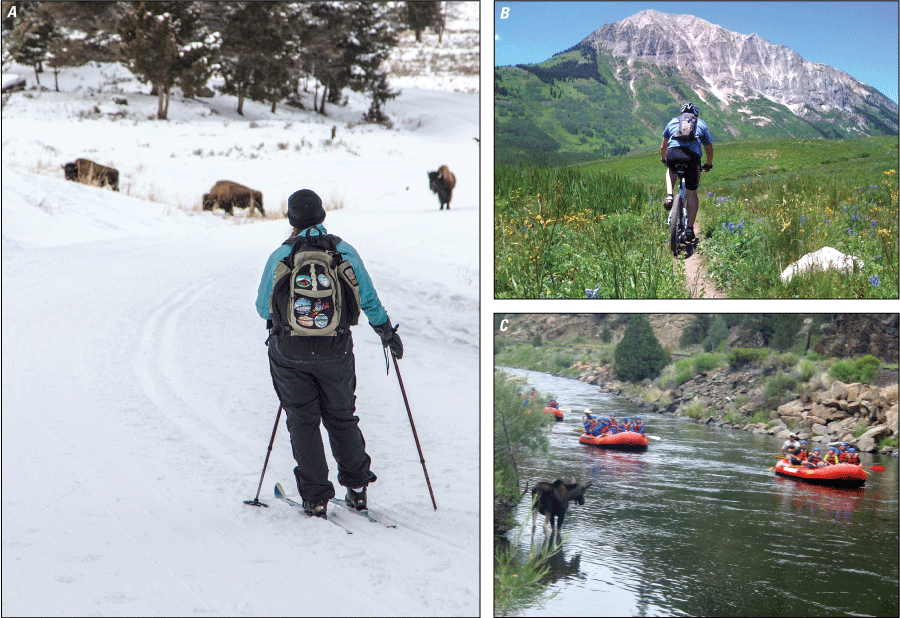
Photographs showing examples of nonmotorized recreation in the western United States. Activities can be distributed very differently across space and time and have complex ecological effects. A, Skiing is limited to areas with winter snow cover but can occur in the undeveloped backcountry in addition to established trails and roads. B, Mountain bikers can be quiet and solitary but cover a large spatial extent and travel at a high rate of speed. C, Whitewater rafting is strongly seasonal and aggregates people to specific river sections, but rafters can be abundant and noisy in critical riparian habitat. Photograph credits: A, Jacob W. Frank, National Park Service, licensed under a Creative Commons Public Domain Mark 1.0 Universal License, https://www.flickr.com/photos/yellowstonenps/31893112870/; B, Trailsource.com, licensed under a Creative Commons Attribution 2.0 Generic License, https://www.flickr.com/photos/trailsource/4744003781; C, Samuel Jordan, U.S. Geological Survey.
Table 2.
Nonmotorized recreation activities addressed in this report, area restrictions of each activity, number of relevant published papers about the relations between nonmotorized recreation and ungulates found in our literature search and included in this report, and sections of this report where more information can be found.1.2.1. Nonmotorized Recreation Activities Not Addressed, Activities with Limited Information Available, and Effects of Nonmotorized Recreation on Habitat
This science synthesis does not address the potential effects of hunting and fishing on ungulates. Accurately synthesizing the ecological effects of these activities is beyond the scope of this report. Hunting and fishing licenses are managed by States, which have regulatory authority for ungulate population management. Hunting seasons for ungulates are primarily in the fall and early winter. Many of the associated activities, such as scouting on foot and scouting with trail cameras, may be especially likely to take place preceding or during hunting season. Information included in this report may inform management of these hunting-associated activities, but the information reviewed here should not be considered comprehensive.
Although in this report we do not address the effects of nonmotorized recreation associated with hunting (for example, scouting and deploying camera traps), these activities have the potential to affect ungulates through increased human activity in the area and the presence of camera traps. Energy expenditure increases linearly with movement rates for ungulates (Parker and others, 1984), so scouting activities that increase ungulate movement could nutritionally stress ungulates. Scouting increased movement rates of mule deer in the day relative to a prehunting period but reduced movement rates at night (Brown and others, 2020, but note that scouting was not exclusively nonmotorized). In contrast, hunter scouting reduced movement of white-tailed deer both day and night (Little and others, 2016; Marantz and others, 2016). However, these studies do not identify if the scouting was motorized or nonmotorized. We were unable to identify studies directly comparing the magnitude of effects of scouting hunters to other nonmotorized recreation activities. Hunters scouting for ungulates during nonmotorized travel are likely to induce the same effects as other recreators traveling off trail (refer to section “3.2.2. Effects of On-Trail Nonmotorized Recreation Compared to Off-Trail Nonmotorized Recreation”), and such encounters could be more common than for other off-trail recreators because hunters seek to overlap with ungulates.
We were unable to identify literature specifically investigating if hunters deploying camera traps for scouting purposes affected ungulates. However, Muñoz and others (2014) determined that the scent of humans deploying camera traps for research purposes reduced white-tailed deer activity relative to sites where human scent was masked, indicating that it is possible that scouting with camera traps could reduce ungulate use of those areas. Henrich and others (2020) determined that once cameras were deployed, deer in Europe reacted to camera trap flashes, but these flashes did not alter site use by deer. Future research focusing on how ungulates respond to the use of camera traps by hunters and researchers may benefit our understanding of this effect (Caravaggi and others, 2020).
Nonmotorized recreation can also affect habitat through mechanisms beyond immediate human presence. Recreators can trample vegetation and cause reductions in the diversity and abundance of plant communities. Recreator activity can also compact soils and increase erosion (Cole, 2004). Recreational trails can serve as vectors for invasion by nonnative plant species (Wells and others, 2012), and pack animals can be additional vectors for spread (Wells and Lauenroth, 2007). Grazing pack animals near campsites can reduce vegetation standing biomass and productivity through time, change plant community composition, and concentrate animal waste (Cole and others, 2004). Human presence in and around natural water bodies, along with the accumulation of biological waste, can degrade water quality (Marion and others, 2016).
We focused this science synthesis on published, peer-reviewed literature on ungulates in western North America, and placed an emphasis on the literature that directly examined the effects of nonmotorized recreation. There is a growing body of literature that addresses motorized recreation and wildlife species other than ungulates. Following, we highlight several management-oriented syntheses that planners may find useful if their needs go beyond the content in this science synthesis:
-
• Miller and others (2020) provided a comprehensive review of wildlife and recreation activities with management recommendations.
-
• Kretser and others (2019) focused on management recommendations for recreation in protected areas.
-
• Machowicz and others (2022) offered a thorough review and management recommendations for key wildlife species in the State of Washington.
-
• The “California Fish and Wildlife Journal, Recreation Special Issue” (California Department of Fish and Wildlife, 2020) focused on the effects of nonconsumptive recreation on wildlife in California through eight articles.
-
• Olliff, Legg, and Kaeding (1999) summarized literature on winter recreation with an emphasis on the Greater Yellowstone Ecosystem.
1.2.2. Past, Present, and Future Patterns of Nonmotorized Recreation Activities Addressed in This Science Synthesis
It is beyond the scope of this science synthesis to summarize the changes in any particular nonmotorized recreation activity or in any particular area. Both regional-scale and site-scale recreation data can be useful in analyses; accessing site-scale data for analyses is reviewed in section “2.1. Quantifying Occurrence of Nonmotorized Recreation Activities and Distribution, Status, and Trends of Activities Across Spatial Scales,” and methods for collecting site-scale data for analyses are reviewed in section “3.5.2. Identifying Areas Important to Ungulates.”
There are several key resources that planners may access to derive quantitative estimates for changes in nonmotorized recreation trends through time at large spatial scales:
-
• Statewide comprehensive outdoor recreation plans identify statewide outdoor recreation trends and issues on a state-by-state basis.
-
• The Bureau of Economic Affairs collects data on the economic footprint of the outdoor recreation industry and offers state-level contributions to the economy and changes in employment in the outdoor industry.
-
• The Outdoor Industry Association’s outdoor participation trends reports are industry-led annual reports of recreation data nationwide.
-
• The National Park Service Visitor Use Statistics and the U.S. Department of Agriculture Forest Service National Visitor Use Monitoring program contain spatially explicit recreation and demographic data of visitors to public lands managed by those agencies.
Broadly, outdoor recreation has drastically increased throughout previous decades and is projected to continue growing (Highfill and others, 2018). Changes in technology continue to reshape how people participate in nonmotorized recreation. Continued improvement in technology expands the ease of access and capabilities for recreation, allowing recreators to cover a wider area and stay out for longer (Miller and others, 2020). For example, fat-tire bikes enable recreators to ride bikes through snow, extending throughout the year a sport that was traditionally constrained by snow cover. These technological advances in recreation equipment increase the number of participants in new activities and can expand the geographic footprint of recreation (Jensen and Guthrie, 2006). Given that these changes will continue to happen, the information in this report should not be the full extent of review for an environmental effects analysis.
Technology will continue to affect the ecological footprint of nonmotorized recreation and blur the definition of what constitutes nonmotorized recreation compared to motorized recreation. Specifically, electric bikes, unmanned aerial vehicles, and other technology-based recreation do not typically include an internal combustion engine (that is, what typically defines motorized recreation) but are nonetheless using stored energy to move people or objects. Electric bikes give users the potential to travel across a larger area, which may increase their disturbance footprint compared to human-powered bikes (Kuwaczka and others, 2023). Unmanned aerial vehicles can disturb wildlife and introduce a novel disturbance to terrain that humans cannot access readily (Mulero-Pázmány and others, 2017). Understanding the effects of these emerging technologies will likely be a focus of land management throughout the coming decades.
Beyond the equipment that recreators use directly to recreate, other technological advances affect how and when people recreate and their footprint. Webcams and point-specific weather forecasts can inform people of real-time conditions, affecting how many people engage in recreation each day. Specific examples of recreators using web-based information to make recreation choices include whitewater kayakers checking streamgages, wildlife watchers checking webcams or point weather forecasts, or recreators using real-time data from Global Positioning System (GPS) navigation apps to determine how busy a particular area is before making the decision to recreate. Technology can also affect popularity of a site among recreators; for example, social media can affect the popularity of a specific location and increase visitation. Thus, there are many ways that technology interacts with recreator decision making and ultimately affects recreation occurrence.
Changes in recreation use can be driven by exogenous factors such as climate change or global pandemics. For instance, during the coronavirus disease 2019 (COVID-19) pandemic, recreational fishing trips increased by 20 percent nationwide because of the ability for people to participate and feel safe from disease transmission while fishing (Midway and others, 2021). The changes resulting from these powerful exogenous forces can be nuanced. For example, rural and urban communities changed their recreation practices at different rates during the first year of the COVID-19 pandemic, and urban populations had larger increases in outdoor recreation frequency, distance traveled to recreate, and distance traveled off roads (Rice and others, 2020).
1.2.3. Types of Proposed Actions Related to Nonmotorized Recreation
Many types of proposed actions may relate to nonmotorized recreation, including the following:
-
• Formally designating user-created trails or routes
-
• Authorizing construction of new trails or routes
-
• Decommissioning existing trails or routes
-
• Developing recreation area management plans
-
• Developing travel management plans
-
• Authorizing construction of new trailhead facilities
-
• Authorizing construction of other recreation access points, such as a boat ramp, fence crossing, or bridge
-
• Authorizing development of new campgrounds
-
• Authorizing or deauthorizing dispersed camping
-
• Authorizing special recreation permits
-
• Authorizing changes to recreation management practices, such as the following:
Although not directly addressed in this science synthesis, many proposed actions that are not specific to nonmotorized recreation can also affect the amount and distribution of recreation. For example, extensive vegetation treatments or fluid minerals development can redistribute recreators because of individual preferences (in other words, recreational users may avoid specific areas because of the presence of heavy equipment or subsequent visual or environmental changes to the area) or because of access restrictions imposed for public safety.
Design features of proposed recreation actions can further affect changes in recreation use. For example, recreational use may increase specifically in response to creating ideal resource conditions for specific activities, such as when a trail constructed for mountain biking receives more use than a general-purpose trail (Symmonds and others, 2000). Information gathered from user groups or other stakeholders can reveal current recreation patterns in a project area, and when combined with stakeholder endorsement and collaborative planning, can lead to synergistic increases in recreation use because of thoughtful design and stakeholder endorsement of common goals (Colorado Trails with Wildlife in Mind Task Force, 2021).
1.3. Predicting Changes in Nonmotorized Recreation Occurrence Resulting from a Proposed Action
Predicting change in nonmotorized recreation use from a proposed action can be challenging. Predictions can be guided by a clear understanding of what aspects of recreation would be most useful to quantify (Watson and others, 2000). For example, estimating the number of groups during the summer season, the total annual number of all visitors, or the total number of overnight stays in an area may be most useful in different contexts. Some proposed actions may affect, and thus necessitate predicting changes to, multiple recreation types simultaneously, such as horseback riders, mountain bikers, and hikers on the same trail. Alternatively, a proposed action may almost exclusively affect a specific recreation activity, such as constructing a boat ramp on a whitewater river.
Methods for predicting changes in recreation use resulting from newly proposed recreation actions are myriad, and there are various approaches, including expert assessments and modeling efforts. Experts may use local knowledge and experience to estimate potential changes in recreation use. Expert assessments can be further informed by spatially explicit recreation data (Lieber and Fesenmaier, 1985) or qualitatively informed through surveys or focus groups (Schoffman and others, 2014; Colorado Trails with Wildlife in Mind Task Force, 2021). Modeling of human, environmental, and climate variables across a project area can help predict changes in recreation activities and patterns through time (Ladle and others, 2017), including using wildlife ecology principles to predict how humans will respond to recreation management actions (Pauli and others, 2019).
Factors to Consider When Characterizing a Proposed Action
The following questions may help resource managers gauge the potential effects of a proposed nonmotorized recreation action on ungulates. Does the proposed action:
• provide access to areas where access did not exist previously?
• have the potential to increase recreation use beyond current levels?
• cut off access to high-quality or sensitive ungulate habitat, escape routes, or refugia?
• take place within ungulate habitat that has no other alternative locations on the landscape?
• have the potential to expand the times of day humans are present in the area?
• make human presence less predictable in the area?
• have the potential to change the type of recreation in the area?
• interact with current patterns of ungulate hunting seasons and hunter access?
2. Characterizing Existing Recreation, Ungulate Populations, and Ungulate Habitat
Section 2 Highlights
• Recreation data can be collected specifically from a project area or estimated from larger scale data sources.
• Federal land management agencies work with State wildlife agencies to understand wildlife population dynamics in a project area.
• Information on key attributes of nonmotorized recreation and ungulate species within a project area can help define baseline conditions for measuring changes to recreation levels and indicators of the conditions of ungulate population and habitat.
We address two components of an affected environment in this science synthesis: (1) describing existing recreation activities, and (2) describing ungulate space use, habitat quality, population trends, and seasonal biology in and around the project area. Each project area will have a unique extent and coverage of available recreation- and ungulate-specific data.
2.1. Quantifying Occurrence of Nonmotorized Recreation Activities and Distribution, Status, and Trends of Activities Across Spatial Scales
Data collected on recreational use in a project area are the most accurate way to quantify the existing recreation environment. Key characteristics consist of the amount, location, frequency, and temporal distribution of users and the type of recreation in which they are engaged (refer also to section “1. Characterizing Ecological Effects of Nonmotorized Recreation”). Clearly identifying what metrics are important for a proposed action can guide analyses, including what data are likely needed for analyses (Watson and others, 2000). Multiple existing recreation datasets may be helpful in characterizing the recreation environment in addition to or in lieu of field-collected data (table 3). Dagan and Wilkins (2023) provide a helpful guide to existing and potential datasets describing recreation in North America.
Importantly, recreation on public lands in North America can be difficult to measure, and any particular method of quantifying recreation will have drawbacks or limitations (Watson and others, 2000). Dispersed use and multiple access points are common on public lands and create challenges for accurately measuring visitor use. Beyond the difficulty of accurately counting visitors without discrete access points, there are often user-created routes that are undocumented in management plans (Loosen and others, 2023). Small-scale use (for example, someone taking a short walk on public lands near their home) is difficult to capture using social media or web-based tools. To understand how recreation is taking place, land management agencies administer visitor-use surveys; the BLM visitor satisfaction surveys are one example.
Table 3.
Potential data sources for quantifying nonmotorized recreation activities at the project scale.[Dagan and Wilkins (2023) reviewed potential recreation data types and their uses, limitations, and accessibility in greater detail. BLM, Bureau of Land Management; RMIS, Recreation Management Information System; GIS, geographic information system; GPS, Global Positioning System]
| Type of recreation data | Source or example | Geographic extent | Description of data |
|---|---|---|---|
| Visitor satisfaction surveys | BLM RMIS | Unit scale | Visitor satisfaction surveys provide site-specific visitor opinions of enjoyment, quality, and recreation opportunities. These surveys can also include information about visitor demographics. |
| Trail counters or camera traps | BLM RMIS | Local scale | Trail counters or camera traps provide imperfect detection of people or vehicles passing a specific point. |
| Parking lot surveys | Watson and others (2000) | Local scale | Parking lot surveys can provide estimates of visitor use to areas through a specific access point. |
| Participatory GIS exercises or voluntary GPS tracking | Watson and others (2000) | Local scale to regional scale | Participatory GIS exercises or voluntary GPS tracking provide visitor-generated, spatially explicit information of where and when people recreate, either through a desktop exercise (GIS) or through real-time tracking (GPS). |
| Outdoor participation trends reports | Outdoor Industry Association | Statewide to nationwide | Outdoor participation trends reports provide State- or national-scale economic analyses and detail broad trends in spending associated with outdoor recreation. |
| Web scraping social media to model recreation presence | University of Washington Outdoor Recreation and Data Lab | Local scale to regional scale | Web scraping social media to model recreation presence can provide estimates of visits to specific areas or sites through time. |
| Google Maps data or internet search data | Owuor and others (2023) | Local scale to regional scale | Google Maps data or internet search data provide a proxy for site popularity, especially seasonal increases in visitor interest in visiting specific sites or areas. |
| Local accommodations reservations, campground reservations, or trail logs | Lesmerises and others (2018) | Local scale | Local accommodations reservations and campground reservations can help estimate visitor abundance if visitor access to an area is correlated with specific accommodations. Further, trail logs can provide some information about visitation rates and group sizes. |
| Crowdsourced, spatially explicit use maps from app users | Strava Metro, AllTrails, onXmaps | Local scale to nationwide | Crowdsourced, spatially explicit use maps from app users provide an estimate of visitor use intensity across space. These use maps can be useful for identifying social trails or distributed use across a large area. |
2.2. Quantifying Ungulate Space Use, Habitat, Population Trends, and Seasonal Biology
Information on ungulate space use, population trends, and their seasonal biology provide a baseline for measuring potential effects of a proposed recreation action and key information for predicting the effects of changing recreation use. Many factors affect ungulate distribution on the landscape, including the traits of species, the season, resource availability, and the distribution of human development and recreation. Most ungulate species in North America have strong seasonal patterns of habitat use, life cycles, and behaviors that are fundamentally important to predicting ungulate occurrence and sensitivity to disturbance by humans (Hobbs, 1989; Parker and others, 2009).
Information about ungulates can be gained by gathering data in the field or leveraging existing datasets to complete analyses (table 4) and by referring to previous analyses in the same area that may offer relevant information. State wildlife biologists can provide information about which ungulate species are in the project area, which may be informed by range maps based on tracked ungulates or expert knowledge.
Table 4.
Commonly available data sources for quantifying ungulate distribution and abundance.| Type of ungulate data1 | Source | Geographic extent |
|---|---|---|
| Seasonal range maps | State wildlife agencies | Statewide and game management unit scale |
| Population estimates and trends | State wildlife agencies | Statewide and game management unit scale |
| Telemetry data | State wildlife agencies, Movebank (https://www.movebank.org/) | Varied |
| Migration routes and timing | State wildlife agencies, U.S. Geological Survey (https://westernmigrations.net/; Kauffman and others, 2020, 2022a, 2022b9798) | Western United States |
| Camera trap detection data | State wildlife agencies, wildlife monitoring programs associated with land management agencies, academic research | Regional |
In this report, we consider 12 ungulate species native to the western United States and reflect the different amounts of literature available for each (table 5): Bison bison (bison), Ovis canadensis (bighorn sheep), Rangifer tarandus (caribou), Pecari tajacu (collared peccaries), Ovis dalli (Dall’s sheep), Cervus canadensis (elk), Alces alces (moose), Oreamnos americanus (mountain goats), Odocoileus hemionus (mule deer), Ovibos moschatus (muskoxen), Antilocapra americana (pronghorn), and Odocoileus virginianus (white-tailed deer). Understanding the presence and distribution of these ungulate species and their seasonal requirements within the project area is key to determining if ungulates are likely to overlap with recreators and be potentially affected by changes in recreation use.
Table 5.
Number of published papers found in our literature search that specifically investigate nonmotorized recreation effects on ungulate species addressed in this report or address the species through a review of other published studies.[Species are listed from largest to smallest number of papers. We were unable to identify relevant studies on muskoxen, so they are not included in this table]
Following, we describe approaches to mapping ungulate distributions and habitat use (section “2.2.1. Mapping Ungulate Distributions and Habitat Use”), describing habitat quality (section “2.2.2. Describing Habitat Quality for Ungulates”), quantifying abundance and population trends (section “2.2.3. Understanding Ungulate Abundance and Population Dynamics”), and understanding components of ungulate seasonal biology relevant to predicting the effects of recreation (section “2.2.4. Ungulate Seasonal Life History”).
2.2.1. Mapping Ungulate Distributions and Habitat Use
Recreators are unlikely to affect ungulates if they do not overlap with ungulates in space and time. To identify zones of potential overlap, land managers and NEPA analysts need to understand where ungulates are present on the landscape (refer to section “2.1. Quantifying Occurrence of Nonmotorized Recreation Activities and Distribution, Status, and Trends of Activities Across Spatial Scales” for details on describing the distribution of recreation activities).
Precise maps of ungulate distributions and habitat use can be constructed if telemetry data from ungulates fit with GPS or very high frequency (VHF) tracking devices (for example, collar or ear tags), or if camera trap data are available. These data are often analyzed using software such as R, Python, or ArcGIS, but free point-and-click tools are rapidly becoming available (MoveApps [https://www.moveapps.org/] compiles many point-and-click tools for easy analysis of wildlife movement data), making these data increasingly easy to work with. Common movement analyses consist of delineation of individual movements to population-level ranges, construction of resource selection functions (RSFs), and prediction of occupancy. For analyses that are data-deficient, expert knowledge may be the best available information.
Delineating Migration Routes and Ranges
Tracking data from GPS- or VHF-collared ungulates can be used to delineate their distribution. Migration Mapper (https://migrationinitiative.org/projects/migration-mapper/; Merkle and others, 2022) is a free, easy-to-use software with a point-and-click user interface that allows the user to identify core seasonal ranges and migration paths based on GPS collar data. The U.S. Geological Survey (USGS) has consolidated and published the migration routes and seasonal ranges of GPS-collared ungulates from many studies in the western United States, following this approach (https://westernmigrations.net/; Kauffman and others, 2020, 2022a, 2022b, 202499). However, the distribution of uncollared ungulates is not captured using this technique.
Resource Selection Functions
Resource selection functions quantify environmental characteristics at locations used by individuals relative to resource availability, making it possible to predict the relative probability of ungulate habitat use across the landscape (Manly and others, 2007). This relative probability allows analysts to predict habitat use in areas where individual ungulates may not be collared but are present, based on collared individuals within that same study area.
In RSFs, GPS locations of collared individuals commonly represent the used locations, but data from camera traps, track surveys, and sign surveys (for example, pellet counts) could also be implemented (Manly and others, 2007). Because an RSF model incorporates resource availability, which may differ among study areas, RSFs are best implemented to predict habitat use within the same study area where the data were collected (Fieberg and others, 2021). Ungulate habitat preferences can vary seasonally and even differ between day and night, so it may be important to account for temporal factors when quantifying resource use, especially in regard to human factors (Ganz and others, 2024).
Occupancy Models
Occupancy models (MacKenzie and others, 2002) are commonly used to analyze species detection data (for example, from camera traps) and can be used to produce maps of ungulate distributions (Burton and others, 2015). These models map the probability of occurrence of a species (that is, the probability that at least one individual is in a site) as a function of landscape features. This model framework accounts for imperfect detection and can also relate species detection probability to spatiotemporal factors such as habitat type, human activities, and distance to water (MacKenzie and others, 2002). In occupancy models, detection is the probability that a species is observed given that at least one individual is present within the sampling unit. Detection probabilities can also be used as an indicator of intensity, use, or site-level abundance, which may be useful for measuring the effects of recreators on ungulate activity and distribution (Suraci and others, 2021). More complex occupancy models can account for factors affecting local colonization, local extinction, and species co-occurrence (MacKenzie and others, 2017). Camera trap studies are noninvasive, which is safer for study animals and human researchers than collaring studies (Bassing and others, 2023).
2.2.2. Describing Habitat Quality for Ungulates
The quality of the surrounding habitat affects how ungulates change their distribution or patterns of resource use in response to recreation (refer to section “3.3.1. Understanding the Spatial Extent of Recreation Effects on Ungulates”). For instance, ungulates are more likely to be affected by recreation in the long term (greater than 6 months) if they are displaced from high-quality habitat to low-quality habitat (Gill and others, 2001). Likewise, recreation that degrades high-quality habitat is likely more consequential than recreation that degrades low-quality habitat. Mapping the relative habitat quality or key resources (for example, water for bighorn sheep; Lowrey and Longshore, 2017) for a species can inform predictions of the effects of changing recreation use. There are a variety of methods for evaluating habitat quality, including creating habitat indices and evaluating existing geospatial products that represent components of habitat quality. Additionally, resource management plans for the area may identify priority ungulate habitat, and assessment, inventory, and monitoring data may also be available.
Geospatial Products and Indices
Many geospatial layers are available that can indicate habitat quality, especially across broad areas, depending on the requirements of the ungulate species. Following, we highlight several national-level products that can be useful, but note that layers optimized for a particular region could be more accurate depending on the goals of the project.
-
• The National Land Cover Database (https://www.usgs.gov/centers/eros/science/national-land-cover-database) maps land cover types across the conterminous United States and Alaska, which can indicate a component of habitat quality, especially for habitat specialists. For instance, grassland cover would indicate better pronghorn habitat than deciduous forests.
-
• The Rangeland Analysis Platform (https://rangelands.app) maps the annual aboveground biomass of vegetation across the conterminous United States, including forbs and grasses in rangelands, and therefore may be a useful indicator of forage availability for some ungulate species.
-
• The Normalized Difference Vegetation Index (NDVI) is a remotely sensed measure of vegetation greenness that is correlated with net primary productivity, and thus availability, of forage biomass for many ungulates (Pettorelli, 2013). However, NDVI is a poor predictor of forage availability in forested ecosystems (Pettorelli, 2013). The Normalized Difference Vegetation Index varies temporally, so identifying the relevant time window or distilling values to a single index (for example, peak NDVI in the growing season) is necessary to apply this metric.
-
• Instantaneous rate of greenup (IRG) quantifies the rate of change of NDVI during the growing season and has been correlated with ungulate movement in the spring because it reflects high-quality forage (Sawyer and Kauffman, 2011; Malpeli, 2022). Like NDVI, IRG is time sensitive, so identifying the relevant time window or distilling values to a single index (for example, peak IRG in the growing season) is necessary to apply this metric.
The best measure of habitat quality is the individual fitness, or lifetime reproductive output, of the individuals occupying that habitat (Van Horne, 1983). Because ungulates can congregate at high densities in habitats that are attractive but associated with elevated rates of mortality (ecological traps or population sinks; Hale and Swearer, 2016), determining habitat quality based on ungulate density and distribution can be unreliable (Van Horne, 1983). However, measuring individual fitness may be challenging given project timelines and financial and logistical constraints.
Creating Habitat Indices
Analysts can account for the multiple factors that affect ungulates’ distribution and persistence (for example, forage availability, distance to water sources, climate, and topography) by aggregating geospatial layers, which may be weighted for relative importance. These products are highly sensitive to the ranking and selection of the different layers (Roloff and Kernohan, 1999). Thus, to apply these techniques effectively, analysts must carefully consider the species’ biology, unique requirements, and regional variation in habitat use. Given these critical nuances, such approaches are better when completed in partnership with wildlife management agencies, research institutions, or both.
Habitat suitability maps quantify the relative value of each area on the landscape (commonly a pixel in a digital, rasterized map) for a particular species. To create a suitability index, multiple resources important to a species are separately mapped as individual layers, relative importance of the layers is determined, and then the resource layers are combined into a single index of habitat quality (Roloff and Kernohan, 1999). For instance, Tendeng and others (2016) created a suitability index for moose based on proximity to water, forage availability, and forest structure.
Habitat sensitivity maps typically identify areas of important habitat for multiple species to determine areas where habitat loss or degradation would be especially detrimental. To create habitat sensitivity maps, analysts typically overlay distribution maps of multiple species (ERO Resources, 2021). In a Colorado project to balance recreation use with wildlife habitat, species maps were weighted by conservation status to create the sensitivity map (ERO Resources, 2021). Section “2.2.1. Mapping Ungulate Distributions and Habitat Use” describes approaches to mapping ungulate distributions.
2.2.3. Understanding Ungulate Abundance and Population Dynamics
Understanding population trends may inform the level of concern for a particular ungulate population. For instance, managers may be more concerned about potential negative effects of recreation on a declining ungulate population than one that is growing. Importantly, recreation is just one of many factors (human and natural) driving these dynamics. Directly measuring ungulate abundance can be challenging because (1) it is difficult to locate ungulates in some types of terrain (for example, under forest cover when observed aerially); (2) individuals can be difficult to distinguish from conspecifics, such that overcounting or undercounting individuals is a risk; and (3) movement of individuals may lead to overcounting or undercounting (Found and Patterson, 2020). Therefore, many State agencies rely on other indicators of population status, including assessing survival of different life stages that determine the population growth rate or considering the nutritional condition of the population.
Survival as an Index of Population Status
Ungulate population growth rates are typically most strongly affected by the survival of adult females (Gaillard and others, 1998). Thus, resource managers may be more concerned about the effects of recreation on this demographic group. In ungulates, juvenile survival tends to vary highly among populations, so changes to recruitment can indicate factors affecting the population, even if juvenile survival has less effect than adult female survival (Gaillard and others, 1998).
Survival rates are typically estimated by deploying tracking technology such as VHF or GPS collars or ear tags on individuals so that field researchers can identify rates and causes of mortality. Additional technologies, such as vaginal implant transmitters, can assist in locating neonates for capture (Bowman and Jacobson, 1998). These data are intensive to collect but may be available from State agencies and published studies. Combined with information on reproduction, analysts can estimate population growth rates using matrix models built on demographic data (Morris and Doak, 2002; Kendall and others, 2019).
If directly tracking individuals is infeasible, determining juvenile to adult female ratios (for example, fawn to doe ratios, calf to cow ratios, and ewe to lamb ratios) can also be informative as indicators of recruitment. These ratios can be estimated through noninvasive methods such as direct observation from the ground (Phillips and Alldredge, 2000), camera trap surveys (Chitwood and others, 2017), or aerial surveys, which are used most commonly (Caughley, 1974, 1977). Although juvenile to adult female ratios tend to be positively related to the population growth rate, they are ineffective in detecting slow declines in the population size (Harris, Kauffman, and Mills, 2010). Further, researchers are unable to determine which demographic rates are driving changes to juvenile to adult female ratios with such surveys, which could reflect pregnancy rates, fetal rates, or juvenile or adult female survival (Harris, Kauffman, and Mills, 2010).
Population Growth Rate
Determining that recreation affects the population growth rate would offer the strongest measure of the potential effects of recreation because recreation activities that alter ungulate behavior may not necessarily affect ungulate abundance (Freddy and others, 1986; Gill and others, 2001). Additionally, knowledge of the population growth rate may inform the level of concern about the potential effects of recreation actions. Resource managers may be more concerned about the effects of recreation on declining ungulate populations compared to stable or increasing ungulate populations (Hobbs, 1989; Phillips and Alldredge, 2000; Wiedmann and Bleich, 2014).
Nutritional Condition
Average body fat percentages below specific thresholds have also been correlated with declining populations in ungulates (Monteith and others, 2014; Stephenson and others, 2020). This information may be available from State agencies that can measure fat content of live animals with a portable ultrasound or determine body fat percentage of dead animals with Kistner scores (rating fat deposits in key locations and converting to percentage of fat; Kistner and others, 1980) or modified Kistner scores (Shipley and others, 2020).
Population Limitation
Identifying the factors limiting the ungulate population can help predict the potential effects of recreation. For instance, a population that is primarily limited by top-down factors (for example, predation, human harvest, and vehicle collisions) with abundant resources available may be mostly unaffected by a functional loss of habitat due to avoidance of recreators (Gill and others, 2001; Larson and others, 2016). In contrast, avoidance of high-quality habitat because of recreation would be more concerning for a resource-limited population. However, most ungulate populations are at least colimited by resource availability, so habitat quality and availability are likely to be important in most environments (Clark and Hebblewhite, 2021).
2.2.4. Ungulate Seasonal Life History
Ungulates have distinct seasonal life history patterns that affect their vulnerability to disturbance throughout the course of the year. The extent and timing of vegetation productivity and dormancy affects survival, birthing and rearing of young, and breeding periods. The seasonal timing of these periods varies depending on the species and the region they inhabit (Toweill and Thomas, 2002; Hewitt, 2011; Heffelfinger and Krausman, 2023), and State wildlife agencies often have detailed information on when these periods occur for a particular population.
Vegetation Productivity and Dormancy
Body condition of female ungulates tends to track vegetation productivity, such that ungulates build fat reserves during seasons when nutritious forage is abundant, whereas body fat declines outside of the growing season (Moen, 1978). The loss of fat reserves outside of the growing season is exacerbated by severe conditions and poor-quality habitat (Forrester and Wittmer, 2013).
For most North American ungulates (outside of the desert southwest), adult female ungulates build fat stores through the summer and fall, and nutritional condition declines in the winter, even in mild conditions (Moen, 1978, Cook and others, 2013). In regions with snowy winters, deep snow increases the energetic cost of movement and inhibits access to forage for grazers (for example, pronghorn, mountain goats, elk, and bighorn sheep), as do ice layers in the snowpack, even when snow depth is shallow (Penczykowski and others, 2017). Accordingly, survival, especially for juveniles, declines in harsh winters (Gaillard and others, 2000; Forrester and Wittmer, 2013). Ungulates tend to congregate in higher density on restricted ranges in the winter, even in snow-free regions or years (Toweill and Thomas, 2002; Hewitt, 2011).
In contrast, ungulates of the desert southwest build fat during wet, warm winters and late summer monsoons that drive plant growth, and body condition declines during hot and dry periods, typically late spring and early summer (Heffelfinger, 2006; Duvuvuei and others, 2023). Access to water is also an important factor for these ungulates in dry periods, and proximity to water shapes deer distribution and population density (Duvuvuei and others, 2023).
Birthing and Rearing Young
During late pregnancy, birth, and nursing periods, nutritional demands of reproductive females peak to meet the energetic requirements of provisioning young (Moen, 1978). This period is critical for adult female ungulates, and nutritional quality during the growing season has the strongest effects on adult survival and recruitment of young for the following year (Cook and others, 2013). Generally, ungulates give birth during or before periods of highest productivity (Toweill and Thomas, 2002; Hewitt, 2011; Heffelfinger and Krausman, 2023). Birthing for ungulates in temperate and mountainous regions of North America is typically in May–June (Toweill and Thomas, 2002; Hewitt, 2011; Heffelfinger and Krausman, 2023), whereas birthing for ungulates of the desert southwest aligns with wet, rainy periods (for example, bighorn sheep give birth in January–March; mule deer give birth in late July–August, aligning with summer monsoons [Quintana and others, 2016]; and Odocoileus virginianus couesi [Coues’ white-tailed deer] give birth in July [Hewitt, 2011]).
Neonatal ungulates hide motionlessly to reduce predation risk, and mothers tend to feed away from young to avoid attracting predators, returning every few hours to nurse (Johnson‐Bice and others, 2023). When ungulates are disturbed at this time of year, reproductive females may flee farther from their young, likely to avoid drawing attention to neonate hiding sites.
Breeding Season
For most North American ungulates, fall is the breeding season, which is commonly referred to as “the rut.” The rut occurs later for southwestern desert ungulate populations (for example, December for desert mule deer [Duvuvuei and others, 2023], January for Coues’ white-tailed deer [Hewitt, 2011]), earlier for some species (for example, bison), and year round in some populations (for example, Cervus canadensis nannodes [tule elk; Toweill and Thomas, 2002] in Point Reyes, California; Becker and others, 2012). During the rut, metabolic demands increase as males increase movement rates by as much as 50 percent to compete with other males in pursuit of breeding females (Moen, 1978; Foley and others, 2015). Among ungulate species, few males breed with many females (that is, a polygynous mating system), so factors affecting males tend to be less important to population dynamics than factors that affect females and offspring (Gaillard and others, 1998).
3. Potential Effects of Nonmotorized Recreation on Ungulates
Section 3 Highlights
• Recreation commonly affects ungulates by altering habitat and inducing a risk response that can affect ungulate habitat use, energetics, and foraging rates, and has the potential to lead to demographic effects on the population.
• Landscape context, temporal factors, the broader wildlife community, the traits of the ungulate species, and population characteristics mediate the effect of recreation on ungulates.
• The long-term (seasonal or longer) effects of recreation on ungulates are most directly measured with demographic indices (in other words, survival, recruitment, and pregnancy rates), nutritional condition, or both. However, studies evaluating these indices are rare.
• Metrics that evaluate the immediate response of individual ungulates to recreation activities (in other words, flight initiation distance, distance fled, alert distance, and cardiac response) reflect the risk-reward tradeoff the ungulate perceives from a given interaction but do not necessarily scale to population-level effects. Such measures can be useful to comparatively evaluate effects from different types of recreation or identify how effects differ depending on habitat.
Humans can affect ungulates in a variety of ways, even when participating in quiet, nonconsumptive recreation activities (fig. 2; Whittaker and Knight, 1998). Indeed, ungulates can have a stronger immediate response to humans on foot than to vehicles, although vehicles are more likely to be lethal (by means of collisions) and can cover far more distance in the same amount of time (Stankowich, 2008; Larson and others, 2016). Nonmotorized recreation affects ungulates through three primary mechanisms: habitat modifications (Monz and others, 2010), direct lethality in rare situations (for example, the collision of a cyclist and a deer; Green and Higginbottom, 2000), and inducing a fear response in ungulates and their nonhuman predators (Frid and Dill, 2002).
First, developed recreation areas can result in direct habitat loss when suitable habitat is converted to trails and associated infrastructure, such as campgrounds, parking lots, and bathrooms (Monz and others, 2010). Recreators can also degrade the quality of the environment by trampling vegetation, introducing invasive species, accelerating erosion, and contributing to the accumulation of biological waste (Monz and others, 2010). If alternate suitable habitats are unavailable and ungulates avoid such locations or use them to a lesser degree, individual ungulates may have fewer nutritional resources, potentially decreasing nutritional condition, reproduction, survival, and ultimately, population performance (Parker and others, 2009).
Second, recreators can kill ungulates accidentally, although such situations are rare and unlikely to alter ungulate behavior or population dynamics (Green and Higginbottom, 2000). For instance, collisions between ungulates and cyclists or skiers traveling at high speeds can kill ungulates. Recreators commonly travel by vehicle to a trailhead, which could lead to increasing collision rates between ungulates and vehicles as an indirect consequence of increased recreation, if vehicular traffic increases as a result of more recreators traveling to trailheads (Green and Higginbottom, 2000; Hill and others, 2020).
Third, ungulates generally respond to recreators as a lethal threat (Frid and Dill, 2002), and ungulates tend to react to humans more strongly than nonhuman predators (Ciuti and others, 2012; Smith and others, 2021; Visscher and others, 2023). Ungulate responses to perceived risk can result in short-term (up to 1 season) and long-term (longer than seasonally) avoidance of areas, affect ungulate time budgets, alter physiology, and have demographic consequences (Prugh and others, 2019). For example, ungulates may flee from an approaching hiker, generally avoid places associated with recreation (Lowrey and Longshore, 2017), alter activity timing to avoid recreation (Green and others, 2023), or increase vigilance at the expense of foraging (Bateman and Fleming, 2017). Such reactions can simultaneously increase ungulate energetic expenditure (for example, while fleeing humans) and decrease foraging time when ungulates prioritize vigilance more than foraging (Frid and Dill, 2002; Bateman and Fleming, 2017). Ungulates may also avoid areas associated with humans throughout longer durations. For example, bighorn sheep avoided high-quality habitat in the Teton Range in Wyoming that was used by backcountry skiers and snowboarders, reducing available high-quality habitat by 30 percent for some individuals (Courtemanch, 2014). When ungulates avoid areas used by humans throughout longer time scales, such habitat becomes functionally unavailable, potentially reducing the carrying capacity of the landscape (Bartmann and others, 1992), although habituation has the potential to lessen such effects (refer to section “3.2.2. Effects of On-Trail Nonmotorized Recreation Compared to Off-Trail Nonmotorized Recreation”). Alternatively, when predators likewise fear and avoid humans, and ungulates’ fear of nonhuman predators supersedes their fear of humans, ungulates can use areas closer to humans, adapting behaviors as a result of the human shield effect against carnivores (Rogala and others, 2011).
Understanding habitat effects of recreation and especially ungulate fear responses is therefore critical for assessing the potential effects of human presence in natural ecosystems and making informed land management decisions (Frid and Dill, 2002). Many factors affect the extent to which recreation activities affect ungulates. Considering the characteristics of the ungulates affected (refer to section “3.1. Ungulate Characteristics That May Affect How Individuals and Populations Respond to Nonmotorized Recreation”), the characteristics of the recreation activity (refer to section “3.2. Aspects of Recreation That Can Affect Ungulate Response”), and the landscape context of the interaction (refer to section “3.3. Landscape Context”) is key to understanding observed dynamics and measuring the extent of effects to predict outcomes of changing recreation use (refer to section “3.4. Commonly Used Metrics to Quantify Ungulate Response to Nonmotorized Recreation”). However, considerable information gaps (refer to section “3.6. Information Gaps”) remain that limit the understanding of the effects of recreation on ungulates. The ability to predict the effects of changing recreation on ungulates (refer to section “3.5. Predicting Effects of Changes to Nonmotorized Recreation on Ungulates”) will continue to improve as new research emerges (refer to section “3.7. The Future of Nonmotorized Recreation Science”).
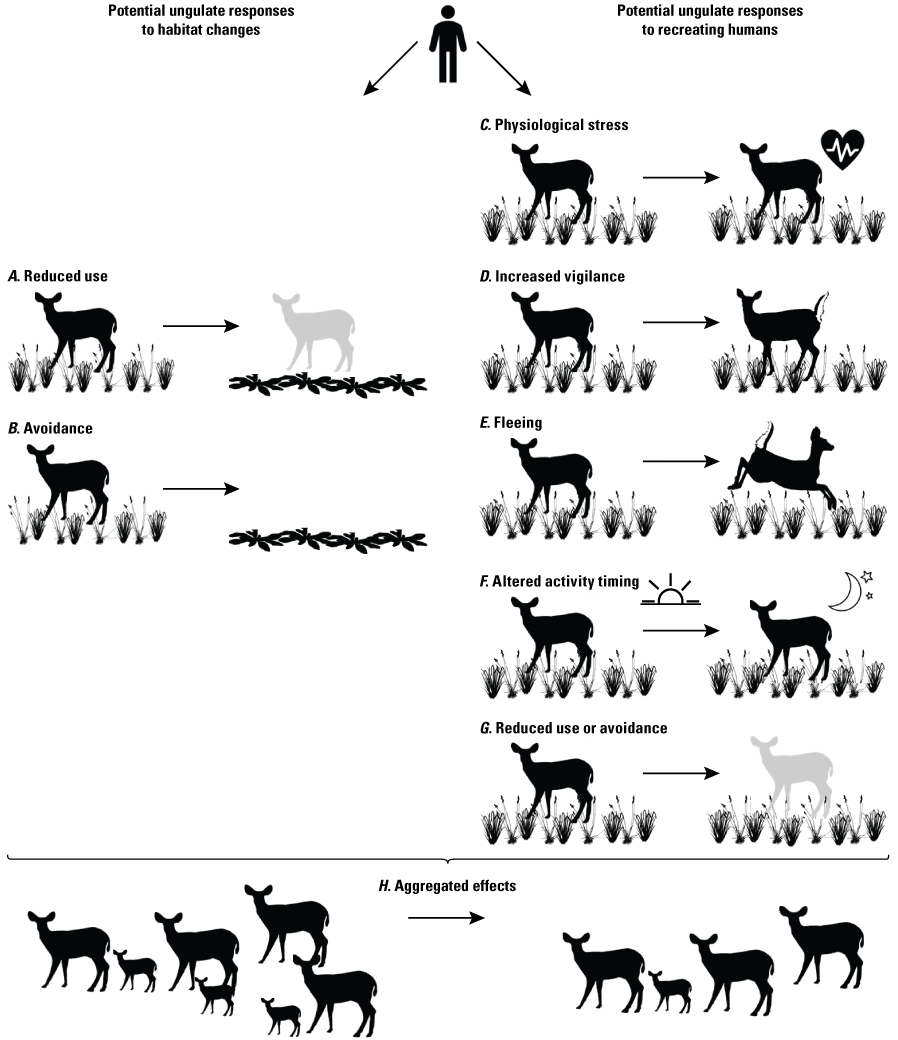
Diagram showing mechanisms by which recreating humans can negatively affect ungulates. A, Humans may alter the landscape by trampling vegetation, causing ungulates to reduce use of habitat (indicated with the transparent deer icon), or B, avoid (indicated with the absence of the deer icon) the area in the short or long term (daily or monthly scales, respectively) (Monz and others, 2010). C, Ungulates can also respond to human presence by increasing their physiological stress response (MacArthur and others, 1982), D, increasing vigilance at the expense of foraging time (Bateman and Fleming, 2017), E, avoiding the area in the short term (hourly scale) by fleeing (Stankowich, 2008), F, altering activity timing (Green and others, 2023), or G, reducing use of or avoiding areas in the longer term (weekly or monthly scale; indicated with the transparent deer icon) (Lowrey and Longshore, 2017). H, Through time, ungulate nutritional condition may decline, and aggregated effects have the potential to depress demographic rates, including reproduction, survival, and ultimately, abundance of the population (Phillips and Alldredge, 2000; Wiedmann and Bleich, 2014; Weterings and others, 2024). Deer icons by Gabriela Palomo-Munoz, licensed under a Creative Commons Attribution-Noncommercial 3.0 Unported License, https://www.phylopic.org/contributors/f57cf3c4-210c-4bcf-a759-9fcbc0cd8ba1/gabriela-palomo-munoz-silhouettes. Grass illustrations by Guillaume Dera, licensed under a Creative Commons CC0 1.0 Universal License, https://www.phylopic.org/images/e6e580fb-56e4-4896-8b65-d11858ca7e90/poa-pratensis, https://www.phylopic.org/images/26e45e79-7726-4095-9aa4-d5831d79c3d9/acorus-calamus. Trampled vegetation illustration modified from Mason McNair, licensed under a Creative Commons CC0 1.0 Universal License, https://www.phylopic.org/images/41f1b7b4-c949-47df-b468-4b3aa10605eb/passiflora-incarnata. Person, heart, and moon icons from Microsoft 365. Sun icon modified from Microsoft 365.
3.1. Ungulate Characteristics That May Affect How Individuals and Populations Respond to Nonmotorized Recreation
Ungulates of North America encompass a variety of species, including those within the Antilocapridae (pronghorn), Bovidae (bison, bighorn sheep, Dall’s sheep, mountain goats, and muskoxen), Cervidae (caribou, elk, moose, mule deer, and white-tailed deer), and Tayassuidae (collared peccaries) families. Among this diversity of taxa, there is considerable variation in ungulate response to nonmotorized recreation (Miller and others, 2001; Stankowich, 2008; Larson and others, 2016). Individual-, social-group-, population-, and community-level factors (refer to section “3.1.1. Scaling from Individuals to Social Groups to Populations to Wildlife Communities”) and species-specific traits, including dietary needs (refer to section “3.1.2. Ungulate Dietary Needs”), movement patterns (refer to section “3.1.3. Migration and Movement Patterns of Ungulates”), use of refugia (refer to section “3.1.4. Ungulate Use of Refugia”), and seasonal life history patterns (refer to section “3.1.5. Ungulate Seasonal Biology”), mediate the effects of recreation on ungulates and are important to consider when predicting the consequences of changing recreation use on ungulates of different populations and species.
3.1.1. Scaling from Individuals to Social Groups to Populations to Wildlife Communities
The effects of nonmotorized recreation on ungulates can be measured across organizational scales. Studies have used individuals, social groups, and populations as units of analysis. Understanding the effects of nonmotorized recreation on ungulates for a proposed action may require multiscale thinking.
Individuals
Ungulates generally perceive humans engaging in nonmotorized recreation as a risk, and the nutritional condition of the affected individual dictates their scope for response and the effect of that response (Frid and Dill, 2002). Individuals in poor nutritional condition (that is, with meager fat stores) may have a weaker response to recreation than a healthy individual because the energetic consequences of fleeing and increased vigilance at the expense of foraging time are greater (Frid and Dill, 2002). Simultaneously, animals in poor nutritional condition are closer to critical thresholds in body fat percentage, below which reproductive success and survival probability decline. Therefore, individuals in poor nutritional condition would suffer more in response to a perceived threat or to the actual or functional loss of habitat (Parker and others, 2009; fig. 3).
Individual-level traits, including personality, age, and sex, can also affect response to recreation. Individual animals’ temperaments differ from bold to shy, and bold individuals are more likely to habituate to human disturbance (Found, 2019; section “3.2.2. Effects of On-Trail Nonmotorized Recreation Compared to Off-Trail Nonmotorized Recreation”). Generally, juvenile ungulates and adult females tend to flee from humans sooner than adult males, and females with young respond more strongly than females without young (Stankowich, 2008).
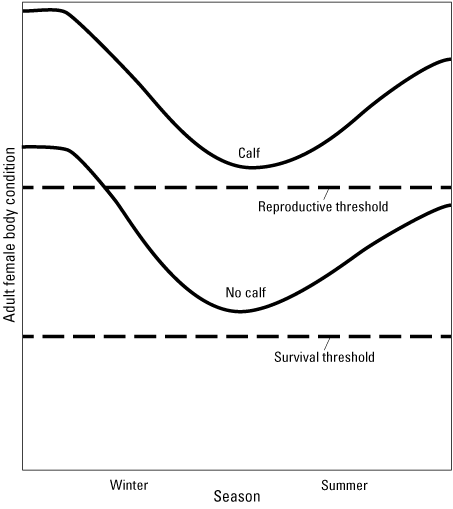
Line graph showing adult female ungulate body condition in relation to season and reproductive cycle. Ungulate body fat varies throughout the year in a predictable cycle in most of North America (but differs in the desert southwest, reflecting the timing of vegetation growth). The body condition of adult females is highest after the growing season (peak fall in temperate and cool climates) and declines through the winter, and reproducing females reach their poorest condition shortly after birth due to the energetic demands of pregnancy and lactation (Moen, 1978). If adult female body condition drops below the critical reproductive threshold, females will either fail to conceive or resorb a fetus. At the extreme, ungulates can starve if body fat reserves drop below the survival threshold. Modified from Parker and others (2009, fig. 1) with permission from John Wiley and Sons.
Social Groupings
The size of the ungulate social group and the distribution of ungulate predators have the potential to shape ungulate response to recreation and the consequences of those interactions (Stankowich, 2008; Becker and others, 2012). Larger groups of ungulates have a higher likelihood of detecting recreators, but the perceived level of threat per individual ungulate is typically less because the risk is diluted by the number of ungulates in the group. As a result, ungulates generally respond to recreators more strongly when in smaller groups (Stankowich, 2008; Becker and others, 2012; but refer to Sproat and others, 2019).
Populations
Individual ungulate response to nonmotorized recreation can be a useful tool to evaluate the specific effects of recreation in different contexts. However, understanding if the cumulative effects of those responses alter survival and reproductive output, which can be scaled up to population-level effects, is arguably more important for understanding the net effects of recreation but is difficult to accomplish (Gill and others, 2001). Demographic metrics such as survival of adult females and juveniles, pregnancy rates, and fetal rates offer a strong index of the net effects of risk responses on ungulate populations (Gill and others, 2001; Prugh and others, 2019).
Factors limiting the population are also important to consider when predicting population-level effects of recreation on ungulates. For instance, populations primarily limited by bottom-up factors (that is, resource availability) will be more affected if they avoid certain habitats to minimize exposure to recreators, thereby forgoing foraging opportunities (Gill and others, 2001). In contrast, populations primarily limited by top-down factors (for example, predation, human harvest, and vehicle collisions) where per capita resources are abundant should be less affected by a reduction in foraging opportunities.
Wildlife Communities
Ungulates co-occur with a wide variety of taxa, such as carnivores that may also be sensitive to human presence (Larson and others, 2019), which may in turn affect ungulates. Thus, understanding ungulate response to nonmotorized recreation may also require consideration and information on co-occurring species. The outcome of such interactions depends on predator and ungulate responses to humans, and these responses may differ depending on how risks shift with the time of day (Ganz and others, 2024).
If both predators and prey mutually avoid areas and times with nonmotorized recreation, they may overlap more in space and time (Van Scoyoc and others, 2023), leading to increased predation rates (Dumont, 1993). However, few studies have investigated such dynamics.
Sometimes, ungulates may exploit areas closer to humans because they provide refuge from predators that fear humans (Berger 2007; Muhly and others, 2011). This so-called “human shield” can increase ungulate abundance by decreasing predation rates (Hebblewhite and others, 2005). However, human shield effects have primarily been documented within protected areas (for example, national parks) (Hebblewhite and others, 2005; Berger, 2007; Sarmento and Berger, 2017). Recent work indicates that human shield effects may be small in multiuse landscapes and further depend on the ungulate species and location among other landscape and recreation factors (Granados and others, 2023).
Ungulates can be attracted to otherwise scarce resources that were made available as a result of nonmotorized recreation (for example, minerals in human urine) (Sarmento and Berger, 2017). In places where ungulates are attracted to otherwise scarce resources, they may be more vulnerable to predators if prey predictably are at high densities and predators do not avoid humans (Frid and Dill, 2002; Geffroy and others, 2015).
3.1.2. Ungulate Dietary Needs
Ungulate dietary niches can generally be classified throughout a spectrum of forage preferences, from grazers (primarily consuming grasses; for example, bison) to browsers (primarily consuming fruits, forbs, and leaves of trees and shrubs; for example, moose), and many North American ungulates are mixed feeders that both graze and browse (Kauffman and others, 2021). The consequences of ungulates shifting habitat use to avoid recreation depends, in part, on the nutritional value of that habitat. For instance, recreation activities that displace a mule deer (primarily a browser) from a grassland to shrubby habitat may be less consequential than activities that displace a mule deer from shrubby habitat to a grassland.
3.1.3. Migration and Movement Patterns of Ungulates
Ungulate species differ in the scale and timing of migration, the proportion of the population that migrates, and flexibility in migration route (Kauffman and others, 2021), which can affect their vulnerability to nonmotorized recreation. For example, presence of winter recreators only on a species’ summer range would not directly affect the species. Likewise, in partially migratory populations, the decision to migrate may affect overlap of individual ungulates with recreators. Species also differ in their fidelity to home ranges and migration routes, and Morrison and others (2021) determined that mule deer showed the strongest site fidelity (that is, showed the least flexibility in site use), followed by moose, bighorn sheep, elk, pronghorn, and caribou (which had the weakest site fidelity). Species with high fidelity to particular sites may have less flexibility to relocate from recreation disturbance, whereas species with weaker site fidelity may be better able to adapt to recreation if there are alternate suitable sites available. There is broad and extensive literature about ungulate migration in North America but little research into the effects of recreation (Kauffman and others, 2021).
3.1.4. Ungulate Use of Refugia
In section “3.3. Landscape Context,” we discuss how landscape context affects risk perception associated with nonmotorized recreation, reflecting the escape strategy of an ungulate species and their proximity to refugia. Importantly, what constitutes refugia strongly depends on the characteristics of the species (Wirsing and others, 2021). For instance, mountain goats (refer to Richard and Côté, 2016) and bighorn sheep (refer to Papouchis and others, 2001; Lowrey and Longshore, 2017) use steep, rocky terrain to reduce predation risk and could be more vulnerable to activities such as backcountry skiing and rock climbing that take place in such habitats (Courtemanch, 2014). Mule deer use uneven terrain of moderate steepness to reduce risk, and white-tailed deer prefer flat ground (Dellinger and others, 2019). Therefore, what constitutes refugia must be considered in the context of a particular species.
3.1.5. Ungulate Seasonal Biology
Ungulates’ sensitivity to recreation varies throughout key periods in their annual life cycle relating to vegetation productivity, the birthing and rearing of young, and the breeding season (refer to section “2.2.4. Ungulate Seasonal Life History”). Although much of the literature focuses on temperate ecosystems, managers can adapt major conceptual frameworks (fig. 3) to the predictable season cycles of abundance and scarcity of resources within their project area.
Vegetation Productivity
Disturbances during the growing season may affect annual survival if recreation affects ungulates’ ability to access high-quality forage. This is because forage during the peak growing season (summer in cool and temperate climates, winter in the desert southwest) has the strongest effect on survival (Cook and others, 2013).
Ungulates tend to be nutritionally stressed outside of the growing season (winter in most regions; hot, dry summer months in the desert southwest) (fig. 3), and snow and cold temperatures can increase energetic demands. Negative responses to nonmotorized recreation in snowy regions can elicit strong effects on individuals, which may scale to population-level effects. Using simulations, Hobbs (1989) showed that increases in human disturbance could increase deer mortality much more strongly in severe rather than mild winters (fig. 4). Effects of severe winter conditions on individuals may also persist into the next summer due to declines in maternal condition, resulting in fewer births and reduced neonate survival (Gaillard and others, 2000; fig 4). Because humans tend to use and develop valley bottoms and lower elevation areas where many ungulates winter, ungulates are often in closer proximity to humans in the winter, increasing the potential for disturbance (Elsen and others, 2020). Further, because ungulates often congregate in higher density in winter months relative to other times of year (Toweill and Thomas, 2002; Hewitt, 2011), recreators may accordingly have a higher per capita effect in the winter if they encounter more ungulates across the same area than in the summer.
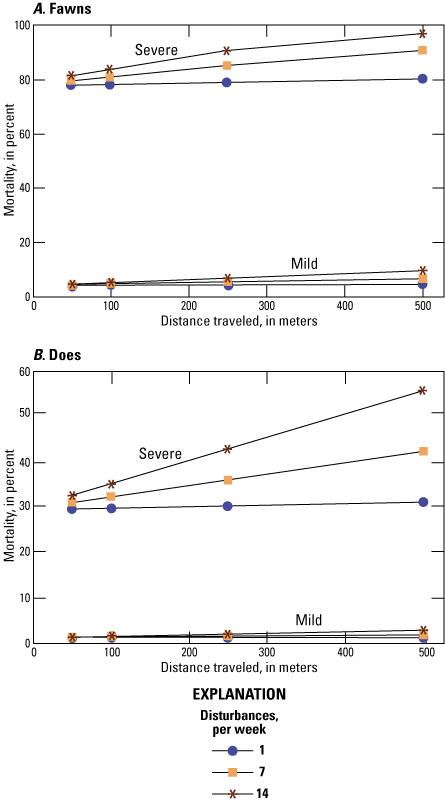
Line graphs showing that ungulate mortality is higher in severe winters than mild winters for mule deer A, fawns (juveniles), and B, does (adult females), in cold and temperate climates. Simulations show that mule deer mortality rates would increase with the number of disturbances by people that cause deer to flee as a result of the energetic costs of fleeing, and the effects would be stronger in severe winters than in mild winters (Hobbs, 1989). Reproduced from Hobbs (1989, fig. 20) with permission from John Wiley and Sons.
Birthing And Rearing Young
Because neonatal ungulates hide away from their mothers to reduce detection by predators, females may return less often to nurse when a threat is perceived, leading to young in poorer condition that have lower rates of survival. For instance, in Canyonlands National Park in Utah, female bighorn sheep fled farther from hikers in the spring when lambing than in summer or fall (Papouchis and others, 2001). Phillips and Alldredge (2000) walked toward elk to simulate the effect of hikers and detected that cow to calf ratios (an index of calf survival) decreased as disturbance rate increased, ultimately lowering the population growth rate.
Breeding Season
During the breeding season, males tend to be less responsive to recreators to prioritize access to females (Stankowich, 2008). However, in one study, male bighorn sheep were most sensitive to recreating humans in the fall breeding season, indicating that recreation could interfere with finding mates (Papouchis and others, 2001). Ungulates in hunted populations respond to humans more strongly than nonhunted populations (Stankowich, 2008; Kays and others, 2017), and ungulate response is also stronger during the hunting season, which generally is near the breeding season, in fall and early winter (Paton and others, 2017).
3.2. Aspects of Recreation That Can Affect Ungulate Response
Nonmotorized recreation activities are diverse, and the type, frequency, timing, speed, group size, and mode of travel of recreational activities can affect ungulates (app. 1). These factors may interactively shape ungulate response to recreation; effects may be further altered by the ungulate species, season, and landscape factors (reviewed in sections “3.1. Ungulate Characteristics That May Affect How Individuals and Populations Respond to Nonmotorized Recreation” and “3.3. Landscape Context”). Effects commonly vary by season and vegetation type; for example, elk were insensitive to group size and frequency of cross-country skiers in one study in open shrublands and forests (Cassirer and others, 1992) but showed increasing avoidance of recreation activities as level of recreation use increased in another study in montane, closed-canopy forests (Rogala and others, 2011). Additionally, prior experiences with humans can intensify or lessen the negative effects of recreation on ungulates (refer to section “3.2.3. Considering Habituation and Sensitization of Ungulates to Recreation and Human Presence”). Specific behavioral responses to nonmotorized recreation activities—and the season and habitat they were observed in—are presented in table 6.
Table 6.
Negative behavioral effects of nonmotorized recreation on ungulates by species-activity pairings.[More information, organized by species and study, is included in tables 1.1–1.5 in appendix 1]
| Recreation type | Behavioral effect on ungulates | Ungulate species | Habitat type | Season | Citation |
|---|---|---|---|---|---|
| Hiking | Increased vigilance | Elk | Grassland, forest | Summer | Ciuti and others (2012) |
| Bison | Grassland | All seasons | Fortin and Andruskiw (2003) | ||
| Reduced habitat use | Elk | Grassland, forest | Summer | Naylor and others (2009) | |
| Bighorn sheep | Grassland | Summer | Wiedmann and Bleich (2014) | ||
| Elk | Forest | All seasons | Rogala and others (2011) | ||
| Fleeing | Bison | Grassland, shrubland | Summer | Taylor and Knight (2003) | |
| Pronghorn | |||||
| Mule deer | |||||
| Bighorn sheep | Desert grassland, woodland | Spring, summer, fall | Papouchis and others (2001) | ||
| Mule deer | Forest | Summer | Price and others (2014) | ||
| Altered activity timing | Mountain goat | Forest, alpine | Summer | Fennell and others (2023) | |
| Mule deer | |||||
| White-tailed deer | Forest | Summer | Anderson and others (2023) | ||
| Mule deer | |||||
| Elk | |||||
| Mule deer | Forest | Summer | Gump and Thornton (2023) | ||
| Moose | |||||
| Mule deer | Grassland, woodland | All seasons | Lewis and others (2021) | ||
| White-tailed deer | Grassland, forest | All seasons | Visscher and others (2023) | ||
| Mule deer | |||||
| Hiking with dogs | Increased vigilance | Bighorn sheep | Grassland, forest | Summer | MacArthur and others (1982) |
| Fleeing | Mule deer | Grassland | Summer | Miller and others (2001) | |
| Mountain biking | Reduced habitat use | Bighorn sheep | Desert shrubland, juniper woodland | Winter, spring | Longshore and others (2013) |
| Bighorn sheep | Desert shrubland | All seasons | Lowrey and Longshore (2017) | ||
| Moose | Forest | Summer | Naidoo and Burton (2020) | ||
| Fleeing | Bison | Grassland, shrubland | Summer | Taylor and Knight (2003) | |
| Pronghorn | |||||
| Mule deer | |||||
| Bighorn sheep | Desert grassland, woodland | Spring, summer, fall | Papouchis and others (2001) | ||
| Reduced foraging | Elk | Grassland, forest | Summer | Naylor and others (2009) | |
| Horseback riding | Reduced habitat use | Elk | Forest | Spring, summer, fall | Wisdom and others (2018) |
| Change in daily habitat use | Mule deer | Forest, woodland | Summer | Reilly and others (2017) | |
| Skiing (backcountry and cross country) | Displacement to lower quality habitat | Bighorn sheep | Forest | All seasons | Courtemanch (2014) |
| Caribou | Forest | Winter | Lesmerises and others (2018) | ||
| Moose | Forest | Winter | Harris and others (2014) | ||
| Reduced foraging | Caribou | Forest | Winter | Duchesne and others (2000) | |
| Fleeing | Elk | Forest, shrubland | Winter | Cassirer and others (1992) |
3.2.1. Specific Aspects of Nonmotorized Recreation That Affect Ungulate Responses
Many aspects of nonmotorized recreation can affect ungulate responses. Specifically, the combination of frequency (people per day), timing, group size, noise produced, speed and direction of travel, and inclusion of domestic dogs are variables that may affect how ungulates respond to recreation.
Frequency
Nonmotorized recreation frequency (number of people or groups per day) can shift ungulate habitat use and presence. A large meta-analysis (including ungulate species and several non-ungulate taxa) found lower wildlife richness and abundance in areas of high recreation use (Larson and others, 2019). Other research has identified recreation thresholds at which habitat use near trails decreases (Rogala and others, 2011). Similarly, moose were not detected by camera trap in the backcountry of Glacier Bay National Park at sites exceeding about 40 visitors per week (Sytsma and others, 2022), and elk activity in Washington declined precipitously on trails with more than 20 recreators per day (Procko and others, 2024).
Timing
Recreation produces daily, weekly, and seasonal patterns in human activity that may affect ungulates. Absent human activity, ungulates tend to be most active at dawn and dusk, so midday recreation should have less effect than activities dispersed throughout the day (Nix and others, 2018). Ungulates generally reduce activity at times of the day and week when humans are most active (midday through evenings and weekends), but effects vary considerably by ecosystem, and these trends do not always hold (George and Crooks, 2006; Lewis and others, 2021; Green and others, 2023; Gump and Thornton, 2023). When ungulates anticipate temporal patterns of recreation activity, they may be able to alter their own activity cycles to reduce temporal overlap with humans, limiting the effects of recreation if resource requirements can be met at other times of day (Sibbald and others, 2011). However, more research could clarify if resource requirements can be met at other times of day.
Background human activities such as hunting may also affect ungulate response throughout the time of day. Hunted populations respond more strongly to recreators at dawn and dusk, whereas nonhunted ungulate populations do not show a difference in response by time of day (Stankowich, 2008). Because many species have already changed their daily activities to take place more at night in response to human presence, increased recreational use of trail systems during nighttime may overlap more with ungulate activity than daytime recreation use in areas where this shift has occurred (Gaynor and others, 2018; Lewis and others, 2021114).
Group Size
The number of people in a group of recreators can affect the likelihood that the group is detected by ungulates, and larger groups of people may have a larger effect on ungulate habitat. Ungulate vigilance may also be affected by recreation group size. For example, caribou were found to be more vigilant in response to larger groups of people, and this effect was inversely related to distance to refugia (Duchesne and others, 2000).
Noise
Recreators participating in the same activities can produce more sound than average by talking loudly, by carrying a portable speaker, or by other deliberate actions that produce sound, such as throwing rocks (Schoenecker and Krausman, 2002). Chronic noise can affect ungulate behavior through time and cause them to avoid areas, and acute noises can startle ungulates and evoke antipredator behavior (reviewed in Rutherford and others, 2023).
Speed and Direction of Travel
Speed of travel by recreators can affect ungulate flight responses. In a large meta-analysis, both speed and directness (angle) of approach were important factors in how ungulates responded to human presence, and faster, more direct approaches resulted in longer fleeing distances (Stankowich, 2008). However, some studies have found contrasting patterns. For example, bighorn sheep have been found to flee longer distances and stay away longer from hikers than mountain bikers (Papouchis and others, 2001), but in other studies, responses of elk (Naylor and others, 2009), bison, mule deer, and pronghorn (Taylor and Knight, 2003) did not differ between hikers and mountain bikers. The direction of travel by nonmotorized recreators and the directness of recreator approach to ungulates have also been shown to have some effect on the magnitude of ungulate responses (Stankowich, 2008).
Domestic Dogs
The presence of Canis lupus familiaris (domestic dogs) has been shown to affect ungulate responses in some studies (Miller and others, 2001), but wildlife taxa responses to dogs are often ambiguous (Reed and Merenlender, 2011). In one study, regular off-leash dog presence doubled the distance that mule deer avoided hiking trails—from 50 to 100 meters (m)—effectively doubling the area of influence that nonmotorized recreation had on mule deer in the area (Lenth and others, 2008). Bighorn sheep have been shown to be more reactive to humans with leashed dogs than humans alone (MacArthur and others, 1982).
3.2.2. Effects of On-Trail Nonmotorized Recreation Compared to Off-Trail Nonmotorized Recreation
Off-trail disturbances tend to have larger effects on ungulates than on-trail disturbances (Papouchis and others, 2001). This is likely because an on-trail encounter with a human is somewhat predictable from the perspective of an ungulate. In contrast, an off-trail encounter with a human is unexpected, and the direction in which the human travels is unpredictable (Stankowich, 2008). Mule deer (Miller and others, 2001; Taylor and Knight, 2003), bighorn sheep (Wiedmann and Bleich, 2014), bison, and pronghorn (Taylor and Knight, 2003) have all been shown to have larger responses to off-trail human presence than on-trail human presence.
Habituation likely explains the mechanism behind these larger responses to off-trail recreation than on-trail recreation. Ungulates use spatial knowledge of and orientation with refugia to inform their movements and evaluate predation risk, and off-trail recreation disrupts carefully calculated habitat use (Taylor and Knight, 2003). We discuss this process further in section “3.2.3. Considering Habituation and Sensitization of Ungulates to Recreation and Human Presence.”
One off-trail recreation activity of note is shed hunting, or the collection of dropped antlers. Shed hunting typically takes place soon after antlers are dropped, commonly in winter or early spring, which coincides with the lowest annual nutritional condition of ungulates (figs. 3, 4). Because males produce antlers, they may overlap more with shed hunters, but shed hunters can also disturb and displace females. Activities intended to disturb deer so that they drop their antlers may be especially detrimental (Western Association of Fish and Wildlife Agencies Mule Deer Working Group, 2015). Though rarely tested in the literature, shed hunting can lead to increases in the daily movements of mule deer and male bighorn sheep in an area where both species’ ranges overlap (Bates and others, 2021), which is linearly related to energy expenditure for ungulates (Parker and others, 1984).
3.2.3. Considering Habituation and Sensitization of Ungulates to Recreation and Human Presence
Habituation and sensitization are adaptive processes common among animals. Patterns of behavior by recreators can facilitate habituation, a clear example being ungulate herds in national and State parks that tolerate the proximity of frequent wildlife watchers (Sutton and Heske, 2017). Repeated exposure to the presence of humans without a negative outcome can decrease the behavioral responses of ungulates to human presence, and food conditioning can also increase ungulate habituation (Braunstein and others 2020). Sensitization is the counterpart of habituation, where ungulates develop an increased responsiveness to human stimuli through time (Blumstein, 2016). For example, in areas where hunting is common, ungulates readily flee human presence because it represents a threatening stimulus (Stankowich, 2008). Ungulates in a project area with existing recreation activities and human presence may be habituated to some degree, and habituation or sensitization may affect the potential outcomes of a newly proposed action on ungulates.
3.3. Landscape Context
The landscape surrounding a recreation area can affect the extent to which ungulates are likely to detect recreating humans, how risky recreating humans are perceived to be, the response of ungulates to humans, and thus the consequences of recreation to ungulates (Frid and Dill, 2002). The proximity of trails and recreators to ungulates (refer to section “3.3.1. Understanding the Spatial Extent of Recreation Effects on Ungulates”) and the complexity of trail systems (refer to section “4.1. Siting Nonmotorized Recreation Infrastructure to Minimize Effects to Ungulates”) play a major role in determining response to recreation, and these effects are moderated by the physical structure of the landscape (refer to section “3.3.2. Landscape Structure”).
3.3.1. Understanding the Spatial Extent of Recreation Effects on Ungulates
Ungulates respond more strongly to recreators when they are closer, and ungulates may not respond to recreators beyond certain distance thresholds (Miller and others, 2001; Rogala and others, 2011). Ungulates respond both to the immediate presence of recreators and to the presence of trails (Wisdom and others, 2018). The spatial extent of recreation effects depends on the distance at which ungulates detect and respond to recreators, termed the “area of influence” (Miller and others, 2001).
The broader wildlife community (refer to section “3.1.1. Scaling from Individuals to Social Groups to Populations to Wildlife Communities”) and the frequency and intensity of recreation (refer to section “3.2. Aspects of Recreation That Can Affect Ungulate Response”) also moderate the size of the area of influence (Rogala and others, 2011). For instance, elk in Yoho and Banff National Parks, Canada, preferred areas within 200 m of trails when human activity was low (presumably to exploit areas free from wolves that avoided humans) but avoided these areas as the number of hikers increased (fig. 5; Rogala and others, 2011). Additionally, the predictability of recreation (for example, on-trail hikers compared to off-trail hikers [refer to section “3.2.2. Effects of On-Trail Nonmotorized Recreation Compared to Off-Trail Nonmotorized Recreation”]) and landscape context, which we expand on in section “3.3.2. Landscape Structure,” further shape the spatial extent of recreation effects (Taylor and Knight, 2003).
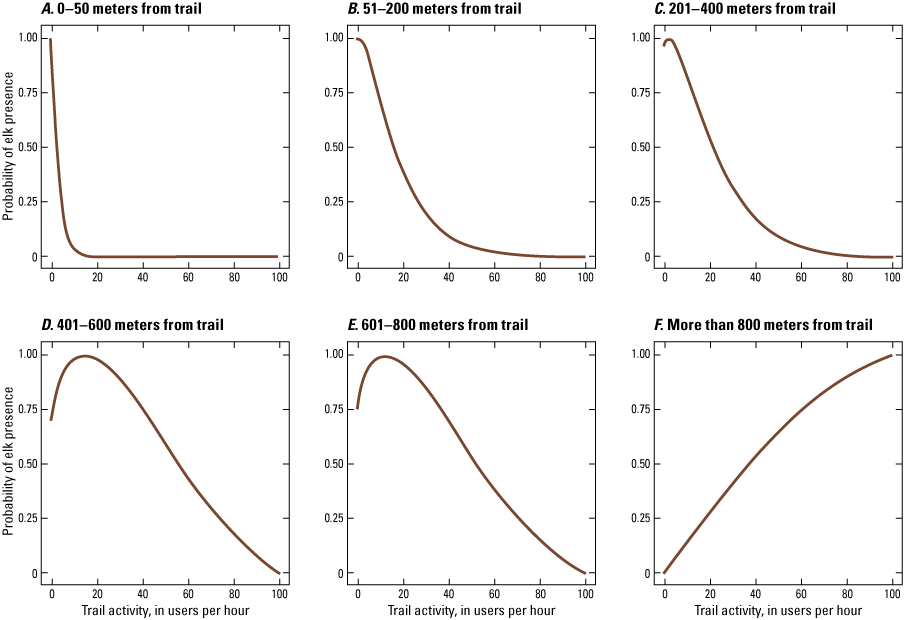
Line graphs showing the probability of elk use of areas in proximity to recreation trails (y-axis) in Yoho and Banff National Parks, Canada. A, The probability of elk use generally decreased with increasing trail activity (users per hour; x-axis), and the largest decreases were at short distances (0–50 meters [m]) from trails. B, The probability of elk use decreased with increasing trail activity at short distances slightly away from trails (51–200 m), and elk increased tolerance of low levels of trail activity (20 users per hour). C, The probability of elk use 201–400 m from trails was similar to 51–200 m from trails. D, Elk preferred to use areas with about 10–40 users per hour at intermediate distances (401–600 m) from trails. E, A similar pattern was found 601–800 m from trails as 401–600 m from trails. F, At larger distances from trails (greater than 800 m), the probability of elk use increased as trail activity increased. The authors determined that elk chose areas near trails when recreation activity was lower because wolves consistently avoided trails, as indicated by the authors’ data. Reproduced from Rogala and others (2011, fig. 2) with permission.
3.3.2. Landscape Structure
The physical environment strongly affects if ungulates perceive humans recreating, and how risky recreators are perceived to be, therefore shaping ungulate response (fig. 6). Landscape visibility, distance to refugia, and resource availability all have the potential to affect this chain of events, shaping the area of influence for a specific location. Ungulates are generally more likely to detect humans—and will respond sooner—in open habitat with high visibility than in closed or wooded habitat with lower visibility (Stankowich, 2008). As a result, the area of influence of recreation (Miller and others, 2001) should increase as landscape visibility increases. Humans are also perceived to be much riskier when ungulates are farther from refugia (refer to section “3.1.4. Ungulate Use of Refugia”).

Illustrations of the relation between landscape configuration, A, and ungulates’ perceived risk, shown on the vertical axis, B. The spatial configuration of a landscape can modify how risky ungulates perceive nonmotorized recreators to be (Ciuti and others, 2012; Gaynor and others, 2021). In this example, the risk perceived by elk is elevated along trails and with proximity to hikers (Wisdom and others, 2018) and reduced by areas of tree cover that provide visual cover from the trail (Stankowich, 2008). Ponderosa pine tree illustration by Kim Kraeer and Lucy Van Essen-Fishman, Integration and Application Network, licensed under a Creative Commons Attribution-ShareAlike 4.0 International License, https://ian.umces.edu/media-library/pinus-ponderosa-ponderosa-pine/. Hiker and elk illustrations by Tracey Saxby, Integration and Application Network, licensed under a Creative Commons Attribution-ShareAlike 4.0 International License, https://ian.umces.edu/media-library/people/tracey-saxby/. Trail and three-dimensional graph illustrations by Taylor Ganz, U.S. Geological Survey.
Quality and distribution of ungulate resources in the project area are important factors governing the consequences of recreation disturbance. If the habitat quality is mostly homogeneous, and there are suitable alternate habitats that ungulates can use, long-term (seasonal or longer) effects of recreation are likely to be smaller. However, if ungulates are displaced from high-quality habitat to lower quality habitat by the proposed recreation activity (for example, Ferguson and Keith, 1982; Harris and others, 2014), fitness of individuals is more likely to be affected. Distribution of resources also affects the immediate response to a recreator. Specifically, ungulates may be less likely to relocate from high-quality resources because the reward of staying offsets the perceived risk of recreator presence, potentially masking negative effects of recreation (Lowrey and Longshore, 2017). Therefore, it can be important to account for habitat quality if assessing the strength of ungulate response to recreators.
3.4. Commonly Used Metrics to Quantify Ungulate Response to Nonmotorized Recreation
A wide variety of metrics have been used to evaluate ungulate response to recreators, resulting in a large variation in the observed responses (Stankowich, 2008). Drawing inference throughout studies is challenging because there is no accepted standard method for quantifying effects (Tarlow and Blumstein, 2007; Stankowich, 2008). It is often necessary to evaluate multiple metrics and data sources to best understand how recreation activities may be affecting ungulates (Marion and others, 2020).
In table 7, we briefly describe common metrics used to measure interactions between ungulates and recreation, indicate associated data types, provide examples from the literature, and refer to relevant analytical frameworks. We classify ungulate responses as short- and long-term avoidance (that is, up to 1 season, and longer than seasonally, respectively), time budget, physiological, and demographic responses, generally following Bateman and Fleming (2017).
Although often more challenging to measure, demographic indices, nutritional condition measures, and activity budgets offer the strongest indicators of the effects of recreation on ungulate populations in the long term (greater than 1 year; Gill and others, 2001). In contrast, metrics that evaluate the immediate responses of individuals (for example, flight initiation distance, distance fled, alert distance, glucocorticoids, and cardiac response) reflect the risk-reward tradeoff the ungulate perceives from an interaction (Stankowich, 2008). Measures of the immediate response of individual ungulates to recreation can be useful to compare effects from different types of recreation or in different habitat contexts or configurations, but immediate responses to recreation do not necessarily lead to population-level effects (Freddy and others, 1986; Gill and others, 2001).
Table 7.
Response metrics and data types commonly used to measure ungulate responses to recreation.[GPS, Global Positioning System; —, not applicable]
| Ungulate response type | Response metric | Data source or type | Example | Specific model or tool1 |
|---|---|---|---|---|
| Short-term avoidance (hourly to weekly scale) | Flight initiation distance | Direct observation | Stankowich (2008) | — |
| GPS telemetry data | Preisler and others (2006) | — | ||
| Distance fled | Direct observation | Miller and others (2001) | — | |
| GPS telemetry data | Wisdom and others (2018) | — | ||
| Alert distance | Direct observation | Miller and others (2001) | — | |
| Avoidance to attraction ratios | Camera traps | Naidoo and Burton (2020) | — | |
| Long-term avoidance (weekly to multiyear scale) | Habitat selection | GPS telemetry data | Lesmerises and others (2018) | Resource selection functions (Manly and others, 2007) |
| GPS telemetry data | Rogala and others (2011) | Step-selection functions (Northrup and others, 2013) | ||
| Track or scat surveys, or both | Zhou and others (2013) | — | ||
| Probability of use | Camera traps | Procko and others (2022) | — | |
| Distribution | GPS telemetry data | Wisdom and others (2018) | — | |
| Camera traps | Kays and others (2017) | Occupancy models (MacKenzie and others, 2002, 2003) | ||
| Intensity of use or detection probability | Camera traps | Anderson and others (2023) | Occupancy models (MacKenzie and others, 2002, 2003) | |
| Time budgets | Activity timing | Camera traps | Gump and Thornton (2023) | — |
| Activity budgets | Direct observation | Becker and others (2012) | — | |
| Camera traps | Schuttler and others (2017) | — | ||
| GPS accelerometer data | Naylor and Kie (2004) | — | ||
| Physiology | Glucocorticoids | Blood, fecal, or tissue samples | Creel and others (2002) | — |
| Alert distance | Direct observation | Miller and others (2001) | — | |
| Cardiac response | Heart rate telemetry | MacArthur and others (1982) | — | |
| Demographic | Body condition | Body condition scoring | Weterings and others (2024) | — |
| Adult female to juvenile ratios | Camera traps | Chitwood and others (2017) | — | |
| Direct observation | Phillips and Alldredge (2000) | — | ||
| Reproductive rates | Pregnancy rates | Weterings and others (2024) | — | |
| Survival | Collar data | Possible, but lacking examples | — |
3.5. Predicting Effects of Changes to Nonmotorized Recreation on Ungulates
There is no standard process to predict the effects of changing recreation use on ungulates. Published techniques differ depending on the issue and scale of analysis, and the scope of an environmental effects analysis depends on the data and resources available to the project team. Analysis begins by gathering information on the ungulates potentially occupying the affected area (refer to section “3.5.1. Preparing for an Analysis”). From there, approaches can generally be classified into three frameworks, ranging from least to most complex:
-
(1) Identifying areas important to ungulates (refer to section “3.5.2. Identifying Areas Important to Ungulates”)
-
(2) Estimating the extent of affected habitat (refer to section “3.5.3. Estimating the Extent of Affected Habitat”)
-
(3) Implementing quantitative methods to predict the effect of changing recreation use on ungulates (refer to section “3.5.4. Implementing Quantitative Methods to Predict the Effect of Changing Recreation Use on Ungulates”)
The first two options are suitable if analysts do not have in situ data measuring the response of ungulates to recreation, although in situ data could be incorporated into these approaches if available. Precisely quantifying how changes to recreation would affect ungulate demographics or abundance would be infeasible using these first two approaches. When fine-scale, site-specific data are available that quantify responses of ungulates to recreation, predictive methods (refer to section “3.5.4. Implementing Quantitative Methods to Predict the Effect of Changing Recreation Use on Ungulates”) could allow analysts to estimate the potential effects of the proposed action on ungulate distributions, habitat use, or demographics. Such data could also improve the accuracy and precision of the first two methods. Analysts could consider using a combination of approaches if data are available to evaluate potential effects of the proposed action from a broader perspective.
When considering how to analyze potential effects of recreation on wildlife, Marion and others (2020) recommended the following guidelines, which we summarize:
-
(1) Identify the issue to guide selection of the response metric of interest. The measured response of the wildlife species should be informed by prior studies indicating the metric is suitable to describe the hypothesized effects of a particular recreation type.
-
(2) Consider the wildlife species that may be affected by recreation to evaluate if potential response metrics are suitable given the movement, distribution, density, detectability, and traits of the wildlife species.
-
(3) Identify the changing recreation activity and determine how to quantify the changes to recreation distribution, timing, and intensity. Recreation changes that are structural (for example, building a campground) can be evaluated with a wider variety of metrics than changes to recreation use (for example, allowing mountain bikes on a trail that previously allowed only hikers), which may require measuring recreation changes with GPS devices or camera traps.
-
(4) Evaluate the wildlife habitat and consider how the structure and nutritional value of habitat (refer to section “3.3. Landscape Context”) may affect (a) ungulate response to recreation and (b) the potential effects of recreation.
-
(5) Account for logistical constraints that may affect the ability to complete the analysis (such as financial, technical, and project timeline) and consider if the spatiotemporal scale of the existing data or data proposed for collection matches the proposed spatiotemporal scale of analysis.
There are many response metrics (table 7) that are commonly used to evaluate effects of recreation on ungulates. Considering these five criteria can help identify an appropriate choice depending on the project goals and available resources.
3.5.1. Preparing for an Analysis
Regardless of specific approach, analysis starts by determining the spatial extent of the project area and describing current and proposed recreation use (refer to section “2.1. Quantifying Occurrence of Nonmotorized Recreation Activities and Distribution, Status, and Trends of Activities Across Spatial Scales”). Analysts then gather information about the ungulate species occupying the affected landscape (refer to section “2.2. Quantifying Ungulate Space Use, Habitat, Population Trends, and Seasonal Biology”). This consists of describing the estimated abundance, population trends, seasonal ranges, habitat use, and habitat requirements of each species that may be affected by the proposed action to the extent this information is available. This information can provide helpful context. For instance, if a population is known to have poor recruitment based on adult female to juvenile ratios, identifying potential effects of recreation on birthing and neonate-rearing areas could be a high priority. Analysis can also determine if telemetry or camera trap data are available for the project area, which can help determine the scope of the analysis, as detailed in the following section, “3.5.2. Identifying Areas Important to Ungulates.” Expert knowledge from State wildlife agencies (table 4) is also a highly valuable source of this information.
3.5.2. Identifying Areas Important to Ungulates
Some analyses superimpose maps of proposed recreation use with maps representing ungulate distributions, core habitats at sensitive times of year (such as winter range, migration routes, and areas for birthing and rearing newborns), and habitat requirements (Colorado Trails with Wildlife in Mind Task Force, 2021; ERO Resources, 2021). This approach is useful because it can identify areas where recreation is more or less likely to affect ungulates based on overlap with important habitat areas. State game agencies commonly have information on ungulate distribution and seasonal habitat use (table 4) based on their expert knowledge or site-specific data.
3.5.3. Estimating the Extent of Affected Habitat
It can be challenging to understand the effects of nonmotorized recreation across individuals, groups, and populations. Managers may instead estimate the spatial extent of habitat that nonmotorized recreation may be affecting. There are multiple approaches to creating an estimate of affected habitat, and managers may need to decide which methods are most appropriate for their project area.
Buffering Recreation Areas to Quantify the Area of Influence
A common approach to estimating recreation effects involves buffering proposed trails or other areas of recreation development (such as campgrounds or picnic areas) by the area of influence (refer to section “3.3.1. Understanding the Spatial Extent of Recreation Effects on Ungulates”) to estimate the percentage of habitat affected. By overlaying buffered trail maps over maps of ungulate distributions, critical habitat areas, or habitat suitability (refer to section “2.2. Quantifying Ungulate Space Use, Habitat, Population Trends, and Seasonal Biology”), analysts can estimate the area affected by the proposed action. The area of influence of recreation can be determined by referencing the available literature or measuring ungulate responses to recreators in a given area, if feasible.
The distance at which studies have documented ungulates responding to humans varies considerably among species and studies but can be as large as 1,000 m (Dertien and others, 2021). Dertien and others (2021) evaluated both motorized and nonmotorized recreation effects, but ungulates can respond to nonmotorized activities more strongly than motorized activities (Gump and Thornton, 2023). Taylor and Knight (2003) suggested a 200-m area of influence for bison, pronghorn, and mule deer. Dertien and others (2021) suggested that a minimum distance of 250 m between parallel trails could provide refuge areas for most mammals (their recommendation reflects analysis of mammals, but more studies represented ungulates than any other taxa within their review).
Because effects of recreation are stronger closer to trails, a graduated approach has also been used to estimate the spatial extent of recreation effects with more nuance. An example of variable spatial buffers comes from a collaborative trail planning effort in Colorado: in mapping human effects in their landscape planning analysis, planners estimated low disturbance 100–400 m from trails and medium disturbance 0–100 m from trails (high disturbances were areas within 100 m of the built environment, such as homes and highways [ERO Resources, 2021]).
If resources are available for a project, researchers may be able to estimate the spatial extent of recreation effects for a particular species in a particular landscape to make more precise predictions. To do so, Dertien and others (2021) recommend identifying the minimum effect threshold, at which 90 percent of observed individuals for a species respond to humans in any capacity (for example, elevated heart rate, changes in habitat use, and fleeing from humans).
GPS telemetry data indicate that elk avoid high-use trails in the longer term (greater than 1 season) and avoid recreator presence by moving away before they can be observed from a trail (Wisdom and others, 2018). This research indicates that direct observation underestimates the zone of recreation effects and that GPS telemetry data are more reliable (Wisdom and others, 2018). This is because ungulates that have a low tolerance for humans may relocate to areas farther from human effects in the longer term; alert and flight distances recorded through direct observation may represent individuals that are already more tolerant of humans because less-tolerant individuals may have fled from observers before they could be detected (Blumstein, 2016).
Researchers have used multiple indicators of ungulate response to determine the spatial extent of recreation effects. For instance, Desjardin and others (2022) considered (1) mean minimum distance of elk from recreators actively using trails, (2) mean distance of elk from trails, and (3) flight initiation distance. They then buffered trails by each of these distances to estimate a range of potential habitat avoidance. Each trail was also classified by primary recreation use (for example, mountain biking, hiking, and equestrian), and distance thresholds were determined based on the response area of GPS-collared elk to the respective recreation type (Wisdom and others, 2018; Desjardin and others, 2022).
Reed and others (2019) suggested that researchers and resource managers could describe the area of influence with more nuance than a simple buffer by accounting for factors that affect ungulate response. For instance, a mountain biking trail should have a larger area of influence during the day than at night when biker use is lower. Similarly, a high-traffic hiking trail could have a larger area of influence than an infrequently used hiking trail.
Viewshed Analysis
Another potential approach to estimate the spatial extent of recreation effects involves using viewshed analysis to determine the visible range from a particular location (Silva and others, 2020). For instance, Dwyer and others (2019) used viewshed analysis to investigate which rock-climbing routes were visible from raptors’ nests to determine if the visual presence of climbers could be disturbing nesting raptors. A similar approach could be used to identify the terrain that is out of the viewshed of a trail and thus what part of the landscape may be perceived as less threatening to ungulates.
3.5.4. Implementing Quantitative Methods to Predict the Effect of Changing Recreation Use on Ungulates
To account for the many factors that affect ungulate responses to recreation, Gutzwiller and others (2017) suggested that analysts could model the distance at which ungulates respond to recreation as a function of recreation variables (for example, type of recreation and group size) and environmental factors (for example, habitat type, distance to refugia, and time of day). Then, a map of the extent of recreation effects could be projected over the landscape as a function of these variables. Gutzwiller and others (2017) explored such techniques using the software programs ArcGIS, FRAGSTATS, and Conefor, and we note that freely available software such as R and QGIS could also be implemented for this purpose.
Existing methods to model ungulate distribution and habitat use can also be implemented to account for the effects of recreation. Resource selection functions (refer to section “2.2.1. Mapping Ungulate Distributions and Habitat Use”; Manly and others, 2007) can be adapted to model habitat use in relation to recreation activities (Lowrey and Longshore, 2017). Likewise, occupancy models (refer to section “2.2.1. Mapping Ungulate Distributions and Habitat Use”; MacKenzie and others, 2017) can be used to examine how recreation—in addition to other habitat qualities—affects species distribution, site-level abundance, local colonization, and local extinction rates. Analysts can then predict how various recreation scenarios could affect habitat use or occupancy with these analytical frameworks.
Gutzwiller and others (2017) suggest developing equations in the form of generalized linear models relating response of interest (such as survival of young) to landscape and recreation covariates. These equations could be used to predict the effect of hypothetical recreation scenarios on ungulates.
Another possible approach follows Bennett and others (2009), who developed a “Simulation of Disturbance Activities” model that mechanistically predicts the effects of different recreation scenarios on wildlife. However, to our knowledge, this model has yet to be tested for predicting recreation effects on ungulates.
Likewise, Gill and others (1996) related a reduction in use of feeding areas to disturbance, thus quantifying the food resources that become functionally inaccessible to wildlife in areas affected by humans. Gill and others (1996) subsequently determined the number of individuals the lost food resources could support, allowing them to predict the effects of disturbance on population size. This approach could be applied to ungulates affected by recreation. However, Gill and others (1996) explored this technique using Anser brachyrhynchus (pink-footed geese) in agricultural fields and not ungulate species in natural ecosystems. One limitation to these approaches is that it may be difficult to account for the many facets of recreation use resulting from a proposed action (refer to section “3.6.4. Quantifying Nonmotorized Recreation”).
3.6. Information Gaps
Key knowledge gaps remain in understanding how recreation affects ungulates. Although there is a nuanced understanding of the ways in which type, frequency, intensity, and timing of recreation can differentially affect ungulates depending on the habitat context and time of year, such factors are rarely incorporated into predictive models (Coppes and others, 2017; Gutzwiller and others, 2017). Doing so could help better inform decision making around recreation planning and ungulate population management. Predicting effects of recreation on ungulates will improve with a more nuanced understanding of the differences in potential relations among ungulate species, ecosystems, and recreation activities (refer to section “3.6.1. Differences Among Species, Ecosystems, and Recreation Activities”); scales of effects (refer to section “3.6.2. Challenges of Scaling”); and effects in protected compared to multiuse landscapes (refer to section “3.6.3. “Effects in Protected Areas Compared to Multiuse Landscapes”). Further work could improve how researchers quantify recreation activities (refer to section “3.6.4. Quantifying Nonmotorized Recreation”) and ungulate perception of risk from recreation (refer to section “3.6.5. Quantifying Perceived Risk”).
3.6.1. Differences Among Species, Ecosystems, and Recreation Activities
The literature about the effects of nonmotorized recreation on ungulates has an uneven number of studies among species and recreation activity types, and mule deer and on-trail hiking receive the most attention (tables 2, 5). Additional research could improve understanding of unexplored species-activity-habitat pairings (table 6), including effects of wildlife viewing and backcountry camping. For understudied species-activity pairings, research completed on other continents for the same or closely related species may be informative. Most meta-analyses evaluating the effects of recreation on wildlife consider a wide variety of taxa across continents (Larson and others, 2016; Bateman and Fleming, 2017; Larson and others, 2019); thus, a meta-analysis focused on North American ungulates could help to fill needed knowledge gaps.
For well-studied species (for example, elk and mule deer), many studies found contrasting responses to humans across populations (Suraci and others, 2021). These discrepancies highlight the need for a better understanding of what drives differences in responses among ungulate populations and among species.
3.6.2. Challenges of Scaling
Most recreation ecology studies only address the stress response of ungulates at small spatial and temporal scales (Frid and Dill, 2002; Lowrey and Longshore, 2017). There is a dearth of literature linking recreation to fitness consequences and abundance, which require longer term evaluation (Baas and others, 2020). Some recreation effects, such as grazing by pack animals used for recreation, and nonnative species introductions and dispersal, are likely to affect large areas, but these effects are some of the least studied (Monz and others, 2010).
Scaling from short-term effects (shorter than 1 season) of recreation on individual ungulates (such as vigilance, fleeing, and temporal avoidance) to population-level effects (such as abundance, population growth, reproductive rates, and survival rates) is a key limitation in understanding the consequences of recreation for ungulates (Harris and others, 2014). Although the mechanisms linking these processes are well understood (Hobbs, 1989), studies that explicitly quantify the demographic consequences of recreation are rare for ungulates (Mitrovich and others, 2020, but refer to Phillips and Alldredge, 2000; Wiedmann and Bleich, 2014; Weterings and others, 2024) and are a critical limitation in the field.
3.6.3. Effects in Protected Areas Compared to Multiuse Landscapes
Protected areas (such as units in the U.S. National Park System) have been the focus of many published studies, but effects may differ in multiuse landscapes where hunting and nonrecreation activities are more common. Studies where ungulates habituate, tolerate closer proximity to humans, or even use areas associated with human activities as refugia from predators commonly happen in protected areas in which hunting is prohibited, likely because ungulates perceive less of a direct threat from humans (Hebblewhite and others, 2005; Berger, 2007; Rogala and others, 2011). This human shield effect appears less prevalent in multiuse landscapes where humans can provide a direct threat of hunting (Granados and others, 2023). More generally, the factors affecting which species habituate to humans and in what conditions remain unclear (Blumstein, 2016).
3.6.4. Quantifying Nonmotorized Recreation
Quantifying nonmotorized recreation precisely remains challenging, and standardizing the metrics used to assess the response of ungulates to recreation would improve the ability to make inferences throughout studies (Gump and Thornton, 2023). It may be that the absolute volume of recreators, not the speed or intensity of the activities, drives the effects of nonmotorized recreation on ungulates (Naidoo and Burton, 2020). Recreation effects are often represented in a binary framework (that is, presence or absence of recreation), which makes identifying thresholds or nonlinearities challenging (Dertien and others, 2021). Further, most studies are observational, which offers important insights but cannot determine causation. Few studies use experimental, controlled trials to understand differences among recreational activities (but refer to Taylor and Knight, 2003; Preisler and others, 2006).
3.6.5. Quantifying Perceived Risk
Little is known about the specific senses (for example, sight, sound, and smell) that ungulates use to detect humans and the risk that humans confer (Wisdom and others, 2018). Because ungulates are more likely to flee from humans in open landscapes (Stankowich, 2008), sight is likely an important factor. Sound is also likely to be important because ungulates respond to the sounds associated with recreation (such as mountain bikes, chatting hikers, and trail runners), even when recreators are not visible (Zeller and others, 2024). A better understanding of the senses with which ungulates evaluate risk could expand options to mitigate recreation effects. For instance, managers could encourage users to avoid using devices such as speakers while recreating if sound was a primary driver of recreation effects on ungulates.
Researchers use many metrics to quantify ungulate response to recreation that may not be directly comparable among studies (for example, flight distance, heart rate, and activity cycles; table 7). Additionally, habitat quality is rarely considered when evaluating ungulate response to recreation, yet ungulates may be less likely to relocate from high-quality habitat because the reward of staying offsets the perceived risk of recreator presence (Lowrey and Longshore, 2017). Therefore, using multiple standard metrics for risk perception and accounting for the surrounding habitat quality could help researchers better identify trends among studies.
3.6.6. Effects of Recreation on Other Species That May Cascade to Affect Ungulates
Few studies of recreation explicitly address interactions among wildlife species, yet recreation may affect ungulates by shaping predator-prey interactions or competition for resources. For instance, if predators and prey both avoid humans spatially, they may increase use of the same habitats, which could elevate encounter rates between predators and prey (Van Scoyoc and others, 2023). Dumont (1993) reported that woodland caribou in Québec, Canada, avoided mountain peaks used by hikers in the summer, resulting in increased mortality of caribou calves due to coyote and black bear predation in the subalpine forests where the caribou relocated. Similarly, predation rates could increase if both predators and prey become more nocturnal with increasing recreation (Patten and others, 2019; Mitrovich and others, 2020). It is also possible that recreation could affect competition among ungulate species if the species respond differently to recreation, but this remains unaddressed in the literature.
3.6.7. Effects from Hunting-Related Activities
The activities associated with hunting (such as scouting, deploying camera traps, extended camping, and carrying out harvested animals) all potentially have effects on ungulate populations and behavior, but these activities have not been as extensively studied as the effects of hunting itself (refer to section “1.2.1. Nonmotorized Recreation Activities Not Addressed, Activities with Limited Information Available, and Effects of Nonmotorized Recreation on Habitat”) and those activities that are typically motorized (Brown and others, 2020). Recreational target shooting, which can be a hunting-related activity but may also take place independently, takes place across public lands, but the effects of this activity on ungulates are largely unexamined in the literature. Though studies exist about the broad environmental effects of target shooting and the effects of noise on wildlife (Bowles, 1995), we were unable to locate any specific studies about the effects of target shooting on ungulates.
3.7. The Future of Nonmotorized Recreation Science
The increase and spread of technology represent a large and imminent change in the ways in which researchers are able to quantify human presence in natural areas. Smartphones represent one major data source that can capture the timing, position, and speed of travel of humans in natural environments. In the United States, 97 percent of citizens own a cell phone, and 85 percent of those devices are smartphones (Pew Research Center, 2024). The ability of these devices to provide location data could generate sophisticated models of human use of natural landscapes. Further, many recreators use GPS-based apps to record outings, and these data could provide even finer grained detail about what activities recreators are engaged in and even what their daily objectives are (table 3).
4. Approaches to Mitigating the Effects of Nonmotorized Recreation on Ungulates
Section 4 Highlights
• Mitigation can take place through planning and nonmotorized recreation infrastructure placement or through recreation management.
• Successful mitigation actions reduce fear-mediated ungulate responses to human presence.
• Types of management practices and design features could consist of the following:
o siting trails and other infrastructure away from critical habitat,
o concentrating recreation use spatially,
o implementing seasonal or daily restrictions on recreation activities, and
o closing areas to all recreation use.
Mitigation
Mitigation can be implemented in multiple ways throughout NEPA analyses and can be divided into five specific aspects—avoiding, minimizing, rectifying, reducing or eliminating, and compensating—as shown in the following definition (BLM, 2008).
Mitigation includes
(1) avoiding the adverse effect altogether by not taking a certain action or parts of an action;
(2) minimizing the adverse effect by limiting the degree or magnitude of the action and its implementation;
(3) rectifying the adverse effect by repairing, rehabilitating, or restoring the affected environment;
(4) reducing or eliminating the adverse effect through time by preservation and maintenance operations during the life of the action; and (or)
(5) compensating for the adverse effect by replacing or providing substitute resources or environments.
In this science synthesis, we use “mitigation” in the broadest sense, encompassing both project design features and mitigation measures.
Land use planning is an opportunity to take a larger scale and longer term perspective of recreation effects on ungulates. Comprehensive planning can help mitigate adverse effects on high-quality ungulate habitat, and regional-scale perspectives and active partnerships are increasingly important to planning outcomes (Colorado Trails with Wildlife in Mind Task Force, 2021). Some decisions related to mitigation can only be permanently accomplished through land use plans, such as closing areas to recreation. Considering how a proposed project and its potential effects conform to land use plans and long-term (greater than 1 season) management objectives for the area is a key step in considering mitigation actions and project design features.
Best management practices are often developed at the local scale and are improved as new knowledge becomes available. Understanding what local knowledge is available and adopting best management practices relevant to an area can be beneficial for large-scale or project-level planning. State wildlife agencies provide feedback on best management practices at the local scale and on monitoring and mitigation through formal NEPA comments.
4.1. Siting Nonmotorized Recreation Infrastructure to Minimize Effects to Ungulates
Human-caused land use change and infrastructure development, including nonmotorized recreation infrastructure (Wiedmann and Bleich, 2014), reduce the movement of mammals worldwide (Tucker and others, 2018). Where recreation development (for example, trails and parking lots) takes place on the landscape can affect how that development affects ungulate behavior and fear responses. For example, ungulates may react differently to human presence when they are closer to areas with concentrated human activity compared to when they are farther from areas with concentrated human activity (Price and others, 2014).
4.1.1. Siting of Concentrated Use Areas
Trail location is an important management tool for mitigating the effects of nonmotorized recreation on ungulates (Naidoo and Burton, 2020) because many nonmotorized recreation activities follow existing trails. The location of trails and availability of access points (such as parking lots) can greatly affect the distribution of humans on the landscape (Braunisch and others, 2011; D’Antonio and Monz, 201643; Larson and others, 2018). Trails located in high-quality ungulate habitat can have negative individual- and population-scale outcomes (Wiedmann and Bleich, 2014).
Trailheads, staging areas, campgrounds, and other areas are important to facilitate recreation access, but the location of these concentrated areas of human activity on the landscape can affect how ungulates and their habitats are affected. Concentrated use areas can have higher abundances of exotic plant species (Aziz and others, 2023), human biological waste (Baron and others, 2023), and human noise and effect (Schoenecker and Krausman, 2002). The associated negative effects to ungulate habitat quality can be mitigated by locating heavy-use areas outside of critical habitats, maintaining connectivity of habitats, and considering planting or using existing vegetation to provide hiding cover around areas of concentrated human activity (Gaynor and others, 2021).
4.1.2. Trail Configuration
The total affected area of newly proposed recreation trails can be reduced if trails are consolidated such that the affected zones from each individual trail overlap, leaving a larger area of the landscape unaffected (Colorado Trails with Wildlife in Mind Task Force, 2021; fig. 7). This consolidation can be challenging if trails are not strategically planned (for example, user-created trails), and managers can use collaborative planning exercises to understand the distribution of trails within a project area.
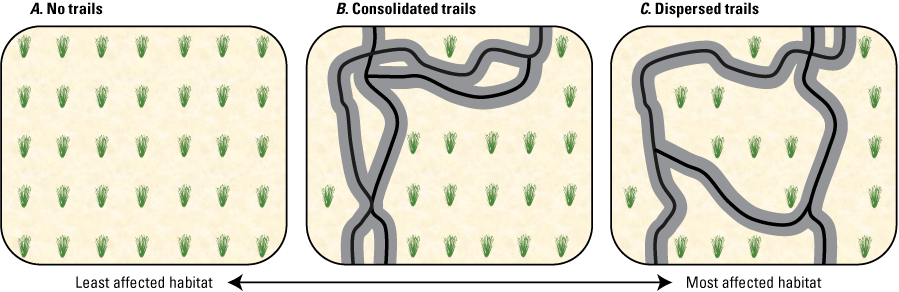
Diagram showing how the configuration of trails (black) can modulate the amount of ungulate habitat affected by nonmotorized recreation, assuming all recreation follows trails. A, A conceptual landscape with no trails will lose no habitat patches (represented as green grass patches) to recreation such that 35 habitat patches are available. B, A landscape with consolidated trails leaves 19 unaffected habitat patches available; these consolidated trails retain larger areas of contiguous habitat patches for ungulates because the zones adjacent to trails (dark gray) overlap more, so fewer habitat patches are affected by the trails. C, A landscape with dispersed trails, in contrast, leaves only 16 unaffected habitat patches available; dispersed trails can have the same trail length as consolidated trails across the same landscape, but because the zones adjacent to trails (dark gray) overlap less, more habitat patches are affected by the trails.
4.1.3. Limiting Trail Density
Because ungulates can be displaced from areas with trails, some managers have proposed limiting the density of trails in an area as a mitigation measure (Colorado Trails with Wildlife in Mind Task Force, 2021). Density of trails is expressed as the sum linear distance of trails per unit area (for instance, trail miles per square mile; fig. 7). For example, a remote area may only have 0.5 mile of trail per square mile on average, whereas a highly developed trail system could have upwards of 6–7 miles of trail per square mile.
There are a few key considerations for using a trail density metric. First, the density value can change greatly depending on the area selected for the spatial extent of the analysis. A threshold value for any possible unit area, freely allowing for a moving sampling window, could be useful to mitigate effects (Wu, 2004). Second, trail density does not account for landscape context, including the topography, ecosystem type, and arrangement of trails within a unit area. Finally, the use of trail density to understand or mitigate effects to ungulates has not been experimentally tested.
4.1.4. Maintaining a Buffer Between Trails and Ungulate Habitat
A spatial buffer between trails and ungulate habitat that is greater than the species’ flight initiation distance can minimize effects of the trail on ungulates and ungulate habitat. Spatial buffers are conceptually derived from flight initiation distances, or the distance at which an ungulate flees from human presence. Flight initiation distances are straightforward to measure and were historically one of the first metrics used to quantify the effect of human presence on ungulates (Stankowich, 2008). Flight initiation distances for a population of ungulates can be measured in the field through direct observation.
However, there are challenges to using spatial buffers for mitigating effects of trail-based nonmotorized recreation on ungulates. First, flight initiation distances vary within the same species. Different flight initiation distances have been reported in the same species across different habitats, times of year, and weather (Stankowich, 2008). Second, habituation can also greatly affect flight initiation distances (Cassirer and others, 1992). Third, off-trail recreation has a greater area of influence than on-trail recreation (Miller and others, 2001), and understanding where recreators may leave trails and travel off-trail may be difficult to estimate. Fourth, spatial buffers usually do not account for landscape contexts such as topography, ecosystem type, or proximity to habitat features like open water or human features (recreation or not) (Colorado Trails with Wildlife in Mind Task Force, 2021; ERO Resources, 2021). Because of the complexity of landscapes and ungulate responses to recreation, adequate spatial buffers between trails and ungulate habitat are likely to vary highly. Finally, we did not find literature that experimentally tested the efficacy of spatial buffers for nonmotorized recreation. Thus, developing varied-width buffers that account for landscape context and explicit testing of any spatial buffers are knowledge gaps in the science of mitigation.
4.2. Seasonal Restrictions to Nonmotorized Recreation Activity
Seasonal trail restrictions have been suggested to reduce human disturbances of ungulates in critical habitats or during important periods of ungulate reproductive cycles. Experimental evidence indicated that protecting elk herds from recreation disturbance during calving season increased population growth (Phillips and Alldredge, 2000). Further research in the same area indicated that seasonal trail closures are an effective way to mitigate recreation effects to ungulates at the population level (Shively and others, 2005). Seasonal restrictions on off-trail travel have also been suggested in the literature, specifically during key times in ungulate reproductive cycles (Papouchis and others, 2001), and State wildlife agencies commonly apply this approach.
Seasonal ungulate biology can affect how animals respond to nonmotorized recreation (refer to section “3.1.5. Ungulate Seasonal Biology”). Seasonal and daily timing restrictions on recreation activities are a tool to minimize recreation effects on wildlife during crucial life history stages, such as breeding and migration (refer to section “4.3. Daily and Time-of-Day Restrictions to Nonmotorized Recreation Activity”). Directly connecting seasonal ungulate biology needs to potential mitigation actions can serve as an important justification to recreation user groups that may be affected by management decisions.
4.2.1. Spring–Summer Mitigation
Most ungulates are born in the spring to summer, and reducing recreation disturbance at this time of year has the potential to affect survival and recruitment of young into the population. Experimental disturbance of elk during the summer decreased calf survival and lowered population growth in central Colorado (Phillips and Alldredge, 2000). Elk cow to calf ratios increased to pretrial levels in the years after that experimental disturbance, highlighting the potential for managers to use seasonal recreation activity restrictions to mitigate negative effects on ungulate populations (Shively and others, 2005). Because most ungulate neonates of the same species are born within a few weeks, even short-term (less than 1 season) management interventions may have substantial effects.
4.2.2. Fall Mitigation
Machowicz and others (2022) suggest that ungulates may be more vulnerable to recreation while migrating in the fall when many individuals follow the same route year after year. Accordingly, the Colorado Trails with Wildlife in Mind Task Force (2021) recommends avoiding trail development or keeping trail densities to a minimum along migration corridors to minimize the effects of recreation.
4.2.3. Winter Mitigation
Because of the sensitivity of ungulates to winter conditions, Machowicz and others (2022) and Colorado Trails with Wildlife in Mind Task Force (2021) recommend avoiding development of new trails and restricting use of existing trails on critical winter range or implementing seasonal closures of winter range. Managers may also consider adapting guidelines depending on the severity of the winter—specifically snow depth. Many ungulates (for example, elk [refer to Sweeney and Sweeney, 1984] and Dall’s sheep [refer to Mahoney and others, 2018]) strongly avoid deep snow, especially when snow depth exceeds half their chest height, indicating that this is a critical height at which movement becomes challenging. Movement is severely affected when snow depth exceeds two-thirds of chest height (Kelsall, 1969; Gilbert and others, 1970). Managers could consider using such thresholds as indicators of winter severity to inform trail restrictions (Duchesne and others, 2000).
4.3. Daily and Time-of-Day Restrictions to Nonmotorized Recreation Activity
Managers can reduce daily human presence through nighttime trail restrictions (Whittington and others, 2019; Lucas, 2020). Most ungulate species are crepuscular (active during twilight) in the absence of disturbance, creating a natural overlap with morning and evening recreators (Gump and Thornton, 2023). Ungulates commonly are more active at night than during the day in response to human presence (Reilly and others, 2017; Lewis and others, 2021), a phenomenon that is occurring among wildlife species across the globe (Gaynor and others, 2018). Nighttime trail recreation does take place, especially in extremely hot environments and at northern latitudes where short day lengths make it difficult to recreate during daylight hours. To reduce overcrowding, heavy recreation use, or conflicts among user groups, managers can implement alternate day schedules, where certain groups are given alternating use days on a predictable schedule (BLM, 2014).
4.4. Restrictions on Recreation Type, Group Size, and Domestic Dogs
Managers can also restrict certain recreation activities in a project area to reduce disturbances to ungulates (fig. 8). Many studies show differences in ungulate species’ responses throughout activity types (table 6), but there is no consensus in the literature about which recreation activities are the most disturbing to ungulates. There are several contradictory findings. For example, hikers created a larger response than mountain bikers for bighorn sheep (Papouchis and others, 2001), but in other studies, mountain bikers created larger habitat avoidance responses for moose than hikers (Naidoo and Burton, 2020) and elk (Wisdom and others, 2018). Further, researchers have found no difference in response to hikers or mountain bikers among bison, mule deer, and pronghorn in the same study (Taylor and Knight, 2003). This lack of clarity on the extent to which different recreation activities may affect ungulates has led some studies to categorize on-trail nonmotorized recreation presence simply as binary (presence or absence of recreation regardless of activity; ERO Resources, 2021).
Given that there are not clear patterns of which recreation activities consistently create the largest responses from ungulates, several considerations could help managers develop management actions:
-
• Restricting a particular recreation activity could reduce the total number of people in an area and ultimately reduce effects (Whittington and others, 2019).
-
• When people can travel faster, they are able to cover more ground in a given period. Thus, horseback riding, mountain biking, or electric biking potentially spread people across a larger area and affect a larger number of animals (Kuwaczka and others, 2023).
-
• Consistent recreation type could help ungulates habituate and decrease their responsiveness to recreator presence. For example, if all trail users were on mountain bikes and not hiking, it could reduce ungulate responses to human presence (Coppes and others, 2017).
-
• Restricting recreation use to on-trail travel only could facilitate ungulate habituation to recreator presence because recreation use would be more predictable (Miller and others, 2001).
Managing group size to reduce environmental effects has a long history in public land management in the United States (Watson and others, 2000; Marion and others, 2020). However, few studies have evaluated ungulate responses to the size of a recreator group, and study results are inconsistent (Becker and others, 2012; Sproat and others, 2019). For example, elk were insensitive to the group size of cross-country skiers in one study in open shrublands and forests (Cassirer and others, 1992). Throughout the many studies included in this science synthesis, almost none of them controlled for recreator group size as a variable. Importantly, outdoor recreator behavior is not uniform across group size, time, and space (D’Antonio and Monz, 2016). For example, group size can interact with recreators’ perceived experiences and, ultimately, their decision to modify their plans and travel farther to seek their desired experience (D’Antonio and Monz, 2016; Sidder and others, 2023).
Restricting domestic dog presence may be a tool for planners to reduce nonmotorized recreator effect in a project area. However, we found only three studies that explicitly tested how individual ungulate species responded to dogs with humans (table 6), and the effectiveness of spatial or temporal dog restrictions in reducing ungulate responses to disturbances from nonmotorized recreation was never directly tested in the literature.
4.5. Total Use Restrictions
Humans and wildlife increasingly overlap in space and time. Creating human-free spaces can create a type of refuge for wildlife that is increasingly rare (Wilson and others, 2020). Indeed, local-scale regulations within protected areas are a key tool in successfully managing species (Barnes and others, 2017). For example, seasonal closures shortly before and after ungulates give birth in the spring, on critical winter range, or on migration routes can reduce human disturbances when ungulates are most sensitive (Hobbs, 1989; Shively and others, 2005; Mumme and others, 2023). Widespread decreases in recreation activity in the first months of 2020 during the COVID-19 pandemic provided some insight as to how ungulates can respond positively to the absence of humans in areas where they were previously present and expand habitat use (Procko and others, 2022; Anderson and others, 2023), indicating that restricting all human access can affect ungulate habitat use and has the potential to scale to population outcomes.
4.6. Monitoring
Implementation monitoring is one tool available to managers to help understand the effects of a particular proposed action. Also known as compliance monitoring, this type of monitoring helps managers understand the extent to which mitigation measures are complied with and evaluate how effective those measures might be (BLM, 2005). For example, a biologist could be present for a one-day nonmotorized recreation event to ensure sensitive areas are properly avoided if that was a permit stipulation. Passive monitoring options can be useful throughout longer time scales. For instance, a hidden trail counter can be deployed to determine if recreators are obeying a trail closure. Monitoring is often prescribed in land use plans. Planners can consider the monitoring needs for individual projects and prescribe monitoring goals if needed.

Photograph of a trail sign informing cyclists of a December to April seasonal closure to protect wintering wildlife. Seasonal trail closures to certain recreation activities can reduce the total number of people in an area and the average speed of recreators. Photograph by the Bureau of Land Management Grand Junction Field Office.
Methods for Developing This Science Synthesis
Rutherford and others (2023) introduced a method for developing science syntheses to inform NEPA analyses, and relevant text from that report is reproduced herein. This synthesis and other syntheses build on that foundation and method and apply it to new topics of management concern on western U.S. lands.
We used a structured literature search to gather science about the effects of nonmotorized recreation on ungulates. We sought information relevant to environmental effects analyses according to the NEPA (Carter and others, 2023), including data and science about nonmotorized recreation use and ungulate life history and movements, methods for measuring the effects of nonmotorized recreation on ungulates, and the efficacy of management actions to reduce potential adverse effects of nonmotorized recreation on ungulates. We focused on publications based in North America at the request of our BLM partners to keep content as relevant as possible to our study area. We also used a narrative review, which involved identifying and synthesizing science based on author expertise on the topic, to supplement the results of the structured literature searches (Sovacool and others, 2018).
We searched for literature published between January 1, 1990, and February 1, 2023 (date of search) using a search of two citation indices (Web of Science and Scopus [accessed through the USGS Library]) and two Federal government publication databases (USGS ScienceBase and USGS Publications Warehouse; Kleist and Enns, 2021). To find literature about ungulates, we used the search phrases “ungulat*,” “cervid*,” “deer,” “moose,” “elk,” “caribou,” “antilocapr*,” “ovis canadensis,” “ovis dalli,” “dall sheep,” “thinhorn sheep,” “bighorn sheep,” “bison,” “mountain goat,” “ovis,” and “sheep.” We included the recreation terms “trail,” “walk*,” “hik*,” “bik*,” “horseback*,” “ecotourism,” “nonmotorized recreation,” “free-flight,” “non-consumptive,” “recreation,” “tourism,” “climb*,” “running,” “runner,” “jogging,” “swim*,” “backpack*,” “camping,” “camper,” “skiing,” “skier,” “ski,” “wildlife viewing,” “bird watching,” “fishing,” “strava,” “snowshoe*,” and “spelunk*.” This search returned 3,144 publications. On the basis of titles and abstracts, we selected 72 publications as relevant articles to review. We included additional peer-reviewed articles, government reports, and other published reports when needed to provide adequate conceptual support throughout this report.
We synthesized information from this literature according to our objective of informing NEPA environmental effects analyses. Rather than reporting all literature we found, we report only the literature applicable to informing analyses about the potential effects of nonmotorized recreation development projects on ungulates. As such, this synthesis does not constitute a comprehensive literature review of all effects of nonmotorized recreation on ungulates. In addition, it is possible that our literature search methods missed some relevant studies.
Throughout the development of this report, we worked with staff from the BLM and USGS (Beier and others, 2017). We refined the structure and content of this report through close collaboration with multiple BLM staff throughout scoping, writing, and review.
References Cited
Anderson, A.K., Waller, J.S., and Thornton, D.H., 2023, Partial COVID-19 closure of a national park reveals negative influence of low-impact recreation on wildlife spatiotemporal ecology: Scientific Reports, v. 13, article 687, 11 p., accessed May 23, 2023, at https://doi.org/10.1038/s41598-023-27670-9.
Aziz, N., Holmes, M.A., Bennion, L.D., Reeb, R.A., and Kuebbing, S.E., 2023, Hiking trailheads, but not trailsides, associated with higher cover of non‐native plants’ trail impact on non‐native plant cover: Applied Vegetation Science, v. 26, no. 1, article e12716, 9 p., accessed December 28, 2023, at https://doi.org/10.1111/avsc.12716.
Baas, J., Dupler, K., Smith, A., and Carnes, R., 2020, An assessment of non-consumptive recreation effects on wildlife—Current and future research, management implications, and next steps: California Fish and Wildlife Journal, Recreation Special Issue, p. 62–73, accessed December 26, 2023, at https://www.ebparks.org/sites/default/files/2020_ca_fish_and_wildlife_special_issue_effects_of_recreation_on_wildlife.pdf#page=62.
Barnes, M.D., Craigie, I.D., Dudley, N., and Hockings, M., 2017, Understanding local‐scale drivers of biodiversity outcomes in terrestrial protected areas: Annals of the New York Academy of Sciences, v. 1399, no. 1, p. 42–60, accessed December 26, 2023, at https://doi.org/10.1111/nyas.13154.
Baron, J.S., Weinmann, T., Acharya, V.K., Charlton, C., Nydick, K.R., and Esser, S., 2023, Marmots do not drink coffee—Human urine contributions to the nitrogen budget of a popular national park destination: Ecosphere, v. 14, no. 4, article e4504, 14 p., accessed October 11, 2023, at https://doi.org/10.1002/ecs2.4504.
Bartmann, R.M., White, G.C., and Carpenter, L.H., 1992, Compensatory mortality in a Colorado mule deer population: Wildlife Monographs, no. 121, 39 p., accessed October 11, 2023, at https://www.jstor.org/stable/3830602.
Bassing, S.B., DeVivo, M., Ganz, T.R., Kertson, B.N., Prugh, L.R., Roussin, T., Satterfield, L., Windell, R.M., Wirsing, A.J., and Gardner, B., 2023, Are we telling the same story? Comparing inferences made from camera trap and telemetry data for wildlife monitoring: Ecological Applications, v. 33, no. 1, article e2745, 23 p., accessed December 26, 2023, at https://doi.org/10.1002/eap.2745.
Bateman, P.W., and Fleming, P.A., 2017, Are negative effects of tourist activities on wildlife over-reported? A review of assessment methods and empirical results: Biological Conservation, v. 211, pt. A, p. 10–19, accessed May 23, 2023, at https://doi.org/10.1016/j.biocon.2017.05.003.
Bates, S.B., Whiting, J.C., and Larsen, R.T., 2021, Comparison of effects of shed antler hunting and helicopter surveys on ungulate movements and space use: Journal of Wildlife Management, v. 85, no. 3, p. 437–448, accessed May 23, 2023, at https://doi.org/10.1002/jwmg.22008.
Becker, B.H., Moi, C.M., Maguire, T.J., Atkinson, R., and Gates, N.B., 2012, Effects of hikers and boats on tule elk behavior in a national park wilderness area: Human-Wildlife Interactions, v. 6, no. 1, p. 147–154, accessed October 10, 2023, at https://www.jstor.org/stable/24874085.
Beier, P., Hansen, L.J., Helbrecht, L., and Behar, D., 2017, A how-to guide for coproduction of actionable science: Conservation Letters, v. 10, no. 3, p. 288–296, accessed February 2, 2023, at https://doi.org/10.1111/conl.12300.
Bennett, V.J., Beard, M., Zollner, P.A., Fernández-Juricic, E., Westphal, L., and LeBlanc, C.L., 2009, Understanding wildlife responses to human disturbance through simulation modelling—A management tool: Ecological Complexity, v. 6, no. 2, p. 113–134, accessed December 26, 2023, at https://doi.org/10.1016/j.ecocom.2008.08.002.
Berger, J., 2007, Fear, human shields and the redistribution of prey and predators in protected areas: Biology Letters, v. 3, no. 6, p. 620–623, accessed December 26, 2023, at https://doi.org/10.1098/rsbl.2007.0415.
Blumstein, D.T., 2016, Habituation and sensitization—New thoughts about old ideas: Animal Behaviour, v. 120, p. 255–262, accessed May 23, 2023, at https://doi.org/10.1016/j.anbehav.2016.05.012.
Bowman, J.L., and Jacobson, H.A., 1998, An improved vaginal-implant transmitter for locating white-tailed deer birth sites and fawns: Wildlife Society Bulletin, v. 26, no. 2, p. 295–298, accessed December 2, 2023, at https://www.jstor.org/stable/3784052.
Braunisch, V., Patthey, P., and Arlettaz, R., 2011, Spatially explicit modeling of conflict zones between wildlife and snow sports—Prioritizing areas for winter refuges: Ecological Applications, v. 21, no. 3, p. 955–967, accessed October 11, 2023, at https://doi.org/10.1890/09-2167.1.
Braunstein, J.L., Clark, J.D., Williamson, R.H., and Stiver, W.H., 2020, Black bear movement and food conditioning in an exurban landscape. Journal of Wildlife Management, v. 84, no. 6, p. 1038–1050, accessed September 26, 2023, at https://doi.org/10.1002/jwmg.21870.
Brown, C.L., Smith, J.B., Wisdom, M.J., Rowland, M.M., Spitz, D.B., and Clark, D.A., 2020, Evaluating indirect effects of hunting on mule deer spatial behavior: Journal of Wildlife Management, v. 84, no. 7, p. 1246–1255, accessed October 11, 2023, at https://doi.org/10.1002/jwmg.21916.
Burton, A.C., Neilson, E., Moreira, D., Ladle, A., Steenweg, R., Fisher, J.T., Bayne, E., and Boutin, S., 2015, Wildlife camera trapping—A review and recommendations for linking surveys to ecological processes: Journal of Applied Ecology, v. 52, no. 3, p. 675–685, accessed December 26, 2023, at https://doi.org/10.1111/1365-2664.12432.
California Department of Fish and Wildlife, 2020, California fish and wildlife journal, recreation special issue: California Department of Fish and Wildlife, 125 p., accessed December 26, 2023, at https://www.ebparks.org/sites/default/files/2020_ca_fish_and_wildlife_special_issue_effects_of_recreation_on_wildlife.pdf.
Caravaggi, A., Burton, A.C., Clark, D.A., Fisher, J.T., Grass, A., Green, S., Hobaiter, C., Hofmeester, T.R., Kalan, A.K., Rabaiotti, D., and Rivet, D., 2020, A review of factors to consider when using camera traps to study animal behavior to inform wildlife ecology and conservation: Conservation Science and Practice, v. 2, no. 8, article e239, 9 p., accessed September 26, 2023, at https://doi.org/10.1111/csp2.239.
Carter, S.K., Haby, T.S., Meineke, J.K., Foster, A.C., McCall, L.E., Espy, L.D., Gilbert, M.A., Herrick, J.E., and Prentice, K.L., 2023, Prioritizing science efforts to inform decision making on public lands: Frontiers in Ecology and the Environment, v. 21, no. 10, p. 453–460, accessed May 20, 2024, at https://doi.org/10.1002/fee.2672.
Cassirer, E.F., Freddy, D.J., and Ables, E.D., 1992, Elk responses to disturbance by cross-country skiers in Yellowstone National Park: Wildlife Society Bulletin, v. 20, no. 4, p. 375–381, accessed October 20, 2023, at https://www.jstor.org/stable/3783054.
Caughley, G., 1974, Interpretation of age ratios: Journal of Wildlife Management, v. 38, no. 3, p. 557–562, accessed May 24, 2024, at https://doi.org/10.2307/3800890.
Caughley, G., 1977, Sampling in aerial survey: Journal of Wildlife Management, v. 41, no. 4, p. 605–615, accessed May 24, 2024, at https://doi.org/10.2307/3799980.
Cherry, C., Leong, K.M., Wallen, R., and Buttke, D., 2018, Risk-enhancing behaviors associated with human injuries from bison encounters at Yellowstone National Park, 2000–2015: One Health, v. 6, p. 1–6, accessed May 23, 2023, at https://doi.org/10.1016/j.onehlt.2018.05.003.
Chitwood, M.C., Lashley, M.A., Kilgo, J.C., Cherry, M.J., Conner, L.M., Vukovich, M., Ray, H.S., Ruth, C., Warren, R.J., DePerno, C.S., and Moorman, C.E., 2017, Are camera surveys useful for assessing recruitment in white‐tailed deer?: Wildlife Biology, v. 2017, no. 1, p. 1–6, accessed December 26, 2023, at https://doi.org/10.2981/wlb.00178.
Ciuti, S., Northrup, J.M., Muhly, T.B., Simi, S., Musiani, M., Pitt, J.A., and Boyce, M.S., 2012, Effects of humans on behaviour of wildlife exceed those of natural predators in a landscape of fear: PLOS ONE, v. 7, no. 11, article e50611, 13 p., accessed May 23, 2023, at https://doi.org/10.1371/journal.pone.0050611.
Clark, T.J., and Hebblewhite, M., 2021, Predator control may not increase ungulate populations in the future—A formal meta‐analysis: Journal of Applied Ecology, v. 58, no. 4, p. 812–824, accessed December 26, 2023, at https://doi.org/10.1111/1365-2664.13810.
Clink, D.J., 2020, [behaviouR—R package and tutorials for teaching of fundamental concepts in behavior and ecology] Field lab 2—Ethograms and activity budgets: RStudio bookdown web page, accessed May 20, 2024, at https://bookdown.org/djc426/behaviouR-R-package-tutorials/field-lab-2-ethograms-and-activity-budgets.html.
Cole, D.N., 2004, Impacts of hiking and camping on soils and vegetation—A review, chap. 4 of Buckley, R., ed., Environmental impacts of ecotourism: CABI Publishing, p. 41–60, accessed October 11, 2023, at https://doi.org/10.1079/9780851998107.0041.
Cole, D.N., Van Wagtendonk, J.W., McClaran, M.P., Moore, P.E., and McDougald, N.K., 2004, Response of mountain meadows to grazing by recreational pack stock: Journal of Range Management, v. 57, no. 2, p. 153–160, accessed October 11, 2023, at https://doi.org/10.2307/4003913.
Colorado Trails with Wildlife in Mind Task Force, 2021, Colorado's guide to planning trails with wildlife in mind: Colorado Parks and Wildlife, prepared by Wellstone Collaborative Strategies and Rocky Mountain Innovation Lab, 57 p., accessed September 1, 2023, at https://cpw.widen.net/s/hpbjvgzbhf/planning_trails_with_wildlife_in_mind_full_plan.
Cook, R.C., Cook, J.G., Vales, D.J., Johnson, B.K., Mccorquodale, S.M., Shipley, L.A., Riggs, R.A., Irwin, L.L., Murphie, S.L., Murphie, B.L., Schoenecker, K.A., Geyer, F., Hall, P.B., Spencer, R.D., Immell, D.A., Jackson, D.H., Tiller, B.L., Miller, P.J., and Schmitz, L., 2013, Regional and seasonal patterns of nutritional condition and reproduction in elk: Wildlife Monographs, v. 184, no. 1, p. 1–45, accessed December 26, 2023, at https://doi.org/10.1002/wmon.1008.
Coppes, J., Burghardt, F., Hagen, R., Suchant, R., and Braunisch, V., 2017, Human recreation affects spatio-temporal habitat use patterns in red deer (Cervus elaphus): PLOS ONE, v. 12, no. 5, article e0175134, 19 p., accessed December 30, 2023, at https://doi.org/10.1371/journal.pone.0175134.
Creel, S., Fox, J.E., Hardy, A., Sands, J., Garrott, B., and Peterson, R.O., 2002, Snowmobile activity and glucocorticoid stress responses in wolves and elk: Conservation Biology, v. 16, no. 3, p. 809–814, accessed December 28, 2023, at https://doi.org/10.1046/j.1523-1739.2002.00554.x.
D’Antonio, A., and Monz, C., 2016, The influence of visitor use levels on visitor spatial behavior in off-trail areas of dispersed recreation use: Journal of Environmental Management, v. 170, p. 79–87, accessed October 11, 2023, at https://doi.org/10.1016/j.jenvman.2016.01.011.
Dagan, D.T., and Wilkins, E.J., 2023, What is “big data” and how should we use it? The role of large datasets, secondary data, and associated analysis techniques in outdoor recreation research: Journal of Outdoor Recreation and Tourism, v. 44, pt. A, article 100668, 11 p., accessed May 20, 2024, at https://doi.org/10.1016/j.jort.2023.100668.
Dellinger, J.A., Shores, C.R., Craig, A., Heithaus, M.R., Ripple, W.J., and Wirsing, A.J., 2019, Habitat use of sympatric prey suggests divergent anti-predator responses to recolonizing gray wolves: Oecologia, v. 189, p. 487–500, accessed October 11, 2023, at https://doi.org/10.1007/s00442-018-4323-z.
Dertien, J.S., Larson, C.L., and Reed, S.E., 2021, Recreation effects on wildlife—A review of potential quantitative thresholds: Nature Conservation, v. 44, p. 51–68, accessed May 23, 2023, at https://doi.org/10.3897/natureconservation.44.63270.
Duchesne, M., Côté, S.D., and Barrette, C., 2000, Responses of woodland caribou to winter ecotourism in the Charlevoix Biosphere Reserve, Canada: Biological Conservation, v. 96, no. 3, p. 311–317, accessed May 23, 2023, at https://doi.org/10.1016/S0006-3207(00)00082-3.
Duvuvuei, O.V., Heffelfinger, J.R., Krausman, P.R., Gray, S.S., and Alcalá-Galván, C.H., 2023, Southwest deserts ecoregion, chap. 14 of Heffelfinger, J.R., and Krausman, P.R., eds., Ecology and management of black-tailed and mule deer of North America: Boca Raton, Fla., CRC Press, 18 p. [Also available at https://doi.org/10.1201/9781003354628-16.]
Dwyer, J.F., Austin, D.D., and Beebe, C., 2019, Unmanned aircraft systems enable three-dimensional viewshed-based assessment of potential disturbance to nesting raptors by recreational rock climbing: Journal of Unmanned Vehicle Systems, v. 8, no. 1, p. 11–18, accessed June 5, 2024, at https://doi.org/10.1139/juvs-2019-0014.
Elsen, P.R., Monahan, W.B., and Merenlender, A.M., 2020, Topography and human pressure in mountain ranges alter expected species responses to climate change: Nature Communications, v. 11, article 1974, 10 p., accessed December 26, 2023, at https://doi.org/10.1038/s41467-020-15881-x.
ERO Resources, 2021, Outside 285 master plan: Colorado Mountain Bike Association, Colorado Parks and Wildlife, and U.S. Department of Agriculture Forest Service, prepared by ERO Resources, 76 p., accessed December 2, 2024, at https://www.comba.org/outside-285.
Fennell, M.J.E., Ford, A.T., Martin, T.G., and Burton, A.C., 2023, Assessing the impacts of recreation on the spatial and temporal activity of mammals in an isolated alpine protected area: Ecology and Evolution, v. 13, no. 11, article e10733, 18 p., accessed March 19, 2024, at https://doi.org/10.1002/ece3.10733.
Ferguson, M.A.D., and Keith, L.B., 1982, Influence of Nordic skiing on distribution of moose and elk in Elk Island National Park, Alberta: Canadian Field-Naturalist, v. 96, no. 1, p. 69–78, accessed December 26, 2023, at https://doi.org/10.5962/p.354766.
Fieberg, J., Signer, J., Smith, B., and Avgar, T., 2021, A ‘how to’ guide for interpreting parameters in habitat‐selection analyses: Journal of Animal Ecology, v. 90, no. 5, p. 1027–1043, accessed December 26, 2023, at https://doi.org/10.1111/1365-2656.13441.
Fix, P.J., Brooks, J.J., and Harrington, A.M., 2018, Achieving goals and making meanings—Toward a unified model of recreational experience: Journal of Outdoor Recreation and Tourism, v. 23, p. 16–25, accessed December 26, 2023, at https://doi.org/10.1016/j.jort.2018.04.004.
Foley, A.M., DeYoung, R.W., Hewitt, D.G., Hellickson, M.W., Gee, K.L., Wester, D.B., Lockwood, M.A., and Miller, K.V., 2015, Purposeful wanderings—Mate search strategies of male white-tailed deer: Journal of Mammalogy, v. 96, no. 2, p. 279–286, accessed October 11, 2023, at https://doi.org/10.1093/jmammal/gyv004.
Forrester, T.D., and Wittmer, H.U., 2013, A review of the population dynamics of mule deer and black‐tailed deer O docoileus hemionus in North America: Mammal Review, v. 43, no. 4, p. 292–308, accessed May 20, 2024, at https://doi.org/10.1111/mam.12002.
Fortin, D., and Andruskiw, M., 2003, Behavioral response of free-ranging bison to human disturbance: Wildlife Society Bulletin, v. 31, no. 3, p. 804–813, accessed December 9, 2023, at https://www.jstor.org/stable/3784603.
Found, R., 2019, Personality influences habituation behaviour in ungulates: Journal of Ethology, v. 37, no. 1, p. 47–58, accessed June 5, 2024, at https://doi.org/10.1007/s10164-018-0567-7.
Found, R., and Patterson, B.R., 2020, Assessing ungulate populations in temperate North America: Canadian Wildlife Biology and Management, v. 9, no. 1, p. 21–42, accessed December 2, 2023, at https://cwbm.ca/assessing-ungulate-populations-in-temperate-north-america/.
Freddy, D.J., Bronaugh, W.M., and Fowler, M.C., 1986, Responses of mule deer to disturbance by persons afoot and snowmobiles: Wildlife Society Bulletin, v. 14, no. 1, p. 63–68, accessed December 26, 2023, at https://www.jstor.org/stable/3782468.
Frid, A., and Dill, L., 2002, Human-caused disturbance stimuli as a form of predation risk: Conservation Ecology, v. 6, no. 1, article 11, 16 p., accessed May 23, 2023, at https://www.jstor.org/stable/26271862.
Gaillard, J.-M., Festa-Bianchet, M., and Yoccoz, N.G., 1998, Population dynamics of large herbivores—Variable recruitment with constant adult survival: Trends in Ecology and Evolution, v. 13, no. 2, p. 58–63, accessed October 11, 2023, at https://doi.org/10.1016/S0169-5347(97)01237-8.
Gaillard, J.-M., Festa-Bianchet, M., Yoccoz, N.G., Loison, A., and Toïgo, C., 2000, Temporal variation in fitness components and population dynamics of large herbivores: Annual Review of Ecology, Evolution, and Systematics, v. 31, no. 1, p. 367–393, accessed October 11, 2023, at https://doi.org/10.1146/annurev.ecolsys.31.1.367.
Ganz, T.R., DeVivo, M.T., Wirsing, A.J., Bassing, S.B., Kertson, B.N., Walker, S.L., and Prugh, L.R., 2024, Cougars, wolves, and humans drive a dynamic landscape of fear for elk: Ecology. v. 105, no. 4, article e4255, 12 p., accessed February 15, 2024, at https://doi.org/10.1002/ecy.4255.
Gaynor, K.M., Cherry, M.J., Gilbert, S.L., Kohl, M.T., Larson, C.L., Newsome, T.M., Prugh, L.R., Suraci, J.P., Young, J.K., and Smith, J.A., 2021, An applied ecology of fear framework—Linking theory to conservation practice: Animal Conservation, v. 24, no. 3, p. 308–321, accessed May 23, 2023, at https://doi.org/10.1111/acv.12629.
Gaynor, K.M., Hojnowski, C.E., Carter, N.H., and Brashares, J.S., 2018, The influence of human disturbance on wildlife nocturnality: Science, v. 360, no. 6394, p. 1232–1235, accessed May 23, 2023, at https://doi.org/10.1126/science.aar7121.
Geffroy, B., Samia, D.S.M., Bessa, E., and Blumstein, D.T., 2015, How nature-based tourism might increase prey vulnerability to predators: Trends in Ecology and Evolution, v. 30, no. 12, p. 755–765, accessed October 11, 2023, at https://doi.org/10.1016/j.tree.2015.09.010.
George, S.L., and Crooks, K.R., 2006, Recreation and large mammal activity in an urban nature reserve: Biological Conservation, v. 133, no. 1, p. 107–117, accessed May 23, 2023, at https://doi.org/10.1016/j.biocon.2006.05.024.
Gilbert, P.F., Wallmo, O.C., and Gill, R.B., 1970, Effect of snow depth on mule deer in Middle Park, Colorado: Journal of Wildlife Management, v. 34, no. 1, p. 15–23, accessed December 28, 2023, at https://doi.org/10.2307/3799486.
Gill, J.A., Norris, K., and Sutherland, W.J., 2001, Why behavioural responses may not reflect the population consequences of human disturbance: Biological Conservation, v. 97, no. 2, p. 265–268, accessed May 23, 2023, at https://doi.org/10.1016/S0006-3207(00)00002-1.
Gill, J.A., Sutherland, W.J., and Watkinson, A.R., 1996, A method to quantify the effects of human disturbance on animal populations: Journal of Applied Ecology, v. 33, no. 4, p. 786–792, accessed May 20, 2024, at https://doi.org/10.2307/2404948.
Granados, A., Sun, C., Fisher, J.T., Ladle, A., Dawe, K., Beirne, C., Boyce, M.S., Chow, E., Heim, N., Fennell, M., Bommel, J.K. van, Naidoo, R., Procko, M., Stewart, F.E.C., and Burton, A.C., 2023, Mammalian predator and prey responses to recreation and land use across multiple scales provide limited support for the human shield hypothesis: Ecology and Evolution, v. 13, no. 9, article e10464, 14 p., accessed December 27, 2023, at https://doi.org/10.1002/ece3.10464.
Green, R.J., and Higginbottom, K., 2000, The effects of non-consumptive wildlife tourism on free-ranging wildlife—A review: Pacific Conservation Biology, v. 6, no. 3, p. 183–197, accessed May 23, 2023, at https://doi.org/10.1071/PC000183.
Green, A.M., Young, E., Keller, H., Grace, T., Pendergast, M.E., and Şekercioğlu, Ç.H., 2023, Variation in human diel activity patterns mediates periodic increases in recreational activity on mammal behavioural response—Investigating the presence of a temporal ‘weekend effect’: Animal Behaviour, v. 198, p. 117–129, accessed May 23, 2023, at https://doi.org/10.1016/j.anbehav.2023.02.002.
Gump, K.M., and Thornton, D.H., 2023, Trucks versus treks—The relative influence of motorized versus nonmotorized recreation on a mammal community: Ecological Applications, v. 33, no. 7, article e2916, 16 p., accessed December 27, 2023, at https://doi.org/10.1002/eap.2916.
Gutzwiller, K.J., D'Antonio, A.L., and Monz, C.A., 2017, Wildland recreation disturbance—Broad‐scale spatial analysis and management: Frontiers in Ecology and the Environment, v. 15, no. 9, p. 517–524, accessed December 3, 2023, at https://doi.org/10.1002/fee.1631.
Hale, R., and Swearer, S.E., 2016, Ecological traps—Current evidence and future directions: Proceedings of the Royal Society B, Biological Sciences, v. 283, no. 1824, article 20152647, 8 p., accessed December 27, 2023, at https://doi.org/10.1098/rspb.2015.2647.
Hall, L.S., Krausman, P.R., and Morrison, M.L., 1997, The habitat concept and a plea for standard terminology: Wildlife Society Bulletin, v. 25, no. 1, p. 173–182, accessed May 20, 2024, at https://www.jstor.org/stable/3783301.
Harris, N.C., Kauffman, M.J., and Mills, L.S., 2010, Inferences about ungulate population dynamics derived from age ratios: Journal of Wildlife Management, v. 72. no. 5, p. 1143–1151, accessed June 5, 2024, at https://doi.org/10.2193/2007-277.
Harris, G., Nielson, R.M., Rinaldi, T., and Lohuis, T., 2014, Effects of winter recreation on northern ungulates with focus on moose (Alces alces) and snowmobiles: European Journal of Wildlife Research, v. 60, p. 45–58, accessed May 23, 2023, at https://doi.org/10.1007/s10344-013-0749-0.
Hebblewhite, M., White, C.A., Nietvelt, C.G., McKenzie, J.A., Hurd, T.E., Fryxell, J.M., Bayley, S.E., and Paquet, P.C., 2005, Human activity mediates a trophic cascade caused by wolves: Ecology, v. 86, no. 8, p. 2135–2144, accessed October 11, 2023, at https://doi.org/10.1890/04-1269.
Heffelfinger, J.R., and Krausman, P.R., eds., 2023, Ecology and management of black-tailed and mule deer of North America: Boca Raton, Fla., CRC Press, 536 p. [Also available at https://doi.org/10.1201/9781003354628.]
Henrich, M., Niederlechner, S., Kröschel, M., Thoma, S., Dormann, C.F., Hartig, F., and Heurich, M., 2020, The influence of camera trap flash type on the behavioural reactions and trapping rates of red deer and roe deer: Remote Sensing in Ecology and Conservation, v. 6, no. 3, p. 399–410, accessed May 20, 2024, at https://doi.org/10.1002/rse2.150.
Hewitt, D.G., ed., 2011, Biology and management of white-tailed deer: Boca Raton, Fla., CRC Press, 686 p. [Also available at https://doi.org/10.1201/9781482295986.]
Highfill, T., Franks, C., Georgi, P., and Howells, T., 2018, Introducing the outdoor recreation satellite account: [Survey of Current Business], [v. 98], [no. 3], accessed December 30, 2023, at https://mmv.boku.ac.at/refbase/files/highfill_tina_franks-2018-outdoor-satellite-account.pdf.
Hill, J.E., DeVault, T.L., Wang, G., and Belant, J.L., 2020, Anthropogenic mortality in mammals increases with the human footprint: Frontiers in Ecology and the Environment, v. 18, no. 1, p. 13–18, accessed December 29, 2023, at https://doi.org/10.1002/fee.2127.
Hobbs, N.T., 1989, Linking energy balance to survival in mule deer—Development and test of a simulation model: Wildlife Monographs, no. 101, p. 3–39, accessed May 23, 2023, at https://www.jstor.org/stable/3830599.
Jensen, C.R., and Guthrie, S.P., eds., 2006, Outdoor recreation in America (6th ed.): Champaign, Ill., Human Kinetics, 373 p. [Also available at https://doi.org/10.5040/9781492597438.]
Johnson‐Bice, S.M., Gable, T.D., Homkes, A.T., Windels, S.K., Bump, J.K., and Bruggink, J.G., 2023, Logging, linear features, and human infrastructure shape the spatial dynamics of wolf predation on an ungulate neonate: Ecological Applications, v. 33, no. 7, article e2911, 20 p., accessed June 5, 2024, at https://doi.org/10.1002/eap.2911.
Kauffman, M.J., Aikens, E.O., Esmaeili, S., Kaczensky, P., Middleton, A., Monteith, K.L., Morrison, T.A., Mueller, T., Sawyer, H., and Goheen, J.R., 2021, Causes, consequences, and conservation of ungulate migration: Annual Review of Ecology, Evolution, and Systematics, v. 52, p. 453–478, accessed October 11, 2023, at https://doi.org/10.1146/annurev-ecolsys-012021-011516.
Kauffman, M.J., Copeland, H.E., Cole, E., Cuzzocreo, M., Dewey, S., Fattebert, J., Gagnon, J., Gelzer, E., Graves, T.A., Hersey, K., Kaiser, R., Meacham, J., Merkle, J., Middleton, A., Nunez, T., Oates, B., Olson, D., Olson, L., Sawyer, H., Schroeder, C., Sprague, S., Steingisser, A., and Thonhoff, M., 2020, Ungulate migrations of the western United States, volume 1: U.S. Geological Survey data release, accessed October 11, 2023, at https://doi.org/10.5066/P9O2YM6I.
Kauffman, M.J., Lowrey, B., Beck, J., Berg, J., Bergen, S., Berger, J., Cain, J., Dewey, S., Diamond, J., Duvuvuei, O., Fattebert, J., Gagnon, J., Garcia, J., Greenspan, E., Hall, E., Harper, G., Harter, S., Hersey, K., Hnilicka, P., Hurley, M., Knox, L., Lawson, A., Maichak, E., Meacham, J., Merkle, J., Middleton, A., Olson, D., Olson, L., Reddell, C., Robb, B., Rozman, G., Sawyer, H., Schroeder, C., Scurlock, B., Short, J., Sprague, S., Steingisser, A., and Tatman, N., 2022a, Ungulate migrations of the western United States, volume 2: U.S. Geological Survey data release, accessed October 11, 2023, at https://doi.org/10.5066/P9TKA3L8.
Kauffman, M., Lowrey, B., Berg, J., Bergen, S., Brimeyer, D., Burke, P., Cufaude, T., Cain, J.W., III, Cole, J., Courtemanch, A., Cowardin, M., Cunningham, J., DeVivo, M., Diamond, J., Duvuvuei, O., Fattebert, J., Ennis, J., Finley, D., Fort, J., Fralick, G., Freeman, E., Gagnon, J., Garcia, J., Gelzer, E., Graham, M., Gray, J., Greenspan, E., Hall, L.E., Hendricks, C., Holland, A., Holmes, B., Huggler, K., Hurley, M., Jeffreys, E., Johnson, A., Knox, L., Krasnow, K., Lockyer, Z., Manninen, H., McDonald, M., McKee, J.L., Meacham, J., Merkle, J., Moore, B., Mong, T.W., Nielsen, C., Oates, B., Olsen, K., Olson, D., Olson, L., Pieron, M., Powell, J., Prince, A., Proffitt, K., Reddell, C., Riginos, C., Ritson, R., Robatcek, S., Roberts, S., Sawyer, H., Schroeder, C., Shapiro, J., Simpson, N., Sprague, S., Steingisser, A., Tatman, N., Turnock, B., Wallace, C., and Wolf, L., 2022b, Ungulate migrations of the western United States, volume 3: U.S. Geological Survey Scientific Investigations Report 2022–5088, 114 p., accessed October 11, 2023, at https://doi.org/10.3133/sir20225088.
Kauffman, M.J., Lowrey, B., Beaupre, C., Bergen, S., Bergh, S., Blecha, K., Cain, J.W., Carl, P., Casady, D., Class, C., Courtemanch, A., Cowardin, M., Diamond, J., Dugger, K., Duvuvuei, O., Ennis, J., Fattebert, J., Flenner, M., Fort, J., Fralick, G., Freeman, I., Gagnon, J., Garcelon, D., Garrison, K., Gelzer, E., Greenspan, E., Hinojoza-Rood, V., Hnilicka, P., Holland, A., Hudgens, B., Kroger, B., Lawson, A., McKee, C., McKee, J.L., Merkle, J., Mong, T.W., Nelson, H., Oates, B., Poulin, M.-P., Reddell, C., Riginos, C., Ritson, R., Sawyer, H., Schroeder, C., Shapiro, J., Sprague, S., Steingisser, A., Stephens, S., Stringham, B., Swazo-Hinds, P.R., Tatman, N., Turnock, B., Wallace, C.F., Whittaker, D., Wise, B., Wittmer, H.U., and Wood, E., 2024, Ungulate migrations of the western United States, volume 4: U.S. Geological Survey data release, accessed May 20, 2024, at https://doi.org/10.5066/P9SS9GD9.
Kays, R., Parsons, A.W., Baker, M.C., Kalies, E.L., Forrester, T., Costello, R., Rota, C.T., Millspaugh, J.J., and McShea, W.J., 2017, Does hunting or hiking affect wildlife communities in protected areas?: Journal of Applied Ecology, v. 54, no. 1, p. 242–252, accessed October 11, 2023, at https://doi.org/10.1111/1365-2664.12700.
Kelsall, J.P., 1969, Structural adaptations of moose and deer for snow: Journal of Mammalogy, v. 50, no. 2, p. 302–310, accessed December 28, 2023, at https://doi.org/10.2307/1378347.
Kendall, B.E., Fujiwara, M., Diaz-Lopez, J., Schneider, S., Voigt, J., and Wiesner, S., 2019, Persistent problems in the construction of matrix population models: Ecological Modelling, v. 406, p. 33–43, accessed December 26, 2023, at https://doi.org/10.1016/j.ecolmodel.2019.03.011.
Kistner, T.P., Trainer, C.E., and Hartmann, N.A., 1980, A field technique for evaluating physical condition of deer: Wildlife Society Bulletin, v. 8, no. 1, p. 11–17, accessed December 26, 2023, at https://www.jstor.org/stable/3781371.
Kleist, N.J., and Enns, K.D., 2021, USGS BiblioSearch—A python tool to facilitate searching, cleaning, and compiling of literature citations from across multiple databases: U.S. Geological Survey software release, accessed April 20, 2023, at https://doi.org/10.5066/P9EW8BO5.
Kretser, H., D’Antonio, A., Burger, J., Largay, B., Merenlender, A., Nelson, T., and Reed, S., 2019, Management recommendations for balancing public access and species conservation on protected lands: Bronx, NY, Wildlife Conservation Society, 15 p., accessed December 2, 2024, at https://doi.org/10.19121/2019.Report.43125.
Kuwaczka, L.F., Mitterwallner, V., Audorff, V., and Steinbauer, M.J., 2023, Ecological impacts of (electrically assisted) mountain biking: Global Ecology and Conservation, v. 44, article e02475, 20 p., accessed May 23, 2023, at https://doi.org/10.1016/j.gecco.2023.e02475.
Ladle, A., Avgar, T., Wheatley, M., and Boyce, M.S., 2017, Predictive modelling of ecological patterns along linear‐feature networks: Methods in Ecology and Evolution, v. 8, no. 3, p. 329–338, accessed December 26, 2023, at https://doi.org/10.1111/2041-210X.12660.
Larson, C.L., Reed, S.E., Merenlender, A.M., and Crooks, K.R., 2016, Effects of recreation on animals revealed as widespread through a global systematic review: PLOS ONE, v. 11, no. 12, article e0167259, 21 p., accessed May 23, 2023, at https://doi.org/10.1371/journal.pone.0167259.
Larson, C.L., Reed, S.E., Merenlender, A.M., and Crooks, K.R., 2018, Accessibility drives species exposure to recreation in a fragmented urban reserve network: Landscape and Urban Planning, v. 175, p. 62–71, accessed June 5, 2024, at https://doi.org/10.1016/j.landurbplan.2018.03.009.
Larson, C.L., Reed, S.E., Merenlender, A.M., and Crooks, K.R., 2019, A meta‐analysis of recreation effects on vertebrate species richness and abundance: Conservation Science and Practice, v. 1, no. 10, article e93, 9 p., accessed May 23, 2023, at https://doi.org/10.1111/csp2.93.
Lee, K.J., and Scott, D., 2011, Participation in wildlife watching—A multiple hierarchy stratification perspective: Human Dimensions of Wildlife, v. 16, no. 5, p. 330–344, accessed December 26, 2023, at https://doi.org/10.1080/10871209.2011.597825.
Lenth, B.E., Knight, R.L., and Brennan, M.E., 2008, The effects of dogs on wildlife communities: Natural Areas Journal, v. 28, no. 3, p. 218–227, accessed May 23, 2023, at https://doi.org/10.3375/0885-8608(2008)28[218:TEODOW]2.0.CO;2.
Lesmerises, F., Déry, F., Johnson, C.J., and St-Laurent, M.-H., 2018, Spatiotemporal response of mountain caribou to the intensity of backcountry skiing: Biological Conservation, v. 217, p. 149–156, accessed May 23, 2023, at https://doi.org/10.1016/j.biocon.2017.10.030.
Lewis, J.S., Spaulding, S., Swanson, H., Keeley, W., Gramza, A.R., VandeWoude, S., and Crooks, K.R., 2021, Human activity influences wildlife populations and activity patterns—Implications for spatial and temporal refuges: Ecosphere, v. 12, no. 5, article e03487, 16 p., accessed May 23, 2023, at https://doi.org/10.1002/ecs2.3487.
Lieber, S.R., and Fesenmaier, D.R., 1985, Physical and social conditions affecting recreation site preferences: Environment and Planning A—Economy and Space, v. 17, no. 12, p. 1613–1625, accessed December 26, 2023, at https://doi.org/10.1068/a171613.
Little, A.R., Webb, S.L., Demarais, S., Gee, K.L., Riffell, S.K., and Gaskamp, J.A., 2016, Hunting intensity alters movement behaviour of white-tailed deer: Basic and Applied Ecology, v. 17, no. 4, p. 360–369, accessed December 2, 2024, at https://doi.org/10.1016/j.baae.2015.12.003.
Longshore, K., Lowrey, C., and Thompson, D.B., 2013, Detecting short‐term responses to weekend recreation activity—Desert bighorn sheep avoidance of hiking trails: Wildlife Society Bulletin, v. 37, no. 4, p. 698–706, accessed December 9, 2023, at https://doi.org/10.1002/wsb.349.
Loosen, A., Capdevila, T.V., Pigeon, K., Wright, P., and Jacob, A.L., 2023, Understanding the role of traditional and user-created recreation data in the cumulative footprint of recreation: Journal of Outdoor Recreation and Tourism, v. 44, pt. A, article 100615, accessed December 2, 2023, at https://doi.org/10.1016/j.jort.2023.100615.
Lowrey, C., and Longshore, K.M., 2017, Tolerance to disturbance regulated by attractiveness of resources—A case study of desert bighorn sheep within the River Mountains, Nevada: Western North American Naturalist, v. 77, no. 1, p. 82–98, accessed May 23, 2023, at https://doi.org/10.3398/064.077.0109.
Lucas, E., 2020, A review of trail-related fragmentation, unauthorized trails, and other aspects of recreation ecology in protected areas: California Fish and Wildlife Journal, Recreation Special Issue, p. 95–125, accessed May 23, 2023, at https://nrm.dfg.ca.gov/FileHandler.ashx?DocumentID=178956&inline=.
MacArthur, R.A., Geist, V., and Johnston, R.H., 1982, Cardiac and behavioral responses of mountain sheep to human disturbance: Journal of Wildlife Management, v. 46, no. 2, p. 351–358, accessed October 11, 2023, at https://doi.org/10.2307/3808646.
Machowicz, A., Vanbianchi, C., and Windell, R., 2022, Recreation and wildlife in Washington—Considerations for conservation: Home Range Wildlife Research, 115 p., accessed May 20, 2024, at https://www.homerange.org/research/wildlife-and-recreation.
MacKenzie, D.I., Nichols, J.D., Hines, J.E., Knutson, M.G., and Franklin, A.B., 2003, Estimating site occupancy, colonization, and local extinction when a species is detected imperfectly: Ecology, v. 84, no. 8, p. 2200–2207, accessed December 28, 2023, at https://doi.org/10.1890/02-3090.
MacKenzie, D.I., Nichols, J.D., Lachman, G.B., Droege, S., Royle, J.A., and Langtimm, C.A., 2002, Estimating site occupancy rates when detection probabilities are less than one: Ecology, v. 83, no. 8, p. 2248–2255, accessed December 29, 2023, at https://doi.org/10.1890/0012-9658(2002)083[2248:ESORWD]2.0.CO;2.
Mahoney, P.J., Liston, G.E., LaPoint, S., Gurarie, E., Mangipane, B., Wells, A.G., Brinkman, T.J., Eitel, J.U.H., Hebblewhite, M., Nolin, A.W., Boelman, N., and Prugh, L.R., 2018, Navigating snowscapes—Scale‐dependent responses of mountain sheep to snowpack properties: Ecological Applications, v. 28, no. 7, p. 1715–1729, accessed December 28, 2023, at https://doi.org/10.1002/eap.1773.
Malpeli, K.C., 2022, Ungulate migration in a changing climate—An initial assessment of climate impacts, management priorities, and science needs: U.S. Geological Survey Circular 1493, 32 p., accessed May 20, 2024, at https://doi.org/10.3133/cir1493.
Marantz, S.A., Long, J.A., Webb, S.L., Gee, K.L., Little, A.R., and Demarais, S., 2016, Impacts of human hunting on spatial behavior of white-tailed deer (Odocoileus virginianus): Canadian Journal of Zoology, v. 94, no. 12, p. 853–861, accessed May 20, 2024, at https://doi.org/10.1139/cjz-2016-0125.
Marion, S., Davies, A., Demšar, U., Irvine, R.J., Stephens, P.A., and Long, J., 2020, A systematic review of methods for studying the impacts of outdoor recreation on terrestrial wildlife: Global Ecology and Conservation, v. 22, article e00917, 15 p., accessed May 30, 2023, at https://doi.org/10.1016/j.gecco.2020.e00917.
Marion, J.L., Leung, Y.-F., Eagleston, H., and Burroughs, K., 2016, A review and synthesis of recreation ecology research findings on visitor impacts to wilderness and protected natural areas: Journal of Forestry, v. 114, no. 3, p. 352–362, accessed May 26, 2023, at https://doi.org/10.5849/jof.15-498.
Merkle, J.A., Gage, J., Sawyer, H., Lowrey, B., and Kauffman, M.J., 2022, Migration Mapper—Identifying movement corridors and seasonal ranges for large mammal conservation: Methods in Ecology and Evolution, v. 13, no. 11, p. 2397–2403, accessed December 26, 2023, at https://doi.org/10.1111/2041-210X.13976.
Midway, S.R., Lynch, A.J., Peoples, B.K., Dance, M., and Caffey, R., 2021, COVID-19 influences on US recreational angler behavior: PLOS ONE, v. 16, no. 8, article e0254652, 16 p., accessed December 27, 2023, at https://doi.org/10.1371/journal.pone.0254652.
Miller, A.B., Cerveny, L.K., Derrien, M.M., Selin, S., and Blahna, D.J., 2020, A research strategy to ignite the science of outdoor recreation on public lands: Journal of Park and Recreation Administration, v. 38, no. 2, p. 1–13, accessed May 23, 2023, at https://doi.org/10.18666/JPRA-2019-10049.
Miller, S.G., Knight, R.L., and Miller, C.K., 2001, Wildlife responses to pedestrians and dogs: Wildlife Society Bulletin, v. 29, no. 1, p. 124–132, accessed May 23, 2023, at https://www.jstor.org/stable/3783988.
Mitrovich, M., Larson, C.L., Barrows, K., Beck, M., and Unger, R., 2020, Balancing conservation and recreation: California Fish and Wildlife Journal, Recreation Special Issue, p. 11–28, accessed December 26, 2023, at https://www.ebparks.org/sites/default/files/2020_ca_fish_and_wildlife_special_issue_effects_of_recreation_on_wildlife.pdf#page=11.
Mockrin, M.H., Aiken, R.A., and Flather, C.H., 2012, Wildlife-associated recreation trends in the United States, a technical document supporting the Forest Service 2010 RPA Assessment: U.S. Department of Agriculture Forest Service, Rocky Mountain Research Station, 34 p., accessed May 23, 2023, at https://digitalcommons.unl.edu/usdafsfacpub/342.
Moen, A.N., 1978, Seasonal changes in heart rates, activity, metabolism, and forage intake of white-tailed deer: Journal of Wildlife Management, v. 42, no. 4, p. 715–738, accessed October 11, 2023, at https://doi.org/10.2307/3800763.
Monteith, K.L., Bleich, V.C., Stephenson, T.R., Pierce, B.M., Conner, M.M., Kie, J.G., and Bowyer, R.T., 2014, Life‐history characteristics of mule deer—Effects of nutrition in a variable environment: Wildlife Monographs, v. 186, no. 1, p. 1–62, accessed December 28, 2023, at https://doi.org/10.1002/wmon.1011.
Monz, C.A., Cole, D.N., Leung, Y.-F., and Marion, J.L., 2010, Sustaining visitor use in protected areas—Future opportunities in recreation ecology research based on the USA experience: Environmental Management, v. 45, p. 551–562, accessed May 23, 2023, at https://doi.org/10.1007/s00267-009-9406-5.
Morrison, T.A., Merkle, J.A., Hopcraft, J.G.C., Aikens, E.O., Beck, J.L., Boone, R.B., Courtemanch, A.B., Dwinnell, S.P., Fairbanks, W.S., Griffith, B., Middleton, A.D., Monteith, K.L., Oates, B., Riotte-Lambert, L., Sawyer, H., Smith, K.T., Stabach, J.A., Taylor, K.L., and Kauffman, M.J., 2021, Drivers of site fidelity in ungulates: Journal of Animal Ecology, v. 90, no. 4, p. 955–966, accessed October 11, 2023, at https://doi.org/10.1111/1365-2656.13425.
Muhly, T.B., Semeniuk, C., Massolo, A., Hickman, L., and Musiani, M., 2011, Human activity helps prey win the predator-prey space race: PLOS ONE, v. 6, no. 3, article e17050, 8 p., accessed June 5, 2024, at https://doi.org/10.1371/journal.pone.0017050.
Mulero-Pázmány, M., Jenni-Eiermann, S., Strebel, N., Sattler, T., Negro, J.J., and Tablado, Z., 2017, Unmanned aircraft systems as a new source of disturbance for wildlife—A systematic review: PLOS ONE, v. 12, no. 6, article e0178448, 14 p., accessed October 11, 2023, at https://doi.org/10.1371/journal.pone.0178448.
Mumme, S., Middleton, A.D., Ciucci, P., De Groeve, J., Corradini, A., Aikens, E.O., Ossi, F., Atwood, P., Balkenhol, N., Cole, E.K., Debeffe, L., Dewey, S.R., Fischer, C., Gude, J., Heurich, M., Hurley, M.A., Jarnemo, A., Kauffman, M.J, Licoppe, A., Loon, E. van, McWhirter, D., Mong, T.W., Pedrotti, L., Morellet, N., Mysterud, A., Peters, W., Proffitt, K., Saïd, S., Singer, J., Sunde, P., Starý, M., and Cagnacci, F., 2023, Wherever I may roam—Human activity alters movements of red deer (Cervus elaphus) and elk (Cervus canadensis) across two continents: Global Change Biology, v. 29, no. 20, p. 5788–5801, accessed October 11, 2023, at https://doi.org/10.1111/gcb.16769.
Muñoz, D., Kapfer, J., and Olfenbuttel, C., 2014, Do available products to mask human scent influence camera trap survey results?: Wildlife Biology, v. 20, no. 4, p. 246–252, accessed May 20, 2024, at https://doi.org/10.2981/wlb.00003.
Naidoo, R., and Burton, A.C., 2020, Relative effects of recreational activities on a temperate terrestrial wildlife assemblage: Conservation Science and Practice, v. 2, no. 10, article e271, 10 p., accessed May 23, 2023, at https://doi.org/10.1111/csp2.271.
Naylor, L.M., and Kie, J.G., 2004, Monitoring activity of Rocky Mountain elk using recording accelerometers: Wildlife Society Bulletin, v. 32, no. 4, p. 1108–1113, accessed December 9, 2023, at https://doi.org/10.2193/0091-7648(2004)032[1108:MAORME]2.0.CO;2.
Naylor, L.M., Wisdom, M.J., and Anthony, R.G., 2009, Behavioral responses of North American elk to recreational activity: Journal of Wildlife Management, v. 73, no. 3, p. 328–338, accessed May 23, 2023, at https://doi.org/10.2193/2008-102.
Nix, J.H., Howell, R.G., Hall, L.K., and McMillan, B.R., 2018, The influence of periodic increases of human activity on crepuscular and nocturnal mammals—Testing the weekend effect: Behavioural Processes, v. 146, p. 16–21, accessed December 26, 2023, at https://doi.org/10.1016/j.beproc.2017.11.002.
Northrup, J.M., Hooten, M.B., Anderson, C.R., Jr., and Wittemyer, G., 2013, Practical guidance on characterizing availability in resource selection functions under a use–availability design: Ecology, v. 94, no. 7, p. 1456–1463, accessed December 28, 2023, at https://doi.org/10.1890/12-1688.1.
Owuor, I., Hochmair, H.H., and Paulus, G., 2023, Use of social media data, online reviews and Wikipedia page views to measure visitation patterns of outdoor attractions: Journal of Outdoor Recreation and Tourism, v. 44, pt. A, article 100681, accessed December 9, 2023, at https://doi.org/10.1016/j.jort.2023.100681.
Papouchis, C.M., Singer, F.J., and Sloan, W.B., 2001, Responses of desert bighorn sheep to increased human recreation: Journal of Wildlife Management, v. 65, no. 3, p. 573–582, accessed May 23, 2023, at https://doi.org/10.2307/3803110.
Parker, K.L., Barboza, P.S., and Gillingham, M.P., 2009, Nutrition integrates environmental responses of ungulates: Functional Ecology, v. 23, no. 1, p. 57–69, accessed May 23, 2023, at https://doi.org/10.1111/j.1365-2435.2009.01528.x.
Parker, K.L., Robbins, C.T., and Hanley, T.A., 1984, Energy expenditures for locomotion by mule deer and elk: Journal of Wildlife Management, v. 48, no. 2, p. 474–488, accessed May 20, 2024, at https://doi.org/10.2307/3801180.
Paton, D.G., Ciuti, S., Quinn, M., and Boyce, M.S., 2017, Hunting exacerbates the response to human disturbance in large herbivores while migrating through a road network: Ecosphere, v. 8, no. 6, article e01841, 18 p., accessed May 23, 2023, at https://doi.org/10.1002/ecs2.1841.
Patten, M.A., Burger, J.C., and Mitrovich, M., 2019, The intersection of human disturbance and diel activity, with potential consequences on trophic interactions: PLOS ONE, v. 14, no. 12, article e0226418, 13 p., accessed December 26, 2023, at https://doi.org/10.1371/journal.pone.0226418.
Pauli, B.P., Sun, E.R., Tinkle, Z.K., Forbey, J.S., Demps, K.E., and Heath, J.A., 2019, Human habitat selection—Using tools from wildlife ecology to predict recreation in natural landscapes: Natural Areas Journal, v. 39, no. 2, p. 142–149, accessed December 26, 2023, at https://doi.org/10.3375/043.039.0202.
Penczykowski, R.M., Connolly, B.M., and Barton, B.T., 2017, Winter is changing—Trophic interactions under altered snow regimes: Food Webs, v. 13, p. 80–91, accessed December 26, 2023, at https://doi.org/10.1016/j.fooweb.2017.02.006.
Pew Research Center, 2024, Mobile fact sheet: Pew Research Center web page, accessed May 20, 2024, at https://www.pewresearch.org/internet/fact-sheet/mobile/.
Phillips, G.E., and Alldredge, A.W., 2000, Reproductive success of elk following disturbance by humans during calving season: Journal of Wildlife Management, v. 64, no. 2, p. 521–530, accessed May 23, 2023, at https://doi.org/10.2307/3803250.
Preisler, H.K., Ager, A.A., and Wisdom, M.J., 2006, Statistical methods for analysing responses of wildlife to human disturbance: Journal of Applied Ecology, v. 43, no. 1, p. 164–172, accessed December 3, 2023, at https://doi.org/10.1111/j.1365-2664.2005.01123.x.
Price, M.V., Strombom, E.H., and Blumstein, D.T., 2014, Human activity affects the perception of risk by mule deer: Current Zoology, v. 60, no. 6, p. 693–699, accessed May 23, 2023, at https://doi.org/10.1093/czoolo/60.6.693.
Procko, M., Naidoo, R., LeMay, V., and Burton, A.C., 2022, Human impacts on mammals in and around a protected area before, during, and after COVID‐19 lockdowns: Conservation Science and Practice, v. 4, no. 7, article e12743, 15 p., accessed May 23, 2023, at https://doi.org/10.1111/csp2.12743.
Procko, M., Winder, S.G., Wood, S.A., Sevigny, M., Collins, D.G., Alves, M., and Prugh, L.R., 2024, Quantifying impacts of recreation on elk (Cervus canadensis) using novel modeling approaches: Ecosphere, v. 15, no. 6, article e4873, 24 p., accessed December 6, 2024, at https://doi.org/10.1002/ecs2.4873.
Prugh, L.R., Sivy, K.J., Mahoney, P.J., Ganz, T.R., Ditmer, M.A., Kerk, M. van de, Gilbert, S.L., and Montgomery, R.A., 2019, Designing studies of predation risk for improved inference in carnivore-ungulate systems: Biological Conservation, v. 232, p. 194–207, accessed December 27, 2023, at https://doi.org/10.1016/j.biocon.2019.02.011.
Quintana, N.T., Ballard, W.B., Wallace, M.C., Krausman, P.R., Vos, J. de, Alcumbrac, O., Cariappa, C.A., and O'Brien, C., 2016, Survival of desert mule deer fawns in central Arizona: The Southwestern Naturalist, v. 61, no. 2, p. 93–100, accessed June 5, 2024, at https://doi.org/10.1894/15-00063R2.1.
Reed, S.E., Larson, C.L., and Crooks, K.R., 2019, Effects of human use of NCCP reserves on reptile and mammal species in San Diego: Wildlife Conservation Society, 122 p., accessed December 27, 2023, at https://sdmmp.com/view_article.php?cid=SDMMP_CID_187_5d65b5f8ae302.
Reed, S.E., and Merenlender, A.M., 2011, Effects of management of domestic dogs and recreation on carnivores in protected areas in northern California: Conservation Biology, v. 25, no. 3, p. 504–513, accessed June 9, 2024, at https://doi.org/10.1111/j.1523-1739.2010.01641.x.
Reilly, M.L., Tobler, M.W., Sonderegger, D.L., and Beier, P., 2017, Spatial and temporal response of wildlife to recreational activities in the San Francisco Bay ecoregion: Biological Conservation, v. 207, p. 117–126, accessed September 5, 2023, at https://doi.org/10.1016/j.biocon.2016.11.003.
Rice, W.L., Mateer, T.J., Reigner, N., Newman, P., Lawhon, B., and Taff, B.D., 2020, Changes in recreational behaviors of outdoor enthusiasts during the COVID-19 pandemic—Analysis across urban and rural communities: Journal of Urban Ecology, v. 6, no. 1, article juaa020, 7 p., accessed December 27, 2023, at https://doi.org/10.1093/jue/juaa020.
Richard, J.H., and Côté, S.D., 2016, Space use analyses suggest avoidance of a ski area by mountain goats: Journal of Wildlife Management, v. 80, no. 3, p. 387–395, accessed May 23, 2023, at https://doi.org/10.1002/jwmg.1028.
Rizzolo, J.B., Delie, J., Carlson, S.C., and Dietsch, A.M., 2023, Gender differences in wildlife-dependent recreation on public lands: Frontiers in Conservation Science, v. 4, article 1006150, 12 p., accessed December 26, 2023, at https://doi.org/10.3389/fcosc.2023.1006150.
Rodgers, J.A.,Jr., and Schwikert, S.T., 2003, Buffer zone distances to protect foraging and loafing waterbirds from disturbance by airboats in Florida: Waterbirds, v. 26, no. 4, p. 437–443, accessed May 20, 2024, at https://doi.org/10.1675/1524-4695(2003)026[0437:BZDTPF]2.0.CO;2.
Rogala, J.K., Hebblewhite, M., Whittington, J., White, C.A., Coleshill, J., and Musiani, M., 2011, Human activity differentially redistributes large mammals in the Canadian Rockies National Parks: Ecology and Society, v. 16, no. 3, 24 p., accessed October 20, 2023, at https://www.jstor.org/stable/26268938.
Roloff, G.J., and Kernohan, B.J., 1999, Evaluating reliability of habitat suitability index models: Wildlife Society Bulletin, v. 27, no. 4, p. 973–985, accessed December 26, 2023, at https://www.jstor.org/stable/3783655.
Rutherford, T.K., Maxwell, L.M., Kleist, N.J., Teige, E.C., Lehrter, R.J., Gilbert, M.A., Wood, D.J.A., Johnston, A.N., Mengelt, C., Tull, J.C., Haby, T.S., and Carter, S.K., 2023, Effects of noise from oil and gas development on ungulates and small mammals—A science synthesis to inform National Environmental Policy Act analyses: U.S. Geological Survey Scientific Investigations Report 2023–5114, 44 p., accessed October 25, 2023, at https://doi.org/10.3133/sir20235114.
Ryan, C.M., Cerveny, L.K., Robinson, T.L., and Blahna, D.J., 2018, Implementing the 2012 forest planning rule—Best available scientific information in forest planning assessments: Forest Science, v. 64, no. 2, p. 159–169, accessed February 2, 2023, at https://doi.org/10.1093/forsci/fxx004.
Sarmento, W.M., and Berger, J., 2017, Human visitation limits the utility of protected areas as ecological baselines: Biological Conservation, v. 212, pt. A, p. 316–326, accessed October 11, 2023, at https://doi.org/10.1016/j.biocon.2017.06.032.
Sawyer, H., and Kauffman, M.J., 2011, Stopover ecology of a migratory ungulate: Journal of Animal Ecology, v. 80, no. 5, p. 1078–1087, accessed December 2, 2024, at https://doi.org/10.1111/j.1365-2656.2011.01845.x.
Schoenecker, K.A., and Krausman, P.R., 2002, Human disturbance in bighorn sheep habitat, Pusch Ridge Wilderness, Arizona: Journal of the Arizona-Nevada Academy of Science, v. 34, no. 1, p. 63–68, accessed May 23, 2023, at https://www.jstor.org/stable/40024904.
Schoffman, D.E., Wilcox, S., Kaczynski, A.T., Child, S., Barr-Anderson, D.J., Sharpe, P.A., and Forthofer, M., 2014, Predicting outdoor recreation area use in a southeastern US county—A signal detection analysis: Journal of Community Health, v. 39, p. 1101–1108, accessed December 2, 2024, at https://doi.org/10.1007/s10900-014-9860-8.
Schuttler, S.G., Parsons, A.W., Forrester, T.D., Baker, M.C., McShea, W.J., Costello, R., and Kays, R., 2017, Deer on the lookout—How hunting, hiking and coyotes affect white‐tailed deer vigilance: Journal of Zoology, v. 301, no. 4, p. 320–327, accessed December 26, 2023, at https://doi.org/10.1111/jzo.12416.
Seavy, N.E., and Howell, C.A., 2010, How can we improve information delivery to support conservation and restoration decisions?: Biodiversity and Conservation, v. 19, p. 1261–1267, accessed February 2, 2023, at https://doi.org/10.1007/s10531-009-9752-x.
Selin, S., Cerveny, L.K., Blahna, D.J., and Miller, A.B., eds., 2020, Igniting research for outdoor recreation—Linking science, policy, and action: U.S. Department of Agriculture Forest Service, Pacific Northwest Research Station, General Technical Report PNW-GTR-987, 257 p., accessed December 26, 2023, at https://doi.org/10.2737/PNW-GTR-987.
Shively, K.J., Alldredge, A.W., and Phillips, G.E., 2005, Elk reproductive response to removal of calving season disturbance by humans: Journal of Wildlife Management, v. 69, no. 3, p. 1073–1080, accessed May 23, 2023, at https://doi.org/10.2193/0022-541X(2005)069[1073:ERRTRO]2.0.CO;2.
Sibbald, A.M., Hooper, R.J., McLeod, J.E., and Gordon, I.J., 2011, Responses of red deer (Cervus elaphus) to regular disturbance by hill walkers: European Journal of Wildlife Research, v. 57, p. 817–825, accessed December 27, 2023, at https://doi.org/10.1007/s10344-011-0493-2.
Sidder, S.A., Hall, T.E., and D’Antonio, A., 2023, Using animal movement theory to inform visitor movement research—Integrating movement ecology and hierarchical habitat selection for outdoor recreation contexts: Society and Natural Resources, v. 37, no. 1, p. 73–90, accessed October 11, 2023, at https://doi.org/10.1080/08941920.2023.2255863.
Silva, R.G.P. da, Henke-Oliveira, C., Ferreira, E.S., Fetter, R., Barbosa, R.G., and Saito, C.H., 2020, Systematic Conservation Planning approach based on viewshed analysis for the definition of strategic points on a visitor trail: International Journal of Geoheritage and Parks, v. 8, no. 3, p. 153–165, accessed June 5, 2024, at https://doi.org/10.1016/j.ijgeop.2020.07.001.
Smith, J.A., Gaynor, K.M., and Suraci, J.P., 2021, Mismatch between risk and response may amplify lethal and non-lethal effects of humans on wild animal populations: Frontiers in Ecology and Evolution, v. 9, article 604973, 13 p., accessed May 23, 2023, at https://doi.org/10.3389/fevo.2021.604973.
Sovacool, B.K., Axsen, J., and Sorrell, S., 2018, Promoting novelty, rigor, and style in energy social science—Towards codes of practice for appropriate methods and research design: Energy Research and Social Science, v. 45, p. 12–42, accessed May 23, 2023, at https://doi.org/10.1016/j.erss.2018.07.007.
Sproat, K.K., Martinez, N.R., Smith, T.S., Sloan, W.B., Flinders, J.T., Bates, J.W., Cresto, J.G., and Bleich, V.C., 2019, Desert bighorn sheep responses to human activity in south-eastern Utah: Wildlife Research, v. 47, no. 1, p. 16–24, accessed May 23, 2023, at https://doi.org/10.1071/WR19029.
Stankowich, T., 2008, Ungulate flight responses to human disturbance—A review and meta-analysis: Biological Conservation, v. 141, no. 9, p. 2159–2173, accessed May 23, 2023, at https://doi.org/10.1016/j.biocon.2008.06.026.
Stephenson, T.R., German, D.W., Cassirer, E.F., Walsh, D.P., Blum, M.E., Cox, M., Stewart, K.M., and Monteith, K.L., 2020, Linking population performance to nutritional condition in an alpine ungulate: Journal of Mammalogy, v. 101, no. 5, p. 1244–1256, accessed December 26, 2023, at https://doi.org/10.1093/jmammal/gyaa091.
Suraci, J.P., Gaynor, K.M., Allen, M.L., Alexander, P., Brashares, J.S., Cendejas‐Zarelli, S., Crooks, K., Elbroch, L.M., Forrester, T., Green, A.M., Haight, J., Harris, N.C., Hebblewhite, M., Isbell, F., Johnston, B., Kays, R., Lendrum, P.E., Lewis, J.S., McInturff, A., McShea, W., Murphy, T.W., Palmer, M.S., Parsons, A., Parsons, M.A., Pendergast, M.E., Pekins, C., Prugh, L.R., Sager-Fradkin, K.A., Schuttler, S., Şekercioğlu, Ç.H., Shepherd, B., Whipple, L., Whittington, J., Wittemyer, G., and Wilmers, C.C., 2021, Disturbance type and species life history predict mammal responses to humans: Global Change Biology, v. 27, no. 16, p. 3718–3731, accessed May 23, 2023, at https://doi.org/10.1111/gcb.15650.
Sutton, N.M., and Heske, E.J., 2017, Effects of human state park visitation rates on escape behavior of white-tailed deer: Human-Wildlife Interactions, v. 11, no. 1, p. 86–98, accessed March 26, 2025, at https://www.jstor.org/stable/27315368.
Sweeney, J.M., and Sweeney, J.R., 1984, Snow depths influencing winter movements of elk: Journal of Mammalogy, v. 65, no. 3, p. 524–526, accessed December 26, 2023, at https://doi.org/10.2307/1381113.
Symmonds, M.C., Hammitt, W.E., and Quisenberry, V.L., 2000, Managing recreational trail environments for mountain bike user preferences: Environmental Management, v. 25, p. 549–564, accessed December 26, 2023, at https://doi.org/10.1007/s002679910043.
Sytsma, M.L.T., Lewis, T., Gardner, B., and Prugh, L.R., 2022, Low levels of outdoor recreation alter wildlife behaviour: People and Nature, v. 4, no. 6, p. 1547–1559, accessed December 2, 2023, at https://doi.org/10.1002/pan3.10402.
Tarlow, E.M., and Blumstein, D.T., 2007, Evaluating methods to quantify anthropogenic stressors on wild animals: Applied Animal Behaviour Science, v. 102, nos. 3–4, p. 429–451, accessed May 23, 2023, at https://doi.org/10.1016/j.applanim.2006.05.040.
Taylor, A.R., and Knight, R.L., 2003, Wildlife responses to recreation and associated visitor perceptions: Ecological Applications, v. 13, no. 4, p. 951–963, accessed May 23, 2023, at https://doi.org/10.1890/1051-0761(2003)13[951:WRTRAA]2.0.CO;2.
Tendeng, B., Asselin, H., and Imbeau, L., 2016, Moose (Alces americanus) habitat suitability in temperate deciduous forests based on Algonquin traditional knowledge and on a habitat suitability index: Écoscience, v. 23, nos. 3–4, p. 77–87, accessed May 23, 2023, at https://doi.org/10.1080/11956860.2016.1263923.
Tucker, M.A., Böhning-Gaese, K., Fagan, W.F., Fryxell, J.M., Van Moorter, B., Alberts, S.C., Ali, A.H., Allen, A.M., Attias, N., Avgar, T., Bartlam-Brooks, H., Bayarbaatar, B., Belant, J.L., Bertassoni, A., Beyer, D., Bidner, L., Beest, F.M. van, Blake, S., Blaum, N., Bracis, C., Brown, D., Bruyn, P.J.N. de, Cagnacci, F., Calabrese, J.M., Camilo-Alves, C., Chamaillé-Jammes, S., Chiaradia, A., Davidson, S.C., Dennis, T., DeStefano, S., Diefenbach, D., Douglas-Hamilton, I., Fennessy, J., Fichtel, C., Fiedler, W., Fischer, C., Fischhoff, I., Fleming, C.H., Ford, A.T., Fritz, S.A., Gehr, B., Goheen, J.R., Gurarie, E., Hebblewhite, M., Heurich, M., Hewison, A.J.M., Hof, C., Hurme, E., Isbell, L.A., Janssen, R., Jeltsch, F., Kaczensky, P., Kane, A., Kappeler, P.M., Kauffman, M., Kays, R., Kimuyu, D., Koch, F., Kranstauber, B., LaPoint, S., Leimgruber, P., Linnell, J.D.C., López-López, P., Markham, A.C., Mattisson, J., Medici, E.P., Mellone, U., Merrill, E., Mourão, G., Morato, R.G., Morellet, N., Morrison, T.A., Díaz-Muñoz, S.L., Mysterud, A., Nandintsetseg, D., Nathan, R., Niamir, A., Odden, J., O’Hara, R.B., Oliveira-Santos, L.G.R., Olson, K.A., Patterson, B.D., Paula, R.C. de, Pedrotti, L., Reineking, B., Rimmler, M., Rogers, T.L., Rolandsen, C.M., Rosenberry, C.S., Rubenstein, D.I., Safi, K., Saïd, S., Sapir, N., Sawyer, H., Schmidt, N.M., Selva, N., Sergiel, A., Shiilegdamba, E., Silva, J.P., Singh, N., Solberg, E.J., Spiegel, O., Strand, O., Sundaresan, S., Ullmann, W., Voigt, U., Wall, J., Wattles, D., Wikelski, M., Wilmers, C.C., Wilson, J.W., Wittemyer, G., Zięba, F., Zwijacz-Kozica, T., and Mueller, T., 2018, Moving in the Anthropocene—Global reductions in terrestrial mammalian movements: Science, v. 359, no. 6374, p. 466–469, accessed December 26, 2023, at https://doi.org/10.1126/science.aam9712.
Turrisi, T.B., Bittel, K.M., West, A.B., Hojjatinia, S., Hojjatinia, S., Mama, S.K., Lagoa, C.M., and Conroy, D.E., 2021, Seasons, weather, and device-measured movement behaviors—A scoping review from 2006 to 2020: International Journal of Behavioral Nutrition and Physical Activity, v. 18, no. 24, accessed March 26, 2025, at https://doi.org/10.1186/s12966-021-01091-1.
Van Horne, B., 1983, Density as a misleading indicator of habitat quality: Journal of Wildlife Management, v. 47, no. 4, p. 893–901, accessed December 26, 2023, at https://doi.org/10.2307/3808148.
Van Scoyoc, A., Smith, J.A., Gaynor, K.M., Barker, K., and Brashares, J.S., 2023, The influence of human activity on predator-prey spatiotemporal overlap: Journal of Animal Ecology, accessed May 23, 2023, at https://doi.org/10.1111/1365-2656.13892.
Visscher, D.R., Walker, P.D., Flowers, M., Kemna, C., Pattison, J., and Kushnerick, B., 2023, Human impact on deer use is greater than predators and competitors in a multiuse recreation area: Animal Behaviour, v. 197, p. 61–69, accessed October 11, 2023, at https://doi.org/10.1016/j.anbehav.2023.01.003.
Watson, A.E., Cole, D.N., Turner, D.L., and Reynolds, P.S., 2000, Wilderness recreation use estimation—A handbook of methods and systems: U.S. Department of Agriculture Forest Service, Rocky Mountain Research Station, General Technical Report RMRS-GTR-56, 198 p., accessed May 23, 2023, at https://doi.org/10.2737/RMRS-GTR-56.
Wells, F.H., and Lauenroth, W.K., 2007, The potential for horses to disperse alien plants along recreational trails: Rangeland Ecology and Management, v. 60, no. 6, p. 574–577, accessed October 11, 2023, at https://doi.org/10.2111/06-102R1.1.
Wells, F.H., Lauenroth, W.K., and Bradford, J.B., 2012, Recreational trails as corridors for alien plants in the Rocky Mountains, USA: Western North American Naturalist, v. 72, no. 4, p. 507–533, accessed October 11, 2023, at https://www.jstor.org/stable/42003924.
Western Association of Fish and Wildlife Agencies Mule Deer Working Group, 2015, Mule deer shed antler hunting: Western Association of Fish and Wildlife Agencies Mule Deer Working Group Fact Sheet, accessed September 26, 2023, at https://wildlife.utah.gov/pdf/mule_deer/mdwg-16_shed_antler_hunting.pdf.
Weterings, M.J.A., Ebbinge, E.Y.C., Strijker, B.N., Spek, G.-J., and Kuipers, H.J., 2024, Insights from a 31-year study demonstrate an inverse correlation between recreational activities and red deer fecundity, with bodyweight as a mediator: Ecology and Evolution, v. 14, no. 4, article e11257, accessed December 3, 2024, at https://doi.org/10.1002/ece3.11257.
Whittaker, D., and Knight, R.L., 1998, Understanding wildlife responses to humans: Wildlife Society Bulletin, v. 26, no. 2, p. 312–317, accessed May 23, 2023, at https://www.jstor.org/stable/3784056.
Whittington, J., Low, P., and Hunt, B., 2019, Temporal road closures improve habitat quality for wildlife: Scientific Reports, v. 9, article 3772, 10 p., accessed May 23, 2023, at https://doi.org/10.1038/s41598-019-40581-y.
Wiedmann, B.P., and Bleich, V.C., 2014, Demographic responses of bighorn sheep to recreational activities—A trial of a trail: Wildlife Society Bulletin, v. 38, no. 4, p. 773–782, accessed May 23, 2023, at https://doi.org/10.1002/wsb.463.
Wilkins, E.J., Chikamoto, Y., Miller, A.B., and Smith, J.W., 2021, Climate change and the demand for recreational ecosystem services on public lands in the continental United States: Global Environmental Change, v. 70, article 102365, 12 p., accessed May 20, 2024, at https://doi.org/10.1016/j.gloenvcha.2021.102365.
Wilson, M.W., Ridlon, A.D., Gaynor, K.M., Gaines, S.D., Stier, A.C., and Halpern, B.S., 2020, Ecological impacts of human‐induced animal behaviour change: Ecology Letters, v. 23, no. 10, p. 1522–1536, accessed May 20, 2024, at https://doi.org/10.1111/ele.13571.
Wirsing, A.J., Heithaus, M.R., Brown, J.S., Kotler, B.P., and Schmitz, O.J., 2021, The context dependence of non‐consumptive predator effects: Ecology Letters, v. 24, no. 1, p. 113–129, accessed May 23, 2023, at https://doi.org/10.1111/ele.13614.
Wisdom, M.J., Preisler, H.K., Naylor, L.M., Anthony, R.G., Johnson, B.K., and Rowland, M.M., 2018, Elk responses to trail-based recreation on public forests: Forest Ecology and Management, v. 411, p. 223–233, accessed May 23, 2023, at https://doi.org/10.1016/j.foreco.2018.01.032.
Wu, J., 2004, Effects of changing scale on landscape pattern analysis—Scaling relations: Landscape Ecology, v. 19, p. 125–138, accessed December 26, 2023, at https://doi.org/10.1023/B:LAND.0000021711.40074.ae.
Wyborn, C., Louder, E., Harrison, J., Montambault, J., Montana, J., Ryan, M., Bednarek, A., Nesshöver, C., Pullin, A., Reed, M., Dellecker, E., Kramer, J., Boyd, J., Dellecker, A., and Hutton, J., 2018, Understanding the impacts of research synthesis: Environmental Science and Policy, v. 86, p. 72–84, accessed February 2, 2023, at https://doi.org/10.1016/j.envsci.2018.04.013.
Zeller, K.A., Ditmer, M.A., Squires, J.R., Rice, W.L., Wilder, J., DeLong, D., Egan, A., Pennington, N., Wang, C.A., Plucinski, J., and Barber, J.R., 2024, Experimental recreationist noise alters behavior and space use of wildlife: Current Biology, v. 34, no. 13, p. 2997–3004, accessed December 3, 2024, at https://doi.org/10.1016/j.cub.2024.05.030.
Zhou, Y., Buesching, C.D., Newman, C., Kaneko, Y., Xie, Z., and Macdonald, D.W., 2013, Balancing the benefits of ecotourism and development—The effects of visitor trail-use on mammals in a Protected Area in rapidly developing China: Biological Conservation, v. 165, p. 18–24, accessed December 30, 2023, at https://doi.org/10.1016/j.biocon.2013.05.007.
Glossary
- Activity budgets
“Activity budgets are used to provide information about how animals spend their time. They are generally presented as the proportion or percent time that an animal spends in a particular activity. They are important for providing baseline data on animal behavior, and can be used for testing hypotheses related to different experimental treatments.” (Clink, 2020 [web page])
- Alert distance
the distance between an animal and an approaching human at which point the animal begins to show alert behaviors to the human (Rodgers and Schwikert, 2003)
- Area of influence
“. . . the probability that an animal will flush or become alert . . . at a given perpendicular distance from a trail or line of human movement. The greater the area of influence, the more disturbing the activity is to wildlife.” (Miller and others, 2001, p. 125)
- Cardiac response
the first stage of a physiological response to stress in vertebrates (Jenkins and Kruger, 1975)
- Carrying capacity
the number of people, other living organisms, or crops that a region can support without environmental degradation (Ricklefs and Miller, 2000)
- Detection probability
the likelihood that something will be identified by an analytical procedure, such as the probability a species is observed given that it is present within a randomly sampled site (MacKenzie and others, 2002)
- Flight initiation distance
“. . . the distance between the predator and prey when the prey flees . . .” (Stankowich, 2008, p. 2160)
- Food conditioning
animal reliance on human-supplied food sources (Braunstein and others, 2020)
- Glucocorticoids
a group of steroid hormones produced by the adrenal gland that have been used as a measure of stress in vertebrates (Ricklefs and Miller, 2000)
- Habitat
“. . . the resources and conditions present in an area that produce occupancy—including survival and reproduction—by a given organism.” (Hall and others, 1997, p. 175)
- Habituation
“Habituation is a process that leads to decreased responsiveness to a stimulus with repeated presentation and is often adaptive in that it makes it less likely that individuals will respond to harmless stimuli.” (Blumstein, 2016, p. 255)
- Human shield effect
when prey successfully exploit areas that have greater human activity that are avoided by human-averse carnivores (Berger, 2007)
- Recreation ecology
“. . . a field of study that describes the types and severity of these resource impacts and how they are influenced by the type, number, and behavior of visitors.” (Marion and others, 2016, p. 359)
- Recreation opportunities
“favorable circumstances enabling visitors’ engagement in a leisure activity to realize immediate psychological experiences and attain more lasting, value-added beneficial outcomes” (BLM, 2005, glossary p. 6)
Appendix 1. Results of Studies About the Effects of Nonmotorized Recreation on Ungulates
Table 1.1.
Brief findings from studies about the effects of nonmotorized recreation on mule deer in North America.[Note, findings from each study not specific to the effects of nonmotorized recreation are not included in this table]
| Recreation type and time scale | Ungulate response type | Study system and geographic location | Season | Study findings related to the effects of nonmotorized recreation on ungulates | Citation |
|---|---|---|---|---|---|
| Hiking (including jogging), biking, equestrian (ongoing recreation) | Return times | Coastal sage scrub, chaparral, oak woodland, some riparian areas (California) | Summer, fall, winter (June–February) | Mule deer showed no patterns of avoidance of recreation but were observed less frequently in areas of high recreation use. | George and Crooks (2006) |
| Hiking (with some biking and equestrian activity, analyzed collectively; ongoing recreation) | Occupancy | Forest, grassland (Colorado) | Spring, summer, fall (May–October) | Mule deer were most active during crepuscular and diurnal periods and shifted their activity patterns to be less active during the day and more active at night on human recreation trails. | Lewis and others (2021) |
| Hiking, biking, equestrian (ongoing recreation) | Occupancy | Forest (British Columbia, Canada) | Spring, summer, fall (May–September) | Mule deer avoided people actively recreating but showed no effect of displacement at the weekly scale. | Naidoo and Burton (2020) |
| Hiking (proximity to research station) | Alert distance, flight initiation distance, gait while fleeing (experimental approach by hikers) | Forest, alpine shrubland (Colorado) | Summer (July–August) | Mule deer showed a larger response to hikers when approached farther away from a long-term (multiple decades) research station than when approached nearby the research station. | Price and others (2014) |
| Hiking, biking (ongoing recreation) | Alert distance, flight initiation distance, displacement distance (experimental approach by hikers or bikers) | Grassland, shrubland (Utah) | Summer (May–August) | Mule deer showed no difference between hikers and bikers and showed a decreased response to the presence of recreators in habitat with visual cover. Mule deer fled from recreators farther when disturbed in the morning compared to evening hours. | Taylor and Knight (2003) |
| Hiking (on and off trail; ongoing recreation) | Occupancy | Forest (British Columbia, Canada) | Summer (July–September) | Mule deer shifted daily activity away from times when recreation was taking place on hiking trails but broadly increased presence as human use increased. | Fennell and others (2023) |
| Hiking (on and off trail; ongoing recreation) | Occupancy | Forest (Washington) | Summer (June–September) | Mule deer showed a positive association with recreation sites through time, possibly to avoid large predators in the area. Mule deer avoided recreation sites while recreation was taking place. | Gump and Thornton (2023) |
| Hiking (on and off trail; ongoing recreation) | Occupancy | Forest, grassland (Alberta, Canada) | Year round | Mule deer and white-tailed deer were analyzed together, and both species showed different responses to human presence throughout seasons. Human presence caused some reductions in habitat use in spring, fall, and winter. | Visscher and others (2023) |
Table 1.2.
Brief findings from studies about the effects of nonmotorized recreation on elk in North America.[Note, findings from each study not specific to the effects of nonmotorized recreation are not included in this table. COVID-19, coronavirus disease 2019]
| Recreation type and time scale | Ungulate response type | Study system and geographic location | Season | Study findings related to the effects of nonmotorized recreation on ungulates | Citation |
|---|---|---|---|---|---|
| Hiking, biking, equestrian (novel recreation—fenced experiment) | Movement, occupancy | Forest, grassland (Oregon) | Spring, summer, fall (April–October) | Elk avoided trails during periods of experimental recreation use and showed slightly higher displacement from bikers than from hikers or equestrians. | Wisdom and others (2018) |
| Hiking (approach to flushing—experimental disturbance) | Reproductive rate | Forest, alpine tundra (Colorado) | Year round | Elk had decreased reproductive rates as a result of intentional, repeated disturbances by off-trail hikers. | Phillips and Alldredge (2000) |
| Hiking (approach to flushing—experimental disturbance) | Movement, behavior | Forest, alpine tundra (Colorado) | Spring, summer, fall (April–October) | Elk were more responsive to recreation presence in mornings than in evenings, and recreation caused elk to spend less time resting and more time moving as they avoided experimentally controlled recreation activities. | Naylor and others (2009) |
| Hiking, biking, equestrian (ongoing recreation) | Behavior | Forest (Alberta, Canada) | Year round | Elk did not change behaviors in response to the presence of bikers and equestrians but spent more time traveling in the presence of hikers. | Ciuti and others (2012) |
| Hiking (ongoing recreation) | Occupancy | Forest (Montana) | Summer (unclear which months) | Elk were detected less frequently near hiking trails after a national park was reopened to the public after COVID-19-related closures. | Anderson and others (2023) |
| Cross-country skiing (ongoing recreation) | Behavior, flight initiation distance | Forest, shrubland (Wyoming) | Winter (December–March) | Elk commonly fled from the presence of skiers to areas of refuge, but this effect varied among study areas. Elk were not affected differently by the total number of skiers, frequency of skier groups, or number of skiers in the first group. | Cassirer and others (1992) |
Table 1.3.
Brief findings from studies about the effects of nonmotorized recreation on moose in North America.[Note, findings from each study not specific to the effects of nonmotorized recreation are not included in this table]
| Recreation type and time scale | Ungulate response type | Study system and geographic location | Season | Study findings related to the effects of nonmotorized recreation on ungulates | Citation |
|---|---|---|---|---|---|
| Hiking, biking, equestrian (ongoing recreation) | Occupancy | Forest (British Columbia, Canada) | Spring, summer, fall (May–September) | Moose avoided people actively participating in all types of recreation activities and showed substantial negative displacement from areas used by mountain bikers. | Naidoo and Burton (2020) |
| Hiking (on and off trail; ongoing recreation) | Occupancy | Forest (Washington) | Summer (June–September) | Moose increased nocturnality in the presence of high levels of nonmotorized recreation, despite low levels of recreation in the area. Moose were attracted to recreation areas, presumably to avoid predators. | Gump and Thornton (2023) |
| Hiking (on and off trail; ongoing recreation) | Occupancy | Forest, grassland (Alberta, Canada) | Year round | Hiking did not affect spatial patterns of habitat use of moose. | Visscher and others (2023) |
| Cross-country skiing | Movement | Forest (Alaska) | Winter (December–February) | Moose were not displaced by cross-country skiing and selected habitat close to trails. | Harris and others (2014) |
Table 1.4.
Brief findings from studies about the effects of nonmotorized recreation on bighorn sheep in North America.[Note, findings from each study not specific to the effects of nonmotorized recreation are not included in this table]
| Recreation type and time scale | Ungulate response type | Study system and geographic location | Season | Study findings related to the effects of nonmotorized recreation on ungulates | Citation |
|---|---|---|---|---|---|
| Hiking (ongoing and novel recreation) | Movement, birth rates, and survival | Grassland (North Dakota) | Year round | Bighorn sheep abandoned lambing areas that had high or erratic levels of recreation and no topographic refuges. They also had lower recruitment. Bighorn sheep were most responsive to off-trail travel or direct approaches by recreators. | Wiedmann and Bleich (2014) |
| Hiking and mountain biking (ongoing recreation) | Movement, behavior | Woodland, grassland (Utah) | Spring, summer, fall (months unclear) | Bighorn sheep showed larger responses to hikers than bikers but did not differ in their responses to recreator groups of different sizes. | Papouchis and others (2001) |
| Hiking (ongoing recreation) | Movement | Woodland, desert shrubland (California) | Year round | Bighorn sheep avoided recreation areas during periods of high use but returned to these areas during periods of low use. | Longshore and others (2013) |
| Biking (novel recreation) | Movement | Desert shrubland (Nevada) | Fall (October) | Bighorn sheep abandoned an area after construction of a high-intensity mountain bike park. | Lowrey and Longshore (2017) |
| Backcountry skiing (ongoing recreation) | Movement | Forest, alpine tundra (Wyoming) | Winter (January–April) | Bighorn sheep avoided areas used by backcountry skiers, reducing the area of available winter habitat. | Courtemanch (2014) |
Table 1.5.
Brief findings from studies about the effects of nonmotorized recreation on other ungulates in North America.[Note, findings from each study not specific to the effects of nonmotorized recreation are not included in this table]
| Recreation type and time scale | Ungulate species | Ungulate response type | Study system and geographic location | Season | Study findings related to the effects of nonmotorized recreation on ungulates | Citation |
|---|---|---|---|---|---|---|
| Hiking (on and off trail; ongoing recreation) | Mountain goat | Occupancy | Forest (British Columbia, Canada) | Summer (July–September) | Mountain goats were attracted to recreation areas, presumably to avoid predators, but were displaced from these areas while recreators were present. | Fennell and others (2023) |
| Hiking (on and off trail; ongoing recreation) | Mountain goat, white-tailed deer | Occupancy | Forest, grassland (Alberta, Canada) | Year round | Mountain goats and white-tailed deer shifted daily activity away from times when recreation was taking place on hiking trails but broadly increased presence as human use increased. | Visscher and others (2023) |
| Hiking (experimental approaches on foot) | Bison | Behavior, movement | Forest, grassland (Saskatchewan, Canada) | Year round | Bison showed no long-term (seasonal or longer) displacement from recreation but would become more alert and flee from hikers if approached too closely. | Fortin and Andruskiw (2003) |
| Hiking, biking (experimental approaches; ongoing recreation) | Bison, pronghorn | Alert distance, flight initiation distance, displacement distance (experimental approach by hikers or bikers) | Grassland, shrubland (Utah) | Summer (May–August) | Bison and pronghorn showed no difference in response between hikers and bikers, and pronghorn fled farther when approached than bison. | Taylor and Knight (2003) |
| Backcountry skiing (ongoing recreation) | Caribou | Movement | Forest, alpine tundra (Québec, Canada) | Winter, spring (December–April) | Caribou avoided skiers and were more likely to do so as skier group size increased. Caribou showed some displacement from ski areas during ski season. | Lesmerises and others (2018) |
| Wildlife watching on skis or snowshoes (ongoing recreation, tours led by a guide) | Caribou | Behavior | Forest (Québec, Canada) | Winter (January–April) | Caribou were more vigilant in the presence of wildlife watchers and spent less time foraging or resting. Caribou may have acclimated to human visitors as the winter season progressed. | Duchesne and others (2000) |
References Cited
Anderson, A.K., Waller, J.S., and Thornton, D.H., 2023, Partial COVID-19 closure of a national park reveals negative influence of low-impact recreation on wildlife spatiotemporal ecology: Scientific Reports, v. 13, article 687, 11 p., accessed May 23, 2023, at https://doi.org/10.1038/s41598-023-27670-9.
Cassirer, E.F., Freddy, D.J., and Ables, E.D., 1992, Elk responses to disturbance by cross-country skiers in Yellowstone National Park: Wildlife Society Bulletin, v. 20, no. 4, p. 375–381, accessed October 20, 2023, at https://www.jstor.org/stable/3783054.
Ciuti, S., Northrup, J.M., Muhly, T.B., Simi, S., Musiani, M., Pitt, J.A., and Boyce, M.S., 2012, Effects of humans on behaviour of wildlife exceed those of natural predators in a landscape of fear: PLOS ONE, v. 7, no. 11, article e50611, 13 p., accessed May 23, 2023, at https://doi.org/10.1371/journal.pone.0050611.
Duchesne, M., Côté, S.D., and Barrette, C., 2000, Responses of woodland caribou to winter ecotourism in the Charlevoix Biosphere Reserve, Canada: Biological Conservation, v. 96, no. 3, p. 311–317, accessed May 23, 2023, at https://doi.org/10.1016/S0006-3207(00)00082-3.
Fennell, M.J.E., Ford, A.T., Martin, T.G., and Burton, A.C., 2023, Assessing the impacts of recreation on the spatial and temporal activity of mammals in an isolated alpine protected area: Ecology and Evolution, v. 13, no. 11, article e10733, 18 p., accessed March 19, 2024, at https://doi.org/10.1002/ece3.10733.
Fortin, D., and Andruskiw, M., 2003, Behavioral response of free-ranging bison to human disturbance: Wildlife Society Bulletin, v. 31, no. 3, p. 804–813, accessed December 9, 2023, at https://www.jstor.org/stable/3784603.
George, S.L., and Crooks, K.R., 2006, Recreation and large mammal activity in an urban nature reserve: Biological Conservation, v. 133, no. 1, p. 107–117, accessed May 23, 2023, at https://doi.org/10.1016/j.biocon.2006.05.024.
Gump, K.M., and Thornton, D.H., 2023, Trucks versus treks—The relative influence of motorized versus nonmotorized recreation on a mammal community: Ecological Applications, v. 33, no. 7, article e2916, 16 p., accessed December 27, 2023, at https://doi.org/10.1002/eap.2916.
Harris, G., Nielson, R.M., Rinaldi, T., and Lohuis, T., 2014, Effects of winter recreation on northern ungulates with focus on moose (Alces alces) and snowmobiles: European Journal of Wildlife Research, v. 60, p. 45–58, accessed May 23, 2023, at https://doi.org/10.1007/s10344-013-0749-0.
Lesmerises, F., Déry, F., Johnson, C.J., and St-Laurent, M.-H., 2018, Spatiotemporal response of mountain caribou to the intensity of backcountry skiing: Biological Conservation, v. 217, p. 149–156, accessed May 23, 2023, at https://doi.org/10.1016/j.biocon.2017.10.030.
Lewis, J.S., Spaulding, S., Swanson, H., Keeley, W., Gramza, A.R., VandeWoude, S., and Crooks, K.R., 2021, Human activity influences wildlife populations and activity patterns—Implications for spatial and temporal refuges: Ecosphere, v. 12, no. 5, article e03487, 16 p., accessed May 23, 2023, at https://doi.org/10.1002/ecs2.3487.
Longshore, K., Lowrey, C., and Thompson, D.B., 2013, Detecting short‐term responses to weekend recreation activity—Desert bighorn sheep avoidance of hiking trails: Wildlife Society Bulletin, v. 37, no. 4, p. 698–706, accessed December 9, 2023, at https://doi.org/10.1002/wsb.349.
Lowrey, C., and Longshore, K.M., 2017, Tolerance to disturbance regulated by attractiveness of resources—A case study of desert bighorn sheep within the River Mountains, Nevada: Western North American Naturalist, v. 77, no.1, p. 82–98, accessed December 9, 2023, at https://doi.org/10.3398/064.077.0109.
Naidoo, R., and Burton, A.C., 2020, Relative effects of recreational activities on a temperate terrestrial wildlife assemblage: Conservation Science and Practice, v. 2, no. 10, article e271, 10 p., accessed May 23, 2023, at https://doi.org/10.1111/csp2.271.
Naylor, L.M., Wisdom, M.J., and Anthony, R.G., 2009, Behavioral responses of North American elk to recreational activity: Journal of Wildlife Management, v. 73, no. 3, p. 328–338, accessed May 23, 2023, at https://doi.org/10.2193/2008-102.
Papouchis, C.M., Singer, F.J., and Sloan, W.B., 2001, Responses of desert bighorn sheep to increased human recreation: Journal of Wildlife Management, v. 65, no. 3, p. 573–582, accessed May 23, 2023, at https://doi.org/10.2307/3803110.
Phillips, G.E., and Alldredge, A.W., 2000, Reproductive success of elk following disturbance by humans during calving season: Journal of Wildlife Management, v. 64, no. 2, p. 521–530, accessed May 23, 2023, at https://doi.org/10.2307/3803250.
Price, M.V., Strombom, E.H., and Blumstein, D.T., 2014, Human activity affects the perception of risk by mule deer: Current Zoology, v. 60, no. 6, p. 693–699, accessed May 23, 2023, at https://doi.org/10.1093/czoolo/60.6.693.
Taylor, A.R., and Knight, R.L., 2003, Wildlife responses to recreation and associated visitor perceptions: Ecological Applications, v. 13, no. 4, p. 951–963, accessed May 23, 2023, at https://doi.org/10.1890/1051-0761(2003)13[951:WRTRAA]2.0.CO;2.
Visscher, D.R., Walker, P.D., Flowers, M., Kemna, C., Pattison, J., and Kushnerick, B., 2023, Human impact on deer use is greater than predators and competitors in a multiuse recreation area: Animal Behaviour, v. 197, p. 61–69, accessed October 11, 2023, at https://doi.org/10.1016/j.anbehav.2023.01.003.
Wiedmann, B.P., and Bleich, V.C., 2014, Demographic responses of bighorn sheep to recreational activities—A trial of a trail: Wildlife Society Bulletin, v. 38, no. 4, p. 773–782, accessed May 23, 2023, at https://doi.org/10.1002/wsb.463.
Wisdom, M.J., Preisler, H.K., Naylor, L.M., Anthony, R.G., Johnson, B.K., and Rowland, M.M., 2018, Elk responses to trail-based recreation on public forests: Forest Ecology and Management, v. 411, p. 223–233, accessed May 23, 2023, at https://doi.org/10.1016/j.foreco.2018.01.032.
Species Names
Common name
Scientific name
bighorn sheep
Ovis canadensis
bison
Bison bison
caribou
Rangifer tarandus
collared peccary
Pecari tajacu
Coues’ white-tailed deer
Odocoileus virginianus couesi
Dall’s sheep
Ovis dalli
domestic dog
Canis lupus familiaris
elk
Cervus canadensis
moose
Alces alces
mountain goat
Oreamnos americanus
mule deer
Odocoileus hemionus
muskox
Ovibos moschatus
pink-footed goose
Anser brachyrhynchus
pronghorn
Antilocapra americana
tule elk
Cervus canadensis nannodes
white-tailed deer
Odocoileus virginianus
Publishing support provided by the Science Publishing Network,
Denver Publishing Service Center
For more information concerning the research in this report, contact the
Director, USGS Fort Collins Science Center
2150 Centre Ave., Bldg. C
Fort Collins, CO 80526-8118
(970) 226-9100
Or visit the Fort Collins Science Center website at:
Disclaimers
Any use of trade, firm, or product names is for descriptive purposes only and does not imply endorsement by the U.S. Government.
Although this information product, for the most part, is in the public domain, it also may contain copyrighted materials as noted in the text. Permission to reproduce copyrighted items must be secured from the copyright owner.
Suggested Citation
Jordan, S.E., Ganz, T.R., Rutherford, T.K., Blocker, M.J., Domschke, C.T., Klasner, F.L., Masters, E.H., Morgan, T.A., Ratajczak, D.R., Teige, E.C., and Carter, S.K., 2025, Effects of nonmotorized recreation on ungulates in the western United States—A science synthesis to inform National Environmental Policy Act analyses: U.S. Geological Survey Scientific Investigations Report 2025–5014, 60 p., https://doi.org/10.3133/sir20255014.
ISSN: 2328-0328 (online)
| Publication type | Report |
|---|---|
| Publication Subtype | USGS Numbered Series |
| Title | Effects of nonmotorized recreation on ungulates in the western United States—A science synthesis to inform National Environmental Policy Act analyses |
| Series title | Scientific Investigations Report |
| Series number | 2025-5014 |
| DOI | 10.3133/sir20255014 |
| Publication Date | May 22, 2025 |
| Year Published | 2025 |
| Language | English |
| Publisher | U.S. Geological Survey |
| Publisher location | Reston VA |
| Contributing office(s) | Fort Collins Science Center |
| Description | x, 60 p. |
| Online Only (Y/N) | Y |