


The Role of Street Cleaning on the Water-Quality Performance of a Stormwater Treatment Pond in Madison, Wisconsin
Links
- Document: Report (12 MB pdf) , HTML , XML
- Data Release: USGS data release - Stormwater treatment pond water-quality load and concentration data at Cherokee Park, Madison, Wisconsin, 2020–24
- Download citation as: RIS | Dublin Core
Acknowledgments
The authors would like to thank Rami Badreddine of the U.S. Geological Survey for field operations and maintaining data integrity, and the City of Madison for coordination of street cleaning in the study catchment.
Abstract
The U.S. Geological Survey, in cooperation with the Wisconsin Department of Natural Resources and the City of Madison, evaluated how street cleaning frequency influences the pollutant removal efficiency of a stormwater treatment pond in Madison, Wisconsin (2020–2024). Paired influent and effluent samples were analyzed for nutrients, sediment, and chloride under a weekly and monthly street cleaning scenario.
Results showed that less frequent cleaning (monthly frequency) led to higher pollutant accumulation on streets, increasing influent concentrations of nitrogen and sediment. This, in turn, allowed the pond to achieve higher overall load-reduction percentage compared to weekly cleaning, particularly for total suspended sediment, total nitrogen, and total phosphorus. Dissolved phosphorus was an exception where removal was significantly greater under weekly cleaning. One explanation could be related to internal phosphorus release from pond sediments under anoxic conditions. Nearly all events showed net export of chloride from the pond, with effluent loads exceeding influent loads for both street cleaning frequencies.
The study highlights that stormwater pond performance is strongly influenced by upstream practices like street cleaning, as higher influent pollutant concentrations can improve apparent removal efficiency. It also cautions that internal processes, such as phosphorus release from sediments, can mask benefits. Water-quality credits prescribed to stormwater treatment practices should consider combined interactions rather than treating practices in isolation.
Introduction
Runoff and pollutants from impervious surfaces are efficiently routed from source to stream through a network of storm sewers (Walsh and others, 2005; Meyer and others, 2005; Kadlec and Wallace, 2008). As cities continue to expand, expansion of this network can increase intensity and frequency of flooding and alter subsidies and fluxes of organic matter creating a complex suite of stressors to downstream receiving waters (Bannerman and others, 1993; Arnold and Gibbons, 1996; Kaushal and Belt, 2012). Left unabated, the increased export of nutrients from the developed landscape to urban ponds and lakes can have ecosystem and human health implications by increasing the occurrence of harmful algal blooms leading to foul odor, fish mortality, toxin production, and hypoxia (Grogan and others, 2023). As such, management of nutrients, particularly nitrogen and phosphorus, from urban sources has been a priority of environmental managers to protect downstream ecosystems.
Beginning in the 1990s, management of stormwater was largely focused on routing runoff from impervious surfaces to one or more public and private ponds. The ponds served as tools to control runoff volume, reduce the threat of localized flooding, and improve water quality (U.S. Environmental Protection Agency [EPA], 2009). Prior studies have shown ponds to be an effective tool to reduce solids and other particulate-bound pollutants by using settling as the primary form of treatment with adsorption, denitrification, biodegradation, and plant uptake as secondary treatment processes (Erickson and others, 2013; McPhillips and Walter, 2015); however, there is a growing body of evidence indicating under certain conditions, ponds may become sources of some pollutants rather than sinks. Taguchi and others (2020) observed internal phosphorus loading, a process by which previously trapped phosphorus is re-released back into the water column, in ponds with low dissolved oxygen (DO) levels near bottom sediments. The amount of internal phosphorus loading is primarily driven by a combination of processes related to oxygen levels, thermal or chemical stratification, sediment chemistry, and hydrology (Song and others, 2017; Taguchi and others, 2020).
Tools to mitigate internal loading have focused on promoting the mixing of the water column such as adding aerators or reducing surrounding vegetation to increase wave disturbance (Hao and others, 2021). Other practices include the addition of chemical reagents such as alum to promote flocculation and bind phosphorus to bottom sediments (Malecki-Brown and others, 2009; Osgood, 2012; James and Bischoff, 2015). Although these practices have demonstrated success in sequestering phosphorus or preventing conditions that promote internal loading, they are temporary measures that may not be cost-effective without properly addressing sources within the watershed that continue to deliver phosphorus and other nutrients to the ponds. Taguchi and others (2022) used hydrologic and water-quality models to assess the benefits of different types of pond maintenance practices to minimize phosphorus export from stormwater ponds. Of the seven maintenance activities evaluated, they concluded inexpensive routine watershed-based maintenance practices, like street cleaning, proved effective at limiting phosphorus export and resulted in substantial cost savings by preventing the need for more expensive remediation strategies.
Results from studies evaluating the efficiency of street cleaners to remove pollutants are mixed. Some conclude that street cleaning can be an effective tool for nutrient management in urban areas based on the evaluation of material collected in the hopper of a street cleaner (Hobbie and others, 2023); however, other studies have shown street cleaning, although efficient at removing an appreciable amount of solids and debris from street surfaces, can be ineffective at improving the quality of stormwater runoff (Selbig and Bannerman, 2007; Law and others, 2008; Sorenson, 2012). More recently, street cleaning has been determined to be an effective tool to reduce the amount of nutrients in runoff, especially in the fall when leaf litter and other organic detritus becomes a major source of dissolved phosphorus (DP) and nitrogen (Hobbie and others, 2014; Selbig 2016; Janke and others, 2017; Selbig and others, 2020). Selbig (2016) used high-powered leaf blowers to remove all organic detritus from the street prior to precipitation events. The intent was to characterize a “best case scenario” for municipal street cleaning operations. They observed that loads of total phosphorus (TP) and DP in stormwater runoff were reduced by 84 and 83 percent compared to no leaf litter removal. Further evaluation of several combinations of municipal leaf collection and street cleaning campaigns showed DP can be reduced by as much as 70 percent (Selbig and others, 2020). They concluded the efficiency, frequency, and timing of street cleaning were the primary drivers of phosphorus and nitrogen reduction in runoff from urban areas with tree canopy. They further noted most nutrient concentrations were in the dissolved fraction making street cleaning more effective than structural practices at reducing the amount of dissolved nutrients in stormwater runoff. Conversely, ponds have been shown to be ineffective at removing dissolved pollutants (Sønderup and others, 2015; Wang and others, 2017). Sønderup and others (2015) showed in a study of 66 ponds that retention of nutrients was a function of age, size, and design. Young ponds (less than [<] 5 years) retained 40–50 percent of the particulate fraction compared to almost nothing for older ponds (greater than 10 years). The trend was the same for the dissolved fraction but with overall lower retention.
A common metric used to determine the pollutant removal efficiency of a pond is the percentage difference between the load of pollutants discharged to the pond compared to the load discharged from the pond. Environmental managers often prescribe minimum percentage reduction targets for stormwater treatment ponds to facilitate proper design. For example, the Wisconsin Department of Natural Resources (WDNR, 2024) assumes a stormwater treatment pond will remove total suspended solids (TSS) by 80 percent if certain design criteria are followed. Similarly, the Minnesota Pollution Control Agency (2024) assigns a 50-percent reduction in total phosphorus when using select design parameters; however, the prescribed performance level may not be consistently achieved if the concentration of these pollutants is so low that further reduction is unlikely (Larm and Wahlsten, 2019); therefore, the ability of street cleaning to reduce pollutants towards an irreducible concentration can greatly influence the overall performance of a stormwater treatment pond.
The purpose of this study was to determine if source control through street cleaning can influence the amount of pollutants received by a stormwater pond, thereby affecting retention capacity as interpreted through a calculated percentage change between influent and effluent concentrations and loads. This information can then be incorporated into urban hydrologic and pollutant loading models that simulate the aggregated water-quality benefits of stormwater treatment trains. This study supports an ongoing effort to identify and define new and existing methods to reduce nonpoint source pollution from urban areas.
Materials and Methods
Influent and effluent concentrations, loads, and discharge were measured at a stormwater treatment pond receiving runoff from a medium-density residential catchment from October 2020 through September 2024. Concentrations and loads from the pond effluent were paired with the influent to calculate a removal efficiency expressed as percentage change.
Site Description
Cherokee Park stormwater pond is a 1.06-hectare stormwater retention pond in Madison, Wisconsin, with a permanent pool of approximately 1.3 meters near the center (fig. 1). The pond is underlined with an impermeable clay layer preventing exfiltration to underlying native soils. The pond was constructed in 2013 following guidelines outlined by the WDNR (2024) and was approximately 7 years old at the time of the study. Removal of accumulated sediment as part of normal maintenance was not done prior to the study. Runoff from an 89-hectare medium-density residential catchment drained to the pond through a 91-centimeter (cm) concrete pipe and a 107- by 213-cm rectangular, concrete culvert. Water levels in the pond were controlled at the effluent by a sharp-crested weir located just upstream from a 91-cm concrete pipe. During extended dry periods, water levels in the pond would decrease because of evaporation, thereby temporarily increasing volumetric storage capacity.
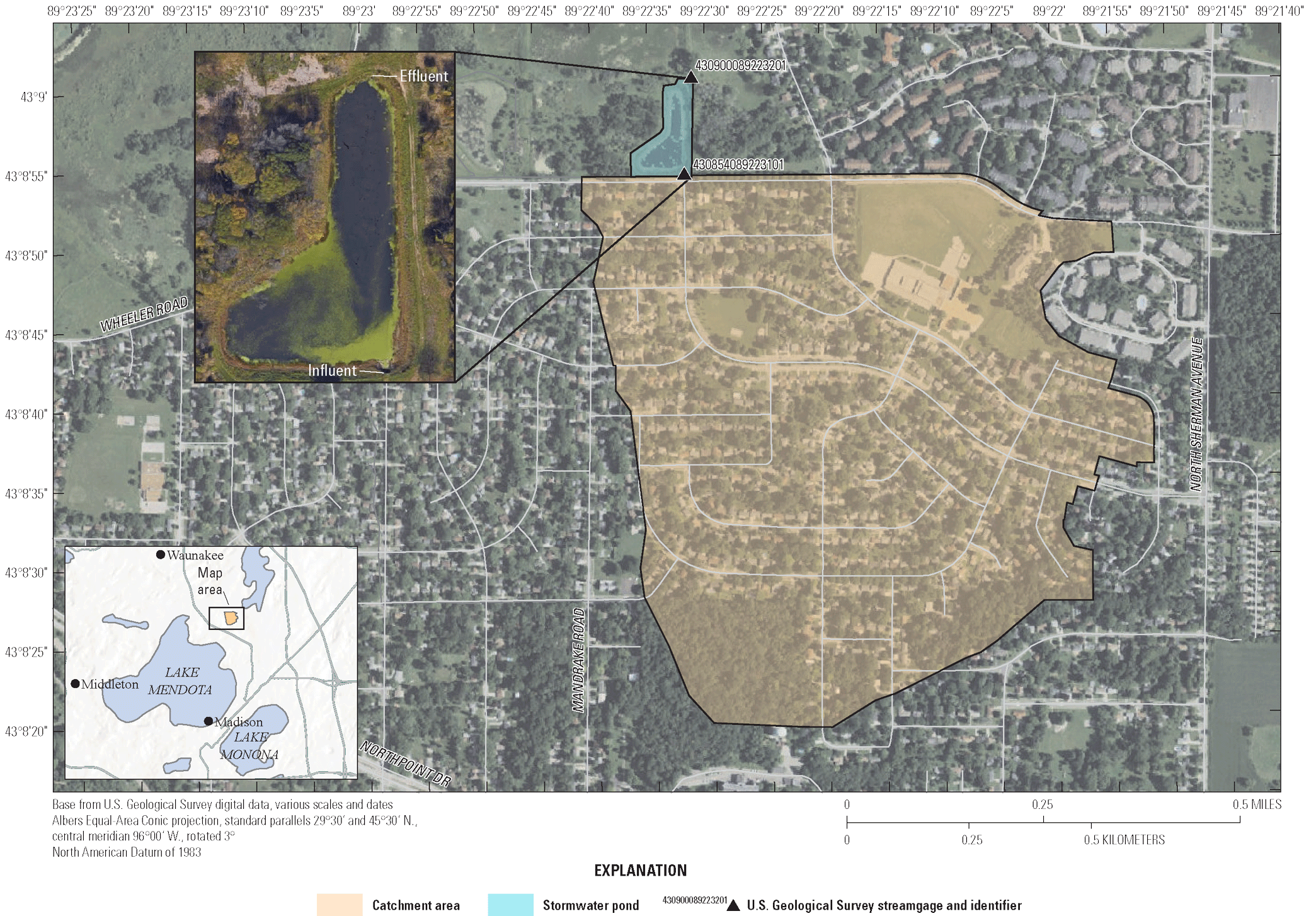
Map showing location of the Cherokee Park stormwater pond with U.S. Geological Survey streamgages in Madison, Wisconsin.
Estimates of overhead street tree canopy were made using a combination of aerial imagery coupled with geographic information system software and field surveys. Street trees within the catchment covered 30 percent of the right-of-way (area between the outer edge of sidewalks on opposing sides of the street) and were generally a mix of mature, deciduous hardwood species. The majority of tree species were characterized as Acer platanoides (Norway maple), Gleditsia triacanthos (honey locust), and Fraxinus pennsylvanica (green ash).
The landscape surrounding the pond consisted of mature forest around the perimeter, except where adjacent to the roadway, and well-established prairie vegetation along the banks. Submergent and emergent aquatic vegetation including Ceratophyllum demersum (coontail), Lemna minor (common duckweed), and a variety of Potamogeton spp. (pondweed), and Nymphaea spp. (water lily) species were present during the growing season (typically May through October).
Sample Collection and Measurement of Nutrient, Sediment, and Chloride Concentrations
USGS streamgages (Cherokee Park East Pond Influent 430854089223101 and Cherokee Park East Pond Effluent 430900089223201) measured stormwater discharge and collected water-quality samples during runoff events at the pipe and culvert influent to the pond and the pond effluent. A detailed description of equipment and methods used to collect a water sample are provided in Selbig and others (2020) and are briefly highlighted herein. Each streamgage was equipped with a volumetric water level and velocity sensor that was used to compute discharge. Precipitation data were collected using tipping-bucket rain gages calibrated to 0.25 millimeter. There was no dry weather flow in either the test or control storm drain network. Automated stormwater samplers collected flow-weighted discrete samples over the duration of an event hydrograph, which were later combined into a single, composite sample resulting in an event mean concentration (EMC). Sample collection was activated by a rise in water level in the pipe during a precipitation event. Water-quality samples were typically collected within 24 hours after runoff cessation. Samples were analyzed at the Wisconsin State Laboratory of Hygiene, in Madison, Wis. All samples were tested for TSS according to Standard Methods 2540D (Lipps and others, 2023), suspended sediment concentration (SSC) according to the American Society for Testing and Materials D3977–97 (ASTM International, 2019), TP and DP according to U.S. Environmental Protection Agency (EPA) Method 200.7 (EPA, 2001), TN and DN according to EPA Method 353.2 (EPA, 1993), and chloride according to Standard Methods 4500–Cl–E (Lipps and others, 2023). Concentration data are provided in Selbig (2025).
Measurement of Dissolved Oxygen and Temperature
A water-quality sonde was placed near the center of the pond at a depth approximately 1.2 meters below the pond surface and 15 cm above the bottom. Measurements of daily mean DO and temperature were recorded to determine whether pond mixing at the surface was sufficient to overcome stratification of the water column, thereby preventing anoxia near the bottom sediment. The sonde was deployed in the spring after ice no longer covered the pond and was removed before ice cover in the winter. Because of equipment failure, the measured timespan covered May 13–November 29, 2022; March 25–November 21, 2023; and March 13–October 21, 2024. Gaps in measured data occurred July 3–27, 2022; October 4–20, 2022; September 20–October 3, 2023; and June 24–July 12, 2024. Daily mean values of DO and temperature are available at Selbig (2025).
Street Cleaning Practices
Two variations of street cleaning frequency were evaluated: a mechanical broom cleaner, like that described by Selbig and Bannerman (2007), operated at a frequency of once per month, and a mechanical broom and regenerative-air cleaner operated at a frequency of once per week (fig. 2). Water-quality samples collected during the weekly mechanical broom and weekly regenerative-air campaigns were combined into a single dataset representing a weekly street cleaning frequency. This was based on prior research concluding the performance of municipal street cleaning programs was more related to the frequency and not the form of technology (Selbig and Bannerman, 2007; Selbig and others, 2020). Street cleaners were typically deployed in late spring and continued through late November (fig. 2). No other maintenance practices (for example, sump cleaning) were done to augment delivery of pollutants to the pond during the study period.

Schedule of weekly and monthly street cleaning during the 2020–24 study period. Samples collected in October and November 2022 reflect a no street cleaning scenario and were censored from this study.
Statistical Analyses
The performance of the stormwater pond was based on a calculated removal efficiency using comparisons of influent and effluent pollutant load from paired sampled events. Storm event loads at each monitoring location were computed by multiplying the EMC by event runoff volumes. Load data are provided in Selbig (2025).
Load data were first tested for normality by use of the Shapiro-Wilk test (Helsel and Hirsch, 2002). Generally, the data were not normally distributed in which case differences between paired influent and effluent loads between street cleaning phases were evaluated by use of the nonparametric Mann-Whitney U test on groups (Helsel and Hirsch, 2002). All statistical tests were first done using a two-tailed test in which the null hypothesis assumed that the central tendency of populations for each street cleaning phase was not different. If the null was rejected, tests were repeated using a one-tailed test to determine if the influent or effluent load for one street cleaning phase was statistically greater or less than another phase. Changes in pollutant load measured at the influent and effluent within each street cleaning phase were evaluated by use of the nonparametric Wilcoxon signed-rank test (Helsel and Hirsch, 2002). All tests used a 95-percent confidence level unless otherwise noted.
Results and Discussion
A total of 59 paired influent and effluent samples were collected during the study period, with 30 and 29 paired samples collected during the monthly and weekly street cleaning phases, respectively. Samples were collected during spring (March–May), summer (June–September), and fall (October–November) when streets were free of ice or snow and street cleaners were actively servicing the test area. No samples were collected during the winter months of December through February in either phase. Only the weekly phase collected paired samples in the fall. On a few occasions, limitations in the amount of raw water collected at the influent or effluent prevented analysis of all analytes. In these situations, TSS, SSC, and (or) chloride were omitted to conserve water for the remaining analytes. A complete list of paired concentrations, loads, and precipitation depth is provided in Selbig (2025).
Results of the Mann-Whitney U test showed no significant differences in precipitation depth, intensity, or runoff volume between street cleaning phases; therefore, changes observed in concentration and load are a result of changes occurring in the watershed and not because of variation in weather patterns. This is an important factor when assessing the influence of a treatment practice without a control.
Comparison of Concentrations
EMCs measured at the effluent were compared to the flow-weighted average of the EMCs measured at the influent pipe and culvert among and between street cleaning phases. The pond was able to effectively reduce concentrations in monthly and weekly phases for all pollutants except chloride (table 1). Results of the Wilcoxon signed-rank test showed these reductions to be significant; however, concentrations of chloride did not follow this pattern with both monthly and weekly phases having influent concentrations that were significantly less than the effluent. Median concentrations of chloride measured at the effluent exceeded the influent by a factor of approximately 5 during the weekly phase and by a factor of 7 during the monthly phase.
Table 1.
Summary statistics of paired event mean concentrations measured at the influent and effluent for each street cleaning phase.[TN, total nitrogen; mg/L, milligram per liter; Std. Dev., standard deviation; COV, absolute value of the coefficient of variation; DN, dissolved nitrogen; TP, total phosphorus; DP, dissolved phosphorus; TSS, total suspended solids; SSC, suspended sediment concentration]
When comparing between street cleaning phases, median and mean pond influent concentrations of TN, DN, TSS, and SSC were greater under a monthly frequency compared to weekly (table 1, fig. 3). This was confirmed by use of the nonparametric Mann-Whitney U test for all except TSS, which failed statistical significance (probability value [p-value]=0.12). Measurements of TSS in stormwater can be highly variable because of the bias incorporated into the analytical method (Selbig and Bannerman, 2011). Although TSS is commonly used by the regulated community, previous studies have documented TSS to be an inferior measurement of the amount of sediment suspended in stormwater, favoring SSC as a more suitable metric (Gray and others, 2000; Selbig and Bannerman, 2011). Higher influent concentrations of SSC during the monthly phase indicate the lower frequency of street cleaning may have allowed for greater buildup of sediment on street surfaces thereby increasing the amount of pollutants available for wash-off during subsequent rain events. Median influent concentrations of TP, DP, and chloride during monthly street cleaning were slightly lower than weekly (table 1) but were not significantly different when evaluated using the Mann-Whitney U test.
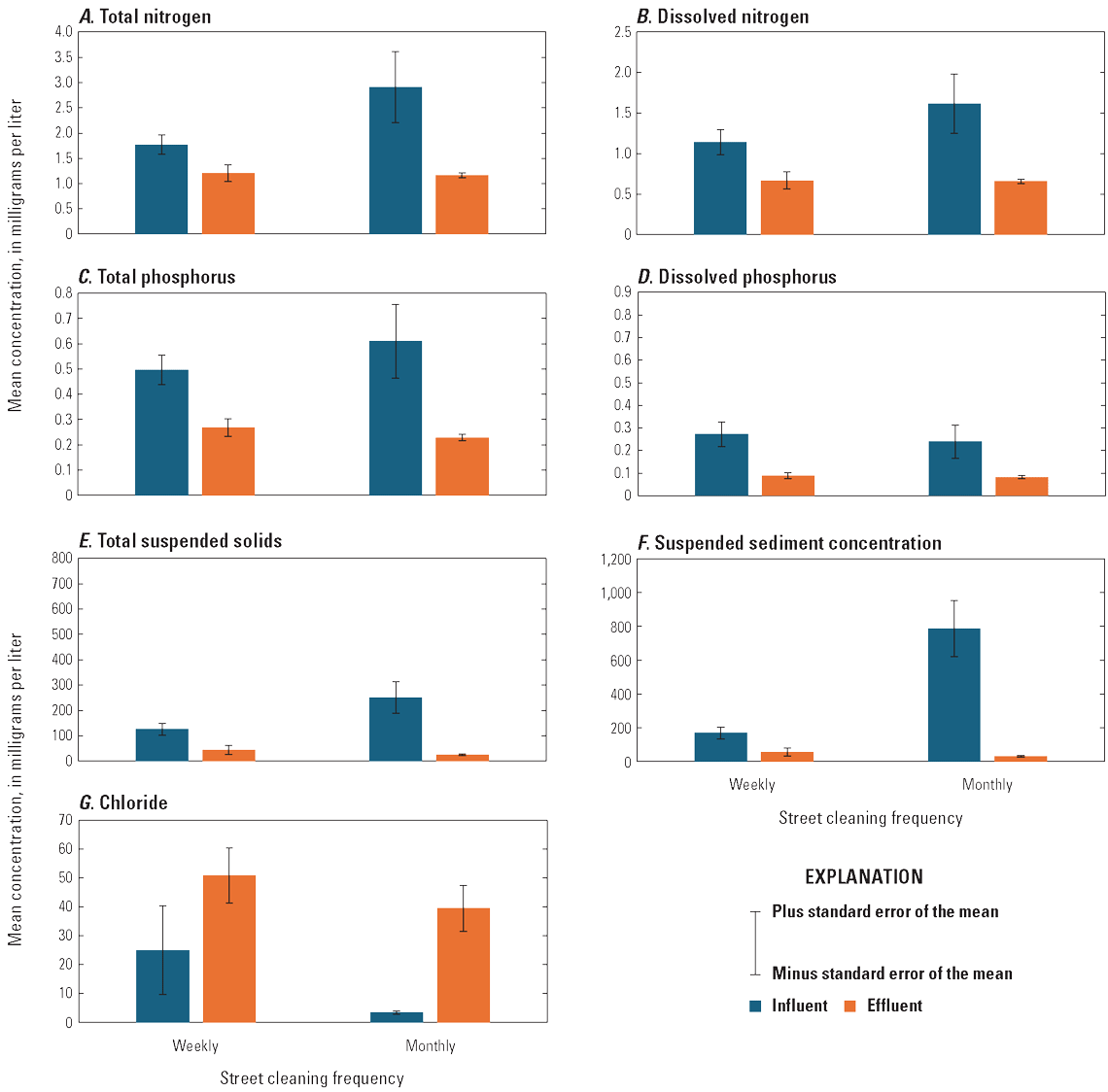
Bar graphs showing mean concentrations of pollutants measured at the pond influent and effluent for the monthly and weekly street cleaning phases. A, Total nitrogen. B, Dissolved nitrogen. C, Total phosphorus. D, Dissolved phosphorus. E, Total suspended solids. F, Suspended sediment concentration. G, Chloride.
Evidence of street cleaning frequency preferentially influencing concentrations of dissolved or particulate nutrients was inconclusive. Concentrations of nitrogen measured at the pipe inlets were primarily in the dissolved phase with the median value of DN, as a percentage of TN, approximating 60 percent for monthly and weekly phases. Changes in season did not appear to alter this pattern with median values of DN remaining near 60 percent in all three seasons monitored (55 percent in fall, 61 percent in summer, 63 percent in spring). Contrary to nitrogen, the amount of phosphorus in the dissolved phase varied by season. Fall concentrations of DP, as a percentage of TP, had the highest median value at 68 percent, whereas spring and summer had only 27 percent and 37 percent, respectively. Comparison of the DP to TP ratio between the street cleaning phases may contain temporal bias, because there were no fall samples during the monthly phase. With fall samples included (n=9), the median concentration of DP, as a percentage of TP, was higher when street cleaning was done weekly compared to monthly at 51 percent and 31 percent, respectively. If fall samples were excluded, the proportions become nearly identical at 34 percent and 31 percent, respectively.
Median concentrations observed at the effluent showed little variation between street cleaning phases for most pollutants. Coefficients of variation were generally less than one, indicating relatively low variability (table 1). TSS and SSC showed considerable variability in effluent concentrations during the weekly phase with coefficients of variation exceeding two. Low variability in effluent concentrations may indicate consistent pollutant removal efficiency regardless of influent concentrations related to changes in street cleaning; however, Spearman’s rank test showed weak to moderately positive correlation (Spearman’s rho coefficient [ρ]=0.39 to 0.45, p-value<0.01) between influent and effluent concentrations for all pollutants except TSS and SSC, which showed no correlation. Although relations between influent and effluent concentrations were not linear, the pond appears to be limited in its ability to reduce pollutants other than sediment as influent concentrations increase.
Comparison of Loads
Similar to reductions observed in pollutant concentrations, the pond was able to reduce the cumulative pollutant load discharged from the effluent for both phases of street cleaning, except chloride (fig. 4, table 2). Overall, the pollutant removal capacity of the pond was greater during the monthly phase except for DP. Both phases showed the largest percentage reductions in sediment load (TSS and SSC), which is typical for stormwater management practices that use settling as the primary form of treatment (EPA, 1983; Gu and others, 2016). Dissolved forms of nitrogen, when compared cumulatively, had slightly higher percentage reductions than the total. Chloride was the only pollutant where more was observed leaving the pond than coming in. Export of chloride ranged between 109 percent in the weekly phase to 860 percent in the monthly. A closer inspection of individual paired samples showed all but six events exported chloride from the pond, three of which occurred in the fall when concentrations (influent and effluent) were generally at their lowest (Selbig, 2025).
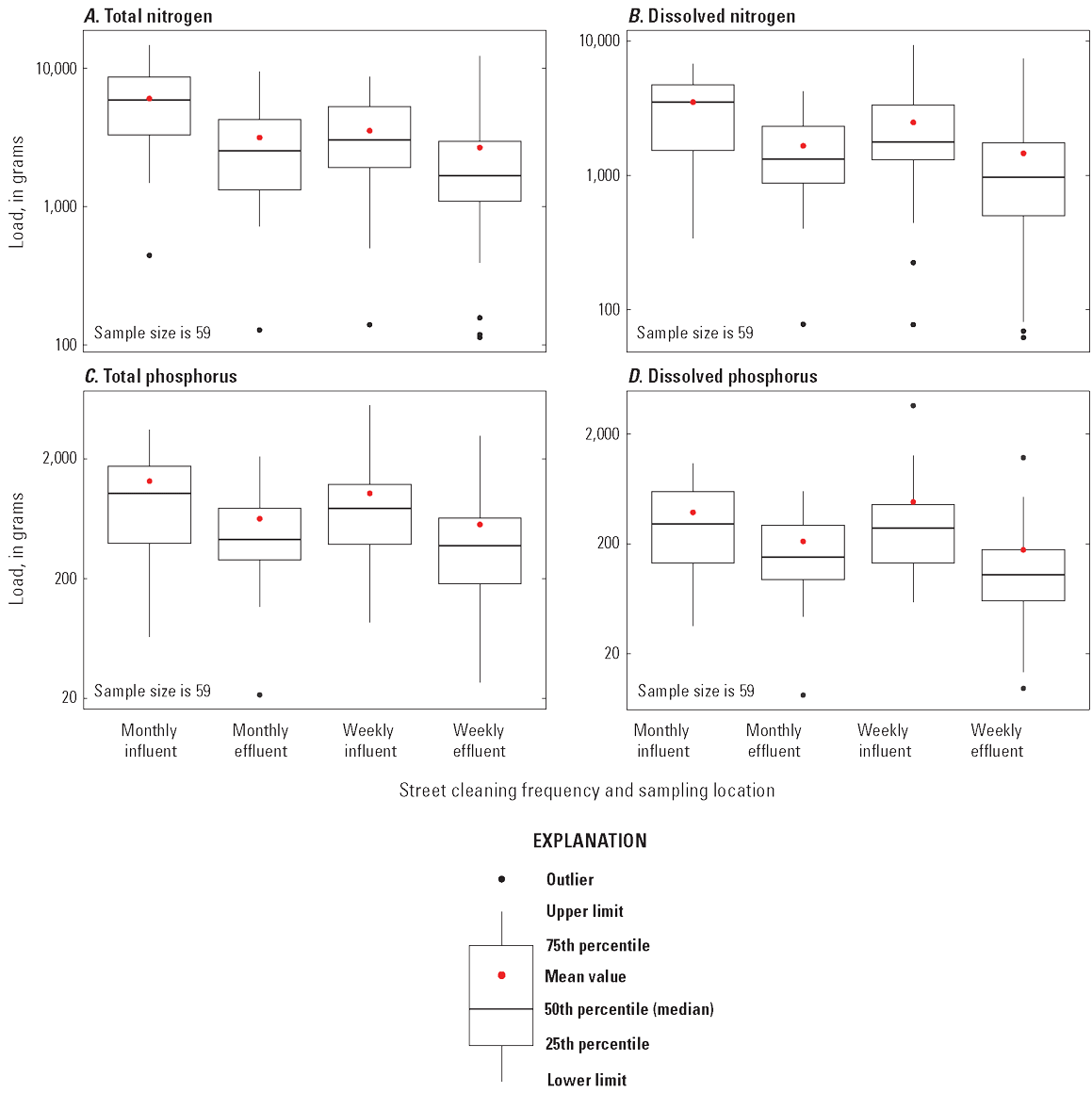
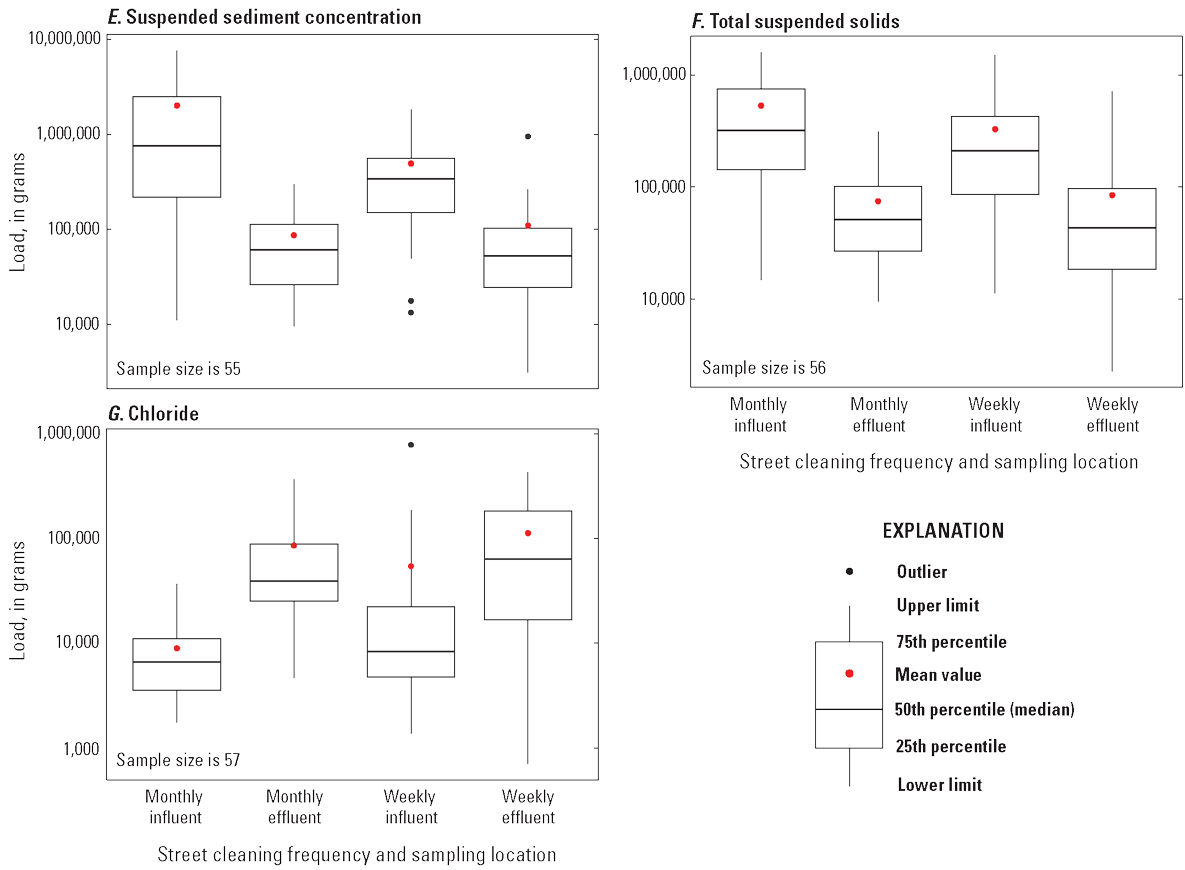
Boxplots showing pollutant loads measured at the pond influent and effluent for the monthly and weekly street cleaning phases. A, Total nitrogen. B, Dissolved nitrogen. C, Total phosphorus. D, Dissolved phosphorus. E, Suspended sediment concentration. F, Total suspended solids. G, Chloride.
Table 2.
Percentage change between the cumulative load of nutrients, solids, and chloride measured at the stormwater pond influent and effluent during weekly and monthly street cleaning phases.[kg, kilograms; TN, total nitrogen; DN, dissolved nitrogen; TP, total phosphorus; DP, dissolved phosphorus; TSS, total suspended solids; SSC, suspended sediment concentration]
Table 2 shows that more load was received by the pond during the monthly phase for all pollutants except DP and chloride. This was supported by use of the Mann-Whitney U test on individual paired events. Results showed TN, DN, TSS, and SSC loads measured at the influent during the monthly phase were significantly greater (p-value<0.05 for TN, DN, and SSC; p<0.10 for TSS) than the weekly phase, whereas TP, DP, and chloride showed no difference. This indicates the reduced frequency of street cleaning allowed for more accumulation of sediment and debris on the street surface, which became available for washoff during subsequent rain events. A similar conclusion was made by Selbig and Bannerman (2007) who observed significant reductions in street dirt for vacuum-assisted and mechanical broom street cleaners operated once per week compared to no street cleaning, whereas a mechanical broom street cleaner operated once per month showed no significant reductions in street dirt. Because the calculated percentage reduction in pollutant load for most treatment practices has been shown to be strongly affected by the influent concentration (Barrett, 2005), the contrast in performance between the monthly and weekly phase was not unexpected.
Comparison of influent and effluent loads are further detailed in table 3 along with the calculated percentage change. Negative percentages indicate reduction, whereas positive percentages indicate export. Contrary to other pollutants, chloride was the only pollutant that consistently had more leaving the pond than entering with median percentage differences for weekly and monthly phases of 258 percent and 639 percent, respectively (Selbig, 2025). Median percentage reductions of TN, DN, and TP were similar for both phases ranging from −39 percent to −51 percent. These values met or exceeded the expected removal performance for ponds based on prior studies (Weiss and others, 2007; Koch and others, 2014; Janke and others, 2022). Sediment (TSS and SSC) had the highest percentage reduction of all pollutants ranging from −78 percent for TSS in the weekly phase to −92 percent for SSC in the monthly phase, meeting target reduction goals established by the WDNR (2024). Reduction of DP showed the greatest disparity between phases. Although both street cleaning phases showed reductions of DP (median values for monthly and weekly at −39 percent and −67 percent, respectively), statistical comparison of individual percentage reductions across all paired events using the Mann-Whitney U test showed the weekly phase to be significantly higher than the monthly phase (p-value=0.01). Similar statistical comparisons of percentage difference for all other pollutants showed no difference between the two street cleaning phases.
Table 3.
Summary statistics of paired event mean loads measured at the influent and effluent during the weekly and monthly street cleaning phases and associated percentage change.[TN, total nitrogen; kg, kilogram; Std. Dev., standard deviation; COV, absolute value of the coefficient of variation; DN, dissolved nitrogen; TP, total phosphorus; DP, dissolved phosphorus; TSS, total suspended solids; SSC, suspended sediment concentration]
It is unclear why reduction of DP during the weekly phase was significantly greater than monthly, whereas all other pollutants were not. One explanation could be related to the lack of samples in the fall during the monthly phase, a time when organic detritus on streets is at its highest. Previous studies have documented the disproportionate amount of leachable phosphorus stemming from leaf litter in the fall compared to spring and summer (Selbig, 2016; Janke and others, 2017; Wang and others, 2020). The seasonal influx of DP during the weekly phase accounted for 26 percent of the total cumulative load observed at the influent. This proportion was not similarly represented in the monthly phase. Repeating the Mann-Whitney U test with fall events removed showed percentage reductions in the weekly phase were still statistically higher than the monthly phase, but with less confidence (p-value=0.11); therefore, differences in the pond’s ability to remove DP can only be partially explained by the discrepancy in seasonal loading between street cleaning phases. Another explanation could be related to internal phosphorus loading within the pond. The release of phosphorus from sediment has been well documented in small ponds under select conditions (Frost and others, 2019; Taguchi and others, 2020). Closer inspection of all paired samples revealed 10 events having DP load at the effluent exceeding what was observed at the influent. Of those 10 events, eight occurred during the monthly phase representing 28 percent of the total cumulative DP load observed at the effluent (Selbig, 2025). Export of DP in pond effluent as a result of internal loading would have falsely misrepresented the reduction capabilities of the pond during this phase.
Although concentrations and rates of DP from pond sediment were not directly measured, evidence of internal loading was apparent. Field measurements of DO revealed anoxic conditions near the pond bottom throughout much of the sampling period from May through October (Selbig, 2025). Stormwater ponds with hypolimnetic anoxia have been shown to be highly susceptible to internal release of sediment phosphorus, which can potentially contribute to downstream eutrophication (Taguchi and others, 2020). Despite persistent anoxia, Janke and others (2022) suggest even large release rates of DP from internal loading may not strongly influence effluent loads. This is largely due to high levels of autotrophic biomass and organic matter (floating vegetation) that maintain high rates of biological production. Despite evidence of anoxic conditions near the pond bottom, it is difficult to quantify the effect, if any, on phosphorus export. More information is needed to accurately assess the influence of internal phosphorus loading on pond performance.
Other factors may also have contributed to pond performance that are unrelated to street cleaning. Janke and others (2022) found storage volume to be a major factor for maintaining high rates of nutrient capture of three stormwater ponds in Minnesota. Increased storage volume from water losses would effectively increase water residence time, which promotes settling and uptake of sediment and nutrients. Because the pond was underlined with an impermeable clay layer, water losses through exfiltration to underlying native soils was unlikely; therefore, increased volumetric storage would come primarily from evaporative losses between storm events. Interevent pond levels were not measured so it is difficult to determine the volumetric storage prior to each storm event. Instead, differences between paired effluent and influent volume, represented as a percentage reduction, was used as a surrogate for storage prior to a storm. Increasing percentage reductions would indicate more storage was available prior to the storm event. These values were statistically compared to corresponding percentage differences in pollutant load by use of the Spearman’s correlation test. Results indicate changes in volumetric storage did not influence changes in pollutant load reductions (table 4).
Table 4.
Spearman correlation coefficients for differences in the percentage change between influent and effluent pollutant load and volume.[ρ, Spearman’s rho coefficient; p-value, probability value; TN, total nitrogen; DN, dissolved nitrogen; DP, dissolved phosphorus; TP, total phosphorus; TSS, total suspended solids; SSC, suspended sediment concentration]
Implications for Urban Stormwater Management
Stormwater ponds are commonly designed to reduce downstream flooding and peak flow rates through attenuation of surface runoff (Emerson and others, 2005). In doing so, stormwater ponds also improve water quality by allowing sediment and sediment-bound pollutants to settle out of suspension. This is the primary form of treatment before discharging to downstream receiving waters. A pond’s capacity to remove sediment and sediment-bound pollutants, often referred to as the removal efficiency, is a simple comparison of the mass of pollutants entering the pond against the mass leaving it; however, the magnitude of removal efficiency is largely driven by the concentration entering the pond, which can be influenced by activities in the sewershed, such as construction or street cleaning. The higher the incoming concentration, the more pronounced the primary form of treatment becomes, resulting in greater reductions in the outgoing concentration (Birch and others, 2006). Conversely, as the incoming concentration gets lower, treatment becomes less efficient and more difficult to reduce even further (Kadlec and Wallace, 2008; Larm and Wahlsten, 2019). For stormwater ponds, the irreducible concentration can be relatively high. This is due to processes internal to the pond, such as algae production and turbidity, that can return pollutants back into the water column (Larm and Wahlsten, 2019).
Regulatory agencies often use models to prescribe a water-quality credit for select pollutants when designed, constructed, and maintained according to published guidelines (Minnesota Pollution Control Agency, 2024; WDNR, 2024). These guidelines generally do not factor how changes in the concentration of certain pollutants, such as solids and phosphorus, are influenced by upstream practices. Based on evidence from this study, a model that applies a numeric water-quality credit to a single stormwater practice, such as a stormwater pond, may be biased when the pond is in series with another upstream stormwater practice, such as street cleaning. For example, guidance on municipal leaf management and street cleaning campaigns was recently issued by the WDNR for participating communities to receive phosphorus water-quality credits (WDNR, 2025). Currently, no additional water-quality credits for phosphorus are given to stormwater ponds when done in the same drainage area as leaf collection and street cleaning. This would have repercussions for the regulated community who are trying to meet pollution reduction targets for downstream receiving waters.
Results from this study have shown that stormwater treatment ponds provide pollutant reduction benefits even when upstream treatment practices (for example, street cleaning) are used. The frequency of street cleaning can influence the accumulation and delivery of pollutants reaching a stormwater pond which, in turn, can affect the pond’s ability to capture and retain those pollutants; therefore, environmental managers should consider the compounding pollutant reduction capabilities of upstream practices when determining water-quality credits for stormwater ponds.
Summary
From 2022 to 2024, the U.S. Geological Survey evaluated paired water-quality samples from a stormwater pond in Madison, Wisconsin, to determine if changes to the frequency of street cleaning influenced the delivery of total and dissolved nutrients, sediment, and chloride to the pond, thereby affecting the calculated reduction efficiency. Less street cleaning likely resulted in greater accumulation of pollutants on street surfaces that subsequently washed off during rain events thus increasing the concentrations delivered to the pond. During monthly street cleaning, statistically higher (probability value less than 0.05) concentrations and loads of total and dissolved nitrogen and sediment were observed at the pond influent; however, total and dissolved phosphorus and chloride failed to meet statistical significance.
Higher concentrations delivered to the pond resulted in greater efficiencies in load reduction. Percentage differences between the sum of influent and effluent pollutant load were higher when cleaning was done monthly compared to weekly for all pollutants except dissolved phosphorus and chloride. Suspended sediment had the highest percentage reduction of all pollutants at 96 percent when street cleaning was done monthly compared to 75 percent when done weekly. Similarly, reductions of total and dissolved nitrogen and total phosphorus were greater during monthly cleaning compared to weekly (total nitrogen, 48 percent versus 32 percent; dissolved nitrogen, 53 percent versus 39 percent; total phosphorus, 51 percent versus 45 percent). Dissolved phosphorus was the only pollutant having higher load reduction during weekly cleaning at 64 percent compared to during monthly cleaning at 46 percent. Contrary to other pollutants, nearly all events, regardless of street cleaning frequency, had more chloride load leaving the pond than entering with cumulative percentage differences of 860 percent and 109 percent under a monthly and weekly cleaning frequency, respectively.
Although monthly street cleaning revealed a higher removal efficiency based on the sum of loads for all events, statistical comparison of individual percentage reductions across all paired events revealed no difference from the weekly cleaning frequency (probability value greater than 0.05), except dissolved phosphorus. Under a monthly street cleaning scenario, event-based reduction percentages for dissolved phosphorus were significantly lower (probability value less than 0.05) when compared to weekly, despite showing no difference in concentration or load at the influent. One reason could be because internal phosphorus loading from bottom sediment created a condition where more dissolved phosphorus left the pond than entered. Eight out of 10 events showing export of dissolved phosphorus occurred during monthly street cleaning, which disproportionately affected the overall percentage reduction compared to weekly street cleaning.
This information can be used by environmental managers who are responsible for assessing the cumulative effect of urban runoff and the structural or nonstructural practices used for treatment on receiving water bodies. Assignment of water-quality credits to various stormwater treatment practices, either individually or in series, should consider upstream practices and their effect on the synergistic performance of downstream stormwater ponds.
References Cited
Arnold, C.L., Jr., and Gibbons, C.J., 1996, Impervious surface coverage—The emergence of a key environmental indicator: Journal of the American Planning Association, v. 62, no. 2, p. 243–258, at https://doi.org/10.1080/01944369608975688.
ASTM International, 2019, Standard test method for determining sediment concentration in water samples, D3977-97R19: West Conshohocken, Pa., ASTM International, accessed August 20, 2025, at https://doi.org/10.1520/D3977-97R19.
Bannerman, R.T., Owens, D.W., Dodds, R.B., and Hornewer, N.J., 1993, Sources of pollutants in Wisconsin stormwater: Water Science & Technology, v. 28, no. 3–5, p. 241–259, accessed August 20, 2025, at https://doi.org/10.2166/wst.1993.0426.
Barrett, M., 2005, Performance comparison of structural stormwater best management practices: Water Environment Research, v. 77, no. 1, p. 78–86, accessed August 20, 2025, at https://doi.org/10.2175/106143005X41654.
Birch, G.F., Matthai, C., and Fazeli, M.S., 2006, Efficiency of a retention/detention basin to remove contaminants from urban stormwater: Urban Water Journal, v. 3, no. 2, p. 69–77, accessed August 20, 2025, at https://doi.org/10.1080/15730620600855894.
Emerson, C., Welty, C., and Traver, R., 2005, Watershed-scale evaluation of a system of storm water detention basins: Journal of Hydrologic Engineering, v. 10, no. 3, p. 237–242, accessed August 20, 2025, at https://doi.org/10.1061/(ASCE)1084-0699(2005)10:3(237).
Erickson, A.J., Weiss, P.T., and Gulliver, J.S., 2013, Optimizing stormwater treatment practices—A handbook of assessment and maintenance: Springer, 337 p., accessed August 20, 2025, at https://doi.org/10.1007/978-1-4614-4624-8.
Frost, P.C., Prater, C., Scott, A.B., Song, K., and Xenopoulos, M.A., 2019, Mobility and bioavailability of sediment phosphorus in urban stormwater ponds: Water Resources Research, v. 55, no. 5, p. 3680–3688, accessed August 20, 2025, at https://doi.org/10.1029/2018WR023419.
Grogan, A.E., Alves-de-Souza, C., Cahoon, L.B., and Mallin, M.A., 2023, Harmful algal blooms—A prolific issue in urban stormwater ponds: Water (Basel), v. 15, no. 13, 2436, accessed August 20, 2025, at https://doi.org/10.3390/w15132436.
Gray, J.R., Glysson, G.D., Turcios, L.M., and Schwarz, G., 2000, Comparability of suspended-sediment concentration and total suspended solids data: Water-Resources Investigations Report 2000–4191, 14 p., accessed August 20, 2025, at https://doi.org/10.3133/wri004191.
Gu, L., Dai, B., Zhu, D. Z., Hua, Z., Liu, X., van Duin, B., & Mahmood, K., 2016, Sediment modelling and design optimization for stormwater ponds: Canadian Water Resources Journal/Revue canadienne des ressources hydriques, v. 42, no.1, p. 70–87, accessed August 20, 2025, at https://doi.org/10.1080/07011784.2016.1210542.
Hao, A., Kobayashi, S., Xia, D., Mi, Q., Yan, N., Su, M., Lin, A., Zhao, M., and Iseri, Y., 2021, Controlling eutrophication via surface aerators in irregular-shaped urban ponds: Water (Basel), v. 13, no. 23, 3360, accessed August 20, 2025, at https://doi.org/10.3390/w13233360.
Helsel, D.R., and Hirsch, R.M., 2002, Statistical methods in water resources: U.S. Geological Survey Techniques of Water-Resources Investigations 04–A3, 522 p., accessed November 17, 2017, at https://doi.org/10.3133/twri04A3.[Superseded in 2020 which is available at https://doi.org/10.3133/tm4A3.]
Hobbie, S.E., Baker, L.A., Buyarski, C., Nidzgorski, D., and Finlay, J.C., 2014, Decomposition of tree leaf litter on pavement—Implications for urban water quality: Urban Ecosystems, v. 17, no. 2, p. 369–385, accessed August 20, 2025, at https://doi.org/10.1007/s11252-013-0329-9.
Hobbie, S.E., King, R.A., Belo, T., Kalinosky, P., Baker, L.A., Finlay, J.C., Buyarski, C.A., and Bintner, R., 2023, Sources of variation in nutrient loads collected through street sweeping in the Minneapolis-St. Paul metropolitan area, Minnesota, USA: Science of the Total Environment, v. 905, 166934, 12 p., accessed August 20, 2025, at https://doi.org/10.1016/j.scitotenv.2023.166934.
James, W.F., and Bischoff, J.M., 2015, Relationships between redox-sensitive phosphorus concentrations in sediment and the aluminum: phosphorus binding ratio: Lake and Reservoir Management, v. 31, no. 4, p. 339–346, accessed August 20, 2025, at https://doi.org/10.1080/10402381.2015.1092483.
Janke, B.D., Finlay, J.C., and Hobbie, S.H., 2017, Trees and streets as drivers of urban stormwater nutrient pollution: Environmental Science & Technology, v. 51, no. 17, p. 9569–9579, accessed August 20, 2025, at https://doi.org/10.1021/acs.est.7b02225.
Janke, B.D., Finlay, J.C., Taguchi, V.J., and Gulliver, J.S., 2022, Hydrologic processes regulate nutrient retention in stormwater detention ponds: Science of the Total Environment, v. 823, 153722, 9 p., accessed August 20, 2025, at https://doi.org/10.1016/j.scitotenv.2022.153722.
Kadlec, R., and Wallace, S., 2008, Treatment wetlands (2d ed.): Boca Raton, Fla., CRC Press, 943 p., accessed August 20, 2025, at https://doi.org/10.1201/9781420012514.
Kaushal, S.S., and Belt, K.T., 2012, The urban watershed continuum—Evolving spatial and temporal dimensions: Urban Ecosystems, v. 15, no. 2, p. 409–435, accessed August 20, 2025, at https://doi.org/10.1007/s11252-012-0226-7.
Koch, B.J., Febria, C.M., Gevrey, M., Wainger, L.A., and Palmer, M.A., 2014, Nitrogen removal by stormwater management structures—A data synthesis: Journal of the American Water Resources Association, v. 50, no. 6, p. 1594–1607, accessed August 20, 2025, at https://doi.org/10.1111/jawr.12223.
Larm, T., and Wahlsten, A., 2019, Applying the parameter “irreducible concentration” in modelling of stormwater treatment facilities: Journal of Civil Engineering and Architecture, v. 13, no. 8, p. 469–476, accessed October, 2024, at https://doi.org/10.17265/1934-7359/2019.08.001.
Law, N.L., DiBlasi, K., Ghosh, U., Stack, B., Stewart, S., Belt, K., Pouyat, R., and Welty, C., 2008, Deriving reliable pollutant removal rates for municipal street sweeping and storm drain cleanout programs in the Chesapeake Bay basin: Center for Watershed Protection, accessed February 20, 2025, at https://www.epa.gov/sites/production/files/2015-11/documents/cbstreetsweeping.pdf.
Malecki-Brown, L.M., White, J.R., Sees, M., 2009, Alum application to improve water quality in a municipal wastewater treatment wetland: Journal of Environmental Quality, v. 38, no. 2, p. 814–821, accessed August 20, 2025, at https://doi.org/10.2134/jeq2008.0033.
McPhillips, L., and Walter, M.T., 2015, Hydrologic conditions drive denitrification and greenhouse gas emissions in stormwater detention basins: Ecological Engineering, v. 85, p. 67–75, accessed August 20, 2025, at https://doi.org/10.1016/j.ecoleng.2015.10.018.
Meyer, J.L., Paul, M.J., and Taulbee, W.K., 2005, Stream ecosystem function in urbanizing landscapes: Journal of the North American Benthological Society, v. 24, no. 3, p. 602–612, accessed August 20, 2025, at https://doi.org/10.1899/04-021.1.
Minnesota Pollution Control Agency, 2024, Minnesota stormwater manual: Minnesota Pollution Control Agency wiki page, accessed November 20, 2024, at https://stormwater.pca.state.mn.us/index.php?title=Main_Page.
Osgood, R.A., 2012, Controlling Wolffia using alum in a pond: Lake and Reservoir Management, v. 28, no. 1, p. 27–30, accessed August 20, 2025, at https://doi.org/10.1080/07438141.2011.642932.
Selbig, W.R., and Bannerman, R.T., 2007, Evaluation of street sweeping as a stormwater-quality management tool in three residential basins in Madison, Wisconsin: U.S. Geological Survey Scientific Investigations Report 2007–5156, 120 p., accessed August 20, 2025, at https://doi.org/10.3133/sir20075156.
Selbig, W.R., and Bannerman, R.T., 2011, Ratios of total suspended solids to suspended sediment concentrations by particle size: Journal of Environmental Engineering, v. 137, no. 11, p. 1075–1081, accessed August 20, 2025, at https://doi.org/10.1061/(ASCE)EE.1943-7870.0000414.
Selbig, W.R., 2016, Evaluation of leaf removal as a means to reduce nutrient concentrations and loads in urban stormwater: Science of the Total Environment, v. 571, p. 124–133, accessed August 20, 2025, at https://doi.org/10.1016/j.scitotenv.2016.07.003.
Selbig, W.R., Buer, N., Bannerman, R.T., and Gaebler, P., 2020, Reducing leaf litter contributions of phosphorus and nitrogen to urban stormwater through municipal leaf collection and street cleaning practices: U.S. Geological Survey Scientific Investigations Report 2020–5109, 17 p., accessed August 20, 2025, at https://doi.org/10.3133/sir20205109.
Selbig, W.R., 2025, Stormwater treatment pond water-quality load and concentration data at Cherokee Park, Madison, Wisconsin, 2020–24: U.S. Geological Survey data release, accessed August 20, 2025, at https://doi.org/10.5066/P13JQZXF.
Sønderup, M.J., Egemose, S., Hansen, A.S., Grudinina, A., Madsen, M.H., and Flindt, M.R., 2015, Factors affecting retention of nutrients and organic matter in stormwater ponds: Ecohydrology, v. 9, no. 5, p. 796–806, accessed August 20, 2025, at https://doi.org/10.1002/eco.1683.
Song, K., Adams, C.J., and Burgin, A.J., 2017, Relative importance of external and internal phosphorus loadings on affecting lake water quality in agricultural landscapes: Ecological Engineering, v. 108, part B, p. 482–488, accessed August 20, 2025, at https://doi.org/10.1016/j.ecoleng.2017.06.008.
Taguchi, V.J., Olsen, T.A., Natarajan, P., Janke, B., Gulliver, J.S., Finlay, J.C., and Stefan, H.G., 2020, Internal loading in stormwater ponds as a phosphorus source to downstream waters: Limnology and Oceanography Letters, v. 5, no. 4, p. 322–330, accessed August 20, 2025, at https://doi.org/10.1002/lol2.10155.
Taguchi, V.J., Janke, B.D., Herb, W.R., Gulliver, J.S., Finlay, J.C., and Natarajan, P., 2022, Wet pond maintenance for phosphorus retention, final report: Minnesota Department of Transportation, Office of Research and Innovation, accessed on August 20, 2025, at https://cts-d10resmod-prd.oit.umn.edu/pdf/mndot-2022-20.pdf.
U.S. Environmental Protection Agency [EPA], 1983, Results of the Nationwide Urban Runoff Program—Volume 1—Final Report: accessed on August 20, 2025, at https://nepis.epa.gov/Exe/ZyPURL.cgi?Dockey=2000SNX3.TXT.
U.S. Environmental Protection Agency [EPA], 1993, Method 353.2, revision 2.0—Determination of nitrate-nitrite nitrogen by automated colorimetry: Environmental Monitoring System Laboratory, Office of Research and Development, U.S. Environmental Protection Agency, Cincinnati, Ohio, accessed February 20, 2020, at https://www.epa.gov/sites/production/files/2015-08/documents/method_353-2_1993.pdf.
U.S. Environmental Protection Agency [EPA], 2009, Stormwater wet pond and wetland management guidebook, EPA-833-B-09-001: U.S. Environmental Protection Agency, accessed November 6, 2024, at https://www.epa.gov/sites/default/files/2015-11/documents/pondmgmtguide.pdf.
Walsh, C.J., Roy, A.H., Feminella, J.W., Cottingham, P.D., Groffman, P.M., and Morgan, R.P., II, 2005, The urban stream syndrome—Current knowledge and the search for a cure: Journal of the North American Benthological Society, v. 24, no. 3, p. 706–723, accessed August 20, 2025, at https://doi.org/10.1899/04-028.1.
Wang, W., Han, Y., Liu, H., Zhang, K., Yue, Q., Bo, L., and Wang, X., 2017, Pollutant removal performance of an integrated upflow-constructed wetland filled with haydites made of Al-based drinking water treatment residuals: Environmental Technology, v. 38, no. 9, p. 1111–1119, accessed August 20, 2025, at https://doi.org/10.1080/09593330.2016.1220428.
Wang, Y., Thompson, A., and Selbig, W.R., 2020, Leachable phosphorus in leaf litter and its impact on phosphorus loads in urban stormwater: Science of the Total Environment, v.743, 10 p., accessed August 20, 2025, at https://doi.org/10.1016/j.scitotenv.2020.140662.
Weiss, P.T., Gulliver, J.S., and Erickson, A.J., 2007, Cost and pollutant removal of storm-water treatment practices: Journal of Water Resources Planning and Management, v. 133, no. 3, p. 218–229, at https://doi.org/10.1061/(ASCE)0733-9496(2007)133:3(218).
Wisconsin Department of Natural Resources [WDNR], 2024, Wet detention pond (1001): accessed November 20, 2024, at https://dnr.wisconsin.gov/sites/default/files/topic/Stormwater/1001WetDetentionPond.pdf.
Wisconsin Department of Natural Resources [WDNR], 2025, Municipal phosphorus reduction credit for leaf management programs: Bureau of Watershed Management Program Guidance, Wisconsin Department of Natural Resources, 11 p., accessed February 7, 2025, at https://dnr.wisconsin.gov/sites/default/files/topic/Stormwater/LeafManagementCredit.pdf.
Conversion Factors
International System of Units to U.S. customary units
Supplemental Information
Concentrations of chemical constituents in water are given in either milligrams per liter (mg/L) or micrograms per liter (µg/L).
Abbreviations
<
less than
DN
dissolved nitrogen
DO
dissolved oxygen
DP
dissolved phosphorus
EPA
U.S. Environmental Protection Agency
EMC
event mean concentration
p-value
probability value
ρ
Spearman’s rho coefficient
SSC
suspended sediment concentration
TN
total nitrogen
TP
total phosphorus
TSS
total suspended solids
WDNR
Wisconsin Department of Natural Resources
For more information about this publication, contact:
Director, USGS Upper Midwest Water Science Center
8505 Research Way
Middleton, WI 53562
608–828–9901
For additional information, visit: https://www.usgs.gov/centers/umid-water
Publishing support provided by the USGS Science Publishing Network,
Rolla Publishing Service Center
Disclaimers
Any use of trade, firm, or product names is for descriptive purposes only and does not imply endorsement by the U.S. Government.
Although this information product, for the most part, is in the public domain, it also may contain copyrighted materials as noted in the text. Permission to reproduce copyrighted items must be secured from the copyright owner.
Suggested Citation
Selbig, W.R., Thiboldeaux, S., and Gaebler, P., 2025, The role of street cleaning on the water-quality performance of a stormwater treatment pond in Madison, Wisconsin: U.S. Geological Survey Scientific Investigations Report 2025–5096, 17 p., https://doi.org/10.3133/sir20255096.
ISSN: 2328-0328 (online)
Study Area
| Publication type | Report |
|---|---|
| Publication Subtype | USGS Numbered Series |
| Title | The role of street cleaning on the water-quality performance of a stormwater treatment pond in Madison, Wisconsin |
| Series title | Scientific Investigations Report |
| Series number | 2025-5096 |
| DOI | 10.3133/sir20255096 |
| Publication Date | September 29, 2025 |
| Year Published | 2025 |
| Language | English |
| Publisher | U.S. Geological Survey |
| Publisher location | Reston, VA |
| Contributing office(s) | Upper Midwest Water Science Center |
| Description | Report: vi, 17 p.; Data Release |
| Country | United States |
| State | Wisconsin |
| City | Madison |
| Other Geospatial | Cherokee Park stormwater pond |
| Online Only (Y/N) | Y |
| Additional Online Files (Y/N) | N |