


Responding to Ecological Transformation in Capitol Reef National Park, Utah—Employee Perspectives from Pilot Interviews from the Cross-Park Resist-Assist-Direct Project
Links
- Document: Report , HTML , XML
- Download citation as: RIS | Dublin Core
Acknowledgments
Thank you to the employees at Capitol Reef National Park who participated in interviews and to former Superintendent Sue Friske and former Chief of Resource Management Jim Roche for their support for this pilot effort. This research was funded by the U.S. Geological Survey North Central, Northeast, and Northwest Climate Adaptation Science Centers. Thank you to other members of the Cross-Park Resist-Accept-Direct project team and our National Park Service and Tribal partners in the other case study parks for your input and advice into the overall study design, including Christy Brigham (National Park Service [NPS]), Brian Chaffin (University of Montana), Katie Clifford (University of Colorado), Mike Durglo (Confederated Salish and Kootenai Tribes), Matt Ellis (NPS), Jaclyn Fox-Rushing (U.S. Forest Service), Karen Kopper (NPS), Dawn LaFleur (NPS), Ashley Rawhouser (NPS), Gregor Schuurman (NPS), Denise Shultz (NPS), and Nate Stephenson (U.S. Geological Survey). Pam Benjamin (NPS), Abe Miller-Rushing (NPS), Rebecca Nelson (University of Melbourne), A.R. Siders (University of Delaware), and Nicola Ulibarri (University of California, Irvine) provided feedback on earlier versions of this report.
Executive Summary
Climate change is causing a range of changes that can affect the natural, cultural, and built resources of the Nation’s protected areas and affect opportunities to visit and recreate in these spaces. Changes in temperature and precipitation patterns also affect species and habitats, leading to ecological transformation. This report describes findings from pilot research conducted in Capitol Reef National Park, Utah (hereinafter referred to as “Capitol Reef” or “the Park”) as part of a larger interagency study of how National Park Service (NPS) staff are considering management of transforming ecosystems.
Participating Capitol Reef staff perceived the most pressing climate impacts in the Park as increasing air temperatures, aridity, and flash floods, which are impacting natural and cultural resources, public safety, and infrastructure. Staff mostly agreed on what the future landscape (approximately 50 years into the future) may look like at Capitol Reef in terms of changes in vegetation and future temperature and precipitation conditions. However, staff had more divergent views or were uncertain about how specific species will adapt to future conditions (for example, how endemic plants might shift their ranges) and are grappling with which management strategies to take at which times. Staff also had differing opinions about how much data is needed to prompt action.
Interviewees agreed that leadership in the Park had made climate change a priority and created a climate-attuned culture among staff. Participating employees described the park culture at Capitol Reef as collaborative, with frequent communication and work across divisions, which, as an example, shapes responses to flash floods and other events (for example, working across divisions on search and rescue, or repairing fencing that is washed out by storms). This collaborative, climate-attuned culture may help Capitol Reef in future problem-solving as it grapples with how to respond to climate change and ecological transformation in the Park.
1.0. Introduction
Rising temperatures, changing precipitation regimes, stronger storms, and other climatic changes are evident across America’s National Parks (Monahan and Fisichelli, 2014). Effects include more severe wildland fires and floods, declining snowpack, melting glaciers, rising sea levels, intensifying drought, and increasing erosion. These effects can impact the natural, cultural, and built resources of the Nation’s parks and affect opportunities to visit and recreate in these spaces (Michalak and others, 2021).
A recent analysis by the National Park Service (NPS) Climate Change Response Program (CCRP) indicates that temperatures have increased at Capitol Reef National Park, Utah (hereinafter referred to as “Capitol Reef” or “the Park”) about 3 degrees Fahrenheit (°F) since 1900, with temperature increases accelerating at a high rate of 6 °F per century since 1970 (National Park Service Climate Change Response Program, 2024). Climate models project significant warming by 2050 for the Park, with projected increases in average annual temperature ranging from +2.3 °F to +8.9 °F (over average temperatures from 1979 to 2012; National Park Service Climate Change Response Program, 2024). Projected changes in precipitation are less clear, with some models projecting a decrease in average annual precipitation by −0.6 inches (−7.4 percent [%]) and others projecting an increase of +3.4 inches (+41.3%; National Park Service Climate Change Response Program, 2024). Given the range of these projections, it is clear that future conditions will not resemble the past.
Parks are required to consider climate change in planning and decision making (see DOI Departmental Manuals 523-1 and 526-1; Department of the Interior, 2023a, 2023b10). NPS guidance as described in “Planning for a Changing Climate” (National Park Service, 2021) provides unit-level managers and their staff with a process and set of key principles for climate adaptation planning, including the importance of developing forward-looking goals and considering more than one scenario of the future. Information about different projections of future climate change can help managers understand the range of temperature and precipitation conditions they might encounter. However, understanding the range of climatological futures and potential impacts from those changes does not tell a manager how to respond. Scientific information is only one factor that informs a manager’s decision space (Clifford and others, 2020). Other internal factors that shape individual manager’s approaches to challenges (in other words, mental models) interact with external factors including social feasibility and institutional context to ultimately determine what alternatives seem possible and preferable (Clifford and others, 2022; Cravens and others, 2024).
This report describes work that is part of a larger interagency collaboration between the U.S. Geological Survey and the National Park Service along with University of Colorado—Boulder and University of Montana to investigate how unit-level park staff are grappling with and responding to the challenge of transforming ecosystems. This project aims to elucidate social, institutional, psychological, and emotional factors that shape conceptions of and decisions about how to respond to ecological transformation. The “Cross-Park Resist-Accept-Direct Project” (formal project title: “A Case Study in Four National Parks Investigating How Institutional Context and Emotions Shape Manager Decisions to Resist, Accept, or Direct Change in Transforming Ecosystems”) is a highly coproduced endeavor, codeveloped and implemented in partnership with a primary staff person in each of the collaborating parks (Acadia, Capitol Reef, Sequoia/Kings Canyon, Glacier, and North Cascades). Given its focus on a cross-boundary challenge (whitebark pine [Pinus albicaulis]), the Glacier National Park case study also includes collaboration with the Confederated Salish and Kootenai Tribes.
Capitol Reef served as the pilot park in the study, providing the research team with invaluable methodological assistance in testing and refining the interview protocol. This report presents descriptive findings from the pilot data collection, which gathered a range of perspectives from park staff to understand how each participating staff member viewed current or anticipated environmental change in the Park and various potential responses. It also provides initial description of key variables that we anticipate will be further addressed in outputs from the larger dataset. Park staff were interested in participating in the pilot study for two primary reasons. First, they were interested in identifying areas of agreement or disagreement about ecological trajectories and management responses that might exist among employees at Capitol Reef (though these findings need to be interpreted in light of the small size of the pilot interview dataset; see “Methods”). Second, park staff wanted to identify areas for future conversations across divisions within Capitol Reef to inform planning and decision making. We hope that the findings from this effort may help inform future conversations as Capitol Reef continues to develop effective stewardship in a changing climate.
2.0. Background
Capitol Reef stretches across Utah’s Emery, Garfield, Sevier, and Wayne Counties, comprising a high-desert landscape in the Colorado Plateau. The Park is one of Utah's “Mighty 5” National Parks, along with Arches National Park, Zion National Park, Bryce Canyon National Park, and Canyonlands National Park. The 241,904-acre park spans a 100-mile section of a geological monocline composed of 19 different strata and is the longest exposed monocline in North America (Frye, 1998; Graham, 2006). The monocline—a wrinkle in the earth’s crust—cradles the Waterpocket Fold, a landform that supports unique ecological communities and a high density of cultural resources (Coles and others, 2009; U.S. Geological Survey, undated). The Park’s unique geologic features and wide-open ranges are some of the main draws of the Park for visitors. The Park was originally designated a National Monument in 1937, comprising 37,711 acres; the approximately 200,000 additional acres of the present park were added in the 1960s and early 1970s (Frye, 1998).
Capitol Reef has a long human history spanning over 12,000 years (Struthers and others, 2022), some of which is preserved in the archeological and cultural resources that the Park stewards. The Fremont archeological culture and ancestral Puebloans inhabited the landscape beginning around 300 CE for over 1,000 years (Frye, 1998; Sucec, 2006, Struthers and others, 2022). Later, Paiute, Ute, Navajo, and Apache peoples resided in Capitol Reef (Struthers and others, 2022). Previous land stewardship has been documented through historical accounts and archeological evidence of fishing, hunting and agriculture within the Park’s boundaries by indigenous peoples (Sucec, 2006; Struthers and others, 2022). Today, 32 federally recognized Tribes have ongoing traditional association with the Park (Frye, 1998; National Park Service, 2020).
Beginning in the 1800s, settlers from the Church of Jesus Christ of Latter-day Saints established missions in the Fremont River Valley. The mission settlements planted stone fruit and apple orchards. These orchards are preserved today in the Park’s Fruita Rural Historic District, a separate unit in the Park dedicated to preserving cultural heritage from this period, including the largest orchards in the National Park system. Increasing air temperatures, aridity, and flash flood events that are becoming more frequent with climate change are causing a range of challenges to the Park’s orchards, as described in section 4.1.
Capitol Reef contains a range of natural resources threatened by climate change, including 840 plant species, 2 of which are federally endangered and 4 that are federally threatened, and many of which are endemic and vulnerable to climate change (Thomas, 2024; Struthers and others, 2022).1 Capitol Reef has confirmed 234 species of birds in the Park and identified riparian areas as climate refugia for conserving songbirds and the Mexican spotted owl (Strix occidentalis lucida) as water availability is critical to species richness (Struthers and others, 2022). Capitol Reef also provides habitat for multiple protected animal species of concern like desert bighorn sheep (Ovis canadensis nelsoni). The Park contains water bodies such as perennial streams, seeps, and hanging gardens, which are important for a range of plant and animal species in its desert ecosystems that are dependent on the North American monsoon and thus vulnerable to changing precipitation regimes.
The following are the federally endangered plant species: Barneby reed-mustard (Schoenocrambe barnebyi) and Wright fishhook cactus (Sclerocactus wrightiae). The following are listed as federally threatened: Jones cycladenia (Cycladenia humilis v. jonesii), Last Chance townsendia (Townsendia aprica), Ute ladies-tresses (Spiranthes diluvialis), and Winkler cactus (Pediocactus winkleri). For more details about species of special concern in the Park see Struthers and others (2022).
Capitol Reef’s rangelands supported approximately 2,800 cattle and 60,000 sheep in the 1890s (Frye, 1998). After Capitol Reef was established as a National Park in 1971, grazing in the Park was restricted to 19 designated allotments for grazing. As of May 2018, grazing is limited to 1 active allotment, with the other 18 having been retired (National Park Service, 2018). The legacy of grazing at Capitol Reef impacted the vegetative communities and soil conditions across the Park’s vast rangelands (Witwicki, 2020; Cole and others, 1997). Climate change is now causing further stress to these grasslands through increased air temperatures and changes in precipitation which are reducing soil crust development, increasing erosion, and causing heat stress on the vegetative communities (Witwicki, 2020; Struthers and others, 2022).
A geospatial analysis produced by the National Aeronautics and Space Administration (NASA) in collaboration with Capitol Reef investigated past changes and 10-year projected vegetation changes at the Park in order to understand trends in vegetative changes for management of key invasive species, including Russian thistle (Salsola tragus), cheatgrass (Bromus tectorum), halogeton (Halogeton glomeratus), African mustard (Malcolmia africana), and blue mustard (Chorispora tenella) (Li and others, 2023). The analysis projected grasslands will expand more than any other vegetative community in the Park by 2033 (a net increase of 5.64%), with expected declines in scrub cover (6.67% reduction) and tree cover (2.02% reduction). The study projected that invasive and introduced species will expand across areas with bare soil and that annual invasive grasses such as cheatgrass would expand within intact native grasses (Li and others, 2023). Finally, this analysis projected an increase in bare mineral soil and rock cover by 2033, reflecting the way increasing aridity and increased viability of invasive species will likely contribute to reducing vegetative diversity in the Park (Li and others, 2023).
Climate change is also affecting visitation patterns at Capitol Reef, exacerbating existing concerns about visitor safety and impacts on natural resource management. In 2023, Capitol Reef recorded 1.268 million visitors, and the 10 highest years of visitation have been recorded in the last 10 years (National Park Service, 2024). Between 2010 and 2019, visitation increased by 83.8% at Capitol Reef, and 70% overall at Utah’s “Mighty 5” National Parks (Templeton and others, 2021). As mean air temperature warms with climate change, visitation is expected to increase at Capitol Reef in the winter and visits during the shoulder seasons of spring and fall are expected to increase across Utah parks (Fisichelli and Ziesler, 2015). Changing air temperatures, precipitation patterns, and more frequent wildfires are combining with already-high post-COVID-19 pandemic visitation trends to increase visitation in the Park and intensify the associated challenges to visitor management (Smith and others, 2018; Fisichelli and Ziesler, 2015; Kim and Jakus, 2019; Templeton and others, 2021).
3.0. Methods
The Cross-Park RAD project draws on qualitative data, specifically semi-structured interviews and focus groups with National Park Service employees. Semi-structured interviews are flexible, conversational interviews that are well suited for studies seeking to understand emerging phenomena and multiple, intersecting influences (Creswell and Creswell, 2017). Capitol Reef served as the pilot location to test and refine the interview protocol to be used in the remaining four case study parks (see appendix 1). This provided the research team with vital information to refine the methods used across the larger study, while providing Capitol Reef with a descriptive baseline of key employees’ attitudes toward ecological transformation in the Park and the chance to learn about how empirical social science might inform park management of climate change impacts. This report describes high-level findings from these pilot interviews (section 4.0).
Capitol Reef employees from a wide range of functions within the Park were interviewed in person the week of February 6–10, 2023. Invited participants were selected by the Chief of Resource Management, in consultation with the Park Superintendent based upon the employees’ role in the Park. The goal was to reach as many key individuals in as many divisions as possible given the limited window to collect data and the limited scope of the pilot effort. We conducted nine interviews.2
One interview was conducted later via video conference due to scheduling constraints.
Interviews ranged from 34 to 83 minutes in length, for 480 total minutes of data. With participant permission, interviews were audio-recorded.3 After professional transcription of the audio recordings, transcripts were analyzed using NVIVO Release 1.7 (Lumivero, Denver, Colo.). We first coded the transcribed data according to the major sections of the interview protocol, and then used emergent coding (Corbin and Strauss, 2008) to identify key themes within the data; the final codebook appears in appendix 2.
This project was approved by the University of Colorado—Boulder Institutional Review Board (IRB), study number 23-0017. As required by the IRB, informed consent to participate and audio record was obtained from each participant before the interview.
4.0. Key Interview Findings
Here we present key themes from the pilot interview data. First, we describe how participants described the challenge of ecological transformation and climate change at Capitol Reef (section 4.1). Then we present factors influencing how employees are responding to this challenge (section 4.2). These factors are organized following the conceptual model presented in Clifford and others (2022).
4.1. How Do Capitol Reef Employees Understand the Challenges of Ecological Transformation and Climate Change?
This section describes how interviewees understand the challenge of ecological transformation and climate change at Capitol Reef, including how they described key impacts of climate change on park resources (see section 4.1.1 and fig. 1), time frames over which they described responding to climate change (see section 4.1.2 and fig. 2), the way they discussed ecological transformation (see section 4.1.3), and comments they made about using the Resist-Accept-Direct (RAD) Framework in Capitol Reef (see section 4.1.4).
4.1.1. Key Climate Impacts on Park Resources that Participants Described
Capitol Reef employees indicated that they are already experiencing climate change as projected in the Capitol Reef Climate Futures Summary report (National Park Service Climate Change Response Program, 2024). They described how these changes are affecting park resources, visitor experience, infrastructure, and operations (fig. 1). In this section, we report the number of participants who mentioned each impact; these counts represent a rough proxy for what was top-of-mind for participants. Given the small size of the sample, we only report counts in this section; other topics did not have sufficient data for similar quantitative analysis of our interview data.
Participants noted changing precipitation patterns characterized by drought conditions or water scarcity (mentioned by eight of nine interviewees) and increased frequency and severity of flash flood events (mentioned by eight of nine interviewees). Staff described flooding events impacting infrastructure by depositing large amounts of sediments and boulders onto roadways and destroying fences for grazing allotments (four of nine interviewees). Such flash floods involve search and rescue activities that include various complex tasks in the Park to protect health and safety (for example, visitors getting trapped in canyons, roads flooding, cars getting washed away, such as the 2022 incidents in Grand Wash in Capitol Gorge). As a result of such changes in the predictability and pattern of precipitation, interviewees described reduced availability of water resources in perennial water sources like the Fremont River and Sulphur Creek and impacts to aquatic species in these water bodies (mentioned by three of nine interviewees) as well as reduced availability of water for irrigation in the Fruita orchards (three of nine interviewees).
Study participants described increasing mean annual air temperatures as one of the most pressing climate change impacts (six of nine interviewees). They linked increasing temperature to a variety of heat-related impacts on visitors (for example, heat stroke, heat exhaustion) and on the native ecosystems (for example, increased rates of evapotranspiration, heat stress and die-off of grasses, shrubs, and trees). One staff member explained that they expect health declines in the orchards from increased spring and summer heat stress. Five of the interviewees pointed out how increased air temperatures in the Park will likely have cascading effects. For instance, staff described how higher temperatures mean reduced water availability for plant species throughout the year, especially creating greater stress before the monsoons, and that they expect climate change will impact the water balance, contributing to plant decline, die-off, and erosion (which will in turn affect archeological resources).

How climate is already impacting resources at Capitol Reef National Park, Utah as described by interviewees.
When participants were asked to describe what they think the landscape of Capitol Reef will look like in 50 years, most described increasing aridity, less water, and more frequent and severe flash floods (mentioned by 6 of 9 interviewees); however, they focused on different impacts of these changes. Four of nine staff noted that they expect less water availability for irrigation and wildlife (including reduced habitat for fish and bird species). Three out of the nine interviewees expected that changing monsoon timing will cause seasonal mismatch between water availability and species needs (in other words, migrating birds, fish, and other phenological cycles will be stressed). Three of the interviewees anticipated reduced orchards in the future in terms of fewer trees and reduced health of the current trees. Other anticipated future changes participants mentioned include fewer trees across the landscape (two of nine interviewees), less shrubs (two of nine interviewees), and more barren ground in the Park (two of nine interviewees). Also, two of the nine interviewees noted that invasive or introduced species will likely shape the future ecosystem to a greater extent than at present.
4.1.2. Timeframes for Responding to Climate Change: Immediate, Emergency Response to Long-Term Planning
Participating Capitol Reef employees discussed 3 timeframes over which they think about responding to impacts of climate change in the Park: (1) immediate term, including emergency response; (2) short and mid-term planning, between 1 and 5 years, which includes for example dealing with visitor capacity and infrastructure needs; and (3) long-term planning more than 5–7+ years out, which could include as far out as 25–100 years in the future dependent on the resource, infrastructure, and response to climate drivers (fig. 2). Emergency responses in Capitol Reef are often focused on dealing with flash flood impacts on public safety and resources (for example, roads flooding, trees washing away in the Fruita orchards). Responses include preemptively closing roads to protect public safety or when needed, working across divisions to rescue visitors trapped in canyons. Key climate impacts for the short and mid-term timeframe include deteriorated or vulnerable infrastructure such as roads or parking lots and the potential need to upgrade infrastructure (for example, paving dirt roads that have been repeatedly washed out). Capitol Reef staff described examples of short and mid-term planning as investing in infrastructure (for example, addressing parking lots located in high-risk areas) and improving localized forecasting before storms. Participants discussed longer-term planning as the timeframe over which the Park would grapple with complex, ecosystem management challenges and hopefully address legal and regulatory challenges with water rights and grazing. Specific responses mentioned by participants included shifting composition of plant species in grasslands and protecting endemic species as their ranges shift. However, they mentioned that planning for multiple climate scenarios makes such longer-term planning challenging.
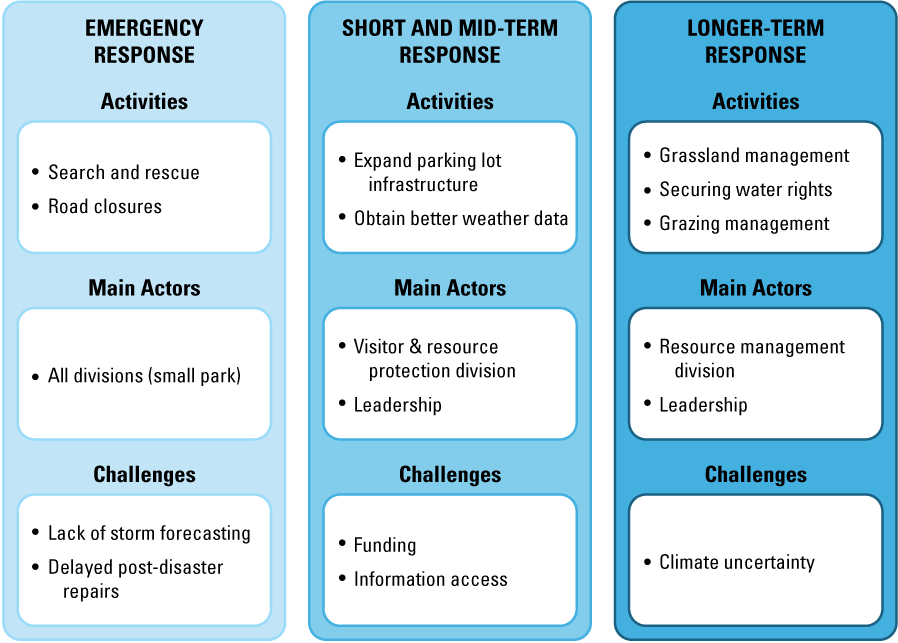
Activities, main actors, and challenges described by interviewees for emergency, short- to mid-term, and longer term response timeframes.
4.1.3. Understanding of Ecological Transformation Among Park Staff
Interview participants reported that staff at Capitol Reef generally agree about the projected future climate conditions in the Park, but that they are less clear about how those conditions will influence future management priorities. As one interviewee described:
I have a pretty clear understanding of where [the climate is] headed. I don’t think the science is too much in question. We can talk about our scenario planning…like warm and wet, and hot and dry.4 I don’t think it really makes a difference in terms of how we manage going forward. It’s the uncertainty of what we manage, what we choose, what the triage is. We have endemic plants. They just shift right off of the Park [in terms of climatic envelope]. Is it our responsibility to create refugia? I think there are a number of unknowns like that (CARE, 7).
This is a reference to the Park-specific downscaled climate models provided for CARE by the National Park Service Climate Change Response (National Park Service Climate Change Response Program, 2024). The “warm and wet” scenario envisions moderately higher air temperatures and increased precipitation while the “hot and dry” scenario envisions even higher temperatures accompanying by decreased precipitation. For more information about how these climate projections are produced, see Lawrence and others (2021) and Runyon and others (2024).
As in this quote, multiple participants agreed with the climate projections described in the Capitol Reef Climate Futures Summary Report (National Park Service Climate Change Response Program, 2024) but are grappling with the uncertainty of what to do in response, or how to respond in the face of what they consider to be a lack of data and information.
Such queries are driving interviewees to confront stewarding a national park in a time of change. The same staff member described how addressing the challenge of ecological transformation may require larger shifts in how park staff approach their roles:
I think the biggest one [perspective about ecological change] that hinders parks is this notion of a static landscape that we are here to preserve and protect. That’s shifting under our feet. I think a lot of us don’t know how to handle that. I think it becomes counterproductive, and I’ll use the primary example [of] the biologist who’s got their one plant or their one animal, and they are going to hang on to that thing while everything else disintegrates around that, and we bought into this for restoration projects. I think that is a tough thing for people in this agency to manage…parks make up such a tiny part of the landscape. To really talk about conservation, from a biological perspective, we have to talk about the rest of the landscape and stop treating [parks] as islands. (CARE, 7)
Similarly, other participating staff suggested that it may not be possible to protect every endemic species, community, or ecosystem feature with the available time, resources, and attention. Some mentioned that the boundaries of the Capitol Reef are unique given the elongated shape of the Park, which can create challenges in terms of the need to work in concert with agencies like the Bureau of Land Management and U.S. Forest Service that share boundaries. Other participants reported they were uncertain about how precipitation changes and shifting baselines for available water resources will affect the Park, in particular future water available for irrigating the orchards.
One specific issue about ecological transformation that participants discussed in the context of uncertainty was the issue of managed relocation of species. Staff mentioned species relocation in the context of broader discussions about determining the appropriate baselines for populations or targets for restoration, which might mean restoring species to historic ranges or might mean actively managing for future potential ranges (in other words, northern migration of species as climate shifts) or could even mean introducing species and genetics from other geographies. One participant explained the dilemma in this way:
Do we restore to just like what the native ecosystem would have been 10 years ago, or do we think about different species…that might be better suited for the changing climate? Which would be an example of…assisted migration where we’re bringing in genetically adapted species from Arizona or something like that (CARE, 1).
One participant, talking in general terms about uncertainty, pointed out that as of yet, staff had not encountered a major disagreement or “serious management actions where we were on different sides,” but that there is variance in how staff across the Park thinks about what the available data means for planning and that staff deals with “[the] lack of information differently” (CARE, 1). This interviewee continued, “it might be more like, we’re discussing a topic and thinking about what it means, but there is some variation in how folks deal with the uncertainty.”
4.1.4. Using the Resist-Accept-Direct Framework to Think about Ecological Transformation at Capitol Reef National Park
Capitol Reef staff are early adopters of the Resist-Accept-Direct (RAD) framework. The RAD framework is a thinking and communication tool developed by an interagency group including the NPS CCRP to guide unit-level managers responding to ecosystems facing the potential for rapid, irreversible ecological change (Schuurman and others, 2020, Schuurman and others, 2022, Schuurman and others, 2025). The framework describes three options—resist, accept, and direct—that collectively encompass the entire set of possible decisions for responding to ecological transformation. It thereby aids NPS managers to make deliberative choices about ecological change (National Park Service, 2025). Capitol Reef staff are employing the RAD framework in multiple retired grazing allotments on rangelands in three different parts of the Park to guide ecosystem restoration in response to land use impacts as well as ongoing and anticipated climate change impacts (Thomas, 2024).
In the interviews, Capitol Reef staff described how they are using the RAD framework to shape restoration efforts. For example, one participant described how they think the RAD framework will shape the work they do in the future:
We’re explicitly thinking about the RAD framework on a regular basis when we think about ecosystem restoration...I think that questions around RAD and climate change are going to just be more and more a part of what I do and a part of our planning processes…This is a long-term priority for resource management (CARE, 1).
This quote highlights that those working in natural resource management are actively thinking about RAD and using it as a tool for adaptive management. The interviewee explained that staff understand the science, and that RAD provides a “good sort of conceptual example of that type of adaptive management” (CARE, 1) to implement in a changing landscape. In the interviews, only those with natural resource or ecological training mentioned the RAD framework.
Interviewees in other divisions described how Capitol Reef’s leadership is climate-focused, which informs all of the Park’s operations. One staff member prefaced that past leadership had not been as focused on climate but contrasted the past with the present (at the time of the interviews; CARE, 2). Another staff member repeated this point, “I think people [in the Park] are focused on climate change. I think in general it's accepted that it's going to [require] making changes to the way that we do things in the coming years” (CARE, 4).
4.2. What Influences How Capitol Reef National Park is Responding or Could Respond to Ecological Transformation and Climate Change?
As described in section 4.1, transforming ecosystems present a complicated challenge for park staff, and determining what to do depends on more than scientific data. One way of analyzing these factors was presented by Clifford and others (2022) in their conceptual model of a natural resource manager’s decision space for responding to ecological transformation. In the Clifford and others (2022) model, the decision space exists at the intersection of internal factors (someone’s mental model of the world, comprised of worldviews, culture, and understanding of ecological transformation) and external constraints, particularly scientific uncertainty (in other words, the state of relevant scientific knowledge and available data), institutional context (in other words, laws, policies, and administrative procedures that constrain planning and management decisions), and social feasibility (in other words, the influence of partner agencies’, resource users’, surrounding communities’, and the greater public’s attitudes towards resource decisions; fig. 3). Together, these internal and external factors explain what options managers consider desirable and feasible. In section 4.2, we use the structure of the Clifford and others (2022) model to organize the factors that interviewees mentioned as influencing their decision making about ecological transformation and climate change in Capitol Reef. The first two sections describe internal factors that shape mental models: section 4.2.1. summarizes the influence of employee backgrounds and worldviews and section 4.2.1 describes the role of culture (at the unit- and NPS-levels). Section 4.2.3 reports how both individual understandings of ecological transformation (an internal factor) and the state of scientific knowledge (an external constraint) shape responses to ecological transformation in the Park. Section 4.2.4 describes the role of social feasibility and stakeholder perspectives as a constraint on employees’ decision making. The final two sections report on two aspects of institutional context that shape decision making: financial resources and funding models (see section 4.2.5) and regulatory context (see section 4.2.6).

A natural resource manager’s decision space as conceived by Clifford and others (2022). The decision space is shaped by a combination of internal and external factors that determine available and favorable alternatives for managing transforming ecosystems. Importantly, none of these factors are fully distinct and in many cases can overlap or combine. Figure appeared originally in Clifford and others (2022).
4.2.1. Employee Backgrounds and Worldviews
Like in any NPS unit, Capitol Reef staff bring a range of personal backgrounds to their roles. Participants described how aspects of their backgrounds and worldviews (in other words, their general set of attitudes and beliefs that subtly shape how they make sense of the world) influence their perspectives about what stewardship means and their opinions about what actions the Park should take in the face of climate change (fig. 4).
One key theme was experiences with and attitudes toward agriculture and working lands. Capitol Reef has a rich history of agriculture preserved in its Fruita District orchards and maintains one active grazing allotment in the Park (Witwicki, 2020). One staff member described how this history of agriculture links to their understanding of the Park and their professional role:
That [working lands element of the Park] is one of the reasons I came here…I liked the fact that this is a porous park. It’s not a headwater kind of jewel, where…we [can] ignore everybody else…We talk to the ranchers. We try to get along with the ranchers, try to—I’d love to be talking about land trusts because nobody wants to see these valleys developed and the ranches go away. There’s still this tension between environmentalists and the locals, and it just—I think it’s a classic tale of the West. It’s just probably more acute here (CARE, 7).
Another staff member, when talking about park-level priorities for responding to climate change, emphasized they hope park management maintains the current commitment to the orchards: “I think it is absolutely critical to just the bones of this park” (CARE, 4). Multiple participants shared they have family ties to the region (some over multiple generations), grew up participating in agriculture, or are currently actively engaged in agriculture in some capacity in their personal lives.
A second theme related to employee worldviews is attitudes that participants hold about human-wildlife interactions. In the interviews, some employees considered culling to be an acceptable wildlife management option for managing outbreaks of a bacterial pathogen, Mycoplasma ovipneumoniae, in the Park’s population of desert bighorn sheep (Ovis canadensis nelsoni) while other employees did not agree. This quotation discusses the Mycoplasma ovipneumoniae outbreak documented in 2018 at Capitol Reef where one desert bighorn sheep was euthanized by the Park in winter of 2021–22 (Sloan and Wehtje, 2022), illustrating the tension in underlying values that shape how park staff make choices about managing wildlife:
Again, the bighorn sheep culling example, there has been some pushback from co-workers, fellow Capitol Reef employees that are not comfortable with that as a management action or only comfortable as…a last resort. Whereas…I would probably both say that the science is fairly clear [and] that it’s the right thing to do biologically…Killing a fairly large, charismatic animal versus just letting nature run its course (CARE, 1).
It is worth noting that this range of views is not unique to Capitol Reef; culling wildlife tends to be a contentious and often unpopular wildlife management strategy (Martínez‐Jauregui and others, 2020; Rubino and Serenari, 2022). As the quote above suggests, one set of attitudes emphasizes the risk of disease spread. While not explicitly present in the data, the other set of attitudes may implicitly emphasize the effort invested to reintroduce desert bighorn sheep in the 1960–1990s and threats to the species from climate, domestic sheep, and predation (Struthers and others, 2022). Alternatively, resistance to culling could be more emotional, related to ideas about what Capitol Reef is like as a place with or without reintroduced desert bighorn sheep, or ideas about what the appropriate role of a manager in a National Park or protected area should be (Wright, 1999; Bath and others, 2022).
4.2.2. Professional Culture
Another internal factor that shapes how employees respond to ecological transformation and climate change is the cultures they belong to, including the professional culture of NPS at both the unit level and the wider agency level (fig. 4).
At the Park level, participants reported that Capitol Reef's internal culture is shaped by collaboration, face-to-face communication, and frequent interdivisional work. These norms are fostered out of necessity due to the relatively small size of the Park’s staff, especially when compared to the acreage of the Park. One employee described that the divisions are not as siloed as at other parks where they had worked. This interviewee likes to “view it as a system and not necessarily individual divisions and that we are [functioning] as a park unit. Everything basically meshes together like a big jigsaw puzzle” (CARE, 8). Another participant explained that they “see folks from every division...[on] a daily basis” (CARE, 3). Such frequency of interacting and communicating is another aspect that defines Capitol Reef’s park-level culture.
These norms of frequent communication and interdivisional work shape how Capitol Reef staff respond to climate change, especially in the case of flash flooding events. Staff pointed out how multiple divisions conduct search and rescue operations: “it’s interdivisional, so that’s some people from Resources and Interpretation, [also] Maintenance” (CARE, 6). Another participant explained how the size of the Park staff, the shape of the Park and its geography combine to necessitate interdivisional collaboration:
We have a lot of boundaries, [we are a] long skinny park that’s surrounded by Forest Service and BLM that have active grazing allotments. We have lots of boundaries, fence boundaries that border areas where there are cattle grazing...we have some areas where cattle are permitted within the Park, but we have lots of areas where a fence breaks from flooding and cows just drift in, and so that’s interdivisional [to respond]. We’re basically all on a team trying to figure out which fences are down (CARE, 1).
As these examples illustrate, Capitol Reef employees described working together across divisions to address challenges they encounter, which suggests a strength for the Park as it responds to climate change and ecological transformation.
Individual Capitol Reef employees work within both the structure of Capitol Reef as a unit and the larger structure of NPS as an agency. Thus, the culture of both the Park and the wider agency subtly shapes the experiences of individual employees as they go about their work. Participants described two key aspects of how the wider culture of NPS influences their approach to their roles. First, as representatives of the national park system, they emphasized that earning and keeping the public’s trust is important and often motivating on a personal level. Second, participants described how the rules and norms of NPS can sometimes create additional challenges in their efforts. For instance, one employee characterized the tension they experience between wanting to find creative management solutions and feeling constrained by NPS norms: “I think it's very easy to get completely locked into a very rigid way of thinking within the Park Service, with how many rules and regulations there are” (CARE, 4). For more on how regulatory context affects responses to ecological transformation, see section 4.2.6.
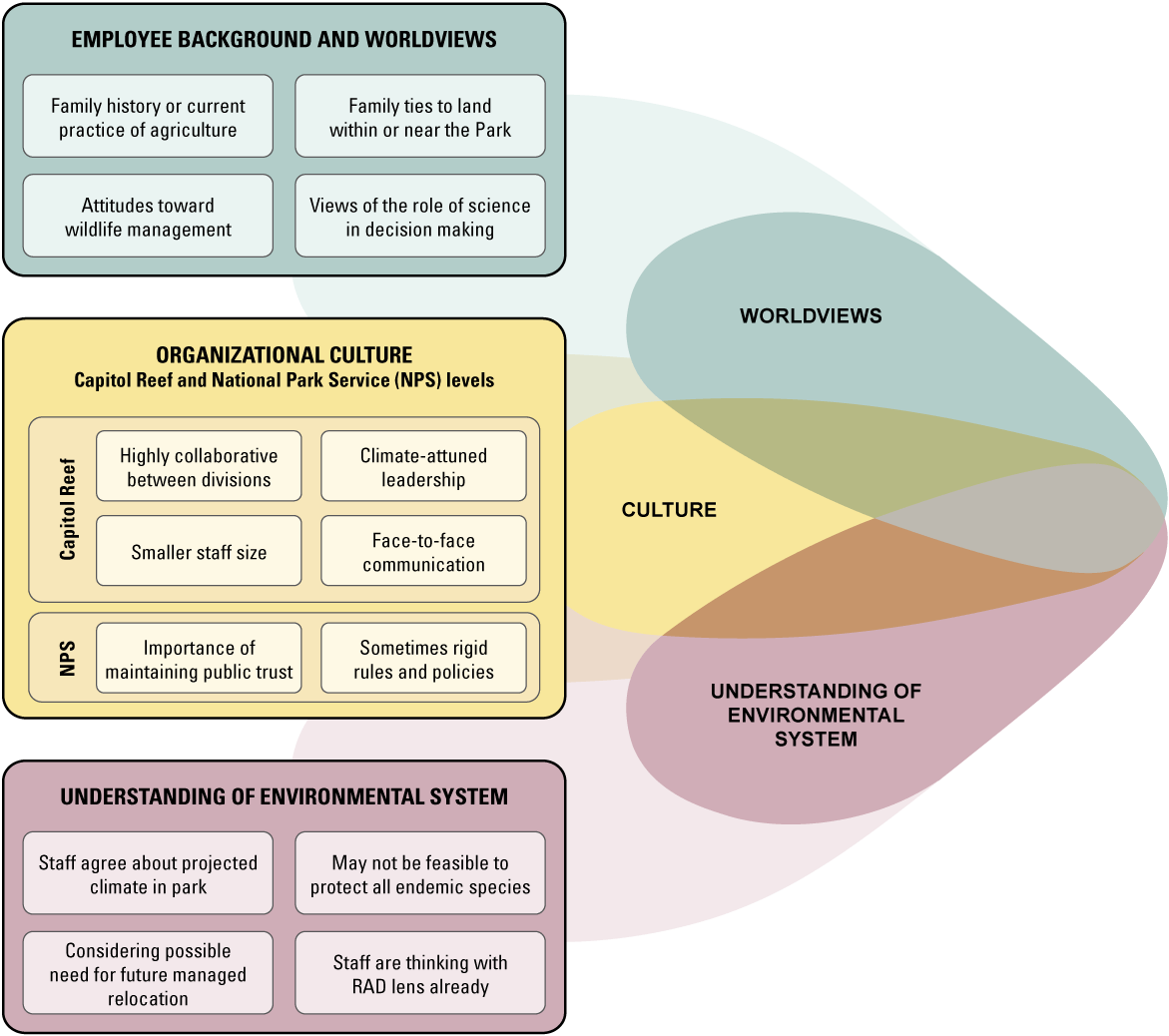
Summary of how interviewees described the influence of internal factors (backgrounds and worldviews, organizational culture, and understanding of the environmental system) on their responses to ecological transformation and climate change. [NPS, National Park Service; Capitol Reef, Capitol Reef National Park; RAD, Resist-Accept-Direct]
4.2.3. Data Availability, State of Scientific Knowledge and Scientific Uncertainty
Scientific understanding appears in the Clifford and others (2022) model both at the individual, internal level (how a person makes sense of scientific information for decision making) and at the external level of the state of the science (the state of knowledge or availability of data to inform a decision). In the interviews, participants described their own personal understanding of the state of the scientific knowledge and uncertainty focused on the lack of data for specific species (fig. 4). Natural resource management staff emphasized that there is limited long-term data for certain species (for example, blackbrush [Coleogyne ramosissima], cheatgrass [Bromus tectorum], desert bighorn sheep [Ovis canadensis nelsoni], and Mexican spotted owl [Strix occidentalis lucida]).
Participants also mentioned general park-level challenges with data availability and obtaining relevant scientific information (fig. 5). Data availability challenges arise at Capitol Reef due to the Park’s large area, remoteness, and limited staff capacity for scientific research. Additionally, the Park has relatively few partnerships with university or outside researchers who might increase research and monitoring capacity. Capitol Reef’s main partnership is with Utah Valley University, which operates a field station in the Park and provides yearly intern support to the Park, but is primarily focused on educational endeavors.5 Some interviewees mentioned two key factors that they perceive to contribute to relative scarcity of long-term research partnerships in Capitol Reef. First, the Park is geographically distant from most research universities. Second, some interviewees indicated that outside institutions may perceive compliance with the National Historic Preservation Act Section 106 (§ 54 U.S.C. § 306108; see table 1) as a barrier to working at the Park. The high density of cultural resources in the Park means that compliance approval for research takes time.6 One participant explained: “University researchers…come in [expecting it to be] real quick, wanting to do something, and we’re like, ‘Maybe you can do that in six months,’” which is seen as a barrier. This staff member continued, explaining that researchers often respond by choosing field sites elsewhere: “Oh, [I am] no longer interested. I’m going to go work with the BLM—or something.’ Yeah, that’s a challenge.” (CARE, 1). In Capitol Reef, as described by some interviewees, this relative lack of partnerships influences the availability of tailored science and data and thus ultimately the Park’s understanding of ecological transformation or climate change impacts on resources.
Capitol Reef Field Station is operated by Utah Valley University through a partnership with Capitol Reef National Park which owns the property. For more information about the research station, see their website (https://www.uvu.edu/crfs/about.html) and annual report (https://www.uvu.edu/crfs/docs/annual-report-2023.pdf).
Research in national park units (and similarly on other federal lands) is performed under permits that ensure compliance with requirements of numerous statutes including the Endangered Species Act, Wilderness Act, National Environmental Policy Act, Archaeological Resources Protection Act, the Antiquities Act, the National Historic Preservation Act, and the Native American Graves Protection and Repatriation Act, etc., as applicable. Time required for this compliance depends on several factors, such as the extent and complexity of the proposed research, and staff workloads and approaches, among others. For more about National Park Service (NPS) research and compliance, see NPS Management Policies 2006, Sec. 4.2 and 5.1; and 36 CFR 2.1 and 2.5.
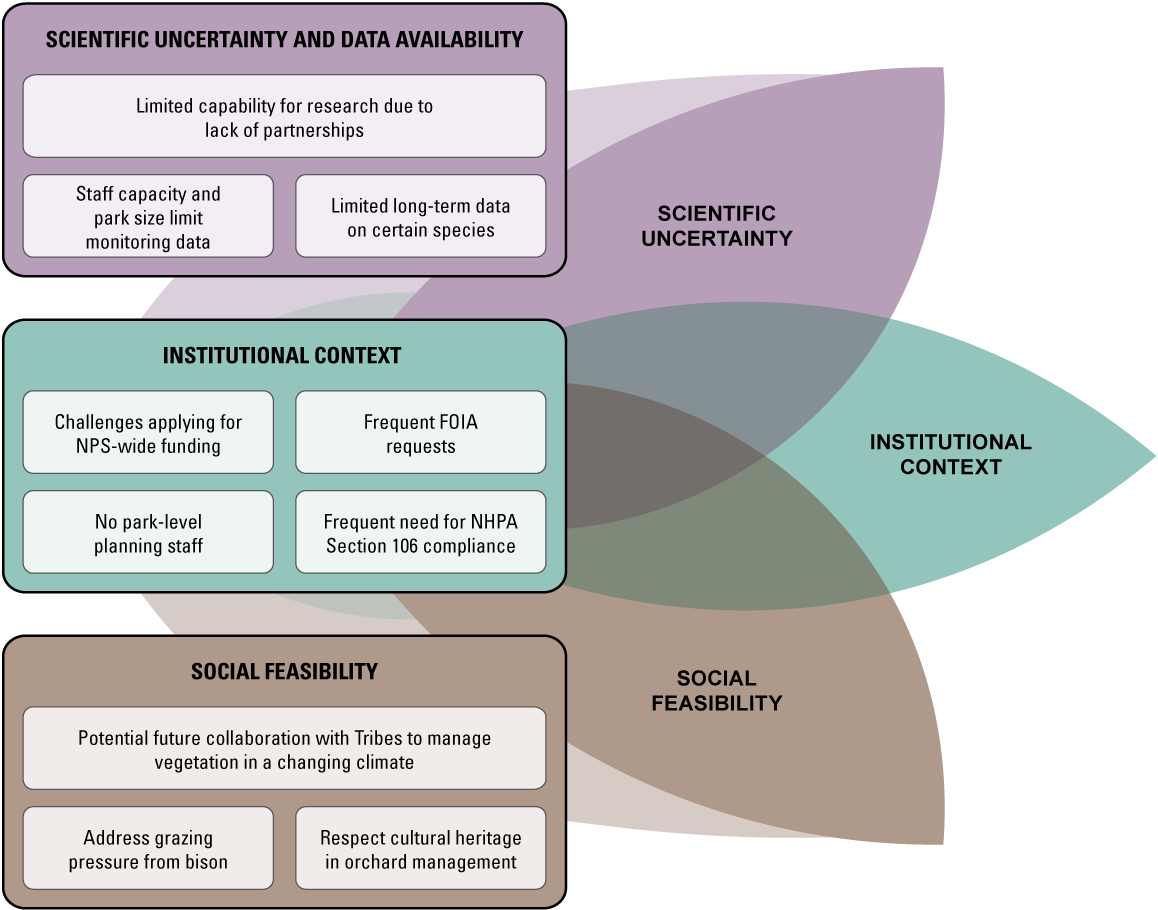
Summary of how interviewees described the influence of external factors (scientific uncertainty and data availability, institutional context, and social feasibility concerns) on their responses to ecological transformation and climate change. [NPS, National Park Service; FOIA, Freedom of Information Act; NHPA, National Historic Preservation Act]
4.2.4. Social Feasibility
Clifford and others (2022) define social feasibility as the way that perspectives of those outside a unit or agency influence or constrain the decision making of natural resource managers. Thirty-two Tribes have ties to lands now managed by the Park and thus may desire to consult on decisions that affect its resources. The social feasibility of RAD decision making at Capitol Reef is also influenced by stakeholders' perspectives, particularly settler descendants and local communities, most of whom are heavily involved in agriculture. Given the diversity of perspectives among stakeholders and Tribes, making decisions about climate change and ecological transformation that balance these views and meet responsibilities for tribal consultation can be challenging. One interviewee described the tension: “It's a very fine balance. It's often a knife edge, it feels like.” (CARE, 5). Staff mentioned three main ways that outside perspectives influence the Park’s choices (fig. 5).
First, some interview participants shared that they see vegetation management in a changing climate as an opportunity for future collaboration with Tribes. One interviewee described this example of collaboration for climate adaptation as follows:
I think vegetation and changes in vegetation is a perfect example [of] involving Tribal communities who have been on this landscape for much longer than we have and have been dealing with those types of changes…[as we in the Park] look at massive revegetation projects, we'll likely have Tribal components, consultation requirements...to address climate-change impacts (CARE, 9).
As this quote summarized, staff suggested that working with Tribes might be important in future climate adaptation efforts at Capitol Reef. Similarly, the Park has identified this as an area for future collaboration and potential co-stewardship (Struthers and others, 2022).
Second, participating staff described their perception of how descendants of early Church of Jesus Christ of Latter-day Saints settlers consider it important that the Park maintain the Fruita orchards and other heritage relevant to historical settlement. One employee described interacting with visitors that have ties to the families who originally planted the Fruita orchards. This interviewee linked the maintenance of the orchards to the Park’s ability to maintain community support: “I think it's really important that we keep those relationships going, so we have the blessing of folks around here, and that we honor those histories,” (CARE, 4). The employee shared that the community has recently been pleased with orchard upkeep and plantings but is sometimes frustrated by federal processes required to complete necessary work. Another staff member summarized their understanding of the Church of Jesus Christ of Latter-day Saints community’s view: “They’re like, “Yeah. As long as you keep the orchards running, we really don’t care how you do it,” (CARE, 7). Capitol Reef is relatively unique among parks in stewarding a living orchard. Participants emphasized that the community’s desires to preserve heritage and park employees’ desires to fulfill this trust will guide future decision making in the Fruita district, even in the face of ecological and climatological change.
Finally, participants described that the Park and local ranchers have shared interests in planning for and responding to encroaching ungulates from state lands, including the Henry Mountain bison herd7 and elk populations on neighboring lands. One participant described the complex situation:
Utah has two free-ranging bison herds on public lands that are managed as wildlife through hunter harvest, one of which is found in the Henry Mountains. For more information, see Bates and Hersey (2016).
There’s not enough actual forage [up in the Henry Mountains] for the bison. At this point in time, in the winter especially, the cow-calf bison come down into the Park. They stay in the Park. Our fences can’t keep them out. There’s no fence that will keep them out because they’re bison, and they do what they wish, but at the same time, this is the grazing allotment in the winter with the cattle on it. It was never intended to have an equal number or more bison grazing at the same time on it. Then you throw in this climate change scenario (CARE, 8).
Another participant explained that neither park employees nor ranchers know the full extent of the bison’s impact on forage “because they are having a lot more use down there than we planned for. We didn’t plan for bison. We planned for cows,” (CARE, 7). Moreover, grazing pressure on different forage species is increased by the “state-managed game park’s 1,500 elk,” (CARE, 7). Interviewees emphasized that responding to ecological change in this setting will be important for both the health of park vegetation and for agricultural stakeholders.
4.2.5. Financial Resources and Funding Models
Clifford and others (2022) describe how institutional context influences what a manager can do, or what they assess as the most feasible or preferable option. Institutional context includes “laws, policies, and administrative procedures that require or prohibit actions, shape resource flows, and influence management decisions” (Clifford and others, 2022, p. 62). In section 4.2.5, we describe how the institutional setting of NPS determines availability of financial resources for Capitol Reef’s response to climate change and ecological transformation. Then, in section 4.2.6., we summarize participant comments about the role of specific laws or policies in shaping regulatory context.
Interviewees discussed a range of challenges that shape resource availability, including increasing visitation, the process of internal funding and grant procurement, and frequent reliance on outside technical assistance (fig. 5). While not a challenge unique to Capitol Reef, staff explained that the current budget and funding structure is not sufficient to deal with increasing visitation, emergency response, and climate adaptation needs. One interviewee explained that the deficiency is even more pronounced when acreage per park is accounted for: “There’s a lot of parks that have similar visitation numbers, but could have a budget that’s three times ours, and they might have a fraction of the acreage.” (CARE, 1). This interviewee explained how historic visitation patterns shape the Park’s budget and how rapid changes in visitation have created an issue: “Capitol Reef became a park in 1971, and we had absurdly low visitation and slow visitation growth for a long time … [current] core park budgets were set around those [visitor] numbers,” (CARE, 1). Another staff member (CARE, 7) mentioned that the Inflation Reduction Act (of 2022) money allocated for National Parks was based on the amount of money the U.S. Congress allocates for each park unit—which is related to historic visitation. At Capitol Reef, the recent increase in visitation over the last decade, combined with the large, remote acreage of the Park’s geography and the annual appropriation, shapes the speed and extent to which the Park is able to respond to emergencies like flash floods or staff search and rescue efforts in the Park, which becomes increasingly important with increasing heat levels and more frequent storms in the Park.
As a result of perceived resource shortfalls, participants explained, Capitol Reef administrators must procure money to meet certain needs through competitive NPS-wide funding requests, cost-share with other organizations, and other creative funding or hiring solutions. Due to the Park’s reliance on competitive funding mechanisms, park staff must pay attention to application timelines and the resources it takes to compete for these monies:
[One of the challenges is] the timelines for when funding comes available, and when we’re told about it. Also, being prepared to actually submit projects to be considered and things like that seem to be… pretty skewed towards really large parks that have big staffs…they have whole planning staffs that are always prepared and ready (CARE, 1).
In Capitol Reef, in contrast, there are no planning staff or designated staff to apply for NPS-wide funds; interviewees described how this is part of other employees’ workload. Further, one interviewee noted, there is a trade-off between focusing on emergencies and solving short-term challenges versus writing proposals to address longer-term needs: “How do you get there when you’re just in the day-to-day trench trying to manage and react, manage flooding, manage cows down in the creek? (CARE, 7).
A second result of the current funding levels and structure is that the Park receives support and technical assistance from the National Park Service’s Intermountain Regional Office, particularly for technical aspects of cultural resource compliance, planning, modeling, and other regulatory issues. One participant described the ways that the Region assists the Park with compliance:
We rely heavily on regional staff…[for instance] a conversation with the Historic Preservation Services Program at the Intermountain Region regarding several projects that we have coming up, cultural landscape inventories, and baseline documentation projects coming up. I think we have a pretty broad net, particularly since we're a small park here, for cultural resources. We tap into a lot of external resources (CARE, 9).
Multiple interviewees mentioned that Capitol Reef does not have specialized staff for planning functions, which means the Park relies on the regional office for assistance: “There’s a whole planning context that needs to happen, but we’re completely dependent on the Washington and regional offices because we don’t have the expertise.” (CARE, 7). Beyond the technical capacity, the interviewee mentioned that “We [at Capitol Reef] don’t have the funding either” (CARE, 7), which presumably limits capacity for climate adaptation planning.
4.2.6. Regulatory Context
The laws and policies that shape how staff manage natural or cultural resources constitute another aspect of institutional context. As at any National Park, staff at Capitol Reef must comply with relevant regulations. Table 1 briefly describes key laws mentioned by interviewees and summarizes their comments about how these laws shape efforts to address climate change and ecological transformation in Capitol Reef (also see fig. 5).
Table 1.
Regulatory constraints at Capitol Reef National Park, Utah as described by interviewees.[Abbreviations: FOIA, Freedom of Information Act; NEPA, National Environmental Policy Act; NHPA, National Historic Preservation Act; U.S.C., United States Code; NPS, National Park Service]
| Law | Summary of participant perspectives on how the law relates to challenges of climate change and ecological transformation | Specific examples mentioned by participants |
|---|---|---|
| Endangered Species Act (16 U.S.C. §§, 1531-1544) | Complying with this law managing listed species and working with the U.S. Fish and Wildlife Service can sometimes create a constraint in Capitol Reef’s efforts to respond to climate change. | Staff had to both account for climate impacts and ensure endangered plants were not
impacted when developing the 2018 grazing plan and with ongoing management of cattle
grazing and trailing in the Park (CARE, 1; CARE, 7; CARE, 8). Capitol Reef is a signatory with the state of Utah in a conservation agreement with the U.S. Fish Wildlife Service to maintain Pleasant Creek and the Fremont River’s water levels to protect the decline of three fish species. (CARE, 8). In the face of uncertain future water resources in the Park, compliance might become more challenging. |
| Freedom of Information Act (5 U.S.C. § 552) | Grazing management in Capitol Reef has been controversial and the focus of past lawsuits. Litigants have used FOIA to obtain agency records. | Staff highlighted the time required to manage relevant records and respond to FOIA requests (CARE, 7; CARE, 8). The scrutiny of repeated lawsuits may also shape how staff make choices in response to new ecological or climatological conditions; research in public administration has suggested that the threat of lawsuits may make agencies more risk adverse (for example, Marantz and Ulibarri [2019]). |
| National Environmental Policy Act (42 U.S.C. §§ 4321 et seq) | Staff described that they must work across divisions and communicate frequently to comply with NEPA’s required deliberate process. Staff considers this when undertaking any major project that significantly affects species, ecosystems, or other resources that requires NEPA compliance. | Some participants perceived that due to the high number of cultural resources in the Park, NEPA may be triggered for a wide range of activities, including natural and cultural resource conservation, facilities construction projects, and research activities (CARE, 8). As described in section 4.2.3, some participants perceived that the combination of abundant cultural resources and frequent need for NEPA compliance influences the amount of scientific research that happens in the Park and thus the amount of locally-relevant data that exists about climate change and ecological transformation. |
| National Historic Preservation Act, Section 106 (U.S.C. 54 U.S.C. § 306108) | Section 106 of the NHPA requires federal agencies to review potential impacts to historic buildings, cultural and archeological resources when taking certain actions. Like with NEPA, the density of cultural resources in the Park means that NHPA Section 106 compliance may affect research and restoration efforts in the Park. | Some participating staff perceived compliance with NHPA Section 106 to create administrative
burdens for completing the process prior to the start of projects, thereby creating
uncertainty about timelines and budgets for projects that have any ground disturbance
(CARE, 1). Capitol Reef relies on frequent assistance from the NPS Intermountain Regional Office to accomplish required reviews under this law (CARE, 9). |
5.0. Summary
In this report, we summarized how participating Capitol Reef National Park (hereinafter referred to as “Capitol Reef” or “the Park”) employees perceive the challenges of climate change and ecological transformation. Then we used the Clifford and others (2022) conceptual framework to describe internal and external factors that shape how Capitol Reef staff are responding to this challenge (see section 4.2). We hope these findings from the pilot interview dataset may aid the Park as it addresses climate adaptation in the future and perhaps be of interest to other units grappling with similar challenges.
5.1. Biggest challenges
Interviewees reported that the two biggest challenges related to climate adaptation planning and decision-making were planning for and responding to: (1) increasingly intense and frequent flash floods and (2) arid conditions in the Park. Flash flood events affect park operations, visitor-use management, and budgets for other projects at Capitol Reef. Participants emphasized how emergency response demands contributions from all staff across all divisions during storm or flood events. They also described how preparing for future flood events is a short to mid-term planning priority: increasing the resilience of infrastructure—such as roads and parking lots—to storms, ensuring visitor safety, and obtaining funding for upgrades or repairs. For example, flash floods wash out fencing in the active grazing allotment, which creates cascading needs for response to protect resources when cattle are not contained within the allotment. Flash floods thus can exacerbate existing challenges such as legal and regulatory compliance, overburdened infrastructure, and demands on the Park's small staff.
Managing increasingly arid conditions in the Park was the other climate impact highlighted by participants. Staff described how rising temperatures and shortages of surface water in rivers and streams can stress plants and wildlife as well as the fruit orchards within the Park’s Fruita historic district. The interviewees emphasized that changes in precipitation patterns will likely affect various vegetative communities including multiple endemic species. One example of the cascading impacts they mentioned was that plant die-off can lead to increased erosion, which can then threaten or damage archeological resources. Park planning for this challenge has focused on restoring soils, managing the added stressor of livestock grazing, and considering potential needs to secure additional water rights for the Park in the future. Rising temperatures, shifting precipitation regimes, and surface water shortages present a challenge across park divisions.
5.2. Areas of Agreement and Disagreement among Participants
Park staff were interested in identifying areas of agreement or disagreement about ecological trajectories and management responses that might exist among employees at Capitol Reef (though these findings need to be interpreted in light of the small size of the pilot interview dataset; see “Methods”). We found that study participants generally agreed about the future effects of climate change in the Park in terms of atmospheric conditions. This is not necessarily surprising given the interviews took place shortly after staff participated in scenario planning workshops led by National Park Service’s Climate Change Response Program; indeed it likely indicates a shared vision of future climate conditions that emerged among park staff from participating in the scenario planning process.
Interviewees also agreed that leadership in the Park had made climate change a priority and created a climate-focused culture among staff. Interviewees were similar to one another in that they were generally uncertain about how successful specific species will be in the future climate at Capitol Reef. For example, some thought endemic plant species will struggle under future climate scenarios, and others thought the loss of these species was less likely, or they were unsure. As a result, interviewees reported uncertainty about which species or ecological communities were most in need of attention; however, some study participants hold roles that would not normally be expected to have detailed knowledge about species or ecosystems. Among the natural resource management staff interviewed, there was some disagreement about how much or what type of scientific data would be necessary before taking actions such as restoration or species relocation (for example, rangeland restoration, introducing grass species through assisted migration, or culling desert bighorn sheep).
Finally, some interview participants perceived that compliance with cultural resource and historic structures is an added challenge in planning for climate change and responding to ecological transformation. The administrative burden of compliance takes up substantial time and staff capacity at Capitol Reef due to the technical aspects of the compliance process and the way it affects projects across divisions. In addition, cultural resource management often involves consultation with Tribes, coordination with the State of Utah and other local stakeholders, and work with the National Park Service's Intermountain Regional or Washington offices. Participating staff mentioned compliance with other laws (National Environmental Policy Act, Endangered Species Act, Freedom of Information Act) as well, highlighting what the Clifford and others (2022) framework suggests conceptually: compliance with laws or policies may constrain which options are perceived as preferable or feasible for responding to climate change and ecological transformation.
5.3. Possible Areas for Future Conversations across Divisions
Park staff were also interested in highlighting areas for future conversations across divisions within Capitol Reef. Based on areas of agreement and disagreement in the pilot dataset, some areas for fruitful discussion might include how the Park is prioritizing different actions under climate change, how to make decisions about threatened and endangered species as ecosystems transform, how to plan for future vegetation communities across the Park given a range of ecological trajectories, and how to move forward in the face of uncertainty and scarce data.
5.4. Conclusion
In closing, this report highlights a range of challenges that staff at Capitol Reef are facing as ecosystems transform in a changing climate. In addition to describing direct impacts on natural and cultural resources, participating employees discussed how climate change intersects with and sometimes comes into tension with existing policies, management approaches, and funding models. At the same time, interviewees also discussed numerous ways the Park is already successfully addressing climate change using the Resist-Accept-Direct framework and capitalizing on strong interdisciplinary relationships and teamwork. By highlighting both challenges and opportunities, the results of this pilot study could help the Park continue to build on early successes and address the complex challenges of the future more holistically.
References Cited
Bates, B., and Hersey, K., 2016, Lessons learned from bison restoration efforts in Utah on western rangelands: Rangelands, v. 38, accessed February 20, 2025, at https://doi.org/10.1016/j.rala.2016.08.010.
Bath, A.J., Engel, M.T., Van Der Marel, R.C., Kuhn, T.S., and Jung, T.S., 2022, Comparative views of the public, hunters, and wildlife managers on the management of reintroduced bison (Bison bison): Global Ecology and Conservation, v. 34, 11 p., accessed September 27, 2024, at https://www.sciencedirect.com/science/article/pii/S2351989422000178?via%3Dihub.
Clifford, K.R., Yung, L., Travis, W.R., Rondeau, R., Neely, B., Rangwala, I., Burkhardt, N., and Wyborn, C., 2020, Navigating climate adaptation on public lands—How views on ecosystem change and scale interact with management approaches: Environmental Management, v. 66, no. 4, p. 614–628, accessed September 30, 2024, at https://doi.org/10.1007/s00267-020-01336-y.
Clifford, K.R., Goolsby, J.B., Cravens, A.E., and Cooper, A.E., 2022, Rapidly assessing social characteristics of drought preparedness and decision making: A guide for practitioners: U.S. Geological Survey, Reston, VA., 41 p., accessed September 30, 2024, at https://doi.org/10.3133/tm17A1.
Cole, K.L., Henderson, N., and Shafer, D.S., 1997, Holocene vegetation and historic grazing impacts at Capitol Reef National Park reconstructed using packrat middens: The Great Basin Naturalist, v. 57, no. 4, p. 315–326, accessed September 26, 2024, https://www.jstor.org/stable/41713018.
Coles, J., Clark, D., Dela Cruz, M., Clark, T., Topp, S., Evenden, A., Wight, A., Wakefield, G., and Von Loh, J., 2009. Vegetation classification and mapping project report, Capitol Reef National Park: Fort Collins, Colorado, National Park Service, Natural Resource Technical Report NPS/NCPN/NRTR—2009/187, 882 p.
Corbin, J., and Strauss, A., 2008, Basics of qualitative research—Techniques and procedures for developing grounded theory (3rd ed.): Thousand Oaks, CA, Sage Publishing. https://doi.org/10.4135/9781452230153.
Cravens, A.E., Clifford, K.R., Knapp, C., and Travis, W.R., 2024, The dynamic feasibility of resisting (R), accepting (A), or directing (D) ecological change: Conservation Biology, v. 39, no. 2, 12 p., accessed September 30, 2024, at https://doi.org/10.1111/cobi.14331.
Department of the Interior, 2023b, Department of the Interior department manual—Part 526—Climate change science—Chapter 1—Applying climate change science: Washington D.C., Department of the Interior, accessed October 2, 2024, at https://www.doi.gov/document-library/departmental-manual/523-dm-1-climate-change-policy-transmittal-sheet.
Department of the Interior, 2023a, Department of the Interior department manual—Part 523—Climate change adaptation—Chapter 1—Climate change policy: Washington, D.C., Department of the Interior, accessed October 2, 2024, at https://www.doi.gov/sites/doi.gov/files/elips/documents/523-dm-1.pdf.
Fisichelli, N.A., and Ziesler, P.S., 2015, Capitol Reef National Park—How might future warming alter visitation? (Park visitation and climate change: Park-specific brief): National Park Service, accessed September 30, 2024, at https://irma.nps.gov/DataStore/Reference/Profile/2222791.
Frye, J.B., 1998, From barrier to crossroads—An administrative history of Capitol Reef National Park, Utah: National Park Service, v. 1–2, accessed October 1, 2024, at https://www.npshistory.com/publications/care/adhi-2.pdf.
Graham, J.P., 2006, Capitol Reef National Park geologic resource evaluation report: Denver, Colorado, National Park Service, accessed October 1, 2024, at https://irma.nps.gov/DataStore/Reference/Profile/644363.
Kim, M.K., and Jakus, P.M., 2019, Wildfire, national park visitation, and changes in regional economic activity: Journal of Outdoor Recreation and Tourism, v. 26, p. 34–42, accessed October 1, 2024, at https://doi.org/10.1016/j.jort.2019.03.007.
Lawrence, D.J., Runyon, A.N., Gross, J.E., Schuurman, G.W., and Miller, B.W., 2021, Divergent, plausible, and relevant climate futures for near- and long-term resource planning: Climatic Change, v. 167, no. 38, 20 p., accessed September 27, 2024, at https://doi.org/10.1007/s10584-021-03169-y.
Li, V., Comin, D., Kowalski, K., and Mazko, E., 2023, Capitol Reef ecological conservation—Mapping vegetation functional groups to inform invasive vegetation management, ecological conservation and restoration in Capitol Reef National Park: National Aeronautics and Space Association, accessed September 28, 2024, at https://ntrs.nasa.gov/api/citations/20230015499/downloads/2023Sum_ID_CapitolReefEco_TechPaper_FD_v2.pdf.
Marantz, N.J., and Ulibarri, N., 2019, The tensions of transparency in urban and environmental planning: Journal of Planning Education and Research, v. 42, no. 3, p. 401–412, accessed October 6, 2024, at https://doi.org/10.1177/0739456X19827638.
Martínez‐Jauregui, M., Delibes‐Mateos, M., Arroyo, B., and Soliño, M., 2020, Addressing social attitudes toward lethal control of wildlife in national parks: Conservation Biology, v. 34, no. 4, p. 868–878, accessed September 27, 2024, at https://doi.org/10.1111/cobi.13468.
Michalak, J.L., Lawler, J.J., Gross, J.E., Littlefield, C.E., 2021, A strategic analysis of climate vulnerability of national park resources and values—Natural resource report: Fort Collins, Colorado, National Park Service, accessed October 1, 2024, at https://doi.org/10.36967/nrr-2287214.
Monahan, W.B., and Fisichelli, N.A., 2014, Climate exposure of U.S. national parks in a new era of change: PLoS One, v. 9, no. 7, 13 p., accessed September 27, 2024, at https://doi.org/10.1371/journal.pone.0101302.
National Park Service, 2018, Capitol Reef National Park livestock and trailing management plan: Denver, Colorado, U.S. Department of the Interior, accessed September 27, 2024, at https://www.nps.gov/care/learn/management/upload/CARE_LGTMP_EA_July2018_508.pdf.
National Park Service, 2020, Capitol Reef National Park—People: National Park Service, accessed September 29, 2024, at https://www.nps.gov/care/learn/historyculture/people.htm.
National Park Service, 2021, Planning for a changing climate—Climate-smart planning and management in the National Park Service: Fort Collins, Colorado, National Park Service Climate Change Response Program, accessed October 1, 2024, at https://irma.nps.gov/DataStore/DownloadFile/662814.
National Park Service, 2024, National Parks visitor use statistics: National Park Service, accessed September 24, 2024, at https://irma.nps.gov/Stats/Reports/Park.
National Park Service Climate Change Response Program, 2024, Capitol Reef National Park climate futures summary: Fort Collins, Colorado, National Park Service, accessed September 27, 2024, at https://irma.nps.gov/DataStore/DownloadFile/705215.
National Park Service, 2025, Resist-Accept-Direct framework: Fort Collins, Colorado, National Park Service, accessed February 20, 2025 at https://www.nps.gov/subjects/climatechange/resistacceptdirect.htm.
Rubino, E.C., and Serenari, C., 2022, Landowner perceptions of and preferences for chronic wasting disease management: Environmental Challenges, v. 8, 6 p., accessed September 28, 2024, at https://doi.org/10.1016/j.envc.2022.100582.
Runyon, A.N., Gross, J.E., Schuurman, G.W., Lawrence, D.J., Reynolds, J.H., 2024, Methods for assessing climate change exposure for national park planning—Park resource report: Fort Collins, Colorado, National Park Service, accessed September 27, 2024, at https://irma.nps.gov/DataStore/FileSource/Get?id=2302720&filename=2302720.html.
Schuurman, G.W., Cole, D.N., Cravens, A.E., Covington, S., Crausbay, S., Hoffman, C., Lawrence, D.J., Magness, D., Morton, J., Nelson, E., and O’Malley, R., 2022, Navigating ecological transformation—Resist–accept–direct as a path to a new resource management paradigm: Bioscience, v. 72, no. 1, p. 16–29, accessed September 27, 2024, at https://doi.org/10.1093/biosci/biab067.
Schuurman, G.W., Hawkings-Hoffman, C., Cole, D.N., Lawrence, D.J., Morton, J.M., Magness, D.R., Cravens, A.E., Covington, S., O'Malley, R., Fisichelli, N.A., 2020, Resist-accept-direct (RAD)—A framework for the 21st-century natural resource manager (No. 2020/2213): National Park Service, accessed at September 27, 2024, at https://doi.org/10.36967/nrr-2283597.
Schuurman, G., Carr, W., Hawkins Hoffman, C., Lawrence, D.J., Miller, B.W., Beever, E.A., Brennan, J., Clifford, K.R., Covington, S., Crausbay, S.D., Cravens, A.E., Gross, J., Hoang, L., Jackson, S.T., Miller-Rushing, A.J., Morrison, W., Nelson, E.A., O'Malley, R., Peterson, J.O., Porath, M.T., Prentice, K., Reynolds, J.H., Sethi, S.A., Sofaer, H.R., Wilkening, J.L., 2025, Clarifying the role of the resist-accept-direct framework in supporting resource management planning processes: Conservation Biology, v. 39, no.4, accessed May 21, 2025, at https://doi.org/10.1111/cobi.70062.
Sloan, W., and Wehtje, M., 2022, An infectious strain of pneumonia threatens Capitol Reef's prized bighorn herd: Park Science magazine, v. 36, no. 2, accessed October 1, 2024, at https://www.nps.gov/articles/000/an-infectious-strain-of-pneumonia-threatens-capitol-reefs-prized-bighorn-herd.htm.
Smith, J.W., Wilkins, E., Gayle, R., and Lamborn, C.C., 2018, Climate and visitation to Utah’s ‘Mighty 5’ National Parks: Tourism Geographies, v. 20, no. 2, p. 250–272, accessed October 1, 2024, at https://doi.org/10.1080/14616688.2018.1437767.
Sucec, R., 2006, Fulfilling destinies, sustaining lives: The landscape of the Waterpocket Fold—An ethnographic overview and assessment of American Indian histories and resource uses within Capitol Reef National Park, Utah and on lands surrounding it: National Park Service, accessed October 1, 2024, at https://npshistory.com/publications/care/eoa.pdf. [Also available at https://www.google.com/books/edition/Fulfilling_Destinies_Sustaining_Lives/dwTpMAAACAAJ?hl=en.]
Struthers, K., Baril, L., Brunson, M., 2022, Natural resource conditions at Capitol Reef National Park—Findings & management considerations for selected resources: Fort Collins, Colorado, National Park Service, accessed September 27, 2024, at https://doi.org/10.36967/nrr-2293700.
Thomas, K., 2024, Rangeland restoration and the RAD framework at Capitol Reef National Park: National Park Service Climate Change Response Program, accessed September 29, 2024, at https://www.nps.gov/articles/000/care-rad.htm.
Templeton, A.J., Goonan, K., and Fyall, A., 2021, COVID-19 and its impact on visitation and management at U.S. National Parks: International Hospitality Review, v. 32, p. 240–259, accessed September 27, 2024, at https://www.emerald.com/insight/2516-8142.htm.
United States Geological Survey, [undated], Geology of Capitol Reef National Park. Geology and Ecology of National Parks, Accessed September 25, 2024, At https://www.usgs.gov/geology-and-ecology-of-national-parks/geology-capitol-reef-national-park.
Witwicki, D., 2020, Status and trends in upland vegetation and soils at Capitol Reef National Park, 2009–2018: Fort Collins, Colorado, National Park Service, accessed September 26, 2024, at https://doi.org/10.36967/nrr-2274407.
Wright, R.G., 1999, Wildlife management in the national parks—Questions in search of answers: Ecological Applications, v. 9, no. 1, p. 30–36, accessed September 27, 2024, at https://doi.org/10.1890/1051-0761(1999)009[0030:WMITNP]2.0.CO;2.
Appendix 1. Pilot Interview Protocol
“Just to give you a bit of background—these interviews are related to climate change and environmental change on National Park landscapes. There are two main question areas. First of all, we’re interested in your perspective on how decisions related to these environmental changes get made in the Park—at the individual level, teams, the Park as a whole, all the way to the National Park Service (NPS). We’re also interested in understanding your experiences—what it’s like for you as a [manager/member of park staff] to work in the Park while these changes are occurring, including elements of your experience that might be exciting, challenging, or even emotional. Do you have any questions for me before we begin?”
“So, with that bit of background on the study, we’re going to start with some basic information about you and your professional role here in the Park…”
-
1. What is your position in the Park, including title?
-
2. Can you briefly tell me about your professional experience and journey that has brought you to this position?
-
3. Can you tell me more about the scope of your responsibilities and duties in your position?
-
4. I’m interested to learn more about how your role relates to others in the Park.
-
a. (If applicable) What decisions or actions do you feel like you can make on your own?
-
b. (If applicable) What decisions require input/collaboration across teams?
-
c. What teams are you on? How (or when) does your team work with other teams?
-
d. (If applicable) What decisions require input/approval from leadership?
-
“Great, thank you! Let’s introduce the ideas of climate change and environmental change with regard to your role in the Park and park management generally. Let’s start with a more light-hearted question.”
-
5. What makes this park special? Or, why is this park important?
-
6. What changes in the Park are you most concerned about?
-
7. Are there any changes you’re excited about or think are a good thing?
-
8. To what extent are your role and responsibilities changing with climate change and environmental change?
-
9. To what extent are your interactions with your team or others in the Park changing with climate change and environmental change?
“Now I would like to transition to talking more deeply about Capitol Reef, the Park landscape, and the ecological transitions and change that the Park is facing.”
-
10. Scientists predict that increasing aridity and invasive species like cheatgrass will continue to affect species and habitats within Capitol Reef. To what extent do you encounter this challenge in your role?
-
11. Taking a step back, the transformation in vegetation regimes we just described has scientific assumptions baked in that you might agree or disagree with. Given your understanding of the high desert of Capitol Reef, how do you predict it might look 50 years from now?
-
12. How do you think we should respond to potential shifts in vegetation in Capitol Reef?
-
13. To what extent do decisions related to changing vegetation regimes feel different from other decisions? Why?
-
14. Given that changing vegetation regimes are a really difficult issue, what motivates you to keep going?
“Let’s talk a little more broadly about decision making related to changing vegetation regimes in Capitol Reef/NPS policy and culture, and the influence of the public on management of changing vegetation regimes…”
-
15. In your opinion, how well are existing park decision making processes working to respond to changing vegetation regimes?
-
16. Are there specific park or NPS policies or regulations that influence your ability to respond to changing vegetation regimes?
-
a. Anything that affects actions you can take or decisions you can make?
-
b. What about Department of Interior-level or broader laws, policies, or regulations? [Probe for specific law or guidance names]
-
c. (If needed) Or, ability to respond to ecological transformation and climate change more broadly?
-
-
17. How does NPS culture (broadly or in this park) impact how you respond to changing vegetation regimes?
-
18. To what extent do the opinions of stakeholders and the public influence the decisions you make about changing vegetation regimes?
-
19. Is there anything else that you’d like to share with me, maybe something we’ve talked about today spurred a thought on a different track?
Appendix 2. Codebook
Table 2.1.
Final codebook used for interview analysis.[Abbreviations: NPS, National Park Service; CARE, Capitol Reef (NPS unit abbreviation designation); SAR, search and rescue; RAD, Resist-Accept-Direct]
For information about the research in this report, contact
Director, Forest and Rangeland Ecosystem Science Center
3200 SW Jefferson Way
Corvallis, Oregon 97331
https://www.usgs.gov/centers/forest-and-rangeland-ecosystem-science-center
Manuscript approved on September 26, 2025
Publishing support provided by the U.S. Geological Survey
Science Publishing Network, Tacoma Publishing Service Center
Edited by Vanessa Ball
Illustration support by Teresa Lewis
Design and layout by Yanis X. Castillo
Disclaimers
Any use of trade, firm, or product names is for descriptive purposes only and does not imply endorsement by the U.S. Government.
Although this information product, for the most part, is in the public domain, it also may contain copyrighted materials as noted in the text. Permission to reproduce copyrighted items must be secured from the copyright owner.
Suggested Citation
Cravens, A.E., Hough Solomon, Z.B., Goolsby, J.B., Yocum, H.M., Tangen, S., and Carr, W., 2025, Responding to ecological transformation in Capitol Reef National Park, Utah—Employee perspectives from pilot interviews from the Cross-Park Resist-Assist-Direct Project: U.S. Geological Survey Scientific Investigations Report 2025–5103, 23 p., https://doi.org/10.3133/sir20255103.
ISSN: 2328-0328 (online)
Study Area
| Publication type | Report |
|---|---|
| Publication Subtype | USGS Numbered Series |
| Title | Responding to ecological transformation in Capitol Reef National Park, Utah—Employee perspectives from pilot interviews from the Cross-Park Resist-Assist-Direct Project |
| Series title | Scientific Investigations Report |
| Series number | 2025-5103 |
| DOI | 10.3133/sir20255103 |
| Publication Date | December 16, 2025 |
| Year Published | 2025 |
| Language | English |
| Publisher | U.S. Geological Survey |
| Publisher location | Reston, VA |
| Contributing office(s) | Forest and Rangeland Ecosystem Science Center, Fort Collins Science Center |
| Description | vi, 23 p. |
| Country | United States |
| State | Utah |
| Other Geospatial | Capitol Reef National Park |
| Online Only (Y/N) | Y |