


Use of Multiparameter Instruments for Routine Field Measurements
Links
- Document: Report (687 KB pdf) , HTML , XML
- Related Work: Techniques and Methods 9-A0 - General introduction for the “National Field Manual for the Collection of Water-Quality Data”
- Project Site: National Field Manual for the Collection of Water-Quality Data (NFM)
- Version History: Version History (3.97 KB txt)
- Superseded Publications:
- Download citation as: RIS | Dublin Core
Requirements and Recommendations
As used in the U.S. Geological Survey (USGS) “National Field Manual for the Collection of Water-Quality Data” (NFM), the terms “required” and “recommended” have the USGS-specific meanings described below:
The terms “require,” “required,” and “requirements” in reference to USGS protocols indicate that USGS Water Mission Area (WMA) policy has been established on the basis of research or consensus of the technical staff, and has been reviewed by water-quality specialists and other professionals having the appropriate expertise. Technical memorandums and other documents that define USGS WMA policy are cited in the NFM. USGS field personnel are instructed to use required equipment and procedures as described in the NFM. Departure from or modifications to stipulated requirements, if necessary for accomplishing specific data-quality requirements or study objectives, must be independently quality assured and documented (Office of Water Quality Technical Memorandum 2002.13—U.S. Geological Survey, 2002).
The terms “recommend,” “recommended,” and “recommendation” indicate that, on the basis of research or consensus, there are several acceptable alternatives to a given procedure or equipment selection in the NFM. Relevant technical memorandums and publications pertinent to such recommendations are cited in the NFM to the extent that such documents are available. Specific requirements, data-quality objectives, or other constraints of a project may affect the choice of recommended equipment or procedures. Selection from among the recommended alternatives should be based on referenced research and sound field judgment, and reasons for the selection must be documented. Departures from or modifications to the recommended procedures must be independently quality assured and documented (Office of Water Quality Technical Memorandum 2002.13—U.S. Geological Survey, 2002).
Abstract
The “National Field Manual for the Collection of Water-Quality Data” (NFM) provides guidelines and procedures for U.S. Geological Survey (USGS) personnel who collect data used to assess the quality of the Nation’s surface-water and groundwater resources. This chapter, NFM A6.8, provides guidance and protocols for the use of multiparameter instruments for routine field measurements, which includes storage and maintenance of equipment, calibration, troubleshooting, and procedures for measurement and reporting. It updates and supersedes USGS Techniques of Water-Resources Investigations, book 9, chapter A6.8, version 1.1, by Jacob Gibs, Franceska D. Wilde, and Heather A. Heckathorn. The use of multiparameter instruments for conducting field measurements has become routine. The methods described here are specific to the use of multiparameter instruments. The field methods described in this chapter are applicable to most natural waters.
Before 2017, the NFM chapters were released in the USGS Techniques of Water-Resources Investigations series. Effective in 2018, new and revised NFM chapters are being released in the USGS Techniques and Methods series; this series change does not affect the content and format of the NFM. More information is in the general introduction to the NFM (USGS Techniques and Methods, book 9, chapter A0) at https://doi.org/10.3133/tm9A0. The authoritative current versions of NFM chapters are available in the USGS Publications Warehouse at https://pubs.er.usgs.gov/. Comments, questions, and suggestions related to the NFM can be addressed to nfm@usgs.gov.
1.0. Introduction
The “National Field Manual for the Collection of Water-Quality Data” (NFM) is the official and citable protocol for the collection of water-quality data by the Water Mission Area (WMA) of the U.S. Geological Survey (USGS). The NFM provides guidelines and procedures for USGS personnel who collect data for water quality in surface water and groundwater, with detailed, comprehensive, and citable procedures. National USGS program and project personnel who collect water-quality data, as well as those in USGS Water Science Centers and including those conducting projects supported by the USGS Cooperative program, are mandated to use protocols provided in the NFM (USGS Office of Water-Quality Technical Memorandum 2002.13—U.S. Geological Survey, 2002). Formal training, as provided in the USGS class “Field Water-Quality Methods for Groundwater and Surface Water,” and field apprenticeships supplement the information provided in the NFM and are needed to collect unbiased, high-quality data.
The USGS National Field Manual provides detailed, comprehensive, and citable procedures for monitoring the quality of surface water and groundwater. Formal training and field apprenticeships supplement the information provided in the NFM.
Chapter A6.8 provides guidance and protocols for the use of multiparameter instruments for routine field measurements, which includes storage and maintenance of equipment, calibration, troubleshooting, and procedures for measurement and reporting. It updates and supersedes USGS Techniques of Water-Resources Investigations, book 9, chapter A6.8, version 1.1, by Jacob Gibs, Franceska D. Wilde, and Heather A. Heckathorn. The use of multiparameter instruments for conducting field measurements has become routine. The methods described here are specific to the use of multiparameter instruments. Additional information on measuring specific water-quality parameters (temperature, dissolved-oxygen concentration, specific conductance, pH, oxidation-reduction potential, alkalinity, turbidity) is available in the other chapters of chapter A6 of the NFM. The field methods described in this chapter are applicable to most natural waters.
Before 2017, the NFM chapters were released in the USGS Techniques of Water-Resources Investigations series. Effective in 2018, new and revised NFM chapters are being released in the USGS Techniques and Methods series; this series change does not affect the content and format of the NFM. More information is in the general introduction to the NFM (USGS Techniques and Methods, book 9, chapter A0) at https://doi.org/10.3133/tm9A0. The authoritative current versions of NFM chapters are available in the USGS Publications Warehouse at https://pubs.er.usgs.gov/. Comments, questions, and suggestions related to the NFM can be addressed to nfm@usgs.gov.
1.1. Overview of Multiparameter Instruments
The miniaturization of sensors and other technological advances in electronics have resulted in water-quality instruments that house multiple sensors capable of making simultaneous readings of various field measurements in environmental waters. With the use of these multiparameter instruments, field measurements can be determined in considerably less time than that generally required when using multiple single-parameter instruments (table 6.8–1). This chapter, NFM A6.8, addresses the short-term or discrete-measurement use of portable multiparameter instruments. Refer to Wagner and others (2006) for information about long-term or continuous-monitor deployment.
Table 6.8.
–1. Advantages and limitations of multiparameter instruments for field use.MULTIPARAMETER INSTRUMENT: An electronic instrument that contains sensors (each specific to the measurement of a given physical, chemical, or biological property) that are bundled in a single housing (a sonde).
NFM chapter A6.8 describes requirements and recommendations that have been developed for routine U.S. Geological Survey (USGS) field studies. The instrument manufacturer is, however, the primary source of information about the maintenance and use of a specific instrument. The protocols and recommendations described in this chapter are meant to complement and enhance the manufacturer’s guidelines, providing the level of quality assurance for which USGS data are held accountable. USGS personnel should identify any discrepancies between the requirements and recommendations described in the NFM and the instructions provided by the instrument manufacturer. The more stringent procedures typically should be used. Personnel should discuss discrepancies with their water-quality specialist and may send any questions to nfm@usgs.gov.
2.0. Equipment and Supplies
Multiparameter instruments are available for discrete measurements made during a site visit or for deployment at a stream, lake, reservoir, well, or other environmental setting, and their sondes or bodies are suitable for use in water that is fresh, brackish, saline, or contaminated. Housings (the sonde) of multiparameter instruments are available in a range of diameters from about 4 inches (in.) (10 centimeters [cm]) to less than 2 in. (5.1 cm). Small-diameter sondes can be used for downhole measurements in wells, but may have more limited wiper and sensor capability than the larger diameter sondes (because fewer ports are available for sensors). Depending on the manufacturer, some instruments can store measurements to internal or removeable memory in a format compatible with a hand-held display, laptop computer, tablet, database input file, or typical cell phone. Many instruments are operated by applications run on tablets or cell phones and communicate by using wireless communication protocols. Instruments may be powered by their own internal batteries or through cables connected to external devices, such as wireless communicators, hand-held displays, or laptop computers.
The use of multiparameter instruments for field measurements has become routine. Advances in technology and design are expanding the sensor capabilities of multiparameter instruments and are improving the utility of the instruments. The procedures required for the maintenance, calibration, and use of these instruments can change over time as a result of technological changes. Users must stay current with respect to how their instrument operates and is maintained. Sensors for the determination of water temperature, specific electrical conductance (SC), pH, dissolved-oxygen (DO) concentration and turbidity are commonly bundled in sondes used for USGS water-quality studies. Permanent sensors for measuring barometric pressure (for use with a DO sensor), water depth (either vented or unvented), and location (global positioning systems) either are standard equipment with many multiparameter instruments or can be added at extra cost. Nonpermanent sensors for measuring oxidation-reduction potential (Eh), fluorescence,1 velocity, and concentrations of nitrate, ammonia, ammonium, chloride, and chlorophyll can be added to many sondes through use of sensor ports. The types and number of sensors that can be bundled in a given sonde depend on the number of ports available in an instrument model, typically four to seven. When selecting a sensor, consult the manufacturer’s recommendations and specifications for the instrument, taking into consideration the environmental conditions to be encountered, the data-quality objectives of the study, and the specific benefit of a particular sensor technology that could be applicable to the anticipated field conditions.
Fluorescence sensors indicate different algal pigment concentrations; see NFM chapter A7.4 and Booth and others (2023) for additional information.
Table 6.8–2 lists the equipment specifications required when making field measurements with a multiparameter instrument. Table 6.8–3 lists the specifications for calibration solutions required when using multiparameter instruments. The requirements in tables 6.8–2 and 6.8–3 may be modified to fit specific project needs. Ancillary supplies and equipment needed to measure field properties with multiparameter instruments (table 6.8–4) are the same as or similar to those required for the calibration and maintenance of single-parameter instruments, and are discussed in detail in the individual field-measurement chapters (NFM chapters A6.1 through A6.7).
Table 6.8.
–2. Specifications for multiparameter instruments.[±, plus or minus; mV, millivolt; −, minus; +, plus; °C, degrees Celsius; SC, specific electrical conductance; μS/cm, microsiemens per centimeter at 25 °C; DO, dissolved oxygen; mg/L, milligram per liter; NFM, USGS National Field Manual for the Collection of Water-Quality Data; nm, nanometer; ORP, oxidation-reduction (redox) potential; mm Hg, millimeter of mercury]
Table 6.8.
–3. Specifications for calibration solutions for multiparameter instruments.[SDS, Safety Data Sheet; NFM, USGS National Field Manual for the Collection of Water-Quality Data; SC, specific electrical conductance; DO, dissolved oxygen; g, gram; L, liter; DIW, deionized water; ORP, oxidation-reduction (redox) potential; SDVB, styrene-divinylbenzene; £, less than or equal to; μm, micrometer]
Table 6.8.
–4. Ancillary supplies related to multiparameter instruments.[NFM, USGS National Field Manual for the Collection of Water-Quality Data; NIST, National Institute of Standards and Technology; μS/cm, microsiemens per centimeter at 25 degrees Celsius; ASTM, ASTM International Company; DO, dissolved oxygen; USGS, U.S. Geological Survey]
2.1. Equipment Transport
Multiparameter instruments have become more robust with time, but the sensors can easily be damaged if handled improperly. Some sensors require storage and transportation in a wet/moist environment, whereas others do not, check the manufacturer’s recommendations. Sondes should not be exposed to extreme heat or cold. Transport in a case that is designed to protect the equipment following the manufacturer’s recommendations is best. For transportation and storage, use a padded case that protects the sonde from shock. The padding should be of a type that will not absorb water. Hard-sided cases should be equipped with a vent so that internal pressure can equalize with that of the atmosphere. Do not expose the case to direct sunlight in order to avoid solar heating of the equipment inside.
2.2. Instrument Maintenance and Storage
Each instrument requires a dedicated logbook that accompanies the instrument.
-
• A separate logbook in which instrument repair, maintenance, and calibration history information is recorded is required to be maintained for each field instrument or replaceable sensor that stores calibration information within the sensor’s internal processor. The logbook should travel with the instrument or be accessible through electronic means. The pages of a paper instrument logbook should be prenumbered consecutively. Do not skip or tear out pages. Water-resistant paper is recommended. Paper logbooks are available to USGS personnel through One-Stop shopping (item Q609FLD).
-
• USGS personnel are encouraged to use electronic rather than paper field notes to increase efficiency and minimize transcription errors. Office of Water Quality Technical Memorandum 2016.09 recommends that all water-quality records, including logbooks, be collected electronically wherever feasible and specifies requirements for electronic records.
-
• Use a blue or black indelible ballpoint pen to write on paper forms and in logbooks. Use of a pencil is not acceptable; felt-tipped pens (for example, Sharpie markers) should not be used, and could compromise the quality of data for samples collected for analysis of volatile organic compounds.
The following recommendations pertain to maintenance of the multiparameter instrument that is used over discrete or short (attended) time intervals. For maintenance of instruments intended for long-term or unattended instrument deployment, refer to Wagner and others (2006) and the instructions provided by the manufacturer.
General care of multiparameter instruments:
-
• Do not leave instruments in vehicles during extremes in temperature. It is good practice to transport and store them in an insulated case or cooler.
-
• Routinely inspect cables for damage, and electronic connectors and sensor ports for corrosion.
-
• Inspect and clean the cable connection and sensor O-rings annually, at a minimum. Lubricate them lightly with silicone grease or Krytox. Replace any that are damaged.
-
• Store cables in a plastic container only after they are clean, dry, and neatly coiled (no tighter than 6-in-diameter coils). Use protective plugs when cable connectors are not in use. When they are in use, protect cables from abrasion or unnecessary tension.
-
• Make sure the instrument is running on software and firmware that is up to date. Check for updates from the manufacturer every 6 months at a minimum and follow the manufacturer’s installation instructions.
Sensor and sonde care and maintenance:
-
• Rinse the sensors immediately after each use with deionized water (DIW).
-
• If the body of the multiparameter instrument (handheld display and sensors-containing sonde only, not the sensors) is particularly dirty or will be stored, clean it with a mild, nonphosphate detergent solution by using a small, nonabrasive brush or cotton swab or cloth, and follow with a thorough water rinse.
-
• Avoid using organic solvents or other corrosive solutions to clean the sensors unless indicated in guidance given by the manufacturer.
-
• Do not coat the sonde or sensors with protective or anti-fouling paint, except as specifically instructed by the manufacturer.
-
• Manufacturers may have instructions specific to their sensors—check the manufacturer’s operating manual for each instrument that will be in use.
Wiper and wiper-brush maintenance:
-
• Inspect the wiper pad and (or) wiper brush for dirt, deterioration, and damage after each use of the instrument. (Not all instruments have a wiper or wiper-brush mechanism.)
-
• Check wiper pads for wear, excessive discoloration, and particle accumulation, and change the pads as needed. Check that the wiper arm is parking properly. Follow the manufacturer’s guidance for conditions requiring changing the pads and for wiper maintenance.
-
• Warm soapy water and a soft toothbrush can be used to clean wiper-brush bristles. Rinse with DIW.
-
• Replace or recondition the wiper brush when it shows excessive splaying.
General storage recommendations for multiparameter instruments and instrument cases:
-
• For short-term storage, some sensors need a small amount of the storage solution added to the protective (transport) cap or calibration cup; check the manufacturer’s instructions.
-
• For long-term storage (longer than 1 week), remove the internal batteries; however, be sure to check the instrument manual for guidance before removing the batteries. Check the instrument manual for recommendations on storage solutions and removal of the individual sensors for storage.
-
• Store multiparameter instruments in a carrying case or plastic container with closed-cell (nonabsorbent) foam cushion (for shock protection). Keep the instrument and case out of direct sunlight and protected against extremely hot or cold temperatures.
-
• Check sensor ports to be sure that either the ports have a properly installed sensor, or the empty ports are sealed with an appropriate plug. Sensors from which data are not being collected routinely can be removed from the sonde for safe storage. The temperature sensor should not be removed. All electrical connections must be clean, dry, waterproof, and protected from dust.
3.0. Calibration
Multiparameter instruments are required to be tested and the sensors calibrated or checked before each field use. Preferably, calibrations are done under laboratory or indoor conditions and are verified in the field. Alternatively, if laboratory or indoor conditions are not available, instruments may be calibrated in the field. Before beginning the calibration or check process, ensure that the sensors are properly installed in the sonde and that the batteries are charged. The following guidelines apply generally to multiparameter instruments. Consult NFM chapters A6.1 through A6.7 for detailed instructions on calibrations and checks of individual parameters. The information in chapters A6.1 through A6.7 is the definitive information for calibration of instruments and is not replaced by the general guidance given here or by guidance found in previous versions of this chapter.
-
• Multiparameter instruments may require warm-up before calibration. Refer to the manufacturer’s recommendations.
-
• The following order is recommended for performing parameter calibrations or checks of multiparameter instruments. This list is generally in the order of increasing ionic strength of the standards. Calibrating from low to high ionic strength should reduce the possibility that residual standards will bias subsequent calibrations if rinses between changes in solutions are not thorough. Rinsing the sensors three times with DIW between different standard solutions is required standard practice.
-
1. Temperature.—Use a NIST-certified or NIST-traceable digital thermometer or thermistor. See NFM A6.1 for specific procedures.
-
2. Specific electrical conductance (SC).—See NFM A6.3 for specific procedures.
-
3. pH.—See NFM A6.4 for specific procedures.
-
4. Dissolved-oxygen concentration (DO).—See NFM A6.2 for specific procedures.
-
5. Oxidation-reduction potential (ORP).—See NFM A6.5 for specific procedures.
-
6. Turbidity.—See NFM A6.7 for specific procedures.
-
7. Ion-selective electrodes.—Followed by chlorophyll-fluorescence and other sensors.
-
-
• Calibration records must be maintained and entered into the appropriate instrument or sensor logbook and field form at the time of calibration or verification.
-
• Keep a hard or electronic copy of past field measurements in the field or site folder. These records contain vital information that can be referenced if performance questions arise. See NFM chapter A1 for more information on field forms and site folders.
-
• Follow the manufacturer’s instructions on how to operate the instrument model and sensors being used. Make sure the units of measurement are set correctly in the instrument’s software setup.
-
• Follow NFM guidance in chapters A6.1 through A6.7 for selection of standards, temperature ranges, rinsing procedures, and specific calibration procedures for each parameter. Note that generally standards are chosen that bracket the expected measurement or deployment range of measurements.
-
• Check sensor ports to ensure that sensors are properly installed or that empty ports are sealed. Sensors from which data are not being collected routinely can be removed from the sonde for safe storage. The temperature sensor should not be removed. All electrical connections must be clean, dry, waterproof, and protected from dust.
4.0. Measurement
The field-measurement procedures implemented depend on the type of water body being studied, onsite characteristics and conditions at the time of measurement, and the objectives and data-quality requirements of the study. The following guidelines apply generally to multiparameter instruments. Consult NFM chapters A6.0 through A6.7 for detailed instructions on measuring individual parameters. The information in chapters A6.0 through A6.7 is the definitive information for making measurements and is not replaced by either the general guidance here or the guidance in previous versions of this chapter. Allow time for the readings on the display to stabilize within the criteria shown in table 6.8–5. Record all required field measurements on the appropriate paper or electronic field forms, laboratory analytical request forms, logbooks, chain-of-custody logs, and other documentation that might be required for the study (see appendix 6.8–1 for an example of a field form). Note on the appropriate form(s) any onsite conditions that could have affected the quality of the data.
Table 6.8.
–5. Stabilization criteria for common field parameters.[±, plus or minus; °C, degrees Celsius; SC, specific electrical conductance; ≤, less than or equal to; %, percent; μS/cm, microsiemens per centimeter at 25 degrees Celsius; >, greater than; DO, dissolved oxygen; mg/L, milligram per liter; TU, turbidity unit]
4.1. Surface Water
Field parameters are commonly measured within a cross section of a surface-water body to (1) help determine how well mixed the stream or river is, and consequently the sampling method to be used; and (2) determine the field-parameter values of the water body at the selected site. In situ use of a multiparameter instrument is a highly efficient means of obtaining surface-water field-parameter data. Considerations when using multiparameter instruments in surface water are listed in the following bullet points. For additional information on field measurements and sampling methods, see NFM A6.0 and NFM A4. For more information on measuring specific individual field parameters, see NFM A6.1 through NFM A6.7.
-
• Many instruments include a pressure transducer that produces a value for the depth of the sonde or the water level. For instruments without pressure transducers, the approximate depth of the sonde as it is lowered through the water column can be noted by placing incremental marks along the instrument cable, or the sonde can be connected to a pressure transducer. Depending on site conditions, the sonde might need to be weighted. Consult the manufacturer’s instructions for proper weighting procedures.
-
• Wait a minimum of 60 seconds for the sensors and sonde body to reach thermal equilibrium with the water at each new measurement location. Some instruments require a longer equilibration time; check the manufacturer’s recommendations.
-
• Plants or debris in the water can interfere with sensors or the guard around sensors, which can adversely affect sensor readings. If field conditions and quality-assurance protocols allow, adjust the locations of the measurements along the cross section or transect to avoid areas that will require stopping and cleaning plant growth, sediment, or debris from the sensors.
4.2. Groundwater
The stability of field-parameter values is monitored toward the end of well purging to help indicate when the water being withdrawn represents fresh formation water and when sample collection should begin (see NFM A6.0, NFM A4). The final field-parameter values typically are recorded after three or more well volumes have been purged and stability criteria have been met.
If the purpose of sampling is to obtain field measurements only, these data can be obtained in situ by deploying a multiparameter sonde into the well, followed by a submersible pump to draw water upward. If water-quality samples will be collected, pumping the water from the well to and through a flow-through cell that contains the instrument’s sensors is another efficient method for collecting field-parameter data without having to remove and redeploy sampling equipment.
Flow-through cells are typically supplied by the manufacturers of multiparameter instruments. Considerations when using multiparameter instruments in groundwater are listed in the following bullet points. For information on field measurements and sampling methods, see NFM A6.0 and NFM A4. For information on measuring specific individual field parameters, see NFM A6.1 through NFM A6.7.
-
• Connect all sampling-pump discharge-tubing fittings securely so that air does not enter the flow-through cell, as air can affect the accuracy and stability of the measurements.
-
• Shield the flow-through cell from direct sunlight to minimize changes in the temperature of the groundwater as it is withdrawn. Changes in temperature can affect the accuracy of other field-parameter measurements that rely on temperature corrections conducted within the sonde.
-
• Wait a minimum of 60 seconds for the sensors and sonde body to reach thermal equilibrium with the water before monitoring field-parameter values. Some instruments require a longer equilibration time; check the manufacturer’s recommendations.
-
• Sediment accumulated in the flow-through cell can adversely affect the sensors of multiparameter instruments. Check to make sure that fittings and flows are oriented to minimize the build-up of sediment (if present) in the flow-through cell.
5.0. Troubleshooting
Multiparameter instruments that perform poorly can be tested to determine the cause of the issue. The complexity of problems and tests may increase with the number of sensors installed on the sonde. Troubleshooting tests should be performed in a prescribed order depending on the types of sensors in use and the potential for sensor contamination. General troubleshooting tips are provided in table 6.8–6. Detailed guidance is available from the instrument’s manufacturer. Consult the manufacturer’s user manual for the specific instrument being used.
-
• If the display shows a warning message, do not use the instrument system until the error has been identified, understood, and corrected.
-
• Unless otherwise specified, sensor ports on the sonde body should be dry before sensors are replaced. Use compressed air or isopropyl alcohol to dry the ports. Before using solvents, such as isopropyl alcohol, be sure they are compatible with the sonde. When using isopropyl alcohol, gently shake the excess liquid from the port and allow sufficient time for the liquid to evaporate before installing the sensor.
Table 6.8.
–6. Troubleshooting tips for typical problems with multiparameter instruments.[NIST, National Institute of Standards and Technology; NFM, USGS National Field Manual for the Collection of Water-Quality Data; DO, dissolved oxygen; SC, specific electrical conductance; ORP, oxidation-reduction (redox) potential]
6.0. Reporting
USGS personnel are instructed to record all field-parameter values on electronic or paper field forms, and to complete and submit information on Analytical Services Request forms of the USGS National Water Quality Laboratory (NWQL) or other laboratories to which samples will be submitted. Record the method (where applicable) that was used to make field measurements. Quality-control checks of the data should be made by a second party and compared for accuracy and consistency. Field-parameter values are required to be entered into NWIS. Recording and storage guidelines for field measurements are summarized in table 6.8–7.
Table 6.8.
–7. USGS guidelines for recording and storing field parameter values.[NWIS, the National Water Information System; °C, degrees Celsius; SC, specific electrical conductance; ≥, greater than or equal to; <, less than; μS/cm, microsiemens per centimeter, DO, dissolved oxygen; mg/L, milligrams per liter; ORP, oxidation reduction (redox) potential; SHE, standard hydrogen electrode; mV, millivolt; FNU, formazin nephelometric unit; ppt, parts per thousand; psu, practical salinity units calculated from specific electrical conductance at 25 degrees Celsius]
It is USGS practice to enter values into NWIS that have more significant figures than are standard for reporting. The NWIS database has rounding built in for reporting. This practice eliminates user errors when reporting rounded values.
Most multiparameter instruments used for USGS turbidity measurement contain single-beam infrared wavelength turbidity sensors and are reported in FNU. Check the Excel spreadsheet at http://water.usgs.gov/owq/turbidity_codes.xls to determine the appropriate turbidity unit of measure and NFM A6.7 for detailed information on turbidity measurement and instrumentation.
Selected References
American Public Health Association, American Water Works Association, Water Environment Federation, 2005, Standard methods for the examination of water and wastewater, 21st ed.: Baltimore, Md., American Public Health Association, American Water Works Association, Water Environment Federation [variously paged].
ASTM International, 2003, D6855–17—Standard test method for determination of turbidity below 5 NTU in static mode: ASTM International, Annual Book of Standards, Water and Environmental Technology, v. 11.01, West Conshohocken, Pa., 15 p., accessed November 2, 2023, at https://compass.astm.org/document/?contentCode=ASTM%7CD6855-17%7Cen-US&proxycl=https%3A%2F%2Fsecure.astm.org&fromLogin=true.
Booth, A., Fleck, J., Pellerin, B.A., Hansen, A., Etheridge, A., Foster, G.M., Graham, J.L., Bergamaschi, B.A., Carpenter, K.D., Downing, B.D., Rounds, S.A., and Saraceno, J., 2023, Field techniques for fluorescence measurements targeting dissolved organic matter, hydrocarbons, and wastewater in environmental waters: Principles and guidelines for instrument selection, operation and maintenance, quality assurance, and data reporting: U.S. Geological Survey Techniques and Methods, book 1, chap. D11, 41 p., accessed November 2, 2023, at https://doi.org/10.3133/tm1D11.
Hach, 2022, User manual for HACH LDO sensor, ed. 4, 16 p., accessed November 2, 2023, at https://www.hach.com/asset-get.download.jsa?id=11728589903.
Hydrolab, 2017, User manual for Hydrolab HL Series Sonde, ed. 2, 24 p., accessed November 2, 2023, at https://www.ott.com/download/hl-series-sonde-bedienungsanleitung-user-manual-manuel-dutilisation-manual-de-usuario-1/.]
Hydrolab, 2019, User manual for Hydrolab HL Series Sensors, ed. 4, 43 p., accessed November 2, 2023, at https://www.ott.com/download/hl-series-sensors-bedienungsanleitung-user-manual-manuel-dutilisation-manual-de-usuario/.
In-Situ, Inc., 2023, Aqua TROLL 600—Operator's manual (revised August, 4, 2023): In-Situ, Inc., 83 p., accessed November 2, 2023, at https://in-situ.com/pub/media/support/documents/Aqua-TROLL-600-Manual.pdf.
U.S. Geological Survey, [variously dated], National field manual for the collection of water quality data: U.S. Geological Survey Techniques and Methods, book 9, chapters A0–A10, accessed November 2, 2023, at https://www.usgs.gov/mission-areas/water-resources/science/national-field-manual-collection-water-quality-data-nfm.
Wagner, R.J., Boulger, R.W., Jr., Oblinger, C.J., and Smith, B.A., 2006, Guidelines and standard procedures for continuous water-quality monitors—Station operation, record computation, and data reporting, ver. 1.0: U.S. Geological Survey Techniques and Methods, book 1, chap. D3, 96 p., accessed November 2, 2023, at https://doi.org/10.3133/tm1D3.
Xylem, Inc., 2020, EXO user manual—Advanced water quality monitoring platform, user manual item #603789REF, Revision K: Yellow Springs, Ohio, YSI, Inc., 243 p., accessed November 2, 2023, at https://www.ysi.com/File%20Library/Documents/Manuals/EXO-User-Manual-Web.pdf.
Appendix 6.8. –1. Example of a U.S. Geological Survey Field Form for Recording Sensor Calibrations and Field Measurements
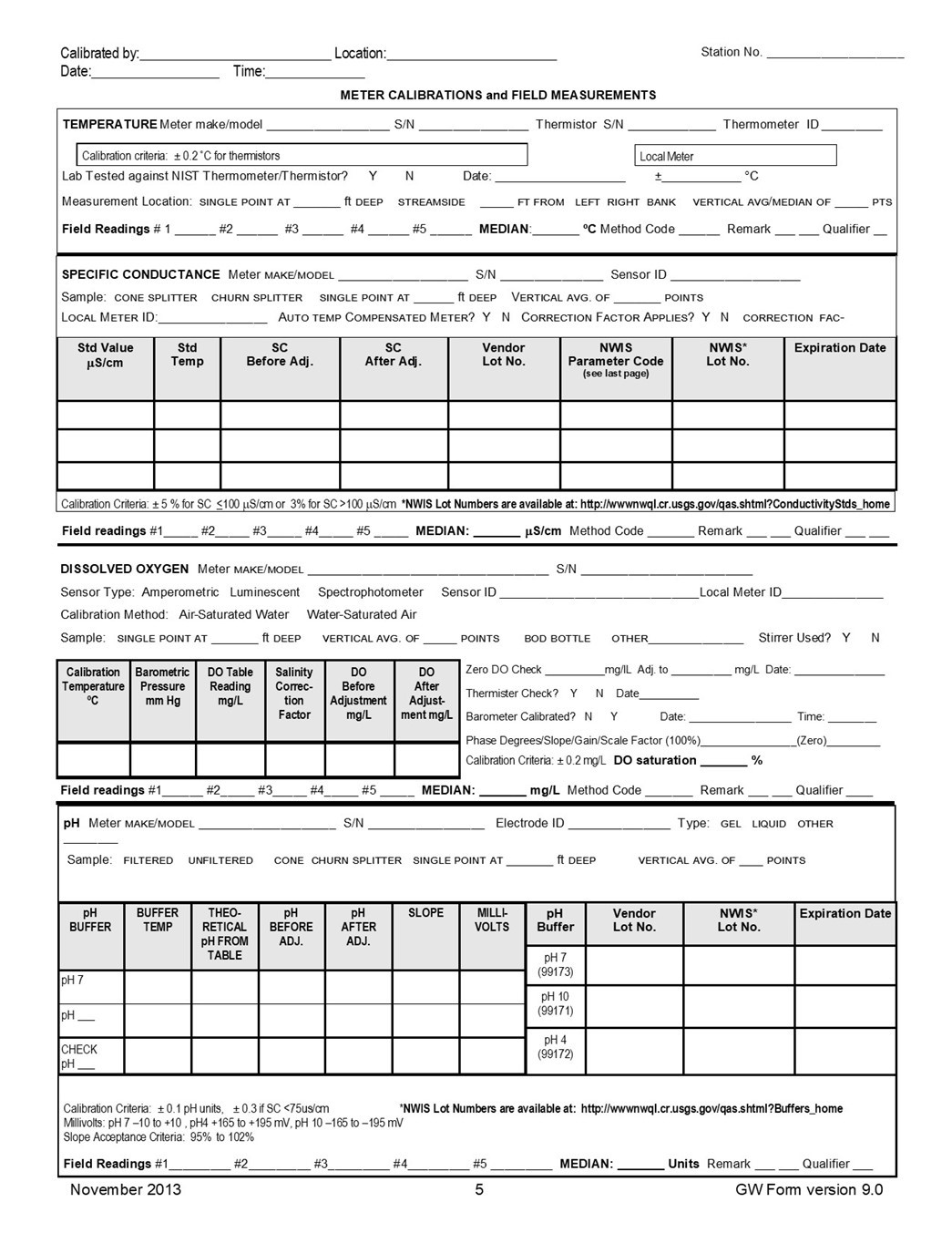
–01.01. Example of a blank U.S. Geological Survey GW Form (version 9.1).
Conversion Factors
Temperature in degrees Celsius (°C), which can be converted to degrees Fahrenheit (°F) by using the following equation:
°F=(1.8×°C)+32
Specific conductance is reported in microsiemens per centimeter at 25 degrees Celsius (µS/cm at 25 °C).
Abbreviations
Eh
measure of the oxidation-reduction potential of a solution
L
liter
µS/cm
microsiemens per centimeter at 25 degrees Celcius)
mg/L
milligram per liter (equivalent to parts per million [ppm])
NFM
National Field Manual for the Collection of Water-Quality Data (USGS)
NWIS
National Water Information System (USGS)
pH
negative base-10 logarithm of the hydrogen ion activity (unitless)
USGS
U.S. Geological Survey
>
greater than
≥
greater than or equal to
<
less than
≤
less than or equal to
Disclaimers
Any use of trade, firm, or product names is for descriptive purposes only and does not imply endorsement by the U.S. Government.
Although this information product, for the most part, is in the public domain, it also may contain copyrighted materials as noted in the text. Permission to reproduce copyrighted items must be secured from the copyright owner.
Suggested Citation
U.S. Geological Survey, 2023, Use of multiparameter instruments for routine field measurements (ver. 1.1, June 2025): U.S. Geological Survey Techniques and Methods, book 9, chap. A6.8, 13 p., https://doi.org/10.3133/tm9A6.8. [Supersedes USGS Techniques of Water-Resources Investigations, book 9, chap. A6.8, version 1.1; and USGS Techniques and Methods, book 9, chap. A6.8, version 1.0.]
ISSN: 2328-7055 (online)
| Publication type | Report |
|---|---|
| Publication Subtype | USGS Numbered Series |
| Title | Use of multiparameter instruments for routine field measurements |
| Series title | Techniques and Methods |
| Series number | 9-A6.8 |
| DOI | 10.3133/tm9A6.8 |
| Edition | Version 1.0: November 28, 2023; Version 1.1: June 12, 2025 |
| Publication Date | November 28, 2023 |
| Year Published | 2023 |
| Language | English |
| Publisher | U.S. Geological Survey |
| Publisher location | Reston, VA |
| Contributing office(s) | WMA - Laboratory & Analytical Services Division |
| Description | v, 13 p. |
| Online Only (Y/N) | Y |
| Additional Online Files (Y/N) | N |