


The 3D Elevation Program—Supporting New Mexico’s Economy
Links
- Document: Report (460 KB pdf) , HTML , XML
- Download citation as: RIS | Dublin Core
Introduction
Federal, State, Tribal, and local entities managing lands in New Mexico have concerns about wildfire risk, wildlife habitat, and flood risk. Land managers in urban areas along the Rio Grande corridor and in the State’s rural northwest and southeast also have concerns about existing and developing roads, buildings, and other infrastructure. Federal, State, Tribal, and local organizations actively manage and monitor New Mexico’s water resources. Critical applications that meet the State’s management needs depend on light detection and ranging (lidar) data that provide a highly detailed three-dimensional (3D) model of the Earth’s surface and aboveground features.
The 3D Elevation Program (3DEP; refer to sidebar) is managed by the U.S. Geological Survey (USGS) in partnership with Federal, State, Tribal, U.S. territorial, and local agencies to acquire consistent lidar coverage at quality level 2 or better (table 1) to meet the many needs of the Nation and New Mexico. The status of available and in-progress 3DEP baseline lidar data in New Mexico is shown in figure 1. 3DEP baseline lidar data include quality level 2 or better, 1-meter or better digital elevation models, and lidar point clouds, and must meet the Lidar Base Specification version 1.2 (https://www.usgs.gov/3dep/lidarspec) or newer requirements. The National Enhanced Elevation Assessment (Dewberry, 2012) identified user requirements and conservatively estimated that availability of lidar data would result in at least $9.32 million in new benefits annually to the State. The top 10 New Mexico business uses for 3D elevation data, which are based on the estimated annual conservative benefits of 3DEP, are shown in table 2.
Table 1.
Data quality levels, pulse spacing, and pulse density. Quality level 2 or better lidar data meet 3DEP requirements.[Specifications for quality level 0 (QL0) are from Heidemann (2012, p. 3 and table 1); for quality levels 1 and 2, specifications are from Sugarbaker and others (2014, table 1). In the quality level column, QL0 represents the highest level of quality. RMSEz, root mean square error in the elevation (z) dimension; cm, centimeter; m, meter; pls/m2, first return pulses per square meter; ≤, less than or equal to; ≥, greater than or equal to]
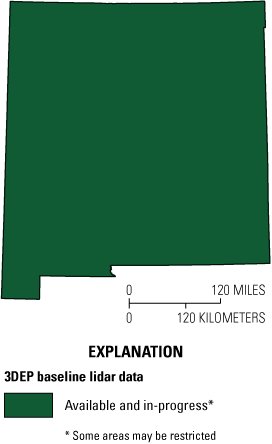
Map of New Mexico showing status of 3D Elevation Program (3DEP) baseline lidar data as of May 2024. Visit https://usgs.gov/NationalMap/LidarExplorer to find and download currently available data.
Table 2.
Conservative benefits estimates for the top 10 New Mexico business uses of the proposed 3DEP data identified in the National Enhanced Elevation Assessment (Dewberry, 2012).Status of 3DEP in New Mexico
Collection of quality level 2 lidar data has been completed in New Mexico, primarily funded by Federal and local sources (New Mexico Geospatial Advisory Committee, 2020). Lidar data can be used to address many issues crucial to New Mexico. The State has also identified mission-critical activities that rely on elevation data and that would benefit from quality levels 0 and 1 lidar data.
Infrastructure and Construction Management
When lidar data are readily available, the need for traditional topographic land surveys (including infrastructure and construction-site planning and estimating) is minimized. Reducing the time required for project planning reduces costs to the public. Lidar data can be used for preliminary highway alignment and design, evaluating existing roadway conditions, integration of geologic and environmental data, and as input to hydraulic modeling for the design of bridges and culverts to accommodate runoff and flooding from large rain events.
Natural Resources Conservation
According to the U.S. Department of Agriculture, Natural Resources Conservation Service (USDA NRCS; 2018, p. 22), the New Mexico office of the NRCS “strives to develop, enhance, and deliver high-quality data and tools to support conservation planning and program delivery. In 2018, the New Mexico NRCS worked with Federal and State partners to acquire additional lidar data, deliver a soil survey-based tool to predict juniper encroachment, and begin development of the Nation’s first Soil Seedbank Suitability Rating Tool.” The New Mexico office of the NRCS partnered with the Federal Emergency Management Agency (FEMA) to acquire additional high-resolution lidar through the USGS and complete statewide coverage. Lidar provides elevation data accuracy to within less than a meter for conservation planning and application.
Flood Risk Management
Lidar data enable more accurate and less expensive hydrologic and hydraulic modeling for flood studies, retention-dam design, dam breach studies, and stormwater management and engineering. Lidar data can be used to map building footprints, impervious surfaces, and potential flood-prone depressions (fig. 2), as well as identify vulnerable properties within a flood plain, facilitate better flood-plain-management decisions, and educate the public on flood-risk zones by providing dynamic 3D models to show the potential effects of flooding from major storm events.
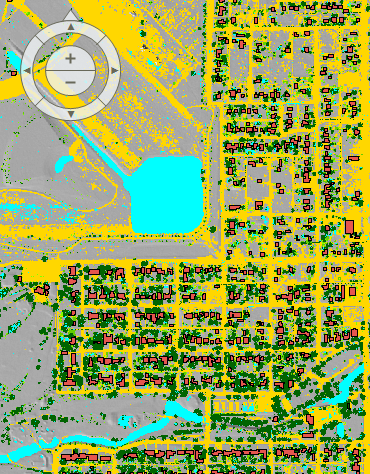
Perspective view of a part of Roswell, New Mexico, derived from lidar point-cloud data. Image shows bare-earth ground in gray, vegetation canopy in green, building footprints in red, impervious surfaces in yellow, and potential flood-prone depressions in blue. Graphic courtesy of Earth Data Analysis Center, University of New Mexico.
Geologic Resource Assessment and Hazard Mitigation
Geologic mapping, including mapping of mineral deposits and conducting hazard assessments, is performed more efficiently and accurately using lidar data. The geologic maps produced by the New Mexico Bureau of Geology and Mineral Resources (NMBGMR) provide a base for further geologic exploration and for making site assessments for development. They depict faults, folds, and cross sections of geologic units. The interactive resources map of New Mexico (NMBGMR, undated) provides a large amount of information on the State's geology and natural resources.
Mineral production in 2023 in New Mexico was worth $1.63 billion (New Mexico Energy, Minerals, and Natural Resources Department, 2024). Most of this by value was from coal, copper, and potash. Other commodities produced include industrial minerals, aggregate and stone, gold, and silver. Aggregate materials are essential to maintain the existing infrastructure and to provide for new construction.
3D Elevation Program (3DEP)
The 3D Elevation Program is managed by the U.S. Geological Survey (USGS) on behalf of the community of Federal, State, Tribal, local, and other partners and users of elevation data. In response to growing needs for high-quality elevation data, the goal of 3DEP is to complete acquisition of nationwide light detection and ranging (lidar) data (interferometric synthetic aperture radar [IfSAR] data in Alaska) to provide the first-ever national baseline of consistent, high-resolution topographic elevation data—both bare-earth digital elevation models and 3D point clouds.
Benefits
-
• Economies of scale by acquiring data for larger areas.
-
• Predictable and flexible Federal investments that can reduce costs and allow better planning.
-
• Consistent national coverage that provides data for applications that span project, jurisdictional, and watershed boundaries.
-
• Simplified data acquisition that provides contracts, project management, quality assurance, and published data specifications.
-
• National benefits of $690 million per year conservatively, with the potential to generate $13 billion per year in additional benefits through applications that span the economy (Dewberry, 2012).
High-Quality Data and Products
3DEP lidar data provide coverage with a minimum of two points per square meter and a vertical error not to exceed 10 centimeters, measured as root mean square error in the elevation (z) dimension (RMSEz) (table 1). 3DEP baseline lidar data products include all data points collected (point clouds) and bare-earth digital elevation models with a 1-meter or better resolution. The USGS integrates the elevation data into The National Map. Data are available free of charge and without use restrictions. To download 3DEP products visit https://apps.nationalmap.gov/downloader/.
Ways to Participate
Participation in 3DEP is open to Federal, State, Tribal, U.S. territorial, and local government partners, as well as private sector partners, and offers the option to acquire even higher quality data. Partners may contribute funds toward projects managed by the USGS, or they may receive cooperative funds to manage their own projects. An annual Data Collaboration Announcement is the mechanism used to establish partner agreements. Organizations and the private sector may contribute existing data that meet 3DEP requirements. For more information refer to the 3DEP website at https://usgs.gov/3DEP/collaborate/.
References Cited
Dewberry, 2012, National Enhanced Elevation Assessment final report (revised March 29, 2012): Fairfax, Va., Dewberry, 84 p. plus appendixes, accessed July 26, 2024, at https://www.dewberry.com/services/geospatial/national-enhanced-elevation-assessment.
Heidemann, H.K., 2012, Lidar base specification (ver. 1.2, November 2014): U.S. Geological Survey Techniques and Methods, book 11, chap. B4, 67 p. with appendixes, accessed July 29, 2024, at https://doi.org/10.3133/tm11B4.
New Mexico Bureau of Geology and Mineral Resources [NMBGMR], [undated], NMBGMR interactive resources map (3d ed.): NMBGMR map, accessed July 29, 2024, at https://maps.nmt.edu/.
New Mexico Energy, Minerals, and Natural Resources Department [NMEMNRD], 2024, Annual report 2024: NMEMNRD report, 76 p., accessed February 10, 2025, at https://www.emnrd.nm.gov/officeofsecretary/wp-content/uploads/sites/2/emmrd_annual_report_2024.pdf.
New Mexico Geospatial Advisory Committee, 2020, Geospatial New Mexico—Overview of Activities, January 2020: New Mexico Department of Information Technology, Office of Geospatial Technologies report, 34 p., accessed November 11, 2024, at https://ftp.nm911.org/NMC_Geospatialoverview_0120.pdf.
Sugarbaker, L.J., Constance, E.W., Heidemann, H.K., Jason, A.L., Lukas, V., Saghy, D.L., and Stoker, J.M., 2014, The 3D Elevation Program initiative—A call for action: U.S. Geological Survey Circular 1399, 35 p., accessed July 26, 2024, at https://doi.org/10.3133/cir1399.
U.S. Department of Agriculture, Natural Resources Conservation Service [USDA NRCS], 2018, New Mexico FY18 annual report: USDA NRCS report, 26 p., accessed July 26, 2024, at https://www.nrcs.usda.gov/conservation-basics/conservation-by-state/new-mexico/nrcs-new-mexico-annual-reports.
For Further Information:
Director, National Geospatial Program
U.S. Geological Survey, MS 511
12201 Sunrise Valley Drive
Reston, VA 20192
Email: [email protected]
USGS National Map Liaison:
Disclaimers
Any use of trade, firm, or product names is for descriptive purposes only and does not imply endorsement by the U.S. Government.
Although this information product, for the most part, is in the public domain, it also may contain copyrighted materials as noted in the text. Permission to reproduce copyrighted items must be secured from the copyright owner.
Suggested Citation
Lydic, C., 2025, The 3D Elevation Program—Supporting New Mexico’s economy: U.S. Geological Survey Fact Sheet 2025–3014, 2 p., https://doi.org/10.3133/fs20253014.
ISSN: 2327-6932 (online)
Study Area
| Publication type | Report |
|---|---|
| Publication Subtype | USGS Numbered Series |
| Title | The 3D Elevation Program—Supporting New Mexico’s Economy |
| Series title | Fact Sheet |
| Series number | 2025-3014 |
| DOI | 10.3133/fs20253014 |
| Publication Date | May 16, 2025 |
| Year Published | 2025 |
| Language | English |
| Publisher | U.S. Geological Survey |
| Publisher location | Reston, VA |
| Contributing office(s) | National Geospatial Program |
| Description | 2 p. |
| Country | United States |
| State | New Mexico |
| Online Only (Y/N) | Y |
| Additional Online Files (Y/N) | N |