


Assessment of Undiscovered Conventional Oil and Gas Resources of the Northern Arabian Peninsula, 2024
Links
- Document: Report (1.67 MB pdf) , HTML , XML
- Data Release: USGS data release - USGS National and Global Oil and Gas Assessment Project—Northern Arabian Peninsula—Assessment Unit Boundaries, Input Data Tables, and Fact Sheet Data Tables
- Download citation as: RIS | Dublin Core
Abstract
Using a geology-based assessment methodology, the U.S. Geological Survey estimated undiscovered, technically recoverable mean conventional resources of 5.1 billion barrels of oil and 19.5 trillion cubic feet of gas in the northern Arabian Peninsula.
Introduction
The U.S. Geological Survey (USGS) assessed the potential for undiscovered, technically recoverable conventional oil and gas resources within a composite total petroleum system (TPS) of the northern Arabian Peninsula (fig. 1). The formation of the composite TPS is related to the tectonic history of the northern and northeastern parts of the Arabian Peninsula (Beydoun and others, 1992; Al-Husseini, 2000; Brew and others, 2001; Fox and Ahlbrandt, 2002; Ruban and others, 2007; Soleimany and Sàbat, 2010; Mouthereau and others, 2012; Barrier and others, 2014; English and others, 2015; Saura and others, 2015; Abdulnaby and others, 2020). Ordovician glaciation covered much of Arabia and northern Africa, and as the glaciers melted, widespread channel systems formed that were subsequently filled with organic-rich Silurian marine source rocks. As Gondwana began to fragment in the late Permian to Late Triassic, rifting formed the northeast–southwest-trending Palmyride and Sinjar graben systems in which were deposited synrift Triassic organic-rich source rocks (Barrier and others, 2014). Passive margin subsidence along the eastern margin of Gondwana from Early Jurassic through Late Cretaceous resulted in extensive carbonate platforms and intraplatform basins in which several major source rocks were deposited, including organic-rich marls of the Jurassic Sargelu, Tuwaiq Mountain, Naokelekan, and Hanifa Formations, and the Cretaceous (Albian–Cenomanian) Kazhdumi Formation. Late Cretaceous transtension, possibly related to a mantle plume, formed the northwest–southeast-trending Euphrates graben system (Litak and others, 1998), which divided the once-continuous Palmyride and Sinjar grabens (fig. 1). Major source rocks in the Euphrates graben system are Upper Cretaceous synrift organic-rich shales (Litak and others, 1998).
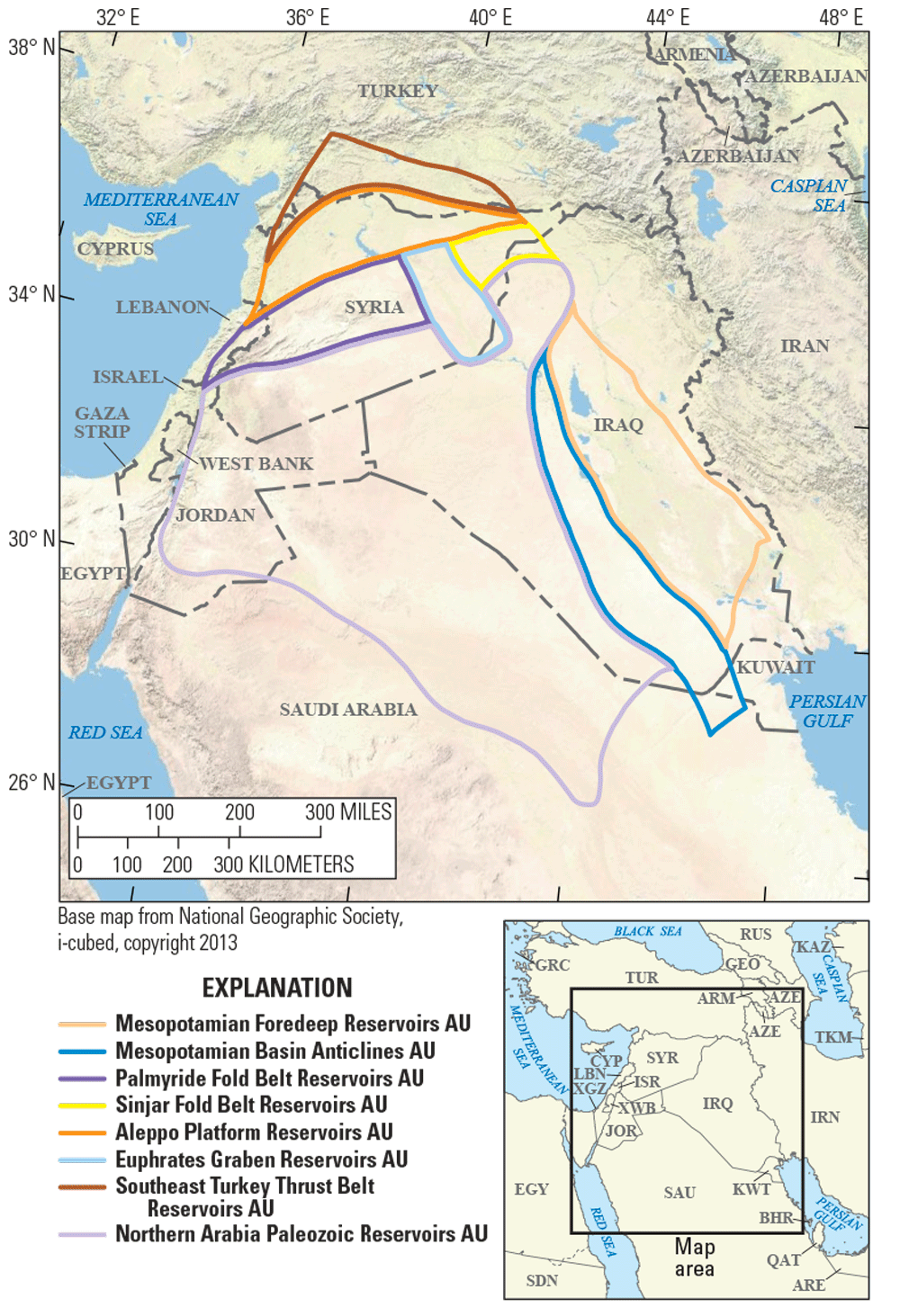
Maps showing the location of eight conventional assessment units (AUs) in the northern Arabian Peninsula.
Total Petroleum System and Assessment Units
The USGS defined a Paleozoic–Mesozoic Composite TPS encompassing petroleum generated from several source rocks deposited on the northern and eastern passive margins of Gondwana. The Silurian Qusaiba Formation has generated most of the oil and gas in the northern part of the Arabian Peninsula (Lüning and others, 2000; Konert and others, 2001; Barrier and others, 2014; Cantrell and others, 2014; İnan and others, 2017; Varol and Demirel, 2020). Along the eastern margin of the Arabian Peninsula, source rocks are organic-rich basinal carbonate platform marls of the Sargelu and Tuwaiq Mountain Formations, Naokelekan and Hanifa Formations, and Kazhdumi Formation (Beydoun and others, 1992; Opera and others, 2013; Barrier and others, 2014; Baniasad and others, 2017). Jurassic and Cretaceous marls are the most important source rocks in the eastern part of the Arabian Peninsula (Beydoun and others, 1992; Ziegler, 2001; Damoulianou and others, 2020; Alipour, 2022). Eight assessment units (AUs) were defined within the composite TPS and reflect the tectonic history and formation of source rocks, reservoir rocks, traps, and generation of oil and gas (fig. 1). The Mesopotamian Foredeep Reservoirs AU and Mesopotamian Basin Anticlines AU have basement-related structural traps related to the formation of the Zagros Fold Belt, with clastic and carbonate reservoirs, and major Jurassic and Cretaceous source rocks. The Palmyride Fold Belt Reservoirs AU and Sinjar Fold Belt Reservoirs AU have Triassic synrift source rocks and reservoirs within structural traps. The Euphrates Graben Reservoirs AU has Upper Cretaceous synrift source rocks and clastic reservoirs in structural traps. The Aleppo Platform Reservoirs AU, Southeast Turkey Thrust Belt Reservoirs AU, and Northern Arabia Paleozoic Reservoirs AU have Silurian Qusaiba source rocks that reached thermal maturity for gas generation. Each of the eight AUs was assessed for undiscovered conventional oil and gas resources. The assessment input data are summarized in table 1 and in Schenk (2025).
Table 1.
Key input data for eight conventional assessment units in the northern Arabian Peninsula.[Gray shading indicates not applicable. AU, assessment unit; MMBO, million barrels of oil; BCFG, billion cubic feet of gas]
Undiscovered Resources Summary
The USGS quantitatively assessed undiscovered conventional oil and gas resources in eight AUs in the northern Arabian Peninsula (table 2). The estimated mean resources are 5,086 million barrels of oil (MMBO), or 5.1 billion barrels of oil, with an F95–F5 range from 1,438 to 12,016 MMBO; 19,546 billion cubic feet of gas (BCFG), or 19.5 trillion cubic feet of gas, with an F95–F5 range from 6,941 to 41,349 BCFG; and 735 million barrels of natural gas liquids (MMBNGL), or 0.7 billion barrels, with an F95–F5 range from 281 to 1,460 MMBNGL.
Table 2.
Results for eight conventional assessment units in the northern Arabian Peninsula.[Gray shading indicates not applicable. Results shown are fully risked estimates. F95 represents a 95-percent chance of at least the amount tabulated; other fractiles are defined similarly. MMBO, million barrels of oil; BCFG, billion cubic feet of gas; NGL, natural gas liquids; MMBNGL, million barrels of natural gas liquids]
For More Information
Assessment results are also available at the USGS Energy Resources Program website, https://www.usgs.gov/programs/energy-resources-program.
References Cited
Abdulnaby, W., Motaghi, K., Shabanian, E., Mahdi, H., Al-Shukri, H., and Gök, R., 2020, Crustal structure of the Mesopotamian plain, east of Iraq: Tectonics, v. 39, no. 11, article e2020TC006225, 16 p., accessed June 25, 2025, at https://doi.org/10.1029/2020TC006225.
Al-Husseini, M.I., 2000, Origin of the Arabian plate structures—Amar collision and Najd rift: GeoArabia, v. 5, no. 4, p. 527–542, accessed June 25, 2025, at https://doi.org/10.2113/geoarabia0504527.
Alipour, M., 2022, Organic facies and paleo-depositional environments of the Aptian–Albian Kazhdumi source rock in the Zagros Basin of Iran: Marine and Petroleum Geology, v. 145, article 105877, 11 p., accessed June 25, 2025, at https://doi.org/10.1016/j.marpetgeo.2022.105887.
Baniasad, A., Rabbani, A.R., Moallemi, S.A., Soleimany, B., and Rashidi, M., 2017, Petroleum system analysis of the northwestern part of the Persian Gulf, Iranian sector: Organic Geochemistry, v. 107, p. 69–85, accessed June 25, 2025, at https://doi.org/10.1016/j.orggeochem.2017.03.005.
Barrier, E., Machhour, L., and Blaizot, M., 2014, Petroleum systems of Syria, chap. 11 of Marlow, L., Kendall, C., and Yose, L., eds., Petroleum systems of the Tethyan region: AAPG Memoir 106, p. 335–378, accessed June 25, 2025, at https://doi.org/10.1306/13431862M1063612.
Beydoun, Z.R., Clarke, M.W.H., and Stoneley, R., 1992, Petroleum in the Zagros Basin—A late Tertiary foreland basin overprinted onto the outer edge of a vast hydrocarbon-rich Paleozoic–Mesozoic passive-margin shelf, in Macqueen, R.W., and Leckie, D.A., eds., Foreland basins and fold belts: AAPG Memoir 55, p. 309–339, accessed June 25, 2025, at https://doi.org/10.1306/M55563C12.
Brew, G., Barazangi, M., Al-Meleh, A.K., and Sawaf, T., 2001, Tectonic and geologic evolution of Syria: GeoArabia, v. 6, no. 4, p. 573–616, accessed June 25, 2025, at https://doi.org/10.2113/geoarabia0604573a.
Cantrell, D.L., Nicholson, P.G., Hughes, G.W., Miller, M.A., Buhllar, A.G., Abdelbagi, S.T., and Norton, A.K., 2014, Tethyan petroleum systems of Saudi Arabia, chap. 16 of Marlow, L., Kendall, C., and Yose, L., eds., Petroleum systems of the Tethyan region: AAPG Memoir 106, p. 613–639, accessed September 4, 2024, at https://doi.org/10.1306/13431867M1063615.
Damoulianou, M.E., Kolo, K.Y., Borrego, A.G., and Kalaitzidis, S.P., 2020, Organic petrological and geochemical appraisal of the Upper Jurassic Naokelekan Formation, Kurdistan, Iraq: International Journal of Coal Geology, v. 232, article 103637, 27 p., accessed June 25, 2025, at https://doi.org/10.1016/j.coal.2020.103637.
English, J.M., Lunn, G.A., Ferreira, L., and Yacu, G., 2015, Geologic evolution of the Iraqi Zagros, and its influence on the distribution of hydrocarbons in the Kurdistan region: AAPG Bulletin, v. 99, no. 2, p. 231–272, accessed June 25, 2025, at https://doi.org/10.1306/06271413205.
Fox, J.E., and Ahlbrandt, T.S., 2002, Petroleum geology and total petroleum systems of the Widyan Basin and Interior Platform of Saudi Arabia and Iraq: U.S. Geological Survey Bulletin 2202–E, 26 p., accessed June 25, 2025, at https://pubs.usgs.gov/bul/b2202-e/.
İnan, S., AbuAli, M.A., and Hakami, A.M., 2017, A petroleum system and basin modeling study of northwest and east-central Saudi Arabia—Effect of burial history and adjacent rock lithology on the gas potential of the Silurian Qusaiba shales, chap. 1 of AbuAli, M.A., Moretti, I., and Nordgård Bolås, H.M., eds., Petroleum system analysis—Case studies: AAPG Memoir 114, p. 1–35, accessed June 25, 2025, at https://pubs.geoscienceworld.org/books/book/2536/chapter-abstract/142144551/A-Petroleum-System-and-Basin-Modeling-Study-of?redirectedFrom=PDF.
Konert, G., Afifi, A.M., Al-Hajri, S.A., and Droste, H.J., 2001, Paleozoic stratigraphy and hydrocarbon habitat of the Arabian plate: GeoArabia, v. 6, no. 3, p. 407–442, accessed June 25, 2025, at https://doi.org/10.2113/geoarabia0603407.
Litak, R.K., Barazangi, M., Brew, G., Sawaf, T., Al-Imam, A., and Al-Youssef, W., 1998, Structure and evolution of the petroliferous Euphrates graben system, southeast Syria: AAPG Bulletin, v. 82, no. 6, p. 1173–1190, accessed June 25, 2025, at https://doi.org/10.1306/1D9BCA2F-172D-11D7-8645000102C1865D.
Lüning, S., Craig, J., Loydell, D.K., Štorch, P., and Fitches, B., 2000, Lower Silurian ‘hot shales’ in North Africa and Arabia—Regional distribution and depositional model: Earth-Science Reviews, v. 49, nos. 1–4, p. 121–200, accessed June 25, 2025, at https://doi.org/10.1016/S0012-8252(99)00060-4.
Mouthereau, F., Lacombe, O., and Vergés, J., 2012, Building the Zagros collisional orogen—Timing, strain distribution and the dynamics of Arabia/Eurasia plate convergence: Tectonophysics, v. 532–535, p. 27–60, accessed June 25, 2025, at https://doi.org/10.1016/j.tecto.2012.01.022.
Opera, A., Alizadeh, B., Sarafdokht, H., Janbaz, M., Fouladvand, R., and Heidarifard, M.H., 2013, Burial history reconstruction and thermal maturity modeling for the Middle Cretaceous–Early Miocene petroleum system, southern Dezful embayment, SW Iran: International Journal of Coal Geology, v. 120, 14 p., accessed June 25, 2025, at https://doi.org/10.1016/j.coal.2013.08.008.
Ruban, D.A., Al-Husseini, M.I., and Iwasaki, Y., 2007, Review of Middle East Paleozoic plate tectonics: GeoArabia, v. 12, no. 3, p. 35–56, accessed June 25, 2025, at https://doi.org/10.2113/geoarabia120335.
Saura, E., Garcia-Castellanos, D., Casciello, E., Parravano, V., Urruela, A., and Vergés, J., 2015, Modeling the flexural evolution of the Amiran and Mesopotamian foreland basins of NW Zagros (Iran-Iraq): Tectonics, v. 34, no. 3, p. 377–395, accessed June 25, 2025, at https://doi.org/10.1002/2014TC003660.
Schenk, C.J., 2025, USGS National and Global Oil and Gas Assessment Project—Northern Arabian Peninsula—Assessment unit boundaries, input data tables, and fact sheet data tables: U.S. Geological Survey data release, https://doi.org/10.5066/P1TSQZVV.
Soleimany, B., and Sàbat, F., 2010, Style and age of deformation in the NW Persian Gulf: Petroleum Geoscience, v. 16, p. 31–39, accessed June 25, 2025, at https://doi.org/10.1144/1354-079309-837.
Varol, N., and Demirel, I.H., 2020, Hydrocarbon potential of the Silurian and Carboniferous shales in the western and Central Taurus region of Turkey: International Journal of Coal Geology, v. 227, article 103518, 16 p., accessed June 25, 2025, at https://doi.org/10.1016/j.coal.2020.103518.
Ziegler, M.A., 2001, Late Permian to Holocene paleofacies evolution of the Arabian plate and its hydrocarbon occurrences: GeoArabia, v. 6, no. 3, p. 445–504, accessed June 25, 2025, at https://doi.org/10.2113/geoarabia0603445.
Disclaimers
Any use of trade, firm, or product names is for descriptive purposes only and does not imply endorsement by the U.S. Government.
Although this information product, for the most part, is in the public domain, it also may contain copyrighted materials as noted in the text. Permission to reproduce copyrighted items must be secured from the copyright owner.
Suggested Citation
Schenk, C.J., Mercier, T.J., Le, P.A., Cicero, A.D., Drake, R.M., II, Gelman, S.E., Hearon, J.S., Johnson, B.G., Lagesse, J.H., Leathers-Miller, H.M., and Timm, K.K., 2025, Assessment of undiscovered conventional oil and gas resources of the northern Arabian Peninsula, 2024: U.S. Geological Survey Fact Sheet 2025–3035, 4 p., https://doi.org/10.3133/fs20253035.
ISSN: 2327-6932 (online)
Study Area
| Publication type | Report |
|---|---|
| Publication Subtype | USGS Numbered Series |
| Title | Assessment of undiscovered conventional oil and gas resources of the northern Arabian Peninsula, 2024 |
| Series title | Fact Sheet |
| Series number | 2025-3035 |
| DOI | 10.3133/fs20253035 |
| Publication Date | July 23, 2025 |
| Year Published | 2025 |
| Language | English |
| Publisher | U.S. Geological Survey |
| Publisher location | Reston VA |
| Contributing office(s) | Central Energy Resources Science Center |
| Description | Report: 4 p.; Data Release |
| Country | Iraq, Israel, Jordan, Lebanon, Saudi Arabia, Syria, Turkey |
| Online Only (Y/N) | Y |