


FluOil—A Tool for Estimating the Transport and Deposition of Oil-Particle Aggregates in Rivers
Links
- Document: Report (2.04 MB pdf) , HTML , XML
- Data Release: USGS data release - FluOil model and related datasets for Kalamazoo River, Michigan, oil spill—July 21 to October 31, 2010
- Download citation as: RIS | Dublin Core
Plain Language Summary
The FluOil tool helps oil spill planners and responders estimate how fast and far oiled sediment (called oil-particle aggregates [OPA]) can travel in rivers during an oil spill, and where it may settle out on the riverbed. The user interface makes it easy to run the tool for a range of river flow conditions and OPA characteristics.
Why a FluOil Tool?
Spilled oil can quickly travel long distances in rivers and create oil slicks that are easily broken up from turbulence, allowing oil to mix with river sediment in the water column and eventually sink. It is important to know where the oil-sediment mixtures, called oil-particle aggregates (OPA), are transported and accumulated so the potential impacts on drinking water intakes, burial of sensitive habitat beds, toxicity to aquatic biota (including benthic organisms), and prolonged sheening problems from resuspension and breakup can be better understood.
The FluOil tool was developed to aid preparedness, response, and restoration activities associated with oil spills in rivers (Lee and others, 2001, 2002; Fitzpatrick and others, 2015; Li and others, 2022). The turbulence and varying flows in a natural river channel may cause an oil slick to break up into small droplets and mix with sediment or organic detritus in the water column and form OPA. This process is similar to the mixing of oil and sediment when waves break along a shoreline (Stoffyn-Egli and others, 2000; Fitzpatrick and others, 2015; Boufadel and others, 2019; figs. 1, 2A–D)). Natural channels vary in width, depth, and roughness, which varies velocities and patterns of turbulence over short distances. OPA have different densities, shapes, and sizes and may be floating, neutrally buoyant, or negatively buoyant (Waterman and Garcia, 2015; Berens and others,2021; Ji and others, 2021a). The FluOil tool estimates how fast OPA travel downstream in rivers and when and where they may deposit (Li and others, 2022).
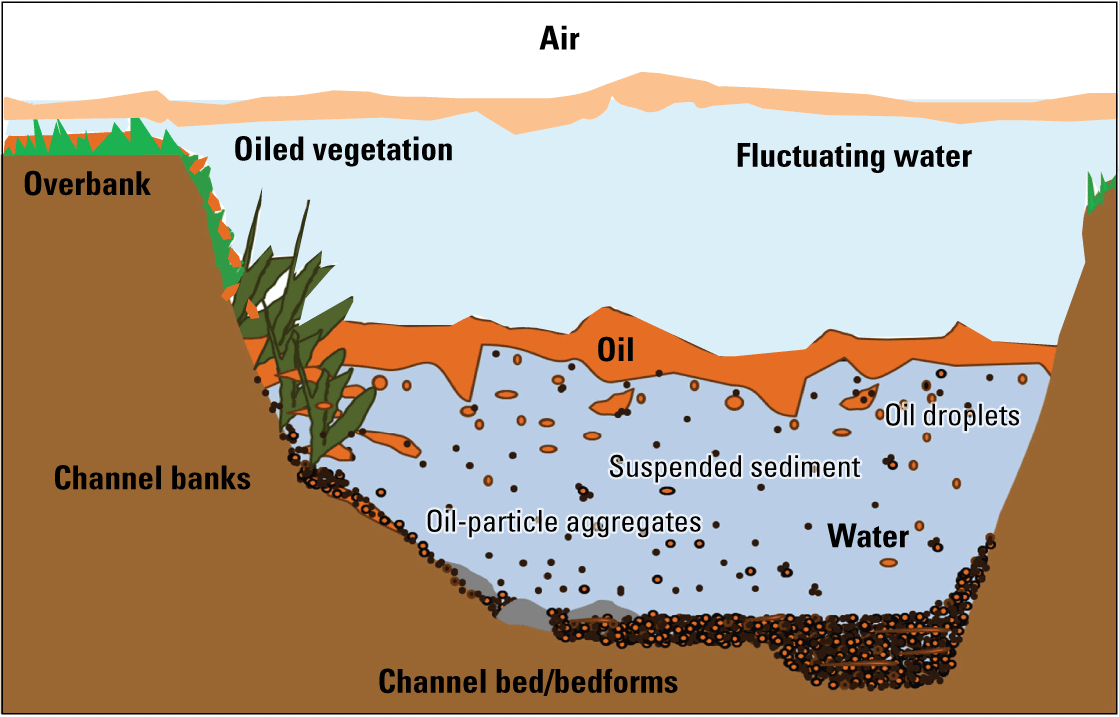
Conceptual diagram showing OPA formation (modified from Fitzpatrick and others, 2015).
The FluOil tool relies on preexisting channel hydraulic data combined with user-specified OPA characteristics of size, settling velocity (considers shape and density of OPA), and critical shear stress to compute OPA transport (Zhu and others, 2022). The OPA settling velocity affects the modeled vertical distribution of OPA in the water column, and the OPA critical shear stress affects where OPA may be deposited and resuspended. OPA tend to accumulate with fine-grained (silt and clay) sediment deposits (mud or muck) in backwater areas, oxbows, side channels, pools, and other slow-moving reaches of rivers during low flows. Deposited OPA can be resuspended during high flows, driving environmental concerns that may extend beyond typical oil spill response timelines (U.S. Environmental Protection Agency, 2016).
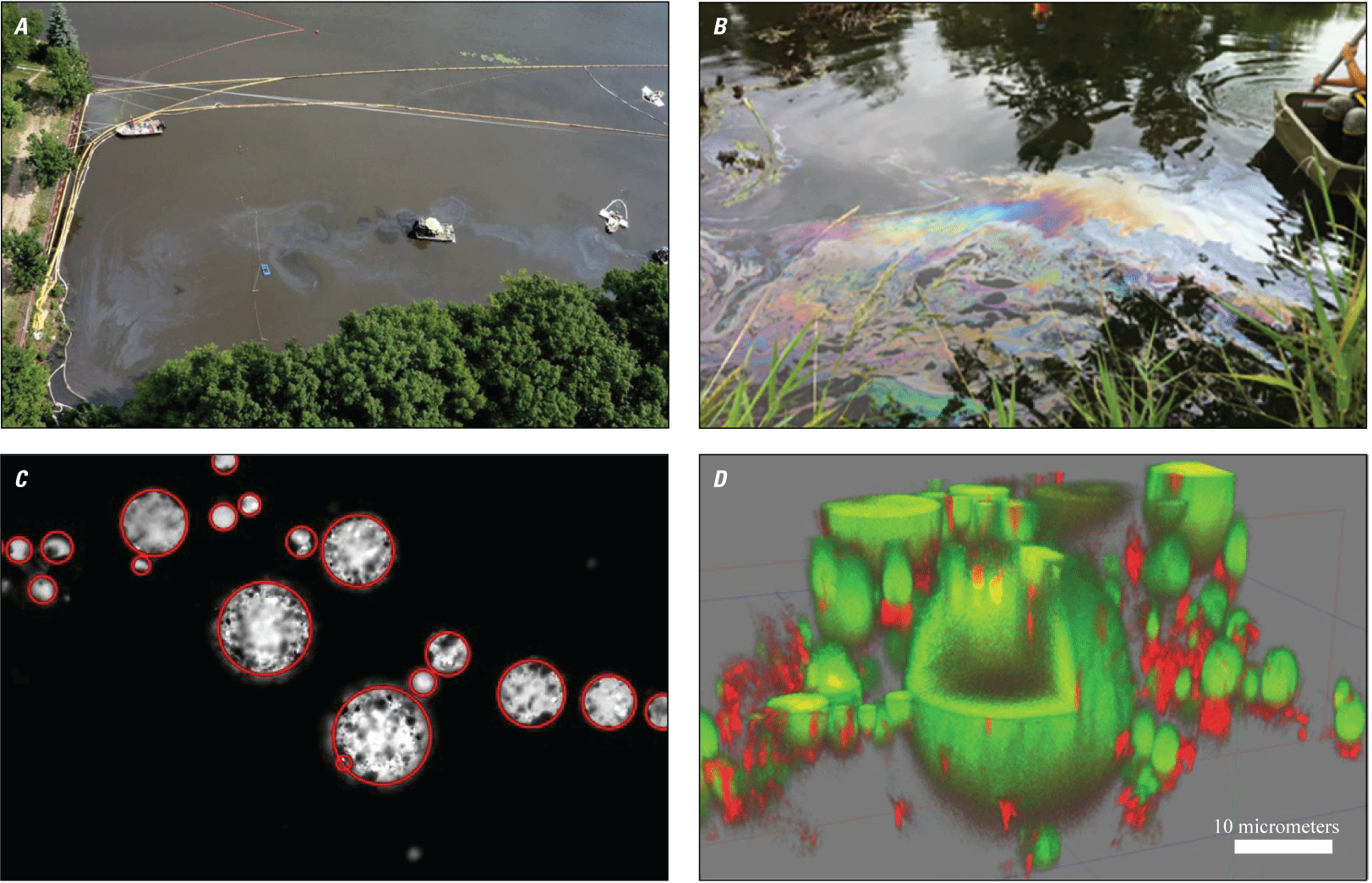
Images showing oil-particle aggregates (OPA) formation in rivers. A, Photograph of the Kalamazoo River upstream from Ceresco, Michigan, on August 13, 2011, showing a submerged oil recovery using river bottom agitation techniques to separate oil and sheen from the sediment so it rises to the surface to be corralled by boom and removed by traditional skimming methods (U.S. Environmental Protection Agency, 2016). B, Photograph of sheen from OPA breakup in the Kalamazoo River after the 2010 Line 6B diluted bitumen spill (U.S. Environmental Protection Agency, August 13, 2012; Dollhopf and others, 2014). C, Ultraviolet epifluorescence of OPA formed under laboratory conditions (black is particle and white is oil; red circle is the diameter; Berens and others, 2021). D, A confocal image of particles penetrating oil droplets (Ji and others, 2021a).
How Does FluOil Work?
The open-source code for FluOil contains a particle tracking algorithm that simulates advection, diffusion, deposition, and resuspension (fig. 3). OPA characteristics are easily adjusted by the user which is helpful because laboratory experiments demonstrate that a range of OPA types, shapes, and sizes can form with wide variation in particle settling velocities and critical shear stresses even with one oil type (Waterman and Garcia, 2015; Zhu and others, 2022; Ji and others, 2023). FluOil is written in MATLAB and adapted from the FluEgg software used to simulate the transport and deposition of carp eggs (Garcia and others, 2013).
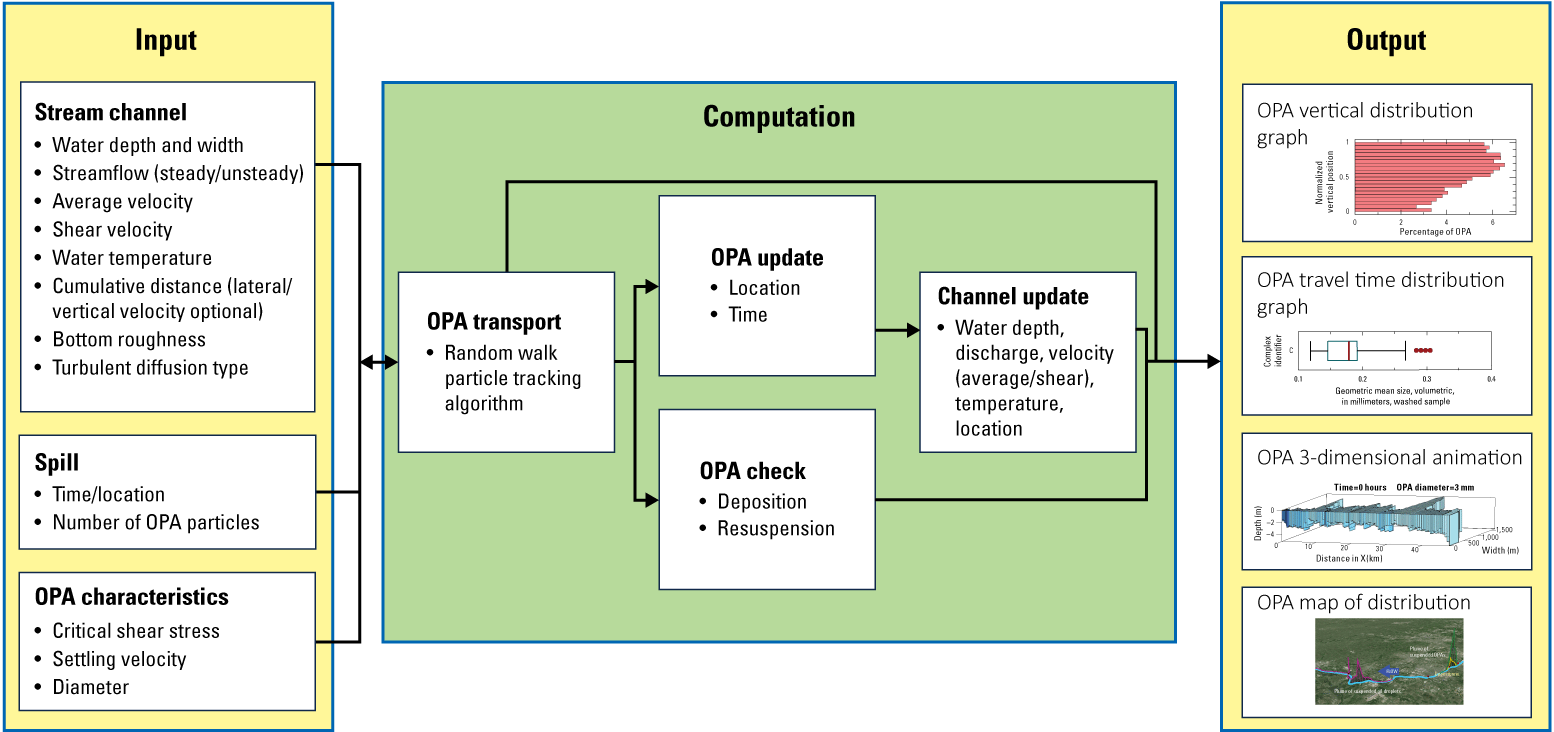
Diagram showing FluOil tool inputs, computation, and outputs for oil-particle aggregates (OPA) transport and fate in rivers (Li and others, 2022). [mm, millimeter; m, meter; km, kilometer]
Additional Information about FluOil Data Inputs
The hydraulic data used in FluOil can come from many sources and have different spatial and temporal resolutions. A common data source is from one- or two-dimensional hydraulic models like HEC–RAS (Hydraulic Engineering Center River Analysis System; U.S. Army Corps of Engineers, 2025). The tool can import HEC–RAS data directly, or the user can input a spreadsheet with the necessary hydraulic data (Li and others, 2022). The tool has choices for how to represent vertical profiles of turbulent diffusivity and longitudinal velocity depending on river conditions (Zhu and others, 2022). FluOil assumes that OPA have already formed and are in the water column and that OPA characteristics do not change during transport. An example of hydraulic inputs constructed in support of a FluOil training at St. Croix River, Minnesota, is in Sortor and others (2023).
FluOil Tool Outputs
The FluOil tool produces graphs of the vertical distribution of OPA in the water column, boxplots of travel time distribution, and a three-dimensional animation of OPA transport (Zhu and others, 2022). A Google Earth utility (Google, 2021) for mapping the distribution of suspended and deposited OPA is under restoration.
Adjustments for the Environment
FluOil can use various resolutions and sources of hydraulic data, and modeled river reaches can include dams and rapids. Multiple scenarios can be run for a range of riverine conditions related to hydraulic characteristics, velocities, streamflow, and water temperature; however, FluOil does not adjust the velocity dynamics in frozen conditions. Changing oil types (for example, viscosity, adhesion, and oil droplet formation) and sediment properties (size, mineral versus organic source, and water column concentration) and the resulting OPA properties are acquired from previous laboratory studies or numerical modeling of OPA formation. OPA properties also can be adjusted to account for expected ranges because hydraulics, turbulence, sediment concentration, and water temperature may vary seasonally and change with flow conditions.
Limitations and Constraints
A MATLAB license is not needed to run the executable, but the user needs to download a free MATLAB Runtime installer R2020a (ver. 9.8). This download may require support from the user’s information technology staff.
Background on Oil-Particle Aggregates Transport and Deposition in Rivers
After successfully using conventional recovery techniques for floating oil during the 2010 Kalamazoo River pipeline rupture of diluted bitumen (a high viscosity oil sands-based product diluted with gas condensate), the lengthy cleanup and recovery of submerged oil required a science-based, multiple-lines-of-evidence approach: geomorphic and sheen mapping, submerged oil assessment, hydrodynamic and sediment transport modeling, oil chemistry forensics, and a net environmental benefit analysis (Dollhopf and others, 2014; U.S. Environmental Protection Agency, 2016). An ultraviolet epifluorescence microscopy technique confirmed the formation of OPA (fig. 4A–C; Lee and others, 2012).
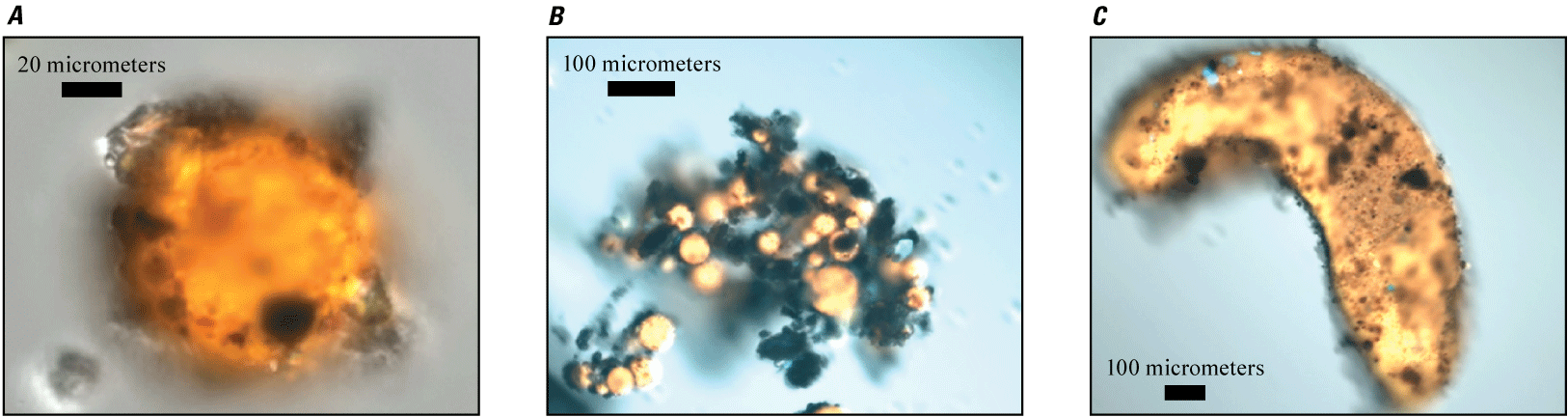
Images showing different types and sizes of oil-particle aggregates (OPA) from Cold Lake Blend diluted bitumen and Kalamazoo River sediment from laboratory experiments with a range of mixing energy. Oil is golden color; sediment is black. A, Single droplet-type OPA; B, Aggregates of droplet-type OPA; C, Irregular-shaped solid-type OPA (images modified from Waterman and Garcia [2015]).
Additional laboratory studies were conducted during and after the Kalamazoo cleanup to better understand OPA formation under different river conditions (Waterman and Garcia, 2015; Berens and others, 2021). The laboratory experiments, based on the abundance of previous studies on OPA formation including Stoffyn-Egli and Lee (2002) and Khelifa and others (2002), indicated that, depending on how the oil and sediment were mixed, the OPA can form multiple arrangements, sizes, and shapes (Waterman and Garcia, 2015). The characterization in part included whether the particles adhered to the outside of an oil droplet that keeps its spherical shape (droplet-type OPA) or whether the particles penetrated the oil, which then forms an irregular-shaped oil mass (solid-type OPA). Droplet and solid types can form aggregates of multiple droplets and particle arrangements. There is also a platy version of the solid-type OPA that is flat or disc-like in shape rather than spherical, also known as flaky particles. These variations affect OPA transport and deposition (Waterman and Garcia, 2015). Numerical models also helped to verify the formation of OPA with different types of oil and sediment in aquatic environments (Khelifa and others, 2005; Zhao and others, 2016).
Laboratory tests and numerical model development are ongoing and scientists continue to investigate OPA formation and breakup with different types of oil, sediment, water, and mixing energies (for example, Wang and others [2020]). The potential spatial distributions of deposited OPA and the transport velocities of suspended OPA can be better understood by varying the critical shear stress and settling velocity across a range of plausible values (for example, Perkey and others [2014]; Waterman and Garcia [2015]; and Li and others [2022]). The default settings for OPA in the FluOil tool start with 5,000 particles with a diameter of 3 millimeters, a settling velocity of 3 millimeters per second, and a critical shear stress of 0.1 pascal. Developing a worst-case scenario representing the fastest transport and farthest downstream deposition is also advisable. Furthermore, recent studies on penetration of particles into oil droplets indicate that OPA may break up into smaller sizes given changes in particle concentration and strength of turbulent mixing, which could happen in rivers during floods (Liu and others, 2023). Although FluOil uses width-averaged channel conditions, the downstream extent of OPA transport can help inform response efforts for submerged oil assessments along banks, backwater areas, and oxbows (Wang and others, 2020).
Why Care about Oil-Particle Aggregates in Rivers?
Most conventional oil spill response measures focus on the floating oil slick, but OPA travel below the water surface and can be missed. Exact percentages are not known, but as little as 1 percent or as much as 10–20 percent or more of oil in a river spill may submerge, mix with sediment, and be transported many kilometers downstream through the water column or deposited along the bed and banks of a river (Fitzpatrick and others, 2015; Ji and others, 2021b). Most types of oil, including light crude, can form OPA. The flow velocity and turbulence needed to break the oil into droplets, along with the interaction of oil with suspended sediment, are more important in determining oil droplet formation and behavior than the physical properties of the spilled oil. Oil breakup with formation of droplets and sediment interactions can happen immediately after a spill (Jones and Garcia, 2018). Response may require early monitoring and containment of submerged oil in addition to conventional containment and recovery of floating oil. Furthermore, deposited OPA, formed and transported during the initial spill, may resuspend and migrate downstream during the next high flow. If deposited with organic-rich sediment, oil and sheen may be released from the deposits along with gas bubbles from anaerobic degradation during warmer temperatures in a process called ebullition (U.S. Environmental Protection Agency, 2016), potentially causing aquatic toxicity, and further necessitating response efforts. The formation of OPA affects the route of oil exposure and its toxicity to pelagic and benthic biota. It will also affect the biodegradation rates of the residual oil in riverine systems, which is a major factor controlling the extent and rates of habitat recovery.
References Cited
Berens, J., Boufadel, M., Fitzpatrick, F., Garcia, M., Hassan, J., Hayter, E., Jones, L., Mravik, S., and Waterman, D., 2021, The formation, transport, and breakup of submerged oil-particle aggregates in Great Lakes riverine environments: Washington, D.C., U.S. Environmental Protection Agency, EPA/600/S–21/061, 26 p., accessed September 3, 2025, at https://cfpub.epa.gov/si/si_public_record_Report.cfm?dirEntryId=354255&Lab=CESER.
Boufadel, M.C., Fitzpatrick, F.A., Cui, F., and Lee, K., 2019, Computation of the mixing energy in rivers for oil dispersion: Journal of Environmental Engineering, v. 145, no. 10, article 06019005, p. 1–4, accessed September 3, 2025, at https://doi.org/10.1061/(ASCE)EE.1943-7870.0001581.
Dollhopf, R.H., Fitzpatrick, F.A., Kimble, J.W., Capone, D.M., Graan, T.P., Zelt, R.B., and Johnson, R., 2014, Response to heavy, non-floating oil spilled in a Great Lakes river environment—A multiple-lines-of-evidence approach for submerged oil assessment and recovery, in International Oil Spill Conference Proceedings, Savannah, Ga., May 5–8, 2014: [Washington, D.C.], American Petroleum Institute, p. 434–448, accessed September 3, 2025, at https://doi.org/10.7901/2169-3358-2014.1.434.
Fitzpatrick, F.A., Boufadel, M.C., Johnson, R., Lee, K.W., Graan, T.P., Bejarano, A.C., Zhu, Z., Waterman, D.M., Capone, D.M., Hayter, E., Hamilton, S.K., Dekker, T., Garcia, M.H., and Hassan, J.S., 2015, Oil-particle interactions and submergence from crude oil spills in marine and freshwater environments—Review of the science and future science needs: U.S. Geological Survey Open-File Report 2015–1076, 33 p., accessed September 3, 2025, at https://doi.org/10.3133/ofr20151076.
Garcia, T., Jackson, P.R., Murphy, E.A., Valocchi, A.J., and Garcia, M.H., 2013, Development of a fluvial egg drift simulator to evaluate the transport and dispersion of Asian carp eggs in rivers: Ecological Modelling, v. 263, p. 211–222, accessed September 3, 2025, at https://doi.org/10.1016/j.ecolmodel.2013.05.005.
Google, 2021, Google Earth Program: Google website, accessed September 3, 2025, at https://www.google.com/earth/about/.
Ji, W., Abou-Khalil, C., Jayalakshmamma, M.P., Boufadel, M., and Lee, K., 2023, Post-formation of oil particle aggregates—Breakup and biodegradation: Environmental Science & Technology, v. 57, no. 6, p. 2341–2350, accessed September 3, 2025, at https://doi.org/10.1021/acs.est.2c05866.
Ji, W., Boufadel, M., Zhao, L., Robinson, B., King, T., and Lee, K., 2021a, Formation of oil-particle aggregates—Particle penetration and impact of particle properties and particle-to-oil concentration ratios: Science of the Total Environment, v. 760, article 144047, p. 1–11, accessed September 3, 2025, at https://doi.org/10.1016/j.scitotenv.2020.144047.
Ji, W., Boufadel, M., Zhao, L., Robinson, B., King, T., An, C., Zhang, B., and Lee, K., 2021b, Formation of oil-particle aggregates—Impacts of mixing energy and duration: Science of the Total Environment, v. 795, article 148781 p. 1–13, accessed September 3, 2025, at https://doi.org/10.1016/j.scitotenv.2021.148781.
Jones, L., and Garcia, M.H., 2018, Development of a rapid response riverine oil-particle aggregate formation, transport, and fate model: Journal of Environmental Engineering, v. 144, no. 12, article 04018125, p. 1–16, accessed September 3, 2025, at https://doi.org/10.1061/(ASCE)EE.1943-7870.0001470.
Khelifa, A., Hill, P.S., and Lee, K., 2005, A comprehensive numerical approach to predict oil-mineral aggregate (OMA) formation following oil spills in aquatic environments, in International Oil Spill Conference Proceedings, Miami Beach, Fla., May 2005: [Washington, D.C.], American Petroleum Institute, p. 873–877, accessed September 3, 2025, at https://doi.org/10.7901/2169-3358-2005-1-873.
Khelifa, A., Stoffyn-Egli, P., Hill, P.S., and Lee, K., 2002, Characteristics of oil droplets stabilized by mineral particles—Effects of oil type and temperature: Spill Science & Technology Bulletin, v. 8, no. 1, p. 19–30, accessed September 3, 2025, at https://doi.org/10.1016/S1353-2561(02)00117-2.
Lee, K., Bugden, J., Cobanli, S., King, T., McIntyre, C., Robinson, B., Ryan, S., and Wohlgeschaffen, G., 2012, UV-epifluorescence microscopy analysis of sediments recovered from the Kalamazoo River: Dartmouth, Nova Scotia, Centre for Offshore Oil, Gas and Energy Research (COOGER), 11 p., accessed September 3, 2025, at https://archive.epa.gov/region5/enbridgespill/ar/web/pdf/enbridge-ar-1546.pdf.
Lee, K., Stoffyn-Egli, P., and Owens, E.H., 2001, Natural dispersion of oil in a freshwater ecosystem—Desaguadero pipeline spill, Bolivia, Proceedings of the 2001 International Oil Spill Conference, Tampa, Fla., March 26–29, 2001: [Washington, D.C.], American Petroleum Institute, v. 2, p. 1445–1448, accessed September 3, 2025, at https://doi.org/10.7901/2169-3358-2001-2-1445.
Lee, K., Stoffyn-Egli, P., and Owens, E.H., 2002, The OSSA II pipeline oil spill—Natural mitigation of a riverine oil spill by oil-mineral aggregate formation: Spill Science & Technology Bulletin, v. 7, no. 3–4, p. 149–154, accessed September 3, 2025, at https://doi.org/10.1016/S1353-2561(02)00056-7.
Li, Y., Zhu, Z., Soong, D.T., Khorasani, H., Wang, S., Fitzpatrick, F., and Garcia, M.H., 2022, FluOil—A novel tool for modeling the transport of oil-particle aggregates in inland waterways: Frontiers in Water, v. 3, 14 p., accessed September 3, 2025, at https://doi.org/10.3389/frwa.2021.771764.
Liu, R., Ji, W., Lee, K., and Boufadel, M., 2023, Modeling the breakup of oil-particle aggregates in turbulent environments for projectile penetration: Langmuir, v. 39, no. 7, p. 2808–2817, accessed September 3, 2025, at https://doi.org/10.1021/acs.langmuir.2c03312.
Perkey, D.W., Smith, S.J., and Kirklin, T., 2014, Cohesive sediment erosion field study—Kalamazoo River, Kalamazoo, Michigan: Vicksburg, Miss., U.S. Army Corps of Engineers Research and Development Center, Coastal and Hydraulics Laboratory, Letter Report, 16 p., accessed September 3, 2025, at https://archive.epa.gov/region5/enbridgespill/data/web/pdf/enbridgespill-kalamazoo-river-letter-report-cohesive-sediment-erosion-field-study-20140424- 16pp.pdf.
Sortor, R.N., Kasprak, A., Soong, D.T., and Jackson, P.R., 2023, Lower St. Croix River steady state hydraulic inputs for FluOil workshop: U.S. Geological Survey data release, accessed September 3, 2025, at https://doi.org/10.5066/P95Y06WF.
Stoffyn-Egli, P., Blenkinsopp, S., Lee, K., and Sergy, G., 2000, Methods for the assessment of oil-mineral-aggregates: Edmonton, Alberta, Canada, Environment Canada, 40 p., accessed September 3, 2025, at https://www.researchgate.net/publication/283266185_Methods_for_the_Assessment_of_Oil-Mineral_Aggregates.
Stoffyn-Egli, P., and Lee, K., 2002, Formation and characterization of oil-mineral aggregates: Spill Science & Technology Bulletin, v. 8, no. 1, p. 31–44, accessed September 3, 2025, at https://doi.org/10.1016/S1353-2561(02)00128-7.
U.S. Army Corps of Engineers, 2025, HEC–RAS user’s manual, version 6.7_Beta2: U.S. Army Corps of Engineers software release, accessed September 3, 2025, at https://www.hec.usace.army.mil/software/hec-ras/download.aspx.
U.S. Environmental Protection Agency, 2016, FOSC desk report for the Enbridge Line 6b oil spill, Marshall, Michigan: U.S. Environmental Protection Agency, 241 p., accessed September 3, 2025, at https://www.epa.gov/sites/default/files/2016-04/documents/enbridge-fosc-report-20160407-241pp.pdf.
Wang, S., Yang, Y., Zhu, Z., Jin, L., Ou, S., 2020, Riverine deposition pattern of oil-particle aggregates considering the coagulation effect: Science of the Total Environment, v. 739, p. 1–10, accessed September 3, 2025, at https://doi.org/10.1016/j.scitotenv.2020.140371.
Waterman, D.M., and Garcia, M.H., 2015, Laboratory tests of oil-particle interactions in a freshwater riverine environment with Cold Lake Blend weathered bitumen: Urbana, Ill., Ven Te Chow Hydrosystems Laboratory, Department of Civil and Environmental Engineering, University of Illinois, 90 p., accessed September 3, 2025, at https://archive.epa.gov/region5/enbridgespill/data/web/pdf/enbridgespill-kalamazoo-river-lab-tests-oil-particle-interactions-201508-95pp.pdf.
Zhao, L., Boufadel, M.C., Geng, X., Lee, K., King, T., Robinson, B., and Fitzpatrick, F., 2016, A-DROP—A predictive model for the formation of oil particle aggregates (OPAs): Marine Pollution Bulletin, v. 106, no. 1–2, p. 245–259, accessed September 3, 2025, at https://doi.org/10.1016/j.marpolbul.2016.02.057.
Zhu, Z., Miles, K.J., and Soong, D.T., 2022, FluOil model and related datasets for Kalamazoo River, Michigan, oil spill—July 21 to October 31, 2010: U.S. Geological Survey data release, accessed September 3, 2025, at https://doi.org/10.5066/P99MJ6MD.
For more information about this publication, contact:
Director, USGS Upper Midwest Water Science Center
8505 Research Way
Middleton, WI 53562 608–828–9901
For additional information, visit: https://www.usgs.gov/centers/umid-water
Publishing support provided by the USGS Science Publishing Network,
Rolla Publishing Service Center
Disclaimers
Any use of trade, firm, or product names is for descriptive purposes only and does not imply endorsement by the U.S. Government.
Although this information product, for the most part, is in the public domain, it also may contain copyrighted materials as noted in the text. Permission to reproduce copyrighted items must be secured from the copyright owner.
Suggested Citation
Fitzpatrick, F., Roland, C., Vaughan, A., Zhu, Z., Soong, D., and Sortor, R., 2026, FluOil—A tool for estimating the transport and deposition of oil-particle aggregates in rivers: U.S. Geological Survey Fact Sheet 2025–3055, 6 p., https://doi.org/10.3133/fs20253055.
ISSN: 2327-6932 (online)
ISSN: 2327-6916 (print)
| Publication type | Report |
|---|---|
| Publication Subtype | USGS Numbered Series |
| Title | FluOil—A tool for estimating the transport and deposition of oil-particle aggregates in rivers |
| Series title | Fact Sheet |
| Series number | 2025-3055 |
| DOI | 10.3133/fs20253055 |
| Publication Date | January 07, 2026 |
| Year Published | 2026 |
| Language | English |
| Publisher | U.S. Geological Survey |
| Publisher location | Reston, VA |
| Contributing office(s) | Upper Midwest Environmental Sciences Center, Central Midwest Water Science Center, Upper Midwest Water Science Center |
| Description | Report: 6 p.; Data Release |
| Online Only (Y/N) | N |
| Additional Online Files (Y/N) | N |