


Wake Atoll Vessel Movement Biosecurity Program Efficacy
Links
- Document: Report (22.9 MB pdf) , HTML , XML
- Download citation as: RIS | Dublin Core
Acknowledgments
This research was funded in part by the U.S. Geological Survey Pacific Island Climate Adaptation Science Center. Logistics, research coordination, and leadership were provided by Stacie Hathaway and Robert Fisher of the U.S. Geological Survey Western Ecological Research Center. We appreciate the administrative support provided by the U.S. Geological Survey Western Ecological Research Center, San Diego and Sacramento offices. Additional administrative support was provided by the U.S. Geological Survey’s Pacific Island Ecosystems Research Center and the Hawai`i Cooperative Studies Unit at the University of Hawai`i at Hilo. We thank Pacific Air Forces Regional Support Center for supporting this project, particularly Kristen Rex and Joel Helm, who provided background and encouragement for the project. Access, transport, and accommodations were provided by the U.S. Air Force (USAF) and facilitated by Kristen Rex. At the time of publication, data for many projects were not available from USAF. Data from this project are available from James Stanford (USAF) upon reasonable request. We thank Naval Facilities Engineering Systems Command and Naval Supply Systems Command Fleet Logistics Center Pearl Harbor for facilities access and cooperation with our inspections at Joint Base Pearl Harbor–Hickam. We thank Captain Bleha (Detachment 1, Pacific Air Forces Regional Support Center) for providing atoll-wide access and general support at Wake Atoll. We thank Chugach Federal Solutions, Inc., teams, especially the temporary Base Operating Support Environmental Technician, Bryan, for sharing his experience and dedication to implementing biosecurity at Wake. We would like to express appreciation for the mess hall, fire department, lodging, logistical, and additional staff that provided for our nourishment, safety, accommodations, and general well-being. And thank you to all others who graciously allowed our surveys to take place in their workspace. We thank Carlton Rochester for assistance with data management, Cindy Hitchcock for assistance with graphics and formatting, and Neil Evenhuis for assistance with species identifications. We thank Leyla Kaufman, Helen Sofaer, and Diane Elam for their thoughtful reviews and helpful comments on this report. Finally, this project would not have been possible without the close and enjoyable collaboration of the survey team, which included authors Stacie Hathaway (U.S. Geological Survey), James Molden (U.S. Fish and Wildlife Service), and Kristen Rex (National Oceanic and Atmospheric Administration). All animal procedures were reviewed and approved by the U.S. Geological Survey’s Western Ecological Research Center via the University of California, Davis’s Institutional Animal Care and Use Committee review process.
Executive Summary
The purpose of this Wake Atoll Vessel Movement Biosecurity Program Efficacy report is to provide the United States Air Force (USAF) with an unbiased review of the Wake Island Biosecurity Management Plan (U.S. Air Force, written commun., 2015; hereafter referred to as the 2015 Biosecurity Plan) for the military base Wake Island Airfield on Wake Atoll (hereafter referred to as Wake). Periodic reviews are an integral step for evaluating plan efficacy and updating plans with new information for improving plan effectiveness. The U.S. Geological Survey (USGS) acted as an external expert to provide the first unbiased assessment of the program and observe how it was being implemented. The 2015 Biosecurity Management Plan goes beyond sea vessel and container biosecurity; however, those aspects were not included in this evaluation.
We used several methods for a quality assurance evaluation of the 2015 sea vessel and shipping container biosecurity program specified in the 2015 Biosecurity Plan. Our evaluation included real-time observations in Hawai`i and at Wake. We surveyed cargo staging areas and empty shipping containers before supply shipment, and the containers, barge, and marina at Wake after shipment. We used various detection tools and techniques (for example, visual encounter surveys, glue boards, chew cards, camera traps, and so on). We carried out an insect mortality experiment trial using one of the required shipping container biosecurity tools (dichlorvos impregnated pest strips). We also included a table-top review of documentation (largely the 2015 Biosecurity Plan) with respect to our observations to provide an assessment of how well the 2015 Biosecurity Plan protocols were carried out and how well they serve their intended purpose.
We observed biosecurity concerns in each focal area and stage of cargo handling (before and after barge movement) across all surveys of containers, flat racks, break bulk, warehouses, and dock areas at Joint Base Pearl Harbor–Hickam on the island of O`ahu, Hawai`i. Using visual inspections, we recorded biosecurity concerns for every empty container we inspected before it was to be stuffed with cargo. Most containers had structural integrity issues (such as holes and damaged floorboards) and sanitation concerns, including live animals and plant matter or seeds. About one-third of the containers had mold, and a few had wet floorboards or standing water. We detected live animals on the break bulk, and flat racks were in poor condition. Next, we inspected cargo staging areas. We noted extensive permeability, potentially allowing organisms to enter freely. Even when closed, most doors and windows could allow organisms and their propagules to enter the building where cargo was staged for the 2018 resupply shipment and the building that had typically been used. We included the adjacent dock area used for staging break bulk and shipping containers and for mooring the barge. We detected more than 5,000 individuals of 105 species during these surveys. We also detected seeds in each location and scattered vegetation in the dock area, including vegetation entering from the outside area separated by a chain link fence.
During surveys at Wake, we observed that 100 percent of the shipping containers, including all containers sent with required biosecurity tools (a rodent snap trap, a glue board, and a pest strip) had live animals. The barge had only one unsecured snap trap for intercepting any potential rodents aboard. We saw areas with deep layers of dirt (or soil; we did not examine it to determine its properties), and there was plant matter with seed heads on the barge gangway that could easily be transported onto the barge. There was also only one snap trap station, and it was improperly placed on the dock. We also observed piled wood and vegetation nearby that could provide refuge to potential stowaway animals escaping.
Combining surveys of the containers, staging areas, barges, and receiving areas done in Hawai`i with those at Wake resulted in detection of more than 9,000 individuals of 131 animal species; nearly 4,000 individuals of 62 species were detected in surveys of containers once they had arrived at Wake. None of the species identified are known to be native to Wake. Our preliminary risk analysis of all species detected included eight species that we scored as high risk of potentially negative effects to biodiversity, infrastructure, or human health should they arrive at Wake and become established. Of these species, six were only recorded using tools not clearly required by the 2015 Biosecurity Plan or being used to implement the plan.
We observed that the required biosecurity tools intended to intercept animals in the cargo staging area (either a rodent snap trap plus a glue board, or a self-resetting rat and mouse kill trap) did not target the suite nor number of species present. Our analysis also indicated that the required biosecurity tools intended to intercept animals in shipping containers were inadequate to handle the number of organisms that were in the containers. The insect mortality trial experiment showed that the pest strips were highly effective for only one of the three species tested, leaving uncertainty about how effective they are across the suite of potential species stowing away in cargo and containers.
Base Operating Support (BOS) did not carry out all 2015 Biosecurity Plan actions, but we also noted that the document uses terminology, such as “recommendation” as opposed to “requirement,” which may lead contractors to consider those actions as optional. However, USAF provided evidence of BOS training and follow up, which included detailed identification of specific requirements for some of the biosecurity actions; nevertheless, we observed that these actions were not being carried out.
The 2015 Biosecurity Plan contains critical and useful components that seem to be well carried out. However, we also saw discrepancies, weaknesses, or both across methods and protocols used for Wake Atoll biosecurity. We observed shortcomings at each stage of our survey as well as in the plan as written, and we suggest general modifications to the 2015 Biosecurity Plan to potentially strengthen biosecurity overall.
Prevention is the most efficient and cost-effective biosecurity measure. Based on our findings, we see possible solutions to improve existing preventative biosecurity efforts and reduce potential incursion at Wake. These potential solutions include creating and implementing the following:
-
• Minimum cargo staging area sanitation and permeability standards
-
• Minimum shipping container integrity and sanitation standards
-
• Stand-alone inspection protocols
-
• Inspection checklists
-
• Monitoring protocols
-
• Accountability reporting
-
• Horizon scanning for prioritizing and targeting species of highest concern
-
• Expansion of educational materials and outreach
-
• Schedules for biosecurity plan reviews and updates
Management of invasive species enhances the capability to protect human health and the environment while advancing mission accomplishment. Biosecurity plans are an integral component for addressing invasive species. Periodic evaluation of the efficacy of these plans is useful for identifying elements that are working well and for illuminating those that can be improved. Evaluations encourage consideration of new tools and adaptation of processes to achieve better outcomes and accommodate potential future threats more efficiently and more cost effectively.
Introduction
The purpose of this Wake Atoll Vessel Movement Biosecurity Program Efficacy Open-File Report is to provide the United States Air Force (USAF) with an unbiased review of the Wake Island Biosecurity Management Plan (U.S. Air Force, written commun., 2015; hereafter referred to as the 2015 Biosecurity Plan) for the military base Wake Island Airfield on Wake Atoll (hereafter referred to as Wake). We used several methods for a quality assurance evaluation of the sea vessel and shipping container biosecurity program specified in the 2015 Wake Biosecurity Plan and summarize the results herein. The U.S. Geological Survey (USGS) acted as an external expert to provide the first unbiased assessment of the program after observing how it was being implemented. This summary also is intended to identify where biosecurity could be strengthened. The 2015 Biosecurity Plan goes beyond sea vessel and container biosecurity; however, aspects other than sea vessel and container biosecurity were not assessed in this evaluation. The goal of this project was to support the USAF in carrying out its mission and achieving its goals for Wake Atoll as set forth in the Integrated Natural Resources Management Plan (INRMP): Wake Island Airfield, Wake Atoll; Kōkeˋe Air Force Station, Kaua`i, Hawai`i; Mt. Ka`ala Air Force Station, O`ahu, Hawai`i (U.S. Air Force, written commun., 2017).
Pests and invasive species have been defined as any organisms that can have real or perceived adverse effects on USAF operations, the well-being of personnel, native plants, animals, and their environment and ecosystem processes; or attack or damage real property, supplies, equipment, or are otherwise undesirable (paraphrased from many sources, including 53 Federal Register [FR] 15975, May 4, 1988, as amended at 78 FR 13507, February 28, 2013). Islands’ potentially unique native biodiversity and isolation contribute to their vulnerability to invasive species (Keppel and others, 2014). Biosecurity programs and pest management plans can be developed and implemented with the goals of preventing the arrival, eradication, or controlling of pests and invasive species to reduce the potential for adverse effects. Such plans have been developed for Wake Atoll (U.S. Air Force, written commun., 2017). Periodic reviews are an integral step for evaluating plan efficacy and updating plans with new information for improving plan effectiveness. This report summarizes an evaluation of current (2018) and potential biosecurity for Wake, and the information herein could be used for updating existing plans. This document was prepared in cooperation with the USAF, and surveys were performed for the 611th Civil Engineer Squadron Natural Resources Program ACES PROJECT no. YGFZOS177788 under agreement number F2MUAA7179GW04 between the USAF and the USGS. Measures being taken to prevent further species introductions were evaluated for potential improvements to better the USAF’s ability to carry out their responsibilities for the prevention, rapid response, and control of non-native species on Wake; to improve the persistence of native terrestrial flora and fauna (which include federally protected seabirds and shore birds covered under the Migratory Bird Treaty Act of 1916 and potentially any federally listed green sea turtles [Chelonia mydas] and Hawaiian monk seals [Neomonachus schauinslandi] that might use shorelines) on Wake; and to carry out the installation’s mission.
Throughout this report, as various biosecurity concerns are discussed, we repeatedly use several terms to describe circumstances and conditions. For clarity, we define key terms used in this document in the “Glossary” section at the end of the report.
Background
Wake is part of the Gilbert–Marshall Island chain in the Pacific Ocean, about 3,500 kilometers (km) west of the Hawaiian Islands, 2,600 km east of Guam, about 3,200 km southeast of Japan, and about 570 km north of Bokak Atoll in the Republic of the Marshall Islands (Bryan, 1959; U.S. Air Force, written commun., 2017). Wake is one of the most isolated terrestrial islands in the Pacific (fig. 1; U.S. Air Force, written commun., 2017), and consists of three islets: Peale, Wake, and Wilkes, arranged in a V-shaped pattern around a central lagoon (fig. 2; Bryan, 1959). Wake is a low atoll with an average elevation of about 4 meters (m; 12 feet [ft]), maximum elevation of about 6.4 m (21 ft) above sea level, and a total land area of about 7 square kilometers (km2; 2.73 square mi [mi2]; U.S. Air Force, written commun., 2008). The climate is tropical maritime with little annual temperature variation (U.S. Air Force, written commun., 2017). Mean annual temperatures range from 24.4 degrees Celsius (°C; 76 degrees Fahrenheit [°F]) to 28.3 °C (83 °F), with an annual maximum of 35 °C (95 °F) and a minimum of 20 °C (68 °F). Rainfall averages about 890 millimeters (mm; 35 inches [in.]) per year (Weatherbase, 2020). Together, high temperatures and low rainfall generally keep Wake in a state of drought (U.S. Air Force, written commun., 2017). Frequent tropical storms and typhoons generating high winds and waves can cause considerable damage to vegetation and infrastructure (U.S. Air Force, written commun., 2017). Wake consists of porous coral rubble and limestone with organic matter in vegetated areas (U.S. Air Force, written commun., 2017). Despite low endemism and biodiversity in general, Wake and other atolls protect several terrestrial and marine natural resources, such as seabirds, shorebirds, and sea turtles (Engilis and Naughton, 2004; U.S. Fish and Wildlife Service, 2005; Pritchard and others, 2022).
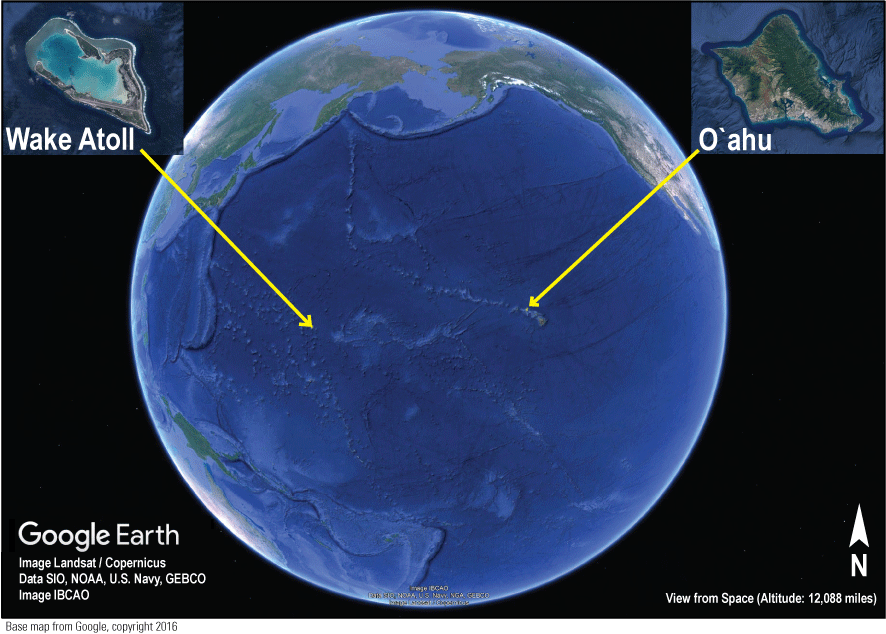
Location of Wake Atoll.
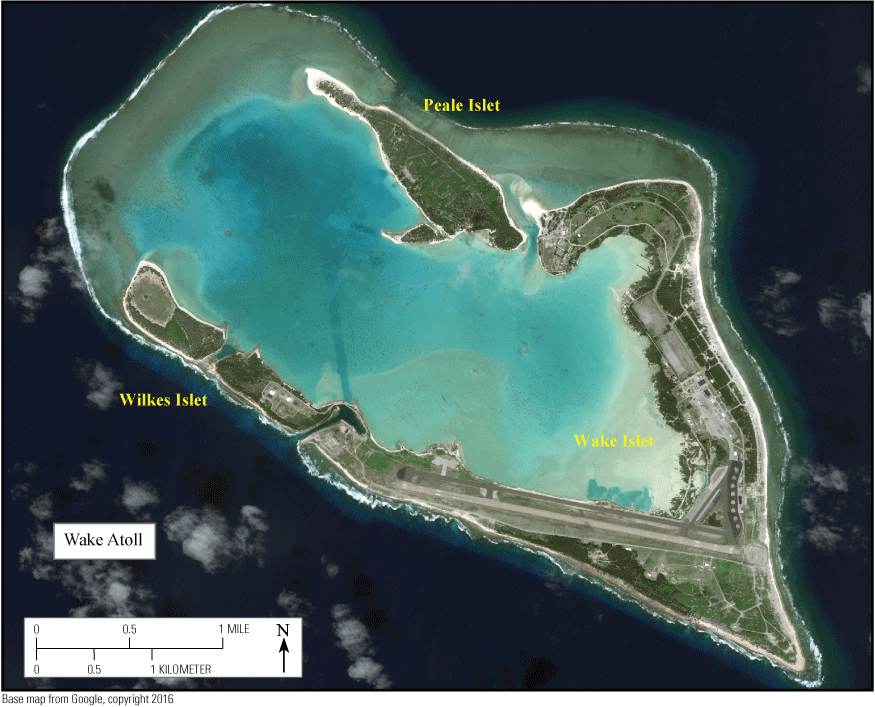
Wake Atoll with labels identifying its three islets.
The history of Wake is important for understanding how its natural resources have been affected over time and illustrates an array of past and current (2018) pathways for invasive species. There is no prehistoric evidence that Wake was populated by pre-European Pacific peoples. Heinl (1947) provides an account of the pre-war history of Wake from 1568 to 1941, and additional historical context is in the Wake Integrated Cultural Resources Management Plan (Verhaaren and Kullen, written commun., 2014) and INRMP (U.S. Air Force, written commun., 2017). The brief history that follows is summarized from these documents. Wake was discovered in 1568 by Spanish explorers although credit is given to British Captain William Wake who rediscovered the island more than 200 years later in 1796. Wake was explored by U.S. Navy Commander Charles Wilkes and naturalist Titian Peale in 1841. The United States formally took possession in 1899. There are reports of several shipwrecks, but otherwise, few visitations until the Japanese began landing to harvest bird feathers and shark fins. A group of Japanese castaways was marooned on the atoll in 1908, and remaining Japanese camps were abandoned by 1922. Most early zoological and botanical observations are from the Smithsonian’s Tanager Expedition, which carried out a biological reconnaissance at Wake in 1923. The U.S. Navy was given jurisdiction over Wake in 1934 and gave permission for Pan American Airlines (Pan Am) to begin constructing facilities to support weekly trans-Pacific flights. In 1938, the Navy began plans for an outlying military base; however, construction did not begin until January 1941. Construction was not yet completed when the Japanese invaded and overran the island in December 1941 and occupied Wake for the rest of World War II. During the war, the Japanese continued to build many structures underground or behind embankments to protect them from repeated bombing. The atoll returned to U.S. possession in 1945 after the Japanese surrendered, and the atoll was again placed under the jurisdiction of the U.S. Navy. Later, civil administration was given to what is now the Federal Aviation Administration (FAA). Military Air Transport Services and later Military Airlift Command provided service to transient USAF aircraft while at Wake, and Pan Am and other airlines reestablished commercial airline services. During that period, the atoll’s population rose to roughly 2,000 people, and an elementary school was constructed. Further botanical and bird surveys were carried out during this period. In 1972, when long-range jet aircraft reduced the need for Wake as a refueling stop, the FAA transferred jurisdiction to the USAF until 1994. After this time, Wake was administered by the U.S. Army for missile defense, then transferred back to the USAF in 2002. On January 6, 2009, by Presidential Proclamation 8336, Wake Atoll was included in the establishment of the Pacific Remote Islands Marine National Monument. The Secretary of the Interior, in consultation with the Secretary of Commerce, has responsibility for management of the monument. On January 16, 2009, through Secretary Order 3284, the Secretary of the Interior delegated management of the monument to the U.S. Fish and Wildlife Service (USFWS). In accordance with Proclamation 8336, this order (3284) states that Wake is under management by the USAF under the 1972 agreement with the Secretary of the Interior (32 CFR part 935) until the agreement is terminated. The USFWS manages the areas surrounding Wake Atoll from the mean low water line out to 50 nautical miles as part of the National Wildlife Refuge System. Emergent lands are managed by the USAF and used for contingency deployments, an emergency landing facility, and fuel storage. With those activities, construction and maintenance at Wake have continued. In addition, there are currently (2019) regular flights to and from the atoll that carry passengers and supplies. Oceangoing barges bring the bulk of materials and supplies to the atoll and transport used equipment and materials off island.
Invasive species are known to be important factors in the decline of unique natural communities, species, and ecological processes (Vitousek, 1990; numerous papers in Veitch and Clout, 2002; Engilis and Naughton, 2004). The USAF uses INRMPs per the Sikes Act to manage and protect natural resources on installations. These are long-term planning documents to guide Department of Defense (DOD) natural resource managers in the management of natural resources to support installation missions while protecting and enhancing resources for multiple uses and biological integrity. The INRMP that addresses Wake includes components that address biosecurity and pest management. The initial Wake Atoll INRMP introduced the goal to “bring together and integrate all management activities in a way that sustains, promotes, and restores the health and integrity of ecosystems and that enhances the human environment on Wake Atoll” (Foothill Engineering Consultants, Inc., written commun., 2000). The 2008 INRMP identified the need for an invasive species risk assessment (U.S. Air Force, written commun., 2008).
Invasive/pest species are recognized as one of the greatest threats to ecosystems and economies (Vitousek and others, 1997; Warziniack and others, 2021). Biosecurity is thus a concern at several scales from global to local, and to address it, prevention and control policies have been and continue to be improved at several levels of government (Rawluk and others, 2021; Ricciardi and others, 2021). A biosecurity plan is an effective tool for identifying and addressing non-native, potentially invasive species problems and concerns (Matos and others, 2018). In 2012, the USAF, with support from private consultants, authored the Wake Island Biosecurity Management Plan (U.S. Air Force, written commun., 2012). This plan was “created to help guide the USAF in carrying out their responsibility for the prevention, rapid response, and control of non-native species on Wake” (U.S. Air Force, written commun., 2012). The plan includes references to existing non-native species laws, policies, and protocols that directly or indirectly address non-native species on Wake. These include international, national, state (Hawai`i—though Wake is not officially part of the state, most of the access to Wake comes directly from Hawai`i), and Air Force Instruction (AFI) laws, policies, and guidelines. The plan recognizes and addresses the importance of minimizing the possibility that new invasive plants and animals may be introduced to Wake. Wake has an active port for supply deliveries and an airfield for military operations connecting it to ports and airfields globally, but in particular, with Guam and O`ahu, Hawai`i. People, supplies, equipment, other cargo, and the vessels themselves act as potential pathways for species invasions and reinvasions that pose a biosecurity risks. This plan was originally created to reduce risks of rodent incursion, and it re-defined the container requirements and other elements of USAF shipping to the atoll. The biosecurity plan was updated in 2015 (U.S. Air Force, written commun., 2015) and was incorporated into the 2017 INRMP as a component plan. The 2015 Biosecurity Plan still retains a rodent focus; however, some components of the intervention measures specified have potential for inhibiting or intercepting invasive species other than rodents.
As defined by order of The Secretary of the Air Force AFI 32-1053, “Integrated Pest Management (IPM) is a planned program incorporating continuous monitoring, education, record keeping, and communication to prevent pests and disease vectors from causing unacceptable damage to operations, people, property, material, or the environment. Integrated Pest Management includes methods such as habitat modification, biological control, genetic control, cultural methods, mechanical control, physical control, regulatory control, and the judicious use of least-hazardous pesticides” (U.S. Air Force, 2014). The goal of the IPM Program for Wake is to “develop and employ a systematic approach for onshore and offshore biosecurity, inclusive of rapid response” (U.S. Air Force, written commun., 2017). The IPM Program for Wake has nested within it an IPM Plan (which is focused on pest management of structures, buildings, and surrounding yards at Wake; Chugach Federal Solutions, Inc., written commun., 2013); a Biosecurity Management Plan (as described previously, it focuses on invasive species prevention, interception, detection, and rapid response; U.S. Air Force, written commun., 2015); and a Biological Control, Survey, and Management Plan (which addresses pest management in the broader context of Wake beyond structures and surrounding yards; U.S. Air Force, written commun., 2017). Biosecurity actions are thus included in the Wake IPM Program goal focusing on preventing invasive species incursions and directing rapid response should invasive species appear. Prevention is by far the most cost-effective management option, followed by early detection of incursion, with potential for successful eradication or control decreasing over time while increasing in cost (fig. 3). Tobin and others (2014) found area of an eradication program, or infestation size, to be a significant predictor of the probability of eradication success and program cost. Wake presents a unique opportunity for increased potential for successful eradications even as time progresses due to its reduced areal extent, and with its remote location, there can be greater control over reintroduction potential. IPM includes creating strategies for the most environmentally sound response for eradication or control of invasive or pest species.
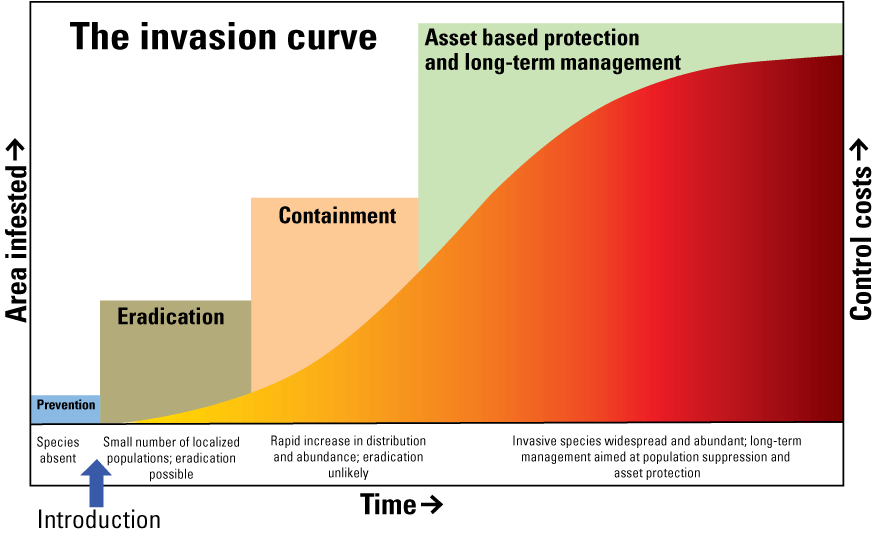
Phases of the invasion curve (adapted from Victorian Government, 2010; Invasive Plants and Animals Policy Framework, State of Victoria, Department of Primary Industries). Preventing the introduction of invasive/pest species is the most cost-effective defense against invasion, followed by eradication, if feasible. Early detection and rapid response actions are generally needed for successful eradication. Eradication success may also be possible after longer periods in small island ecosystems given appropriate tools and methodology, though expenses are still higher as distribution and abundance expand. When eradication is not feasible or tools have not been created, containment and long-term control of an invasive/pest species population may be the only management option. This option generally requires costly and possibly indefinite financial investment.
The INRMP calls for the Wake biosecurity plan to be updated periodically. Before moving forward with updating the document, the USAF determined it would make the next version of the plan more valuable by testing the efficacy of the tools called out as requirements for shippers. In 2017, the USAF issued funds to the USGS to support an evaluation of the 2015 Biosecurity Plan. The evaluation included real-time implementation observations as well as a table-top review of documentation. The 2015 Biosecurity Plan for Wake states, “The invasion and the reinvasion routes for invasive species accessing Wake Atoll can be described in three pathways: via air, contracted barge, or stranded vessel. Cargo containers and break bulk cargo (goods that must be loaded individually, and not in intermodal containers) arriving to Wake via an annual barge (usually) departing the Fleet Industrial Supply Center at Joint Base Pearl Harbor–Hickam (JBPHH) on the island O`ahu, Hawai`i, are the biggest concerns and threats. Sporadic vessel and air traffic from Guam, specifically Andersen Air Force Base and the Commercial Port of Guam, has resulted in the need to coordinate with U.S. Department of Agriculture Wildlife Services to ensure canine teams (trained to detect invasive brown tree snakes) inspect any goods and transportation platforms prior to departure.” The 2015 Biosecurity Plan suggests protocols to be used for vessel and shipping container biosecurity. The primary goals of this project were to (1) provide an assessment of how well these protocols were being carried out and how well they serve their intended purpose, and (2) identify additional or alternative tools to further strengthen invasive species management at Wake. Strengthening invasive species management could increase the protection of vulnerable species and habitat, human habitants, and visitors and reduce the potential for negative effects from invasive species on the installation’s mission.
Methods
Our evaluation of the 2015 Biosecurity Plan primarily as it relates to moving supplies to Wake Atoll via barge contained five main elements: (1) surveys before barge movement, (2) surveys after barge movement, (3) a preliminary risk assessment for any species detected during surveys, (4) a small-container insect mortality experiment to test fumigant requirements in shipping containers, and (5) an evaluation of the 2015 biosecurity document text in which processes are outlined to assess the potential for improvements to the procedures. Later in this section, we give a brief overview of these five elements followed by more detailed and specific information.
The USGS, with the participation of the USAF 611 CES/CEIE Biosecurity Manager (hereafter referred to as 611th Biosecurity Manager), carried out efficacy evaluations of shipping container and cargo staging area biosecurity before barge movement. Evaluations occurred at JBPHH, where procured supplies are staged for loading onto an annual resupply barge for Wake. These were followed by evaluations of the resupply barge and shipping containers upon arrival at Wake.
The USGS carried out surveys of the JBPHH and Wake warehouses and shipyards, the barge, and the shipping containers before and after vessel movement when we had access. Target organisms for these surveys were rodents, reptiles, and arthropods. Any species encountered were identified to the lowest taxonomic level possible. We also recorded any other animal taxa or animal sign (for example, webs, fur, frass, and feces) that we detected as well as the presence of plant matter, including animal or plant propagules (for example, eggs, pupae, seeds, and cuttings). Arthropod species identifications were made by Robert Peck, (Hawai`i Cooperative Studies Unit, University of Hawai`i at Hilo) or were sent out to specific taxonomic experts as needed. In several cases, it was not possible to confidently identify a specimen, or series of similar specimens, to the species level. In those cases, the species most closely thought to represent the specimen in question was preceded by the abbreviation “nr.,” which indicates that it is near, or similar to, that species. In some other instances, specimens could only be identified to the genus, family, or in a few cases, order level. There were two instances where it was not possible to confidently identify specimens to family, and “nr.” was included after the family name used in these cases.
-
1. Surveys before barge movement:
-
• We assessed a sanitation baseline (the state of cleanliness or presence of dirt [which could include soil], debris, liquids, organisms, and so on) of all non-presealed empty shipping containers and their seaworthiness as well as vessels received from the vendor(s).
-
• We observed and recorded any invasive species or biosecurity concerns and any tools used at the government staging facility.
-
• We observed the Navy, BOS contractor, and shipping vendors as they stuffed shipping containers and deployed biosecurity tools according to the 2015 Biosecurity Plan.
-
• We evaluated the biosecurity tools currently (2018) implemented for the barge movement.
-
• We identified additional and alternative tools that could be used for quick evaluation of potential stowaways (an organism unintentionally transported) in shipping containers upon arrival of the tug and barge to Wake.
-
• We installed temperature loggers that recorded average minimum and maximum temperatures in shipping containers spanning departure from JBPHH to arrival at Wake.
-
-
2. Surveys after barge movement:
-
• We documented invasive species or sign upon opening containers for brief inspections of the interiors after they were unloaded from the barge.
-
• We noted containers that did not have required biosecurity tools.
-
• We collected the supplementary USGS-provided biosecurity tools and, to the extent possible, the tools required by the 2015 Biosecurity Plan for analysis.
-
• We inspected the barge once we had access after cargo was unloaded.
-
• We inspected the container interiors once we had access after cargo was unloaded.
-
• Throughout this process, we observed and engaged with the BOS contractor wherever and whenever possible.
-
-
3. Container insect mortality trial:
-
4. Preliminary species risk assessment:
-
• Although the outline of components for addressing the specific request from the USAF is detailed above, we added two additional tasks. As an initial step to inform USAF regarding potential invasive or pest species status should species arrive and become established at Wake, we carried out a small-scale, internal preliminary risk analysis using our findings.
-
• While the focus of this project was an assessment of how well protocols used for vessel and shipping container biosecurity were being carried out and how well they served their intended purpose, we also reviewed the 2015 Biosecurity Plan and other documentation provided relevant to shipping via the resupply barge.
Detailed Methods for Each of the Four Elements Evaluated for Wake Biosecurity Efficacy
Surveys Before Barge Movement
Surveys before barge movement consisted of evaluating several different elements of biosecurity. We developed and carried out sanitation baseline surveys to assess the presence of potentially invasive species in shipping containers that arrived empty and later got stuffed with cargo. Sanitation baseline surveys here refers to an assessment of how clean an area or item, in this case the empty shipping container exteriors and interiors, were when initially surveyed. We were primarily looking for presence or evidence of animals, sign of presence, or their propagules, but we also noted signs of plants, presence of mold, soil, and anything that could potentially harbor invasive species. Likewise, we carried out sanitation baseline surveys of the government cargo staging facility to note invasive species or biosecurity concerns as well as tools that were being used in accordance with the 2015 Biosecurity Plan. The staging facility where cargo is stored and empty containers are delivered was at the Naval Supply Systems Command (NAVSUP) Fleet Logistic Center Pearl Harbor. The empty containers get delivered to the gated dock area at Kilo Pier. Cargo may be housed in two of the warehouses adjacent to the dock area, or if too large to fit in a container, it is stored outside in the dock area (fig. 4). We carried out pre-barge surveys at JBPHH between April 3 and 16, 2018. These included surveys of warehouses and the adjacent dock as well as break bulk and each shipping container and flat rack (racks designed to haul oversized items that will not fit in a shipping container) planned to be used for shipping cargo to Wake. We accessed these areas on weekdays during NAVSUP normal business hours, which limited us to daytime active surveys, so passive traps could not be monitored daily in some cases.
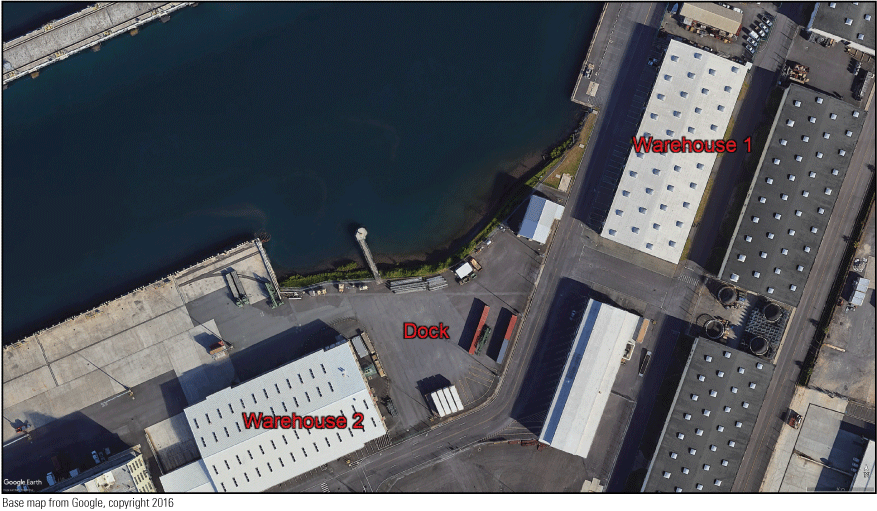
Warehouses and dock at Joint Base Pearl Harbor–Hickam that serve as cargo staging areas for Wake Atoll resupply cargo.
During container stuffing, we observed the Navy BOS contractor and shipping vendor as they stuffed cargo into the containers, and we added additional or alternate tools (for example, wax tags, chew cards, and additional glue boards) for quick evaluation of the containers and vessels once at Wake. We also included digital thermometers for recording minimum and maximum temperatures in a subset of containers after they were stuffed to document the potential for temperatures inside containers to reach temperatures lethal to target organisms. We expected to survey for organisms above the draft line on the barge and tug vessels; however, USGS could not be present when the vessels arrived.
Supplies for the Wake annual resupply barge are typically loaded into standard 20-ft intermodal end opening steel containers built to International Organization for Standardization (ISO) specifications. These containers are made of corrugated steel and a plywood floor. Container inspections took place during three phases over the course of this study and are defined as (1) Empty: before any cargo is loaded into the containers; (2) Stuffed: cargo gets loaded into the container, detection tools are placed by biologists, and the container is sealed; and (3) Unstuffed: after container cargo has been unloaded at its destination. We addressed the sanitation baseline of shipping containers during the empty phase of pre-barge movement. We observed the BOS contractor and shipping vendor and added additional tools, including wax tags, chew cards, and additional glue boards during the stuffed phase. We surveyed containers after barge movement, primarily in the unstuffed phase, at Wake.
Sanitation Baseline of Shipping Containers
We assessed container sanitation to evaluate the role shipping containers may have in moving potential invasive species, based on inspections using visual encounter surveys (VES) both outside and inside. Visual encounter surveys involve walking through locations of interest and searching for target species. We recorded, photographed (where relevant), and collected specimens or signs of their presence as well as any other information we felt was important about the search item or area. Here, target organisms were animals, or their signs, but we also included plant matter and any visible dirt, soil, and debris. In addition to the standard shipping containers, we also surveyed the flat racks and break bulk items that were staged for shipping to Wake.
We recorded plant matter during all surveys, including seeds, to the extent possible though no identifications were made as part of this study. We also recorded seeds when we could see them in debris we collected from containers, and we saved all dirt (or soil) and debris for a grow out study (Yanger and others, 2025) to assess seed viability and identify species of any that could be adequately grown. Preliminary results are included in the discussion.
Empty Container Inspections
We inspected 30 containers between April 4 and 7, 2018 (fig. 5). We labeled and surveyed the condition inside each empty container as thoroughly as possible within the time limit we had for inspecting each container. We inspected the outsides of containers to the extent possible. The containers were initially stacked on top of each other and placed right next to each other, and therefore, we were not able to check all sides of the containers, nor was it possible to inspect the undersides of containers (fig. 6).
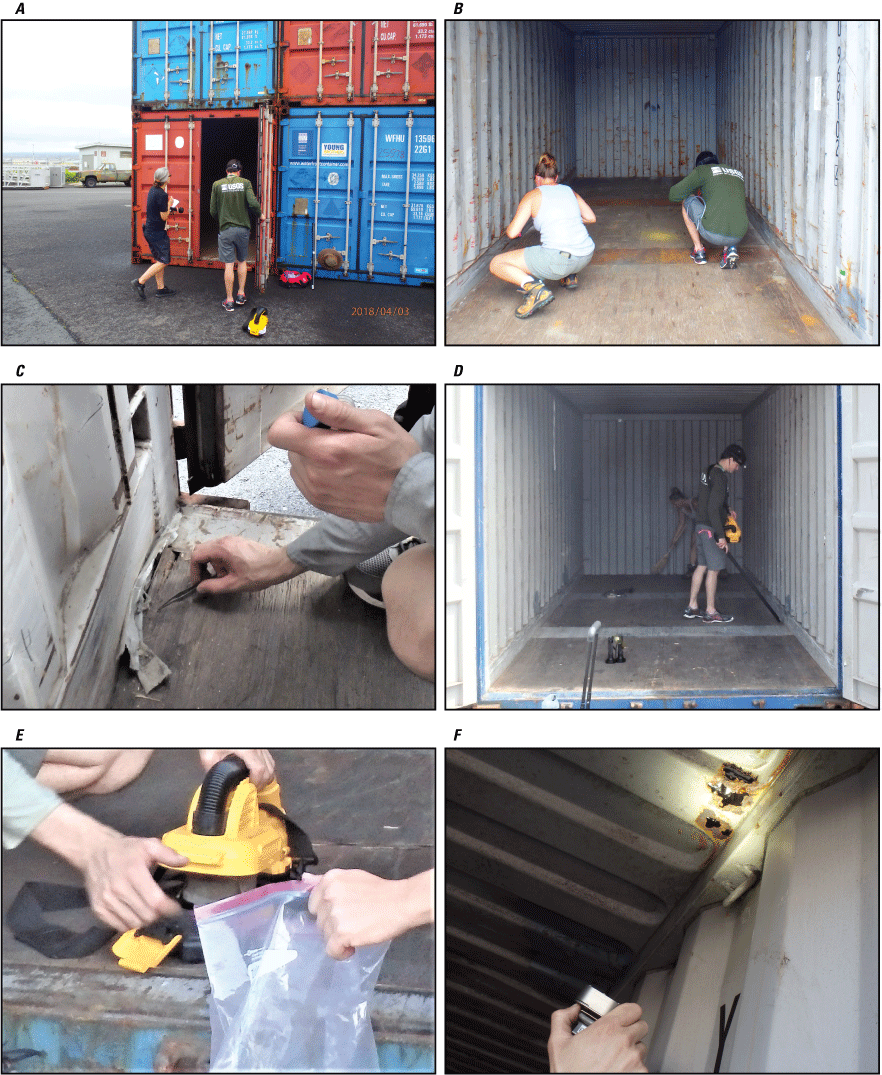
Resupply barge shipping containers for Wake Atoll Vessel Movement Biosecurity Program efficacy evaluations in 2018 were initially inspected at Joint Base Pearl Harbor–Hickam. Researchers inspected A, container exteriors for any stowaway animal or plant matter and B, container insides for any flora or fauna. Researchers also C, collected specimens and D, swept and vacuumed containers to collect as much remaining material as possible inside containers. Debris collected from the inside of the container E, was placed into a clean, 1-gallon plastic bag for further analysis. Researchers F, checked containers for leaks and integrity issues that could facilitate the movement of flora or fauna. Photographs by S.A. Hathaway, U.S. Geological Survey.
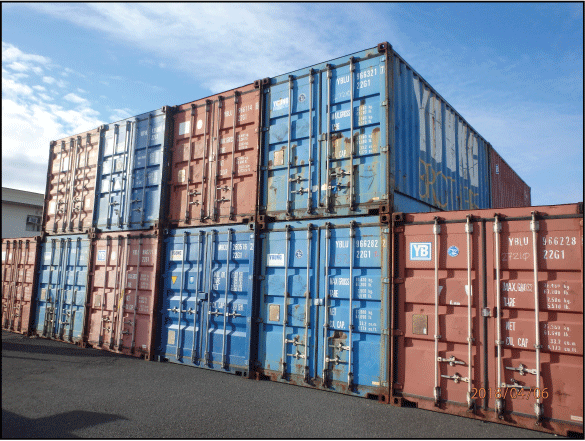
Empty shipping containers at Joint Base Pearl Harbor–Hickam before stuffing with cargo for 2018 Wake resupply shipment. Photograph by S.A. Hathaway, U.S. Geological Survey.
We spent about 20 minutes inspecting each container and the break bulk items and about 5–7 minutes inspecting each flat rack. During our VES for target organisms, primarily animal material or sign, we collected specimens for subsequent identification (figs. 5B, C). Due to time constraints, we did not attempt to collect every organism, but we attempted to collect representative specimens of each unique taxon encountered.
Once collected, we temporarily placed live arthropod specimens on ice and transferred them into vials of 95-percent ethanol. We kept dead specimens, seeds, and other plant matter in dry vials. We collected specimens of as many target organisms as possible within our time constraints. After searching for specimens, we vacuumed the container with a DeWalt 20V Max half gallon wet/dry vacuum customized with nylon fine mesh over the air filter for collecting intake and then swept with a broom to collect anything remaining (fig. 5D). Later, materials collected from each container (dirt [or soil], debris, trash, and other) were weighed, photographed, and inspected for any animals, animal sign, seeds, or other plant material which may not have been collected previously (fig. 5E). Flat racks and break bulk items were not vacuumed or swept. Before USGS arrival to the project site, six shipping containers that had been previously delivered were inspected by the 611th CES Biosecurity Manager. These six containers had been swept and set with baited glue boards before USGS surveys. Glue boards were removed after a few days from all but one container before USGS surveys. One glue board had been overlooked and was removed when we inspected the container.
Once we completed specimen collection, we inspected the interior of the container for biosecurity concerns, such as holes leading to the outside (fig. 5F). Next, one or two people remained inside the container while another completely shut the door. Inside, we used an ultraviolet flashlight to look for any animal sign, such as urine, and with no light, we looked for any visible light leakage from the outside to verify holes in the container. Because containers were stacked and placed right next to each other, our ability to see light coming in was limited. Therefore, we consider our surveys for holes to be conservative.
Throughout this process, we took notes and photographs of every container to document their condition and any integrity concerns. Integrity was assessed by the external and internal inspections for breaches, such as holes, missing or torn door gaskets, broken seams, broken or splintered flooring, bolts missing from flooring, or failed patches that could potentially allow animal or plant movement into or out of the container or act as habitat. We also noted if we detected water or mold inside, and to a lesser extent, we noted buckling of the sides or ceiling of the containers. We counted the number of holes that could allow animal movement in or out. We gave each container a hole severity score based on the holes we could see leaking light into the container when it was closed. We subjectively scored the size of holes from zero to three based on how much light we could see coming in while the doors were closed: 0 means no visible light, 1 means light leakage indicating a small hole estimated at about 1 mm that could allow the movement of very small animals, 2 means a hole or gap greater than 1 and less than 7 mm, and 3 means greater than or equal to 7 mm. The number and size of holes is considered conservative due to limits in search time and due to containers being stacked side by side and on top of each other. We also counted holes based on the number of bolts missing from the floorboards; each missing bolt created a passage to the outside of about 7 mm in diameter. A score from 0 to 7 was assigned based on the number of missing bolts: 0 means no bolts missing, 3 means 1 bolt missing, 4 means 2–5 bolts missing, 5 means 6–9 bolts missing, 6 means 10–13 bolts missing, and 7 means 14 or more bolts missing. We combined the light leakage scores with the missing bolts score to assign an overall integrity severity score to each container. The overall integrity ratings ranged from 0 to 5 (with 0 being no breaches in integrity detected), indicating least to greatest severity.
Based on the poor condition of some of the containers we observed, we thought it could be useful to determine if they had been inspected for safety and integrity, which could trigger needed service, repairs, or removal from shipping operations. We discovered that a conference for container safety jointly convened by the United Nations and the International Maritime Organization (IMO) in 1972 resulted in the adoption of the International Convention for Safe Containers (CSC; https://www.ecfr.gov/current/title-49/subtitle-B/chapter-IV/subchapter-B; CFR title 49, subtitle B, chapter IV, subchapter B 450–453, accessed March 28, 2022). A CSC plate is typically affixed to the outside of the left door of a container and has a manufacture date and inspection date (if after 5 years). The goal of the CSC is to maintain a high level of safety for human life in the transport and handling of containers and to facilitate the international transport of containers by providing uniform international safety regulations. In compliance with the CSC, after containers are 5 years old, they are required to be inspected at least every 30 months. A CSC plate is fastened to shipping containers at the time of manufacture, and the date of its next inspection is marked on the plate, so we began recording this information.
Container Stuffing and Biosecurity and Detection Tool Setting
When it was time for cargo to be stuffed, the containers were moved from the dock area adjacent to warehouse 2 (W2 [JBPHH supply building]) to the area outside of warehouse 1 (W1 [JBPHH building 405]). These were the same containers we inspected while empty. Container stuffing took place from April 6 to 11, 2018. We observed the stuffing process by NAVSUP and recorded if the BOS was present for inspections throughout the process and if the required biosecurity tools were placed in each container (for example, Trapper T-Rex Rat Snap, hereafter referred to as snap trap, baited with a professional gel rodent attractant, Bell Laboratories, Inc. [Windsor, Wis.], Provoke Monitoring Gel, placed in a bait station, a glue board [also referred to in the 2015 Biosecurity Plan as a sticky trap] on the floor, and a pest strip attached to a top tiedown near the door). We observed the stuffing of a total of 20 containers. We were informed that there would also be refrigerated containers (hereafter referred to as reefers) being stuffed, but this did not happen during our inspection surveys.
Before each container was closed and sealed, we placed several additional interception and detection tools inside each container to determine their utility as potentially required tools in the future (fig. 7) and to evaluate the efficacy of the current (2018) required biosecurity tools. Detection tools are described in detail in appendix 1. We added wax tags and chew cards on the container doors to target rodent activity, glue boards on the inside walls of the container doors to target climbing or flying organisms, glue boards on the floor of the container (supplementing the one glue board requirement for each container per the Wake biosecurity program), and hanging yellow glue boards to target flying organisms. All non-required tools were placed in each container in triplicate. Wax tags and chew cards were secured to container doors. We used Gorilla Tape duct tape (hereafter referred to as duct tape) and neodymium magnets to affix wax tags and chew cards at a height that would be accessible to rodents, approximately 2.5–8 centimeters (cm; 1–3 in.) from the container floor. Glue boards were secured to container doors with duct tape and neodymium magnets approximately 1.5 m (5 ft) off the floor, yellow glue boards were suspended from a ceiling tie down and hung approximately 1.5–2 m (5–6.5 ft) off the floor on one side of the front of the container, and duct tape was used to secure the glue board traps to the floor near or at the front of the container. We added three chew cards and three glue boards to the floor of the cab of the jet-fuel vehicle.
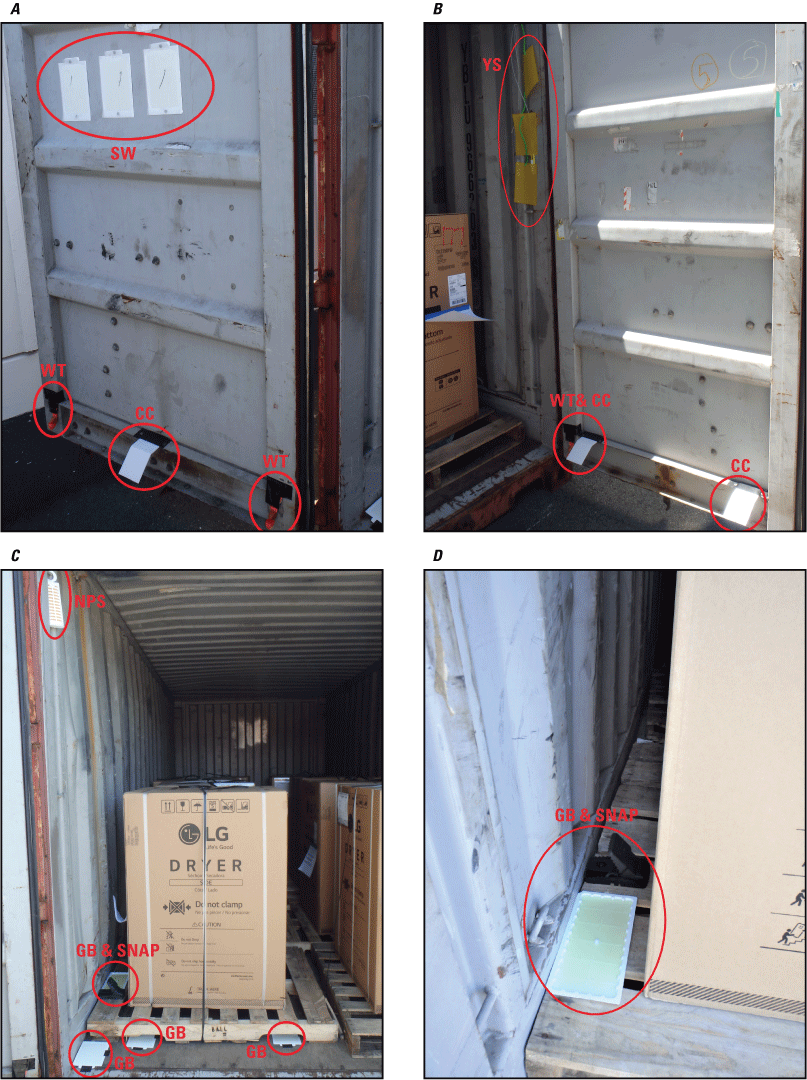
A suite of biosecurity tools that was placed in each 2018 Wake Atoll resupply container at Joint Base Pearl Harbor–Hickam during the stuffing phase as they were stuffed with cargo including A, two wax tags (WT), one chew card (CC) and three glue board traps were placed on one container door (SW); B, one WT, two CC, and three yellow glue board traps (YS) were placed on another container door; C, three glue board traps (GB) were taped to the container floor, one pest strip (NPS) was attached to the upper left lashing bar, one snap trap (SNAP), and one GB were placed on a pallet; and D, close-up of a SNAP and GB on pallet. The SNAP, NPS, and one GB are tools required by the Wake Island Biosecurity Management Plan, and the WT, CC, YS, SW, and three additional GB were added as part of the evaluation of the efficacy of this plan. Photographs by S.A. Hathaway, U.S. Geological Survey.
We also placed Onset HOBO TidbiT and Pendant data loggers (Bourne, Mass.) in five of the resupply intermodal containers selected at random to examine temperature minimums, maximums, and averages. Temperatures may affect survival of animal species that could be unintentional stowaways in cargo being transported between Hawai`i and Wake. Loggers were set to record temperature in 15-minute intervals from the onset of stuffing to unstuffing. In four containers, loggers were cable tied in groups of three just inside the doors of the containers on the bottom left front tiedown provision (fig. 8). This area was chosen for accessibility. In one container, loggers were tied to the middle, center roll bar of a vehicle, placing them in the center of the container.
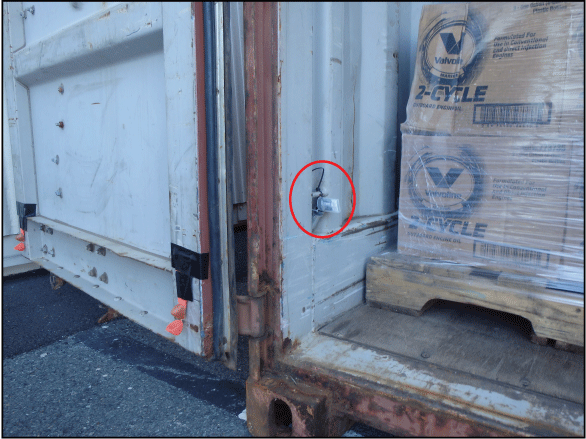
Temperature loggers (circled in red) placed in a stuffed shipping container used for the 2018 Wake Atoll resupply shipment. Photograph by S.A. Hathaway, U.S. Geological Survey.
Sanitation Baseline of Cargo Staging Areas
Similar to our shipping container assessments, we assessed baseline sanitation in the cargo staging areas. We used the same VES method and added passive trapping tools to evaluate the efficacy of biosecurity tools that are required in these areas by the 2015 Biosecurity Plan.
Cargo Staging Areas
Two warehouses (W1 and W2) at JBPHH Kilo Pier are generally used to store non-perishable cargo before it is loaded into the shipping containers that are transported on a barge to Wake (fig. 4). During this study, W1 was used to store cargo. Warehouse 2 had historically been the main warehouse used for storing cargo before stuffing into shipping containers and shipment to Wake (K. Rex, National Oceanic and Atmospheric Administration, oral commun., 2018). The area we called the dock is adjacent to W2 and is where containers were stored before and after stuffing before barge arrival (fig. 4).
We did sanitation baseline surveys of cargo staging areas looking for signs of organisms or propagules from April 3 to 16, 2018, at JBPHH; these consisted of surveys of W1, W2, and the dock. We used a variety of detection techniques and tools. Before we began surveys of the shipping containers, we did an initial walk through at each of the warehouses and the dock on April 3 to identify biosecurity concerns and determine if biosecurity tools stipulated by the 2015 Biosecurity Plan were deployed at W1, W2, and the dock. In these surveys, we looked for a high density of baited snap traps, glue board traps, or both, each placed in tamper resistant bait stations (fig. 9) or A24 Goodnature self-resetting rat and mouse kill traps (hereafter self-resetting trap; [fig. 10]) placed along walls and in corners inside and outside of all buildings.
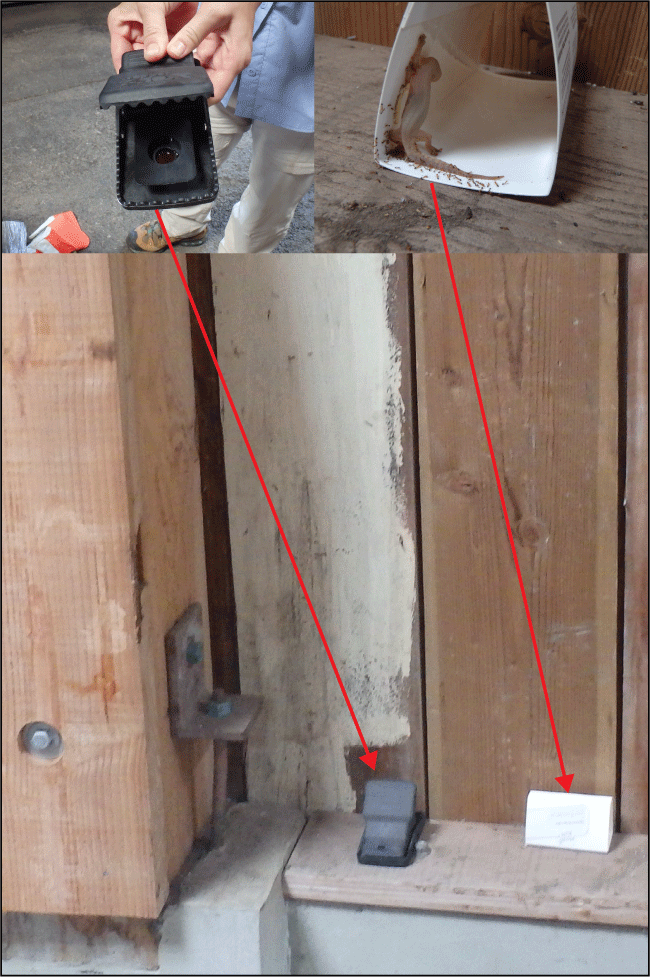
Example of snap trap and glue board trap (without bait stations) tool options required for biosecurity at cargo staging areas (warehouses and the adjacent dock area) for Wake Atoll resupply cargo. Photographs by S.A. Hathaway, U.S. Geological Survey.
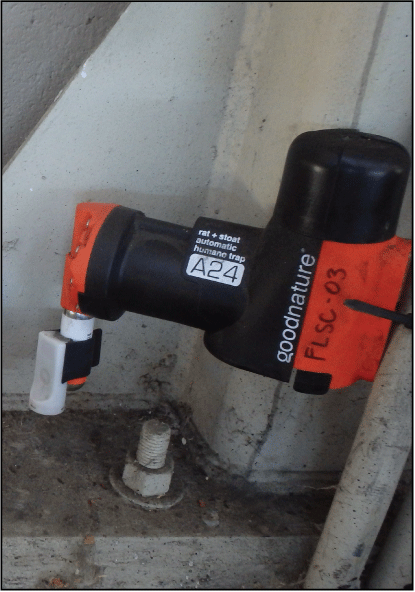
Example of a self-resetting trap tool option required for biosecurity at cargo staging areas (warehouses and the adjacent dock area) for Wake Atoll resupply cargo. Photograph by J.C. Molden, U.S. Geological Survey.
We did VES before setting up additional detection tools. We set several tools within the warehouses at multiple detection stations to identify organisms that could be transported to Wake along with cargo, to determine the utility of the tools for potential use in the future for detection and interception, and to evaluate the efficacy of the biosecurity tools that were being used.
Warehouse 1
On April 6, 2018, we set up 20 detection stations inside warehouse 1 (W1). Each station had various tools designed to detect target organisms, with a minimum of seven detection tools: a yellow pan trap; wax tag; chew card; hanging yellow glue board; glue board on ground; glue board off of the ground, such as placed on a pallet; and glue board on a wall (figs. 11, 12). Additionally, five tracking tunnels (fig. 12A) and six cameras (fig. 12C) were placed at strategic locations within W1. Yellow pan traps were removed from W1 on April 13, 2018, to reduce specimen loss due to decomposition. The remaining tools were removed from W1 on April 16, 2018. During all surveys, when collecting glue boards with arthropod captures, we placed plastic spacers on the board and replaced the original protective film before stacking them for shipment to the Pacific Island Ecological Research Center (PIERC) for identification.
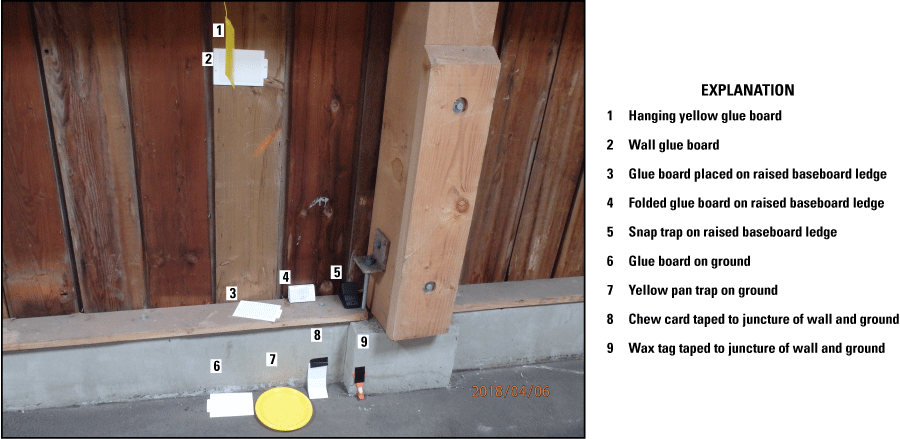
Example of a station with animal detection tools used at cargo staging warehouses at Joint Base Pearl Harbor–Hickam for evaluating Wake Atoll vessel movement program biosecurity in 2018. Photograph by S.A. Hathaway, U.S. Geological Survey.
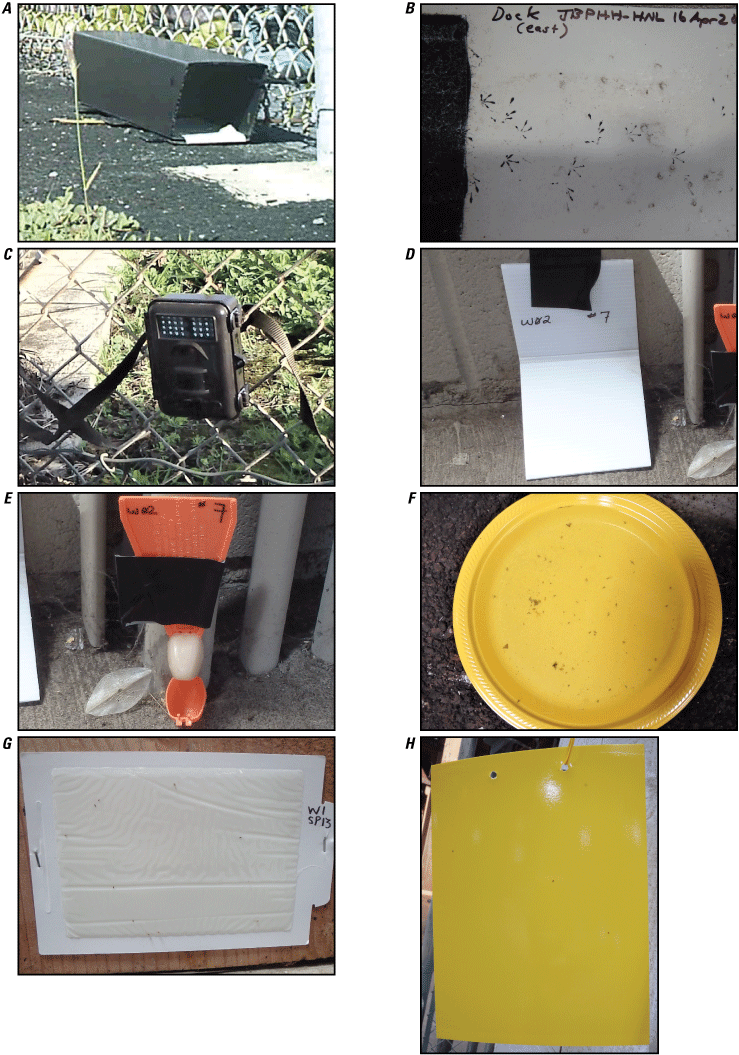
Examples of detection tools used for evaluating biosecurity at cargo staging areas (warehouses and the adjacent dock area) at Joint Base Pearl Harbor–Hickam, including A, a Pest Control Research Ltd. tracking tunnel; B, an example tracking tube card insert with unknown lizard prints collected from dock area; C, a camera trap; D, a chew card; E, a wax tag taped with a neodymium magnet clung to a metal pipe; F, a yellow pan trap filled with soapy water; G, a glue board; and H, a yellow glue board trap. Photographs by S.A. Hathaway, U.S. Geological Survey.
Warehouse 2
On April 10, 2018, we set up 10 detection stations in warehouse 2 (W2) with the same 7 standard tools (yellow pan trap, wax tag, chew card, hanging yellow glue board, glue board on ground, glue board raised off of the ground such as on a pallet, and glue board on a wall) used in W1 as well as 5 tracking tunnels and 6 cameras. All tools were removed from W2 on April 16, 2018.
Dock
We placed 21 glue boards on the ground under empty Wake resupply shipping containers on April 5, 2018, and removed them on April 6, 2018, due to container repositioning. Because of the openness of the dock area, there were few places to put tools. We placed three tracking tunnels and three cameras in the dock area and kept them running from April 10 to 16, 2018.
Sanitation Baseline of the Barge and Tug
We planned to look for target organisms on the barge before cargo loading, but it was not possible due to scheduling logistics. We verified whether the required third-party rodent inspections had been submitted for the barge and tug before arrival at the JBPHH dock.
Surveys After Barge Movement
Container Arrival and Unstuffing on Wake
Containers arrived at the Wake dock on May 9, 2018, and were unloaded from the barge throughout the day. Initial surveys were brief so as not to interrupt the workflow. Once a group of containers was unloaded and the area was safe for entry, we quickly opened each container, briefly scanned inside to record if we saw anything moving, took notes on the required biosecurity tools, removed and labeled all USGS installed tools, and immediately shut the container doors so the containers could be loaded onto a truck and sent to the various supply yards for unstuffing. We left the required biosecurity tools in the containers until unstuffing was completed. The fate of those tools is unknown; they had been removed from containers before we had access for VES. Once containers were unstuffed, we were able to perform a 20-minute VES in most containers to search for any remaining target organisms. Throughout the different stages of our surveys on Wake, we observed BOS presence to the extent possible and had brief interviews with the temporary stand-in for the BOS Environmental Technician to gather additional information on Wake Atoll biosecurity.
Barge and Tug Inspection
We inspected the resupply barge at Wake on May 10, 2018, after most cargo had already been unloaded. This inspection consisted of a VES for about 20 minutes. We checked the condition of the barge and status of the required biosecurity tools.
Post-Barge Movement Analyses
We added a variety of tools in the cargo staging areas and to the shipping containers during the stuffing process to provide a preliminary assessment of the efficacy of biosecurity tools currently (2018) being used for detection and interception. We compared species detection results between biosecurity tools currently (2018) required (self-resetting traps in W2; snap traps and SG in W1 and containers; and pest strips in containers) and the tools we added as part of our surveys. We used simple comparisons of detections.
We analyzed the relative effectiveness of three glue board types and locations (placed on the ground, container wall and door, and a hanging yellow glue board) using a multinomial Poisson mixtures model for removal sampling using count data that accounts for imperfect detection (Royle, 2004; Royle and Dorazio, 2006). These models have been shown to give reliable and robust estimates of population abundance even when detection and density are relatively low (Costa and others, 2020). For statistical analyses, we used R (R Development Core Team, 2017) package “unmarked” version 1.2.5 to fit a multinomial-Poisson mixtures model to our data (https://rdocumentation.org/packages/unmarked/versions/1.2.5).
We fit the model with and without container as the site covariate, which allowed for overall mean and individual abundance estimates for each container. We used trap type (glue boards placed on the ground, on the container wall and door, and hanging glue boards) as the detection covariate to estimate the capture probabilities for the three glue board types and locations. Abundance and capture probabilities are conservatively presented with 95-percent confidence intervals (CI). Cumulative probabilities were calculated by subtracting the product of probabilities.
We also examined the temperatures in containers we had equipped with Onset HOBO TidbiT and Pendant data loggers (Bourne, Mass.). To examine how container temperatures might affect animal stowaways, we used the GlobTherm database (Bennett and others, 2019; https://doi.org/10.5061/dryad.1cv08), a compilation of experimentally derived critical maximum temperatures (Bennett and others, 2018), to extract and summarize upper thermal limits for terrestrial animals. Lastly, we ran a pilot experiment testing the effectiveness of the required pest strip in the containers during cargo shipping. Details of that experiment are described separately below.
Container Insect Mortality Trial
We did a small trial of the effectiveness of the dichlorvos pest strip used to control stowaway insects in cargo containers sent to Wake. The pest strip used is a 65-gram (g) dichlorvos impregnated plastic strip that is designed as a controlled-release insecticide. According to the manufacturer, one pest strip will kill visible and hidden flies, gnats, mosquitos, moths, silverfish, cockroaches, spiders, beetles, earwigs, and other insects as listed on contact and prevent new infestations. The effective area listed on the label is 900–1,200 cubic feet (ft3; 25.5–34 cubic meters [m3]), and the strip is meant to last for 4 months (18853_HS_NoPestStrip https://s7cdn.spectrumbrands.com/~/media/HomeAndGarden/Hot%20Shot/Files/Labels/071121055804.pdf, accessed September 3, 2018). A standard 20-ft ISO intermodal shipping container is approximately 1,165 ft3 (33 m3).
We did the trial inside containers from September 8 to 20, 2018, at the USGS Western Ecological Research Center, San Diego Field Station, using two 16-ft intermodal shipping containers with a square footage of approximately 1,000 ft3 (28.3 m3). We deployed a single pest strip in the treatment container. The pest strip was suspended on a front, top tiedown provision, as is done for biosecurity for Wake (fig. 13A). A control container did not have a pest strip added. We included a few items in the containers to simulate a sparsely stuffed container environment. We considered the smaller container size, few items in the container, and more limited hiding areas for the test subjects to be a conservative test of the efficacy of the pest strip.
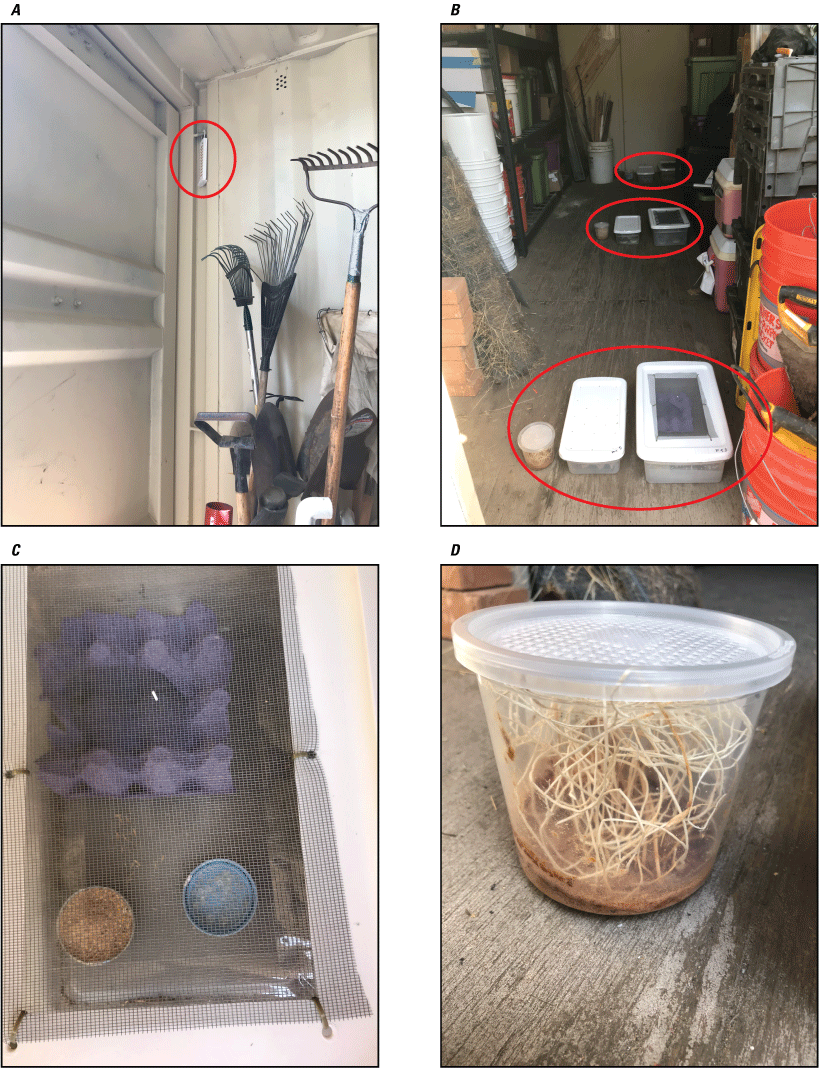
Components of a shipping container trial for evaluating the efficacy of using dichlorvos impregnated pest strips as a biosecurity tool, including A, location of pest strip (circled in red) hanging inside treatment shipping container at a front top tiedown provision; B, view from door of treatment shipping container showing insect enclosures (circled in red) placed at three distances from where pest strips were placed; C, cockroach and cricket enclosures containing a dish of commercial roach and cricket chow as well as a dish of insect water gel crystals; and D, fruit fly containers containing commercial culture media. Photographs by S.A. Hathaway, U.S. Geological Survey.
Live, healthy adult Dubia cockroaches (Blaptica dubia), banded crickets (Gryllodes sigillatus), and flightless fruit flies (Drosophila hydei) available commonly as feeder insects were used as models to test the effectiveness of dichlorvos vapor (the pest strip) in the treatment container. Healthy cockroach and cricket individuals (30 of each species) were selected and housed separately by species in plastic enclosures with air holes. Cockroach and cricket enclosures contained a paper egg tray for shelter, a dish of dry food (Dubia Diet [27.3-percent crude protein, 6.3-percent crude fat, 4.5-percent crude fiber, 10.7-percent moisture, and 5.8-percent ash]), and hydrated insect water crystals obtained from a local pet store (figs. 13B, C) so that any mortality would be due to dichlorvos. Similarly, fruit flies were enclosed in groups of 20 in plastic containers with a commercial culture medium (fig. 13D). One enclosure of each species was placed equidistant at three locations from the door for a total of nine enclosures in the treatment container (fig. 13B). Three sets of enclosures of each species were placed similarly in the control container. Containers were sealed on September 8, 2018, and opened on September 20, 2018, to conservatively mimic the duration of the actual cargo movement to Wake. Storage containers were locked so no one could open containers while the experiment was in progress.
We collected temperature data inside the treatment and control containers as well as outside of the containers using the same methods as those used with the resupply barge containers (see the “Container Stuffing and Biosecurity and Detection Tool Setting” section for more details).
We analyzed mortality data using a general linear mixed effects model before and after treatment design across the three species included in the study. For statistical analysis, we used the lme package in R (R Development Core Team, 2017). The significance level was set to 0.05.
Preliminary Species Risk Assessment
As an initial step to inform the USAF regarding potential invasive or pest species status should species arrive and become established at Wake, we carried out a small-scale, internal preliminary risk analysis using our findings. As defined in the 2016–18 NISC Management Plan, “Risk analysis is the set of tools or processes incorporating risk assessment, risk management, and risk communication, which are used to evaluate the potential risks associated with a non-native species or invasion pathway, possible mitigation measures to address the risk, and the information to be shared with decision-makers and other stakeholders” (National Invasive Species Council, 2016).
We based our approach on Booy and others (2017) and Richmond and others (2023). The protocols consist of a stepwise semi-quantitative procedure and consensus-building among taxonomic experts to identify high ranking species that are alien invasives and that could be managed effectively. However, because a full risk assessment was beyond the scope of this project, our evaluation was carried out by the contributing authors, Stacie A. Hathaway, Robert N. Fisher, and Robert Peck. It is difficult to predict which species are likely to cause serious damage when introduced to a new location. One of the best guides pointing to potential invasiveness is identifying species that have already proven to be invasive elsewhere. We assigned preliminary risk assessment and management feasibility scores for Wake based on published information for each species or similar species and based on our own expert opinion. Each species was assigned a preliminary risk category for potential invasive or pest effects ranging from low to high. Should a given species be detected at Wake, management feasibility was also ranked low to high considering factors, including cost, whether known management tools are available, and the likelihood of success in achieving eradication or control at Wake.
2015 Wake Biosecurity Management Plan Text Review
To evaluate the text of the 2015 Biosecurity Plan, we assessed what was written in the plan compared to the implemented actions we observed during our surveys. We also looked at the wording used in the plan and processes outlined to identify where alternatives or enhancement might be considered to strengthen biosecurity.
Results
We identified biosecurity concerns in each focal area and stage of cargo handling (before and after barge movement) across all surveys of containers, flat racks, break bulk, warehouses, and dock areas. Due to time constraints, not every individual organism could be collected. Nonetheless, these surveys resulted in a combined total count of 9,474 individuals of 131 animal species across 3 phyla, 24 orders, and 75 families (table 1). None of these species are known to be native to Wake. At minimum, detections were composed of 1 snail, 121 arthropods, 1 amphibian, 2 lizards, 4 birds, and 2 mammal species counting living, dead, and sign of all target organisms. Some specimens were identified to the lowest taxonomic level possible (order, family, or genus) but not all species due to poor specimen quality (for example, an unidentifiable life stage, or only an animal part or animal sign, such as feces). Seven higher order taxa were not identifiable to the species level. Others could be differentiated to species level but have not yet been described (for example, there are four undescribed Acari species named in this report as Acari 1, Acari 2, Acari 3, and so on). Note that any reference to unnamed species (for example, Acari 1) is specific to this project and does not necessarily have any relationship to unresolved species names elsewhere. Photographs of each species collected are included in appendix 2. We also recorded 79 instances of plant matter.
Table 1.
Summary of all species detected during Wake Atoll Vessel Movement Biosecurity Program efficacy evaluations in 2018.[Species function: U, unknown; Pr, predator; Po, Pollinator; O, omnivore; H, herbivore; D, detritivore; Sc, scavenger; F, fungivore; B, blood feeder; M, microbivore; Ps, parasitoid; Pa, parasite; Status at Wake (no species could be confirmed native to Wake): U, unknown; A, alien; I, invasive; Impact type: U, Unknown; FS, food storage pest; S, structural damage; HH, human health; B, biodiversity; Preliminary risk assessment (Risk): L, low; M, medium; H, high; Preliminary management feasibility (Mgmt feas): L, low; M, medium; H, high. Some specimens are listed as unidentifiable due to poor or partial specimens and included at the lowest taxonomic level they could be identified. Total is total number of specimens detected combining those at Joint Base Pearl Harbor Hickam (Pre is before barge transport to Wake) and Wake (Post is after unstuffing cargo at Wake). Detected on Wake indicates whether each species has currently (2019) or historically been detected on Wake: N, no; P, possibly; Y, yes; U, unresolvable; S is sign only (for example, frass, webs, hair, animal parts); E, eradicated. Abbreviations: nr., closest taxonomic reference used in cases of identification uncertainty; NA, not applicable]
We detected animal sign (for example, body parts, feathers, feces, frass, fur, tracks, or webs) in various locations throughout our surveys. We reported 139 instances of animal sign; however, due to time constraints, if the sign did not represent a unique species, not all instances were exhaustively recorded. In general, we did not attempt to count individuals from camera trap photos. When we detected animal sign but no bodies or body parts of specimens of that taxon, we conservatively included these as a count of one in summary tables. Detection of sign does not indicate how recently the area was occupied but provides an indication of occupancy at some point in time. Such a sign may indicate that a live animal was recently present, that a dead animal was present since the last inspection, or that sanitation could be improved. Plants were an opportunistic target for this study. We recorded plant matter, including seeds, to the extent possible though no identifications were made at the time of this study.
Across all identified species combined, four species made up two-thirds of all specimens collected. These species included 2,837 laboratory flies (Megaselia scalaris), 1,219 barklice (Liposcelis sp.), 1,356 plaster beetles (Cartodere constricta), and 946 Singapore ants (Trichomyrmex destructor). Most of the laboratory flies and Singapore ants were collected before cargo loading (83 percent and 93 percent, respectively) largely in the warehouses, and most of the barklice and plaster beetles were collected in the containers after barge movement (94 percent and 96 percent, respectively). Most of the barklice and plaster beetles collected before cargo loading were collected in the warehouses (91 percent and 100 percent, respectively). Of the 131 species detected in this study, 17 have been detected at Wake, and some are established (for example, house geckos; table 1; Hathaway and others, 2025). No species could be confirmed to be native to Wake. It is of interest to note that in the process of identifying arthropod species we collected at JBPHH from the staging areas for cargo bound for Wake, we discovered a non-native fungus gnat species, Apyrtula sastrei, new to the United States and otherwise known only from the island of Dominica (N. Evenhuis, Bernice Pauahi Bishop Museum, written commun., 2020), illustrating the continual influx of non-native species to new locations and the need for vigilance in biosecurity.
We scored eight species to be of high risk for potentially negative effects at Wake: mongoose (Herpestes javanicus), brown anole (Anolis sagrei), cane toad (Rhinella marina), common myna (Acridotheres tristis), house sparrow (Passer domesticus), zebra dove (Geopelia striata), domestic cats (Felis catus), and house geckos (Hemidactylus frenatus). Seven were medium risk: powderpost beetle (Lyctus sp.), southern house mosquito (Culex quinquefasciatus), drywood termite (Cryptotermes cynocephalus), subterranean termite (Coptotermes sp.), the longhorn crazy ant (Paratrechina longicornis), big-headed ant (Pheidole megacephala), and Singapore ant. Three were low-to-medium risk: cigarette beetle (Lasioderma serricorne), Monomorium ant (Monomorium sp.), and ghost ant (Tapinoma melanocephalum). Finally, 99 were low risk, and 18 had unknown risk for Wake (table 1).
Detailed Results for Each of the Four Elements Evaluated for Wake Biosecurity Efficacy
Surveys Before Barge Movement
Sanitation Baseline of Shipping Containers and Break Bulk
During baseline sanitation surveys, we found biosecurity concerns with both container types being used (intermodal containers and flat racks) as well as with break bulk. Specific results for each cargo type are provided below.
Intermodal Shipping Containers
We recorded 366 animal specimens representing 26 species (table 2) from the empty shipping containers. We collected 188 live and 178 dead arthropods, which encompassed 19 and 9 species, respectively (table 2), across 28 empty containers. We detected live arthropods in 27 out of 30 (90 percent) of the empty containers and either dead arthropods or animal sign (several had webs and one had feathers) in the three in which we did not find live animals (table 2; fig. 14). There were potentially additional species present in containers given that not every animal could be captured; some could not be identified to specific species due to current (2023) taxonomic unknowns (for example, undescribed species), and some specimens were in poor condition (for example, damaged or only partially present). A few specimens were lost during transportation.
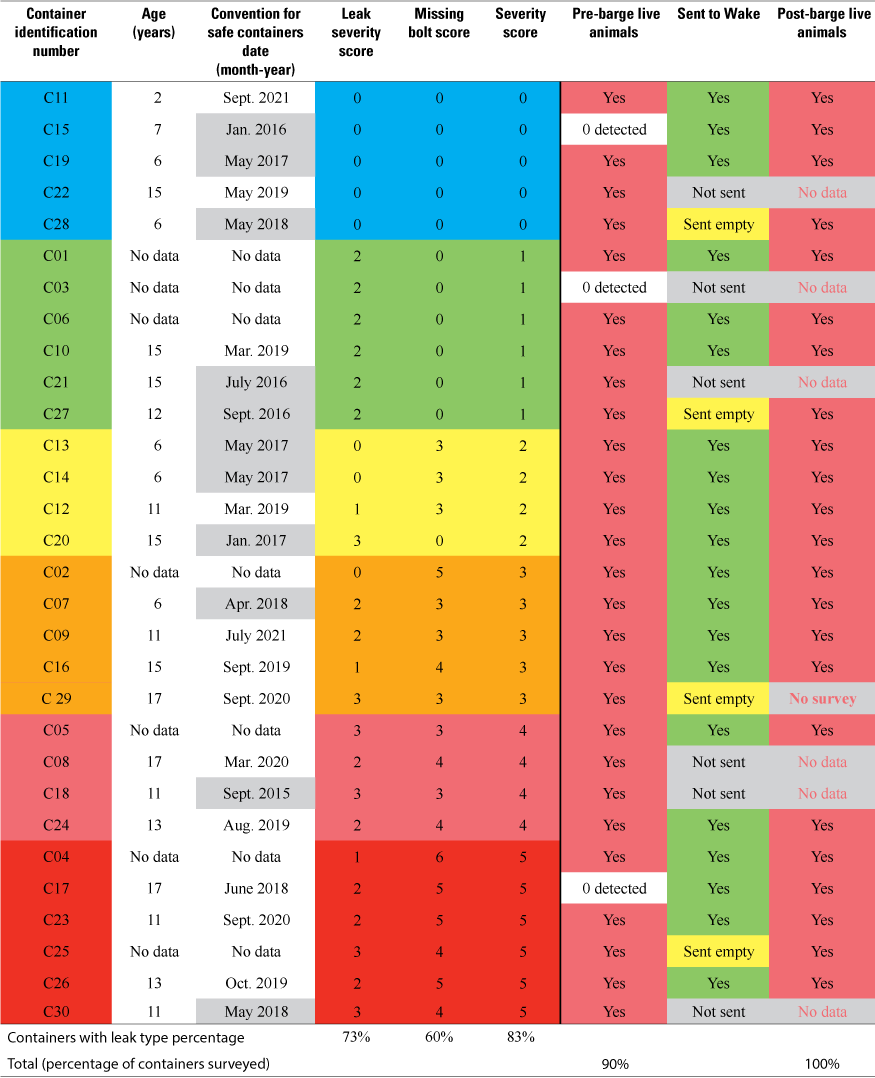
Summary of baseline shipping container conditions and indications of the presence of live animals when inspected before and after use for the transport of cargo during Wake Atoll Vessel Movement Biosecurity Program Efficacy 2018 surveys. Scoring of leak severity was based on number and size of holes in the container large enough to detect light coming through and number of missing bolts in floorboards leaving openings to the outside of the container. Color coding ranges from cool (blue) to hot (dark red), corresponding with increasing level of leak severity. Gray coding indicates status of container International Convention for Safe Containers (CSC) date of next required inspection is current (no gray) or either expiring within one month of shipping to Wake, or expired (gray). Pre-barge, inspections that took place before the shipping container stuffed with cargo; Post-barge, inspections that took place after containers had arrived at Wake. Abbreviation: %, percentage.
Table 2.
Summary of number of animal species and individuals detected during 2018 Wake Atoll Vessel Movement Biosecurity Program Efficacy evaluations carried out at Joint Base Pearl Harbor–Hickam before barge transport (pre-barge) and after unstuffing cargo at Wake Atoll (post-barge) across all surveys. Surveys included visual encounter surveys and various types of traps in cargo storage areas (warehouses and loading dock), shipping containers (intermodal and flat rack), and break bulk.[If animal sign was unique taxonomically, it was counted one time. Live includes presumed live when captured with trap. Abbreviations: #, number; Ind, individuals; JBPHH, Joint Base Pearl Harbor-Hickam; —, no data. Surveys: VES, Visual Encounter Survey; Reefer, refrigerated container; MDA, Missile Defense Agency containers]
We recorded dead arthropods or parts of arthropods in 13 containers. Of these containers, 18 had webs, spider molts, or both, and 7 had frass. Three containers had visible lizard feces, and three had feathers. All containers had some form of plant matter, including at least nine confirmed to contain seeds. All 30 empty containers contained dirt (or soil) and debris, with the amount collected from vacuuming and sweeping ranging from 18.4 to 689.3 g (table 3; fig. 15). Every container had woody debris, paper, or both, as well as other trash items. Of the samples gathered by vacuuming and sweeping, 25 had easily visible plant material or seeds, and 4 contained insects or their body parts.
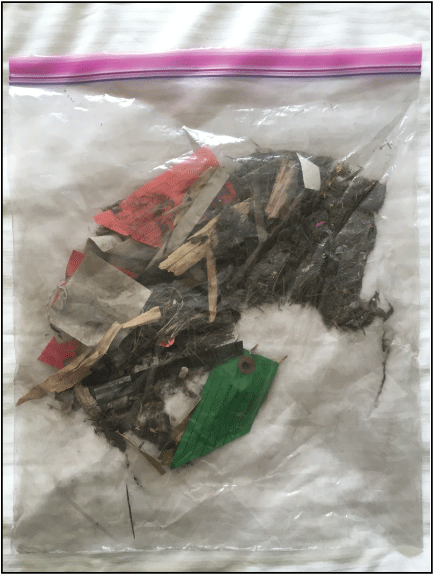
Example of contents from sweeping and vacuuming one shipping container before stuffing with cargo contained in a 1-gallon plastic bag. Photograph by S.A. Hathaway, U.S. Geological Survey.
Table 3.
Summary of dirt (or soil) and debris weight and presence of select components (when easily detected by eye) collected from empty shipping containers inspected as part of 2018 Wake Atoll Vessel Movement Biosecurity Program Efficacy surveys.[g, grams; —, not detected; x, detected]
We recorded and photographed biosecurity concerns for every container we inspected (examples provided in app. 3). We detected structural integrity issues in 25 of the 30 intermodal containers inspected; of these containers, 22 (73 percent) had at least one area where light could be seen coming in from outside, and 18 (60 percent) were missing as many as 14 floor bolts (fig. 14). Severity scores ranged from 0 to 5 and averaged 2.6. The containers were stored side by side and stacked, making detection of holes leaking light and damaged floorboard estimates conservative. We were not able to inspect all exterior walls nor were we able to inspect on top of or underneath any containers. We observed damaged floorboards in 17 of the containers, some of which had boreholes with fresh frass indicating use by animals as habitat (fig. 16). We also observed 20 containers with mold on the inside (fig. 17). Three of the containers with mold had either wet floorboards or pooled water (fig. 18). We recorded 14 containers with buckled sides or ceilings or both.
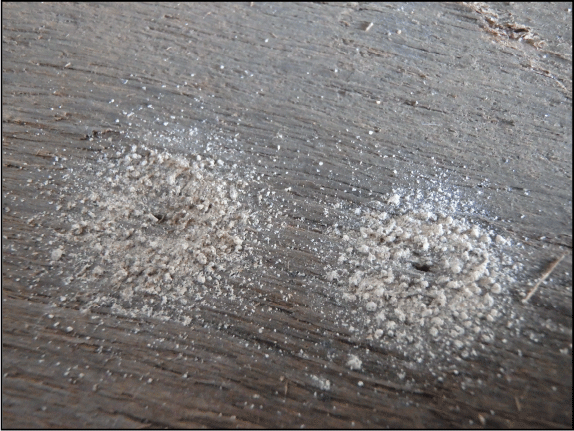
Example of boreholes detected in the floorboards in empty shipping containers during inspections before stuffing with cargo for Wake Atoll resupply, spring 2018. Photograph by S.A. Hathaway, U.S. Geological Survey.
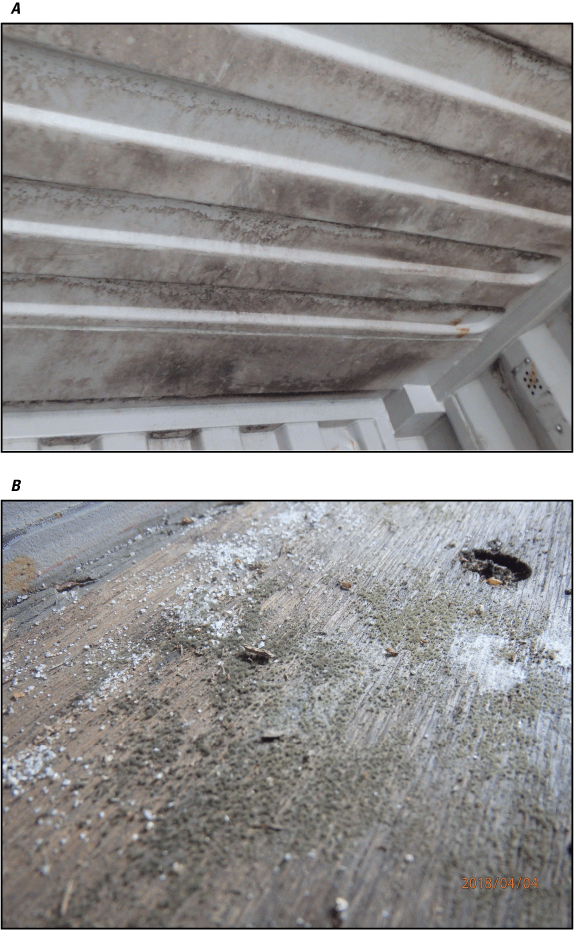
Examples of mold detected on A, ceiling and B, flooring in empty shipping containers during inspections before stuffing with cargo for Wake Atoll resupply, spring 2018. Photographs by S.A. Hathaway, U.S. Geological Survey.
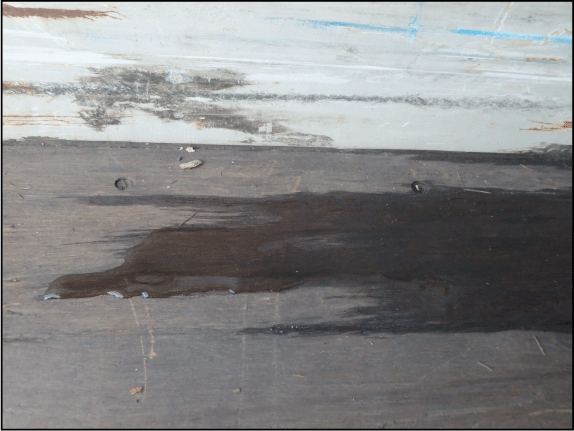
Example of water detected in empty shipping containers during inspections before stuffing with cargo for Wake Atoll resupply, spring 2018. Photograph by S.A. Hathaway, U.S. Geological Survey.
The ages of the 23 containers from which we collected these data ranged from about 1.7 to 17 years. The average age was about 11 years and 3 months. We noted that 9 of the 23 containers (39 percent) had expired CSC dates, with expirations ranging from one month to 2.7 years before departure and an average of 1.43 years since expiration. Two more were expiring the month of departure from Hawai`i (fig. 14).
Flat Racks
Full inspections of the flat racks were not possible because they were placed right next to each other, and not all parts of the racks were accessible (fig. 19). In addition, two were rusted to the point of having visible holes, and we did not walk on them due to their condition. Of the racks, 3 of 8 were relatively dirty with 1 having more than 2 cm of dirt (or soil) and debris on top (app. 3, fig. 3.1; containers C33, C34, and C38). We could see that one had water inside, but we were not able to tell if there were any organisms living in it. We detected one live ant on one of the racks, insect parts on another, webs on two racks, and plant matter on four racks. Combined, we detected three animal taxa on flat racks (table 2).
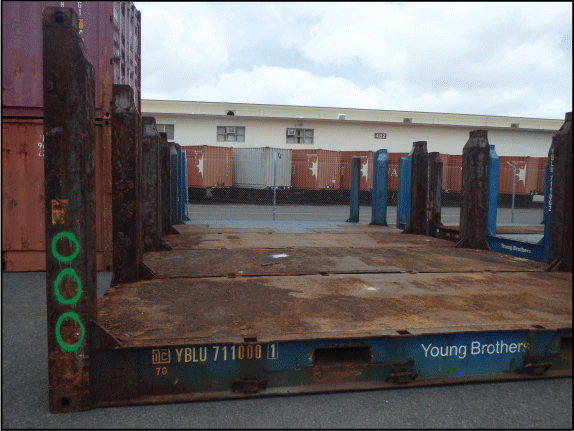
Flat racks stored side by side during inspection of empty shipping containers before stuffing with cargo for Wake Atoll resupply, spring 2018. Photograph by S.A. Hathaway, U.S. Geological Survey.
Break Bulk
Of the three break bulk items, two (a jet-fuel vehicle and a hazardous materials cabinet) housed live arthropods (app. 3, fig. 3.1; containers C31 and C45). We detected five specimens of four taxa across all VES (table 2). The jet-fuel vehicle also contained light amounts of dirt (or soil), mostly associated with the wheel wells (fig. 20). We did not examine it carefully to determine its properties. We also found plant matter on the jet-fuel vehicle.
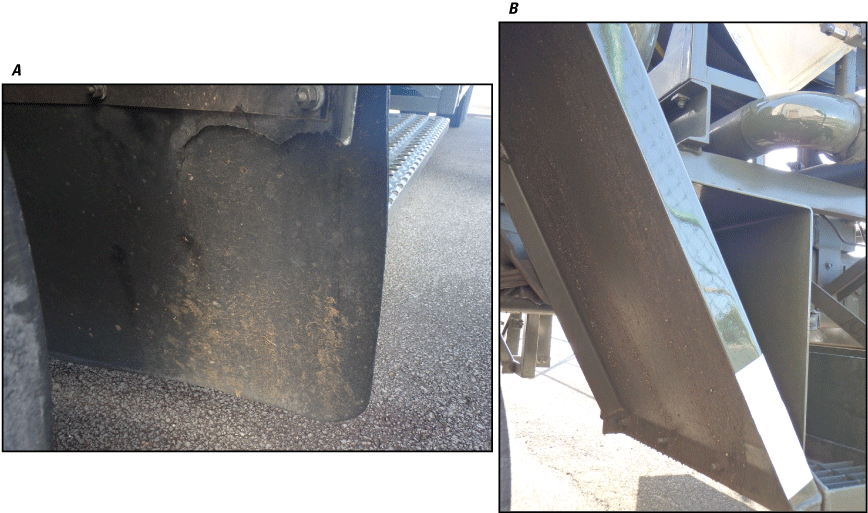
Examples of light soil detected on A, a jet-fuel truck and B, a wheel well during inspections of cargo as part of the Wake Atoll resupply shipment in spring 2018. Photographs by S.A. Hathaway, U.S. Geological Survey.
Sanitation Baseline of Cargo Staging Areas
Our initial walk through of the warehouses and dock area revealed a variety of potential biosecurity concerns. We noted a high level of permeability of the warehouses and the dock area. The doors and windows of the warehouses and the fencing in the dock area had openings. The dock also had a driveway with no gate. These openings could provide access points for organisms of various sizes. Both warehouses and the dock had gaps that allowed fairly large sized animals (at least the size of an adult domestic cat) to move in or out at all times (figs. 21, 22). Receptacles were present and being used for trash. However, our VES at the two main warehouses and the dock used for cargo storage revealed some dirt (or soil) and debris. The overall area was generally clear of vegetation, but there was some vegetation growing within the dock area, and we confirmed presence of plant matter, including seeds, in the dock area and warehouses. Upon inquiry, we were told insect control had been taking place. We found sign of target organisms and live specimens before setting up additional detection tools. Visual encounter surveys were done opportunistically during the daily trap station checks in the warehouses and dock area, and any animals, animal sign, and plant material were recorded, with representative specimens collected, photographed, or both.
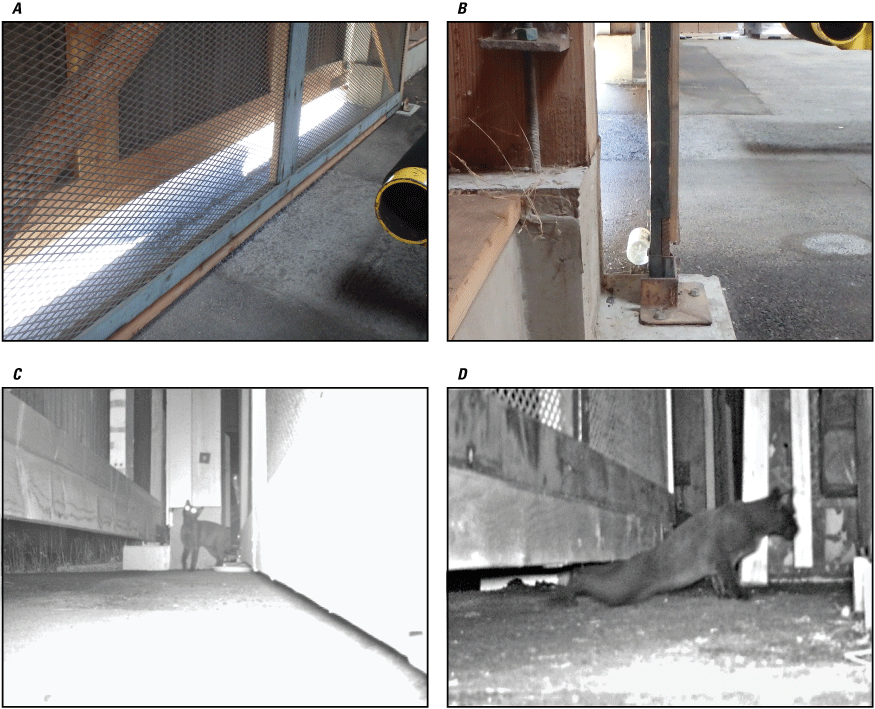
Examples of permeability of Warehouse 1 at Joint Base Pearl Harbor–Hickam used as a staging area for cargo intended to be shipped to Wake Atoll, spring 2018. Cargo bay door gaps in Warehouse 1 with A, a closed door seen from inside looking out; B, the same door as seen from the side; C, a closed door with a camera trap capture of a domestic cat (Felis catus) for gap-size reference; and D, another door showing a cat entering the warehouse. Photographs by S.A. Hathaway and J.C. Molden, U.S. Geological Survey.
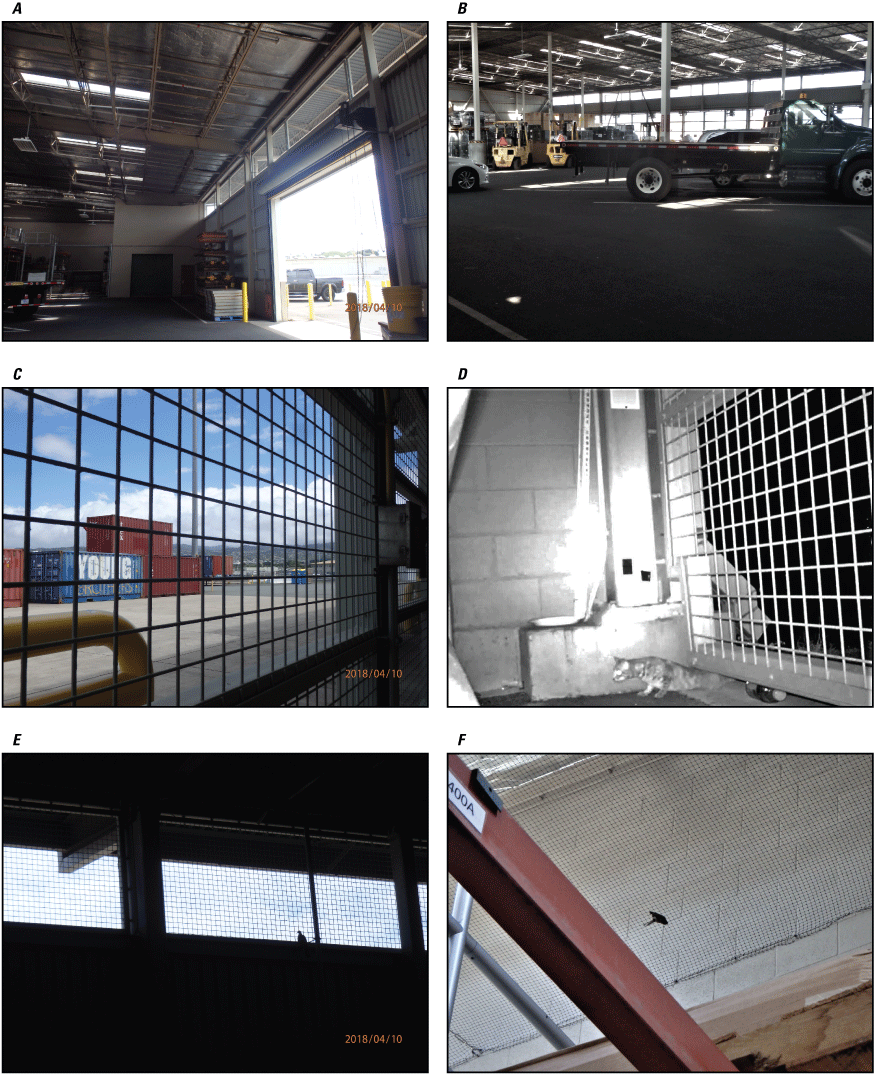
Examples of permeability of Warehouse 2 at Joint Base Pearl Harbor–Hickam used as a staging area for cargo intended to be shipped to Wake Atoll, spring 2018. Cargo bay door and window gaps in Warehouse 2 with A, a view of the east end of Warehouse 2; B, a view of north end facing the harbor with open link walls; C, a view of resupply containers on the dock, as seen from inside the warehouse through open link walls; D, a domestic cat (Felis catus) captured by remote camera entering under open link walls of the warehouse; E, an unknown bird species inside wire mesh windows of the warehouse; and F, a bird netting installed on ceiling of the warehouse with a dead unknown bird species. Photographs by S.A. Hathaway and J.C. Molden, U.S. Geological Survey.
We observed that there were active biosecurity tools (either baited self-resetting traps or baited snap traps plus glue boards) in the staging areas (figs. 9, 10). The biosecurity tools had been set up or activated by the 611th Biosecurity Manager. Across all staging areas combined, we counted 5,166 individuals of 105 species (tables 2, 4).
Table 4.
Summary of species detections in cargo staging areas, shipping containers, and oversize cargo using different tools added during Wake Atoll Vessel Movement Biosecurity Program Efficacy Project 2018 with results from preliminary assessment of risk to Wake should species detected become established there.[Risk: H, high; M, medium; L, low; U, unknown. Surveyed area: Cargo staging areas (warehouses and loading dock), empty shipping containers (C, standard containers; FR, flat rack containers), and oversized cargo (BB, break bulk) before cargo stuffing. Tools included by U.S. Geological Survey: P, camera; SG, glue board on ground; SP, glue board on a pallet or similar structure off of the ground; SW, glue board mounted on a wall about 1.5 meters off the ground; VES, visual encounter survey; YP, yellow pan trap; YS, hanging yellow glue board. Tool required by Wake Biosecurity Program: SKRR, glue board on ground; SNAP, snap trap. Abbreviations: —, no detections; nr., closest taxonomic reference used in cases of identification uncertainty; NA, not applicable; S, sign only was detected (for example, frass, webs, hair, animal parts)]
Specific Results for the Three Staging Areas Assessed
During baseline sanitation surveys, we found biosecurity concerns in each cargo staging area potentially being used (warehouses and dock). Specific results for each staging area are provided below.
Warehouse 1
Warehouse 1 is largely constructed of wood with asphalt flooring (fig. 23). The initial walk through revealed some design challenges for keeping plant and animal matter out of W1. The building was permeable to the outside due to several rolling door entries with sizeable gaps at the bottoms and on the sides (fig. 21). Several snap traps and glue boards had been set around the warehouse by March 29, 2018, by the 611th Biosecurity Manager several days before the start of USGS surveys. Traps were not placed in protective bait stations as the 2015 Biosecurity Plan requires (fig. 9). Although the BOS had purchased bait stations, they were not the correct type to fit the snap traps. If replacements were ordered, they did not arrive in time to be used. We discovered traps in the cargo staging areas were not being monitored.
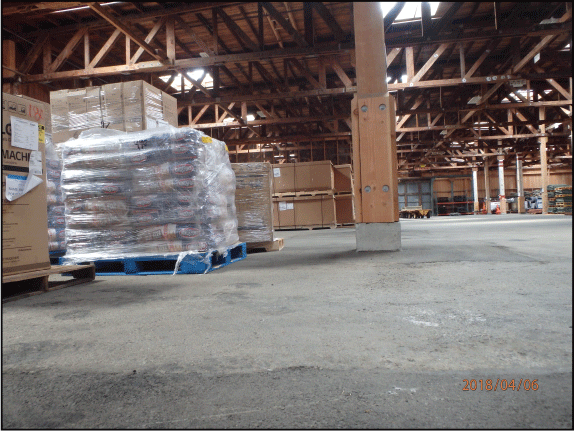
Warehouse 1 at Joint Base Pearl Harbor–Hickam, primarily constructed of wood with asphalt flooring, was being used as a staging area for cargo intended to be shipped to Wake Atoll in spring 2018. Photograph by S.A. Hathaway, U.S. Geological Survey.
All cargo for this (2018) supply shipment from Hawai`i to Wake, except for large (break bulk) items stored outside on the dock area and perishables stored at another location, were housed temporarily in this warehouse. Much of the cargo had already arrived before our surveys began and was being stored there. The cargo was mostly contained in large cardboard boxes, smaller boxes, or items were shrink wrapped and palletized (fig. 24). Inspections of cargo were thus superficial and generally consisted of only the accessible exteriors of the containment material. There were crevices and other openings that were inaccessible for inspecting without moving or disassembling most of the cargo. We were unable to access all cargo.
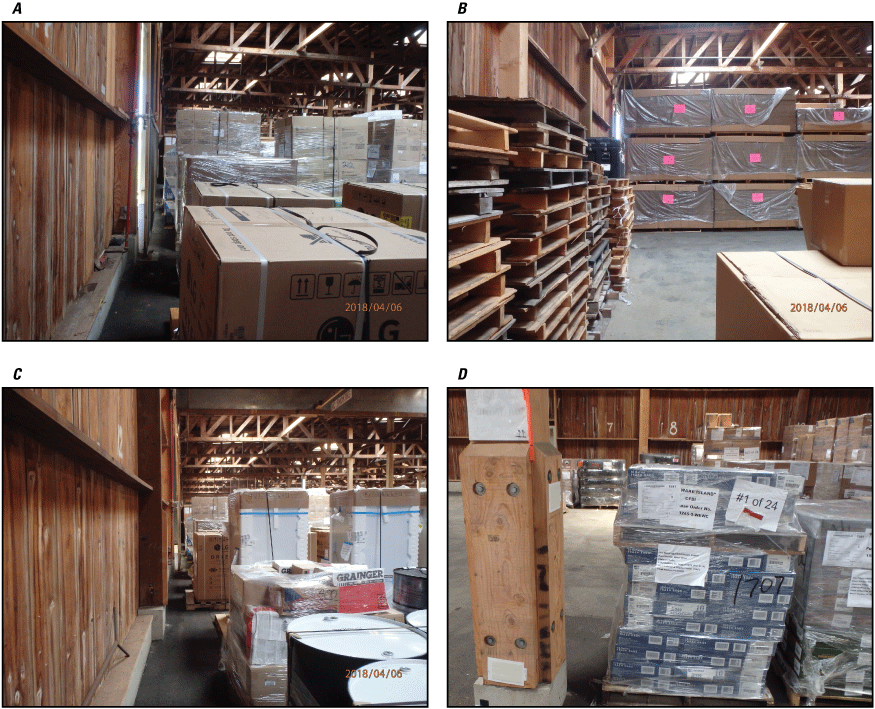
Warehouse 1 at Joint Base Pearl Harbor–Hickam used as a staging area for cargo intended to be shipped to Wake Atoll, spring 2018. A, Wood wall adjacent stacked cargo; B, stacks of empty pallets near cargo to be shipped; C, wood warehouse wall adjacent more cargo to be shipped; and D, cargo inside warehouse stacked on pallets. Photographs by S.A. Hathaway, U.S. Geological Survey.
We recorded 2,772 individuals of 90 species across all traps and VES in W1 (table 2), including specimens, evidence, or both, of mongoose, cats, lizards, birds, and arthropods as well as plant matter, including seeds, inside the warehouse (fig. 25). The camera trap detection tools revealed cats and mongoose inside the warehouse and showed how easily they can enter through the bay doors (fig. 21). One glue board was lost between day 7 and day 10 (May 13–16) when we were unable to check traps due to lack of access during the weekend.
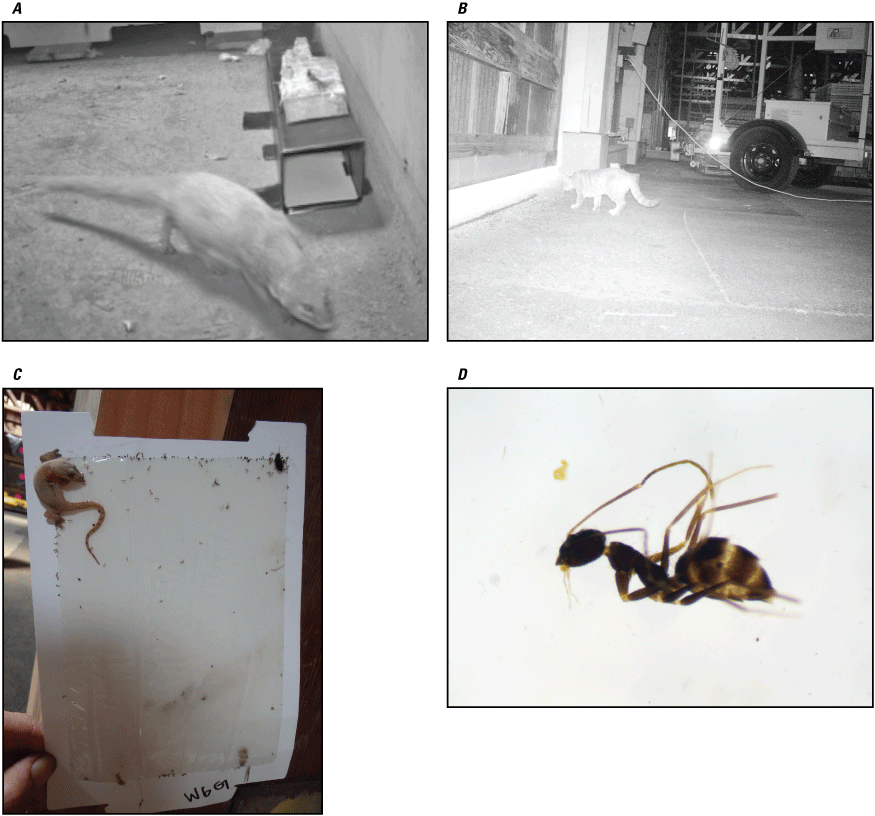
Animals detected in Warehouse 1 at Joint Base Pearl Harbor–Hickam, used as a staging area for cargo intended to be shipped to Wake Atoll in spring 2018, contained a variety of mammal, reptile, and arthropod species, including several known to have potential to be invasive, such as A, mongoose (Herpestes javanicus); B, cat (Felis catus); C, house gecko (Hemidactylus frenatus); and D, longhorn crazy ant (Paratrechina longicornis). Photographs A–C by S.A. Hathaway and J.C. Molden, U.S. Geological Survey; photograph D by Robert Peck, Hawai`i Cooperative Studies Unit, University of Hawai`i at Hilo.
Warehouse 2
Before spring 2018, all cargo for the resupply barge shipments from Hawai`i to Wake, with the exception of large (break bulk) items stored outside on the dock area and perishables which are held at another location, were housed temporarily in this warehouse (K. Rex, National Oceanic and Atmospheric Administration, oral commun. 2018; fig. 26) However, no cargo destined for Wake was stored here during our surveys. There were significant gaps at the bottom of W2 roll-up door entries, and the doors and windows were made as open metal grills that are extremely permeable (fig. 22). Before USGS surveys began, the 611th Biosecurity manager checked the self-resetting traps in W2 to be sure they were operational and had adequate bait on March 29, 2018. Overall, we detected 2,250 individuals of 68 species across all traps and VES in W2 (table 2), including specimens, evidence, or both, of cats, lizards, birds, and arthropods as well as plant matter, including seeds, inside W2 (fig. 27). The camera trap detection tools revealed that larger animals, such as cats and birds, could easily enter W2 (fig. 22).
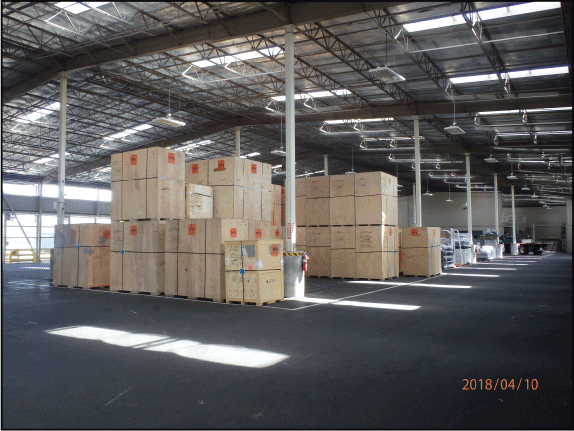
Warehouse 2 at Joint Base Pearl Harbor–Hickam used as a staging area for cargo intended to be shipped to Wake Atoll spring 2018. Photograph by S.A. Hathaway, U.S. Geological Survey.
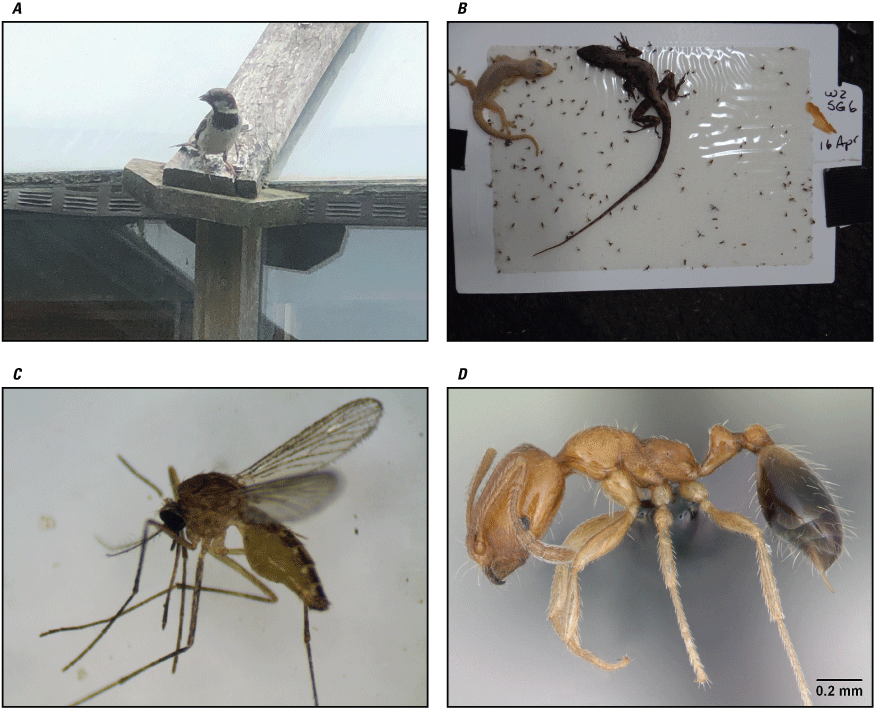
Animals detected in Warehouse 2 at Joint Base Pearl Harbor–Hickam, used as a staging area for cargo intended to be shipped to Wake Atoll in spring 2018, included a variety of mammal, bird, reptile, and arthropod species, including several known to have potential to be invasive, such as A, house sparrows (Passer domesticus); B, brown anole (Anolis sagrei; left) and house gecko (Hemidactylus frenatus; right); C, southern house mosquito (Culex quinquefasciatus); and D, Singapore ant (Trichomyrmex destructor). Photographs A–B by S.A. Hathaway and J.C. Molden, U.S. Geological Survey; photograph C by Robert Peck, Hawai`i Cooperative Studies Unit, University of Hawai`i at Hilo; and photograph D by April Nobile CASENT0125190, https://www.antweb.org/bigPicture.do?name=casent0125190&shot=p&number=1.
Dock
The dock area is used as a staging area for break bulk and the shipping containers before and after they get stuffed with cargo (fig. 28). In the dock area, two self-resetting traps had been set up outside W2. We verified that these traps had been baited and operational on March 29, 2018, before USGS surveys commenced. Overall, we recorded 139 individuals of 23 species across all traps and VES (table 2) on the dock. We recorded specimens, signs, or both of cats, birds, lizards, amphibians, and arthropods as well as plant matter, including seeds (fig. 29). There were small areas of vegetation growing within the central dock area and larger areas growing in at the fence line of the dock area (fig. 30). The fencing around the dock area is chain link, which allows not only the movement of animals but also any seeds outside to be easily blown into the staging area.
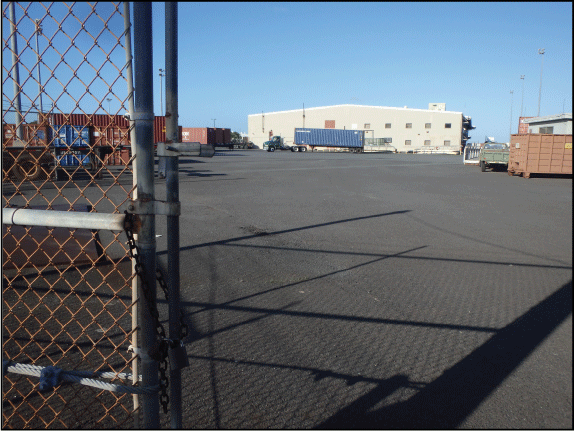
The dock area at Joint Base Pearl Harbor–Hickam where break bulk and shipping containers are stored before being loaded onto the barge for Wake Atoll. Photograph by S.A. Hathaway, U.S. Geological Survey.
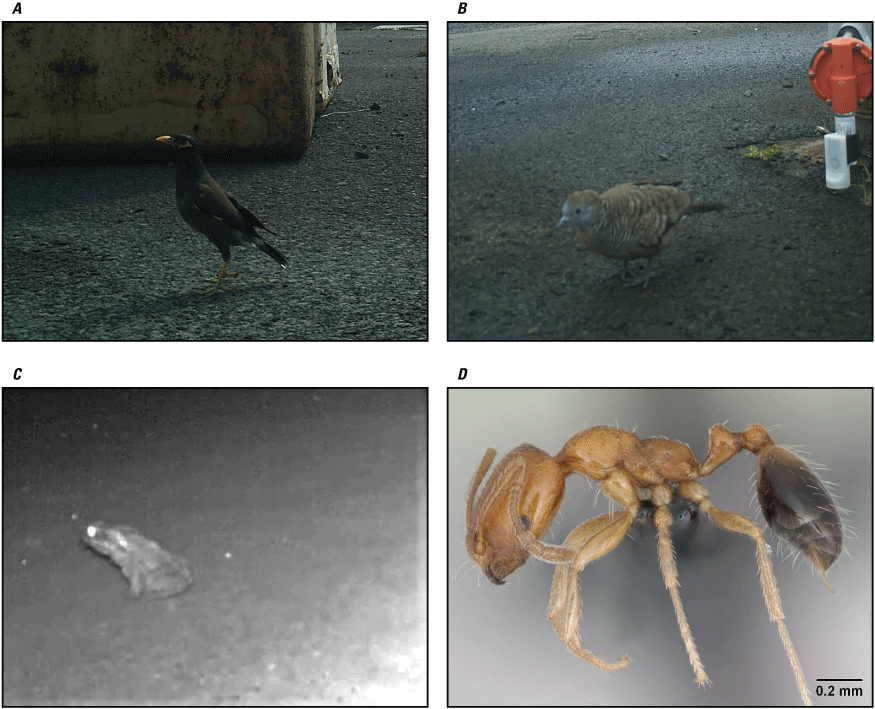
Animals detected in the dock area at Joint Base Pearl Harbor–Hickam, used as a staging area for cargo intended to be shipped to Wake Atoll spring 2018, included a variety of mammal, bird, reptile, and arthropod species, including several known to have potential to be invasive, such as A, common myna (Acridotheres tristis); B, zebra dove (Geopelia striata); C, cane toad (Rhinella marina); and D, Singapore ant (Trichomyrmex destructor). Photographs A–C by Stacie A. Hathaway and James C. Molden, U.S. Geological Survey; photograph D by April Nobile CASENT0125190, https://www.antweb.org/bigPicture.do?name=casent0125190&shot=p&number=1.
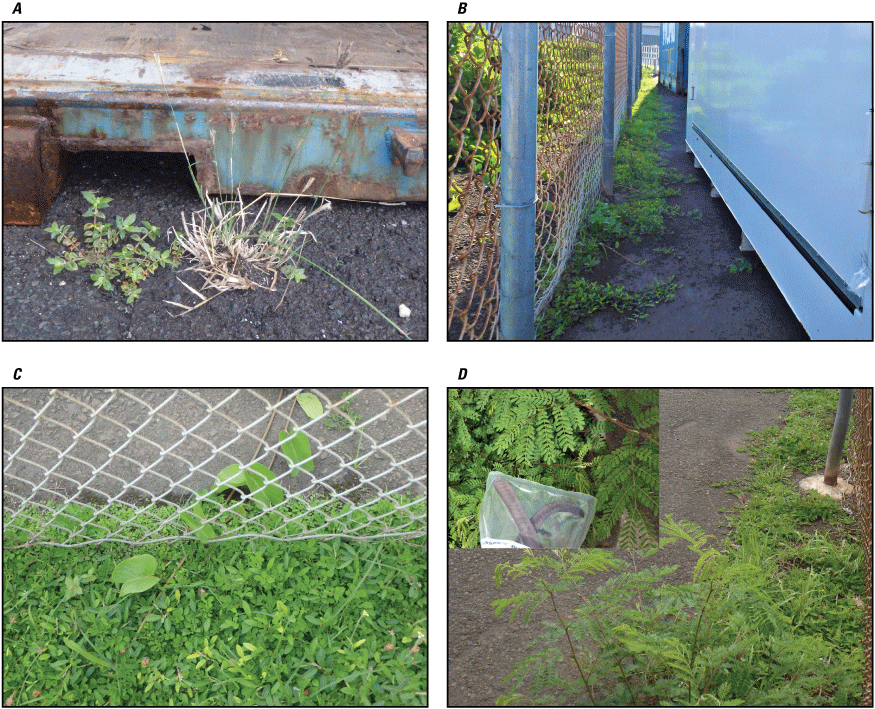
Examples of plants seen growing around dock near warehouse cargo staging areas at Joint Base Pearl Harbor–Hickam, including A, plants with mature seed heads growing in front of container at dock container staging area; B, various plant species growing through the fence into the staging area; C, vines creeping through fencing into dock staging area; and D, examples of the invasive species Leucaena leucocephala (koa haole, tangantangan) growing inside the dock staging area along with seed pods collected. Photographs by S.A. Hathaway, U.S. Geological Survey.
Container Stuffing and Biosecurity and Detection Tool Setting
While we observed the container stuffing process by NAVSUP, we did not observe any individuals or obvious signs of animals (for example, chew marks, food piles, feces, urine, and so on) though the process moves quickly, and time spent for observation was brief. We noted that there were no BOS inspection staff present throughout the stuffing process, and they had not placed the required biosecurity tools in containers. Rather than sending containers without, we placed the required biosecurity tools in each container. However, we note that, according to the 2015 Biosecurity Plan, snap traps were to be contained within bait stations. Because the incorrect bait stations had been purchased, we could not use bait stations.
Barge and Tug
Due to scheduling logistics, we were not present to survey for biosecurity tools or target organisms on the barge before cargo loading. We verified the required Rodent-free Vessel Inspection Certificate had been submitted to the 611th Biosecurity Manager (apps. 4, 5) for the barge and the tug, but they had not been submitted to the BOS Contractor Environmental Technician. We were not able to verify that rodent traps in bait stations were deployed on the dock directly adjacent to the barge or that rat guards were used on dock lines.
Surveys After Barge Movement
Sanitation of Shipping Containers, Break Bulk, and Barge
At Wake, we again observed biosecurity concerns with both container types being used (intermodal containers and flat racks) and break bulk. We also found biosecurity concerns with the barge that we had not been able to survey previously, and in the dock area at Wake.
Intermodal Shipping Containers
Across all inspections at Wake, we recorded 3,935 individuals representing 62 species (table 2). During our surveys at Wake, we discovered that there were two additional containers that had not been present during our initial inspections nor during cargo stuffing. These containers were sent to Wake empty, and we noted that the containers were not clean and had been sent without biosecurity tools. We were not able to inspect these additional containers at Wake. We also observed four of the original containers that we inspected in Hawai`i were sent without cargo. We were not aware that they would be sent empty, and therefore, we had not added biosecurity tools. We detected live arthropods in all 20 stuffed containers as well as in the 3 of 4 surveyed containers that were sent empty (fig. 15). The fourth surveyed container that was sent to Wake empty was being stuffed with items being sent from Wake to Hawai`i before we had a chance to survey it.
Due to time constraints, we attempted to collect representatives of each species, but we were unable to collect every individual seen during VESs. Across all container VESs and glue boards, we collected 3,924 individuals representing 62 arthropod species as well as a common house gecko (Hemidactylus frenatus; caught on a glue board; table 2). One of the required glue boards was inaccessible under a pallet when containers were first opened and was no longer in the container after unstuffing. Based on what we could see initially, no larger sized animals had been intercepted, but any small arthropods that may have been on that glue board were not counted. There may have been additional species inside the shipping containers. Some small arthropods escaped capture, some were not identified to species level due to specimen quality, and a few specimens were lost. We observed that 6 of 20 snap traps had been triggered, but none had captures. One was inaccessible, and we were not able to tell whether it had been triggered when the container was first opened. There were no chew marks on any of the wax tags or chew cards.
Given the short time period between containers being unloaded off the barge and then taken away to be unstuffed, we were not able to inspect the sides, tops, or underneath containers. We also noted that containers were being unstuffed before our access for VES. In addition, when we arrived to do VES of containers at one of the locations, we observed one of the unstuffers sweeping out the inside of a container. We were informed that they had been told by the vendors that containers had routinely been returned dirty and needed to be cleaned before shipping back. We do not know how many containers were swept before our VES. Together, moving, opening, unstuffing, and sweeping may have allowed some organisms to enter containers before our surveys and possibly many organisms to be removed from containers to the Wake environment. In all, comparing these data with those collected for Wake biodiversity surveys (Hathaway and others, 2025), we detected 11 species that have previously been recorded at Wake, 5 that have possibly been detected, 38 that have not, and the rest were unresolvable (table 1).
A reefer container and two freezers were sent to Wake. We did not have access to the reefers at Wake until after they had been unloaded. To our knowledge, they did not have snap traps or glue boards set in them (K.R. Rex, National Oceanic and Atmospheric Administration, oral commun. 2018). Because contents are for human consumption, a pest strip would not be included. We detected live and dead organisms in the reefer and one freezer and dead specimens in the remaining freezer, including the carcass of a common house gecko. We also detected cockroach oothecae (egg masses within a protective covering) in the reefer and pupae in a freezer. We also observed numerous shipment seals and tags in one reefer along with other debris and organic matter, indicating that it was likely moved at least 12 times to 3 or more islands (Kaua`i, Molokai, and O`ahu) without appearing to have been cleaned before it was sent to Wake Atoll (app. 3, fig. 3.1; container C50).
Four sealed Missile Defense Agency (MDA) containers were not unstuffed during our surveys, and we did not carry out a full VES, but we were able to have them opened briefly to check the status of biosecurity tools and collect any data we could in the brief time they were opened for us. From what we could see given our access, we noted that, rather than a pest strip, there appeared to be bags of silica, presumably designed for reducing humidity, in two of the containers. We verified that there was a pest strip in one of the four containers. We saw one snap trap that had been triggered in one of the containers, but nothing had been captured. We did not see bait stations in any MDA containers. We detected live arthropods in three of the containers. In addition, there were two glue boards in one of the four containers, and in another, the protective film had not been removed from the glue board, rendering it inactive (app. 3, fig. 3.1; container C42).
Flat Racks
Full inspections of the flat racks were not possible because they were placed right next to each other, and not all parts of the racks were accessible. Due to time constraints, we prioritized intermodal container inspections and simply noted that the racks were in similar condition to when they left JBPHH, with dirt (or soil) and debris on top. Upon discussion with the BOS at Wake about the racks, we were told that they were not the type that had been requested for sending some break bulk items from Wake to Hawai`i and that they ended up making the transit without being used.
Break Bulk
We collected 11 live arthropods representing 5 species and a plant seed in the jet-fuel truck. We recorded a cockroach ootheca on the pallet upon which a mower was transported.
Barge
Although the intent was to inspect the barge for target organisms immediately, it had been docked for more than 24 hours before we were allowed access. We recorded a variety of biosecurity successes and concerns related to the dock area as well as to the barge itself (fig. 31). It is unknown when or how many bait stations were added to the barge. During our inspection, we observed only one bait station on the barge while it was docked at Wake. The bait station was open, and the trap was triggered but empty (fig. 31A). No evidence of rodents was seen here or elsewhere on the barge. Rat guards were deployed on mooring lines holding the barge and tug to the dock while at Wake. Initially, the incorrect size rat guard was used, but this was corrected (fig. 31B). The BOS caught the error and later replaced them.
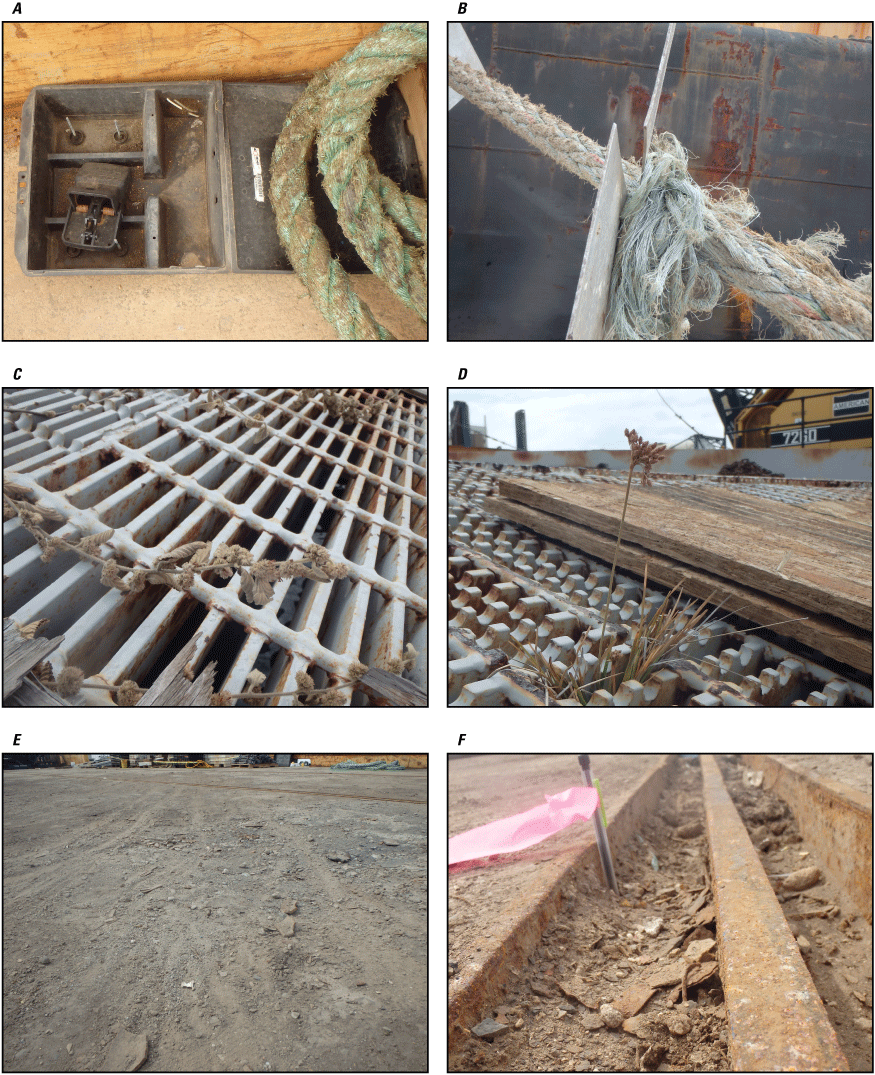
Examples of biosecurity concern related to the barge at Wake Atoll including A, a rodent station open with trap triggered but empty; B, a rat guard that was installed leaving space a rodent could fit through; C, the barge gangway attached with seed heads that could be transported onto the barge; D, an additional species with seed head in the gangway that is attached to the barge; E, soil on the barge deck; and F, an illustration of dirt (or soil) and debris depth on the barge deck. Photographs by S.A. Hathaway, U.S. Geological Survey.
We also noted that the gangway that was set up for the supply barge contained plant matter with seed heads (figs. 31C, D). Seeds could easily be transferred to the barge and transported elsewhere. The gangway can also potentially be used by animals to depart from or gain access to the barge.
The barge deck in general had a great deal of potential for providing refuge to stowaway organisms, and the barge deck had extensive areas of dirt (or soil) and debris (fig. 31E). There were places in which dirt (or soil) and debris were as much as 7 cm deep; there was also trash on the deck (fig. 31F). There were some instances of damaged wood, with increasing potential to harbor wood boring animals, such as termites and wood boring beetles, or serve as habitat for other species to stowaway the longer it is kept aboard.
A different barge was tied up to the dock right behind the resupply barge. This additional barge was not part of this survey and thus was not boarded for inspection. In compliance with preventive biosecurity, we noted at least four bait stations and two triggered empty traps outside of bait stations aboard. There were no rat guards on the mooring lines from this barge to the dock (fig. 32). This barge sat very low in the water and was moored close to the dock. Rats may be more likely to access the barge by running along dock lines without rat guards, but the barge sitting low in the water close to the dock could potentially allow them to jump directly onboard.
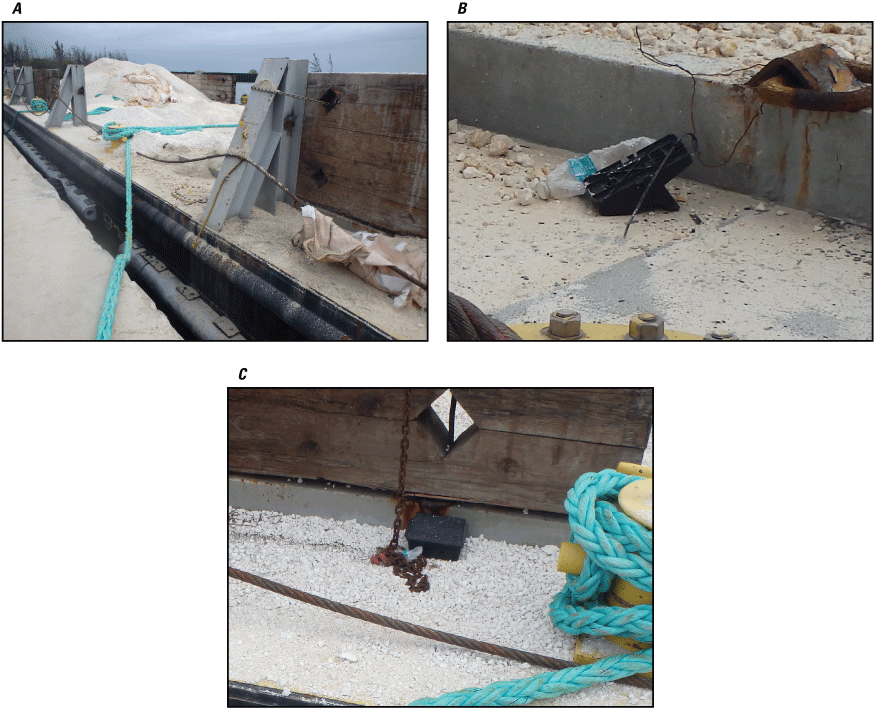
Examples of a biosecurity success and some concerns related to a nearby barge (not part of the Wake Atoll Biosecurity Efficacy Study) at Wake Atoll, spring 2018. Concerns included A, a barge docked with no rat guard on dock lines; and B, snap traps present but not set or contained in a bait station. In terms of success, C, there were several rodent bait stations aboard. Photographs by S.A. Hathaway, U.S. Geological Survey.
Only one bait station was seen on the dock positioned near the second barge (fig. 33). There were also piles of wood and refuse materials in proximity to the dock (fig. 34). These could serve as refuge to any potential escaping stowaway animals.
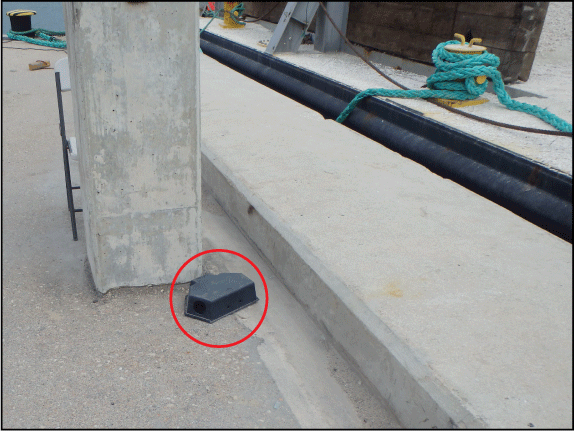
A partial biosecurity success at the dock at Wake Atoll was the presence of one rodent bait station (circled in red), though it was not flush with the dock. Photographs by S.A. Hathaway, U.S. Geological Survey.
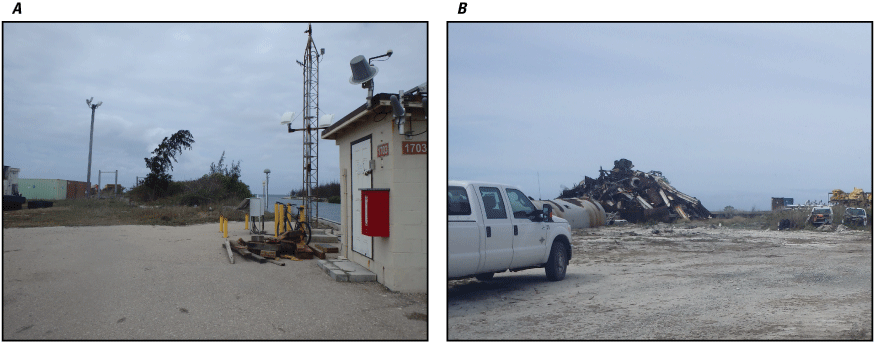
Examples of biosecurity concerns observed as part of the Wake Atoll Biosecurity Efficacy Study at Wake Atoll, spring 2018. Concerns included A, vegetation and wood piles stacked near the dock and B, refuse nearby that could provide refuge to potential stowaway animals escaping. Photographs by S.A. Hathaway, U.S. Geological Survey.
Although the BOS Environmental Technician was present during barge arrival and unloading, he was generally attending to different aspects of operations than those on which we were focused. We did have a chance to have brief discussions. He revealed that he was on a temporary assignment and was given limited communication directing his activities, especially before arriving at Wake. He was doing his best to find information onsite regarding requirements for his role.
Biosecurity Tools and Analysis
Across the eight different biosecurity tools used during these surveys (VES, self-resetting traps, snap traps, glue board traps, wax tags, chew cards, cameras, and track tunnels), we detected no signs of rodents at any stage of the surveys. There were no signs of rodents based on VES, snap traps, wax tags, chew cards, or glue boards that were placed in containers that were shipped with cargo to Wake. Because there were no rodent detections during inspection surveys in staging areas at JBPHH and no other visible evidence when we initially opened containers (and no reports otherwise from the BOS), it may be unlikely that any rodents were transported in containers during this barge resupply.
Across the variety of tools we used in the cargo staging areas and containers for evaluating the 2015 Biosecurity Plan, we detected no rodents but numerous other animals, including a snail, spiders, ants, other arthropods, and various vertebrates, including amphibians, reptiles, birds, and mammals (cats and mongoose). The tools that had been set to comply with the 2015 Biosecurity Plan (self-resetting traps, snap traps, and folded glue-boards) did not detect any non-reptile vertebrate taxa (table 4). Overall, we observed that the required biosecurity tools intended to intercept animals in the cargo staging area did not target the suite of species nor the number of organisms present.
Once the containers arrived at Wake, we counted 3,314 individual animals representing 56 species across the 183 glue boards that we added to containers at JBPHH (9 per container and 3 in the jet-fuel truck), and 149 additional captures by VES (table 5). Of these individual animals, 1,399 were barklice, 525 were flies, and 1,143 were plaster beetles. Of the species, 32 were in just one container, and 2 species were detected in all 20 containers. At least 327 individuals were intercepted by 2015 Biosecurity Plan required glue boards. We were able to access and photograph 19 of these glue boards (out of 20). Animals on the 2015 Biosecurity Plan required glue boards were identified and counted from the photographs. These required glue boards averaged approximately 17 individuals per board compared to an average of about 47 individuals per glue board that we placed on the ground. The required glue boards captured about 9 percent of the total animals that we detected during these surveys. It is likely we missed some animals on the required glue boards because our examination was of photographs; however, the most diminutive species, such as the barklice, were most likely to be missed, and these did not make up a high proportion of captures overall. From our photographs of the required glue boards, most captures were flies or plaster beetles (178 and 137, respectively). We noted 30 of the species detected in the containers that had been stuffed and sent to Wake had been recorded in WH1, WH2, or the dock area but not in the empty containers at JBPHH. We detected three species in the empty containers but not in WH1, WH2, or the dock area at JBPHH, and we detected eight species that had not been recorded before container arrival at Wake.
Table 5.
Summary of species detected during surveys and with various tools set in 20 shipping containers stuffed with cargo once retrieved at Wake. Summary also includes if species were detected before stuffing, or in the cargo staging areas (warehouse or dock) at Joint Base Pearl Harbor Hickam (JBPHH) during the Wake Atoll Vessel Movement Biosecurity Program Efficacy Project 2018.[Risk (results from preliminary assessment of risk to Wake should species detected become established there): L, low; M, medium; H, high; U, unknown. Tools included by U.S. Geological Survey: SG, glue board on ground; SW, glue board on wall; YS, hanging yellow glue board; VES, visual encounter survey. Tool required by Wake Biosecurity Program: SG-Rex, glue board on ground. Abbreviations: # of containers, number of containers each species was detected in; WH, warehouse; —, no detections; N, no; Y, yes; nr., closest taxonomic reference used in cases of identification uncertainty; NA, not applicable]
Abundance estimates for arthropods in each of the containers ranged from 37 to 1,751, with an average of 255 arthropods per container (standard deviation [SD] is equal to 394). We evaluated biosecurity tools that we added to stuffed containers with respect to representing the arthropod community. The glue boards placed on the ground performed better than the yellow hanging boards, which performed better than those on the wall (table 5; fig. 35). However, the probability of capturing the arthropods present in the containers on a single trap, such as a glue board placed on the ground, wall, or hanging, were 24, 2, and 1 percent, respectively (95-percent CI: 20–27 percent, 1.9–2.6 percent, and 0.7–1 percent). Even the best performing location (glue boards on the ground) would require approximately 19 boards to capture the community with a 95-percent confidence level. The cumulative capture probabilities for yellow hanging glue boards, and those on the container wall reached about 37 percent and 17 percent (95-percent CI), respectively, with 20 boards, and the curve had not yet begun to flatten. In addition, although the glue boards on the ground also captured more unique species (19 compared to 5 and 3), we detected 11 additional unique species through VES. These VES results included one of the arthropod species (powderpost beetle) that we identified as medium risk and low management feasibility. Though this animal was observed dead, it did make it to Wake in a container. We also captured one individual of the only species ranked as high concern (common house gecko) on a glue board that we had added and placed on the ground.
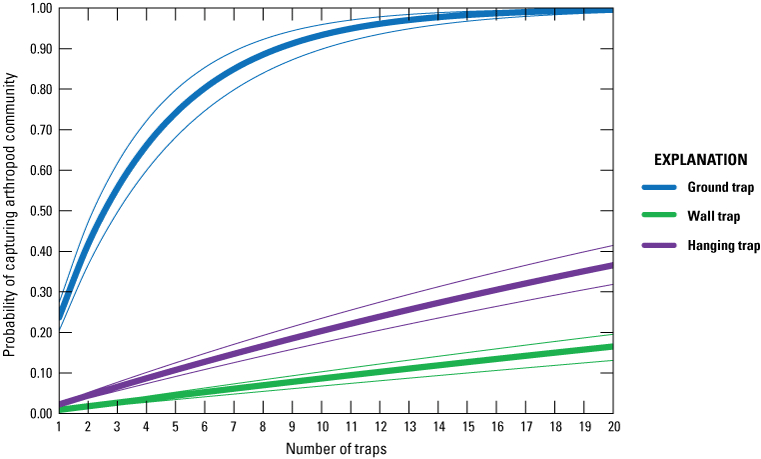
Cumulative probability of capturing the arthropod community in shipping containers using glue boards placed on the ground (thick blue line), the container wall (door; thick green line), and hanging (thick purple line) with 95-percent confidence intervals (thin lines).
In comparison, the VES of previously inspected containers that were sent empty without biosecurity tools also revealed six live and five dead arthropod species (table 2). Visual encounter surveys of the reefers resulted in 11 species detected. Notably, these included three species detected alive and one dead common house gecko. The remaining six species were found dead. However, of the eight species we counted as dead, we included fly pupae and cockroach oothecae that may have been viable. Unfortunately, previously uninspected containers that were sent empty without biosecurity tools were being stuffed before we could do VES.
Temperature Monitoring
The average temperature reading of the 3 loggers was calculated for each 15-minute interval per container. Across all containers, temperatures ranged from a minimum of 20.5 to a maximum of 42.2 °C, and averages ranged from 25.6 to 26.9 °C (table 6; fig. 36). Maximum temperatures were 31.9, 33.7, 40.8, 41.1, and 42.2 °C for Containers 01, 14, 20, 24, and 13, respectively. Although Container 13 reached the highest temperature, Container 24 maintained higher temperatures for a longer duration.
Table 6.
Summary of temperatures recorded in shipping containers once stuffed at Joint Base Pearl Harbor–Hickam through their arrival at Wake Atoll during Wake Atoll Vessel Movement Biosecurity Program Efficacy Project 2018 surveys.[°C, degrees Celsius]
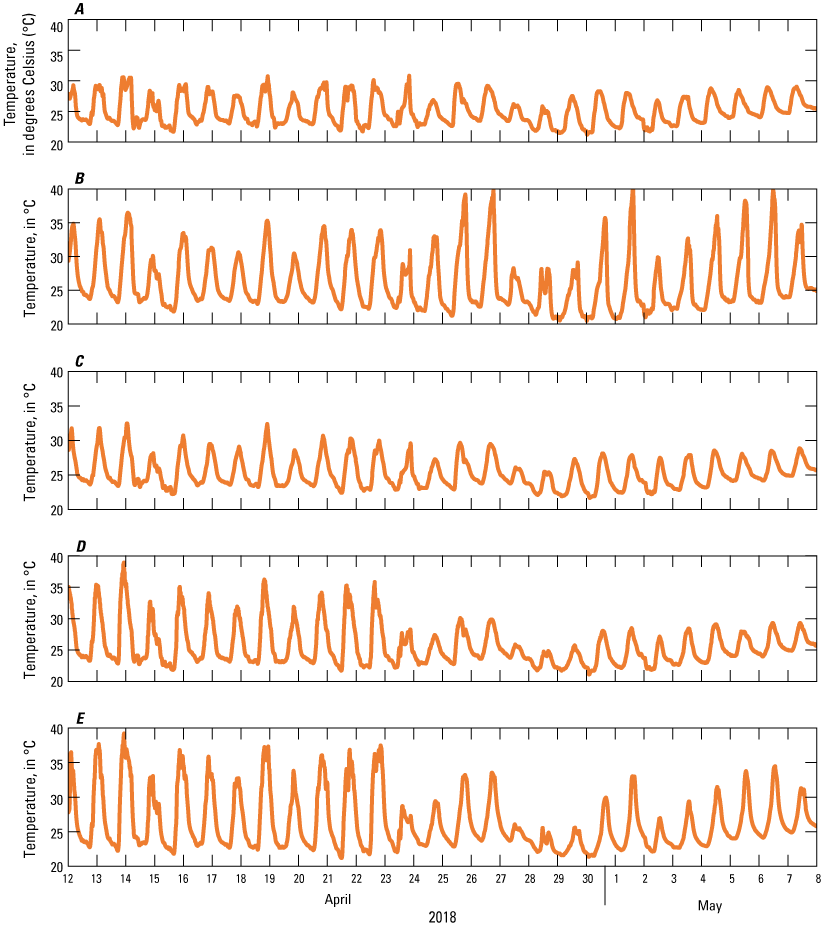
Temperatures recorded inside shipping containers from the time they were stuffed with cargo at Joint Base Pearl Harbor–Hickam until they were opened at Wake Atoll. Temperature readings were taken at 15-minute intervals beginning on April 12, 2018, 10:00 Universal Time Coordinated (UTC) +12 and ending on May 8, 2018, 08:00 UTC +12. Graphs correspond to the following Containers: A, 01; B, 13; C, 14; D, 20; and E, 24.
The GlobTherm reported tolerance limits for terrestrial animals relevant to our study (mammals, birds, reptiles, amphibians, and arthropods; Bennett and others, 2019; https://doi.org/10.5061/dryad.1cv08) ranged from 10 to 51 °C (n=981; table 7). The average maximum tolerance was lowest for mammals (33.5 °C; n=230), followed by birds (34.3 °C; n=111) and amphibians (35.4 °C; n=114). Arthropods (n=242) and reptiles (n=284) had the highest average limits (41.8 °C). Of the 981 species evaluated, 264 (27 percent) had critical thermal tolerances above the highest maximum temperatures recorded for shipping containers sent to Wake in spring 2018 (tables 6, 7). These were mostly arthropods (118) and reptiles (142).
Table 7.
Summary of reported critical thermal maximum (cTmax) tolerance limits (using data from GlobTherm [Bennett and others, 2019; https://doi.org/10.5061/dryad.1cv08]) for terrestrial animals relevant to Wake Atoll Vessel Movement Biosecurity Program Efficacy Project 2018 surveys.[n, number of species; °C, degrees Celsius; #, number; >, greater than; <, less than; —, no data]
Container Insect Mortality Experiment
We found no correlation between the distance from the pest strip and insect mortality. Our results indicate that the treatment is effective for adult fruit flies (t=3.73, p=0.001) but not for crickets (t=0.88, p=0.39) or roaches (t=−0.096, p=0.92; fig. 37). No fruit flies survived in the treatment container, whereas most of the fruit flies survived in the control container (figs. 37, 38A). We observed pupae in the control containers, indicating eggs already present in the medium had developed, reproduction had occurred, or both (fig. 38B). Cockroaches had good survivorship in the treatment and control containers, whereas crickets experienced high mortality in both containers (figs. 38C, D, respectively). Interestingly, in the treatment shipping container, we detected live unidentified invertebrates living in the fruit fly media and invertebrate larvae in the cricket enclosure that did not appear to be affected by pest strip exposure (figs. 38A, E).
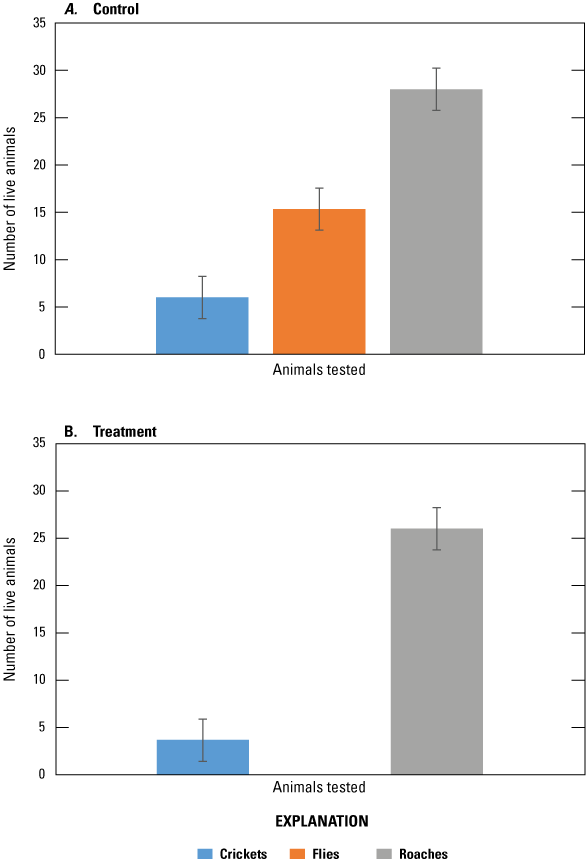
Histograms showing mean and 95-percent confidence interval of crickets (Gryllodes sigillatus), flies (Drosophila hydei), and cockroaches (Blaptica dubia) in the A, control group compared to those in the B, dichlorvos (pest strip) treatment container. No fruit flies in the treatment container survived whereas many fruit flies survived in the control container; cockroaches had good survivorship in the treatment and control containers whereas crickets experienced high mortality in both containers (fruit flies [t=3.73, p=0.001] but not crickets [t=0.88, p=0.39] or roaches [t=−0.096, p=0.92]).
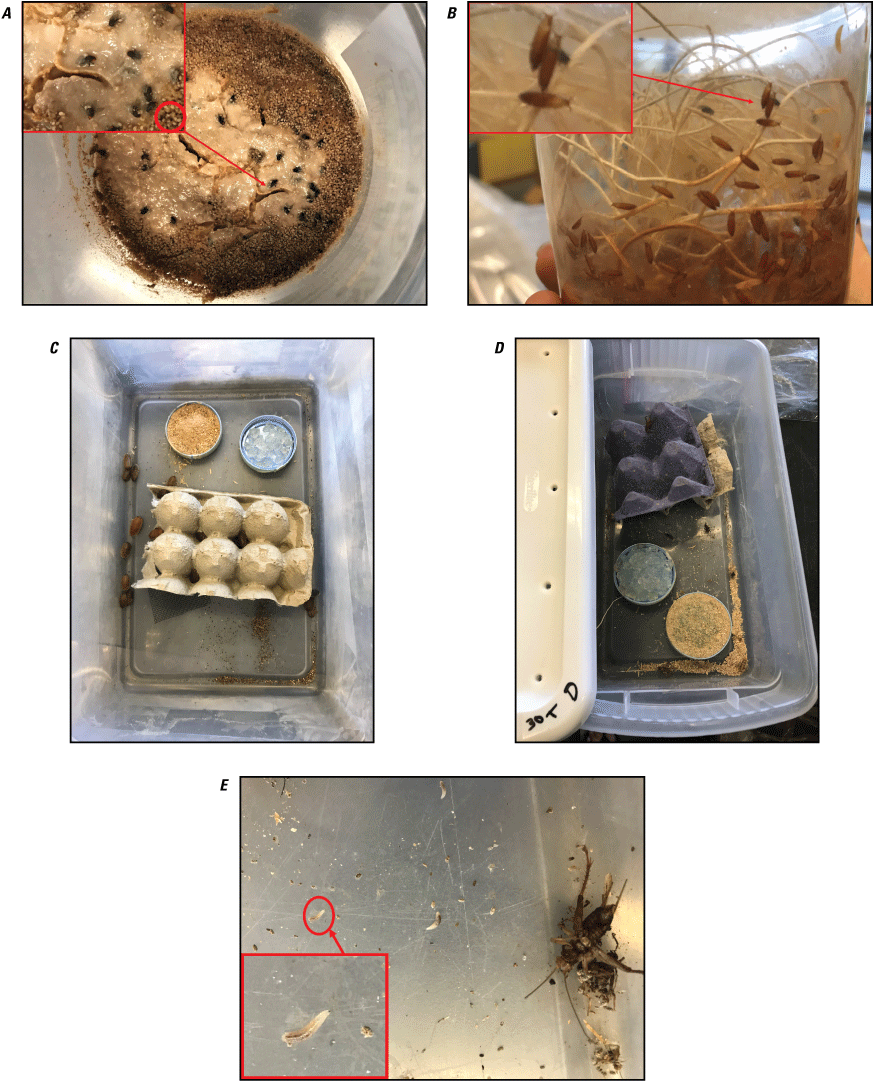
Examples of state of test animals after shipping container trial evaluating the efficacy of using dichlorvos impregnated pest strips as a biosecurity tool, including A, dead fruit flies (Drosophila hydei) with inset showing close-up of dead individuals and live invertebrates (species unknown; circled), post-trial, from the treatment shipping container; B, live fruit flies and pupae with inset showing close-up of pupae, post-trial, from the control shipping container; C, live Dubia roaches (Blaptica dubia), post-trial, from the treatment shipping container; D, live and dead crickets (Gryllodes sigillatus), post-trial, from the treatment shipping container; and E, dead cricket and a live unknown larvae, from the post-trial, treatment shipping container. Photographs by S.A. Hathaway, U.S. Geological Survey.
The maximum temperatures were 34.4 and 32.5 °C for the control and treatment containers, respectively. The maximum temperature outside of the containers was 30.2 °C (fig. 39). The results indicate that temperature was not a factor in the mortality observed during the pest strip experiment.
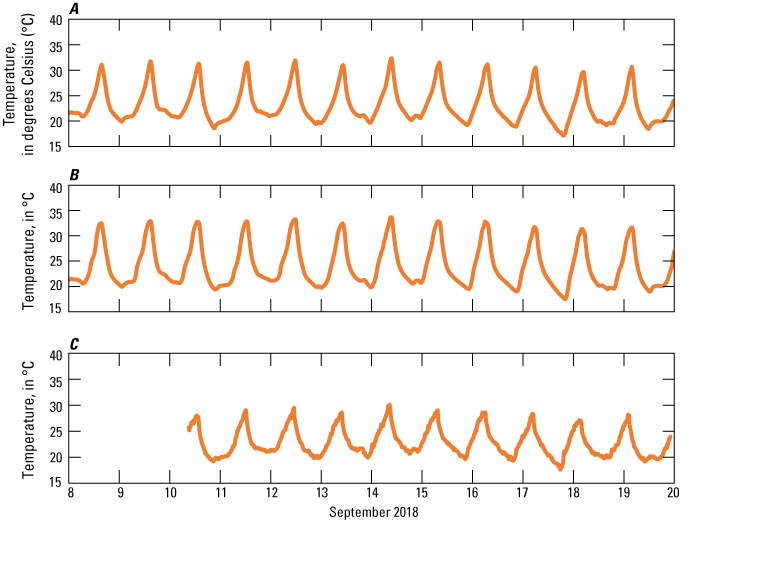
Temperatures recorded from the insect trial containers from September 8 to 20, 2018, and external temperatures from September 10 to 20, 2018. Graphs correspond to the following containers: A, insect trial, treatment temperatures; B, insect trial, control temperatures; and C, insect trial, external temperatures.
2015 Wake Island Biosecurity Management Plan Text Review
In evaluating the 2015 Biosecurity Plan text, we summarized the basic requirements and recommendations contained in the document (mostly in section 5.0–Prevention) and indicated aspects that were well covered, aspects that were not, and aspects that could not be assessed (table 8). Table 8 also includes the components of a supplemental summary sheet that refers to all required actions for the resupply barge shipments according to the document “Wake Island Airfield Barge Biosecurity Requirements”. The supplementary document was given to the BOS to follow for the spring 2018 barge resupply shipment (K.R. Rex, National Oceanic and Atmospheric Administration, written commun., 2018). Many of the observations in this table have been covered specifically in other results sections. For example, in compliance with quarantine requirements and recommendations, traps for rodents had been deployed in cargo staging areas by the 611th Biosecurity Manager, and rodent inspections of the tug and barge took place in compliance with pre-screening. Examples of non-compliance included purchase of incorrect biosecurity tools despite the 611th Biosecurity Manager providing an in-person demonstration as well as written follow up guidance and containers without biosecurity tools in place (but it was done by our field team: Stacie A. Hathaway, James C. Molden, and Kristen R. Rex). Additionally, there were no quarterly inspection reports, despite the recommendation that quality assurance inspections take place quarterly at each staging facility.
Table 8.
Wake Island Biosecurity Management Plan (U.S. Air Force [USAF], written commun., 2015) requirements and recommendations text and Wake Island Barge Biosecurity Requirement document supplied to the contractor (for the 2018 Wake Atoll resupply shipment; [K.R. Rex, National Oceanic and Atmospheric Administration, written commun., 2018]) compared to observations by U.S. Geological Survey (USGS) during the 2018 Wake barge resupply shipment in April at Joint Base Pearl Harbor–Hickam (JBPHH) for cargo staging and in May at Wake Atoll upon barge arrival.[Section(s) quoted in Biosecurity Plan are included for reference. Abbreviations: hrs/day, hours per day; (-), non-compliance observed; (+), compliance observed; app., appendix; (?), unknown compliance; (NA), not applicable; EPA, U.S. Environmental Protection Agency; CES, Civil Engineer Squadron; CEIE, Civil Engineer–Installation Management Flight Environmental Element; PRSC, Pacific Air Forces Regional Support Center; BOS, Base Operating Support; FISC, Fleet Industrial Supply Center; —, not applicable]
We noted that there are some instances where the descriptions of the barge requirements were confusing and could be clarified. In other cases, the verbiage was clear, but the protocol did not appear to be followed. There were also recommendations or requirements that we were not able to assess, such as whether cargo staging areas were kept lit 24 hours per day.
Discussion
The 2015 Biosecurity Plan contains critical and useful components, and some of these appear to be well implemented. However, we also noted discrepancies, weaknesses, or both, across methods and protocols used for Wake Atoll biosecurity at the time of our assessment (2018). These were observed at each stage of our survey as well as in our assessment of the 2015 Biosecurity Plan. Here we suggest general modifications that could potentially strengthen biosecurity overall.
Shipping Container Sanitation
Baseline sanitation surveys of shipping containers for transporting cargo to Wake resulted in a surprising number of real and potential biosecurity weaknesses with all types of cargo shipment surveyed (containers, flat racks, and break bulk). Concerns regarding the initial condition of most of the containers, flat racks, and break bulk items included organisms living within empty containers and multiple entry points to containers (visible from outside or inside the container or holes in the floorboards). We observed damaged floorboards in most of the containers, and though it was difficult to access the crevices of damaged areas, we verified at least some were harboring animals. The break bulk cargo items were cleaner but still harbored dirt (or soil), debris, and target organisms.
During our inspections before barge movement, we detected more organisms than we could capture and remove from the empty containers and storage areas. Uncaptured and unremoved organisms increased uncertainty about the sources of organisms detected upon arrival in Wake. Organisms we detected at Wake through VES and on glue boards could be animals that remained in the containers after our initial inspections, were on cargo when containers were stuffed and entered containers via breaches in container integrity, or most likely, a combination of both. The high numbers of live animals detected at Wake, which were not obvious while cargo was being loaded, also indicates that organisms were transported hidden within cargo or as propagules (for example, eggs, pupae, larvae, or seeds), or both, and emerged while containers were closed between ports.
Convention for Safe Containers dates indicated that some of the containers were due or overdue for inspections. Although the minimum inspection frequency is an international requirement through the IMO and focuses on minimum structural integrity for safe transport, the location of Wake and the results of this study indicate that ensuring that all containers being sent to Wake meet the IMO CSC standard (CSC compliant) could have multiple benefits. Convention for Safe Containers-compliant containers could potentially improve staff and cargo safety as well as biosecurity. Container integrity (such as intact flooring and door seals, absence of holes, and doors that are easy to operate and close properly) is essential for reducing or eliminating unintentional animal entry before and after stuffing. Ensuring proper sanitation for containers used for cargo shipping to Wake could reduce, if not eliminate, plant and animal stowaways. Likewise, inspections before accepting containers to be used for cargo shipments could be used to assess the state of sanitation and integrity and could strengthen biosecurity. Our results provide critical data that can be used by USAF decision makers in their management of barge movement contracts under Executive Orders 13112 (Executive Office of the President, 1999) and 13751 (Executive Office of the President, 2016). An additional level of biosecurity to consider would be investigating the possibility of using containers with all steel flooring. Although typically composed of marine grade plywood and treated with pesticides, we noticed that wood flooring can degrade over time and provide habitat or breaches to outside. In addition, using plastic rather than wood pallets for palletizing cargo may further reduce potential habitat for wood boring animals that might be inadvertently transported to or from Wake (Biebl and Querner, 2021). However, a quantitative analysis indicates that this alternative could be most valuable when treated pallets may not be an option and biosecurity risks are considered high because plastic pallets may have a greater carbon footprint than wood pallets (Weththasinghe and others, 2022). Many factors are considered in cradle-to-grave assessments such as that of Weththasinghe and others (2022). Their results may not directly apply to Wake, but the biosecurity benefits of using plastic pallets may be considered more important than reducing carbon footprint.
There are few publications that evaluate the efficacy of biosecurity procedures for shipping cargo. Gadgil and others (2000) examined the exteriors of 3,681 shipping containers from September 1997 to May 1998 that landed at New Zealand ports. The authors’ focus was specifically on pests relevant to New Zealand forests. They identified contaminants on containers—mineral or organic material (including soil), fungi, plant matter (including seeds), invertebrates (including eggs), and vertebrates. Of these containers, 16 percent carried non-quarantinable, and 23 percent carried quarantinable contaminants. The authors considered a container to be quarantinable if viable pests or fungi belonging to genera with plant pathogens or plant parasitic nematodes were found on it. Soil was the most frequent contaminant, with most of it on the bottoms of containers. Soil was considered quarantinable because of its potential to carry pathogenic fungi, nematodes, and so on. Of the 1,150 containers from which soil was collected and tested, 83 percent carried fungi belonging to genera that included plant pathogens. Stanaway and others (2001) surveyed the interior floors of 3,001 empty shipping containers at 9 container parks around Brisbane, Australia, between February 28 and August 20, 1996. They collected 7,400 live and dead insects in 1,174 (39 percent) of the containers, and live insects were found in 176 (6 percent) of containers. In comparison, we detected live arthropods in 93 percent of the containers when surveyed before stuffing and shipping. We detected animal presence (arthropods and vertebrates) in 100 percent of containers after they had been unstuffed at Wake. Propagules of non-native plant taxa can hitchhike on reefer air-intake grilles and then become established. Lucardi and others (2020) proposed vacuuming air-intake grilles at point-of-origin or stops along the way and studying the efficacy of pre-emergent herbicide application to the air-intake grilles to mitigate this risk. We were not present for reefers’ loading in Hawai`i nor immediately upon unloading after arrival at Wake. They had been onsite at Wake for several days before we surveyed them, so we only inspected the interiors of the containers. We suggest following up with a similar investigation, expanded to include animals and their propagules, and adding the solutions suggested by Lucardi and others (2020) to biosecurity actions for reefers bound for Wake.
Flat racks were only briefly visually inspected at Wake and were in similar condition as when originally inspected in staging areas at JBPHH. Due to their initial condition and how closely they were placed next to each other, our inspections were limited, but nevertheless, revealed issues with sanitation and possibly safety. We discovered water inside one flat rack, but we were not able to get a closer look. Water inside the flat rack poses concern for potential transport of mosquitos, which are known to be disease vectors. Mosquitos have been documented for decades being moved with standing water, such as in tires and general maritime transport. Additionally, mosquito eggs are desiccation resistant (Swan and others, 2022). As with the intermodal containers, our results provide critical data that can be used by USAF decision makers in their management of flat rack movement contracts with respect to Executive Orders 13112 (Executive Office of the President, 1999) and 13751 (Executive Office of the President, 2016). Ensuring flat racks meet CSC standard and minimum sanitation requirements could potentially improve staff and cargo safety as well as biosecurity. Additionally, the report from the BOS that the incorrect type of flat racks was sent indicates not just the importance of double-checking appropriate needs for Wake but also implies an unnecessary biosecurity risk if the incorrect cargo or containment is shipped. Attention to specific cargo containment needs and ensuring container and flat rack integrity and sanitation before use for cargo could also enhance biosecurity.
Container Temperature Monitoring
It was not surprising that the temperatures we observed were variable across the monitored containers. Our results were similar to those of Perry and Vice (2007) and Kraus and others (2018) who evaluated the potential for passive thermal fumigation to serve as brown tree snake (Boiga irregularis) control in surface transportation from Guam. Both studies noted that exposed containers reached high temperatures, but that shading by other containers greatly decreased the maximum temperature reached inside. Likewise, temperatures in filled containers were lower compared to empty containers, and maximum temperatures inside boxes and furniture were even lower. In our study, one of the five containers for which we logged temperatures was above 35.4 °C for a maximum duration of 8 hours. This longer duration of high temperatures in this container might be explained by the difference in height placement of the loggers (approximately 1.5 m) with warmer air toward the top of the container compared to logger placement near the floor in all other containers.
The upper thermal limits are not known for most of the species observed during our sample period. However, Bennett and others (2019) compiled experimentally derived upper tolerance limits for more than 2,000 terrestrial and aquatic species into the GlobTherm database. We examined GlobTherm data in relation to the potential effects of maximum temperatures recorded in shipping containers. In spring 2018, we collected temperature data beginning at the container stuffing phase at JBPHH. Temperatures were recorded until the containers were unloaded at Wake. About 73 percent of terrestrial animal species in the GlobTherm database would perish in containers with the highest maximum temperature we observed, but about 90 percent would have survived in containers with the lowest maximum temperatures if heat were the only mortality factor.
A rapid temperature spike was never observed during the study, only gradual cyclic changes between night and day, which may allow an animal’s physiology to adjust or for the animal to move between cooler and warmer areas of the container. For example, the animal could move into spaces between cargo or settling near drums of liquids, which could create a temperature buffer and more moderate microclimates during the hottest and coolest parts of a given day.
Although our data indicate temperatures may exceed the tolerances of some individuals or suites of species, we do not consider the temperature extremes recorded as a dependable preventative for the introduction of animal species from Hawai`i to Wake. While assessing radiative heating as a thermal treatment for brown tree snakes, Kraus and others (2018) also observed that passive solar radiant heating was unreliable, but an active radiant-heating system showed promise for reliably treating tightly packed cargo relatively quickly and at low cost without damage to cargo. They report that an end temperature of 41 °C for 1 hour or higher temperatures over less time are sufficient for sterilizing cargo for brown tree snakes. They suggest creating standard procedures to radiatively heat cargo items that can withstand heating to 45–50 °C. Such actions may serve as reliable means of preventing a host of potentially damaging invasions. Likewise, thermal heating would be an effective treatment for most terrestrial ectotherms; however, the temperatures reached were not high enough to effectively kill at least one lizard species and several ant and beetle species in the cTmax data we reviewed from Bennett and others (2019). They suggest that a temperature extended to 56 °C (or perhaps held at a lower temperature for longer) could potentially treat all species for which a critical thermal maximum (cTmax) is known. However, Strang (1992) reports higher temperatures for longer are needed for some arthropod species. It should be noted that we did not evaluate thermal tolerance (cTmax or critical thermal minimum [cTmin]) for plant propagules. Some biosecurity plans have called for cargo to be frozen for at least 48 hours before being loaded onto a ship or barge (Hathaway and Fisher, 2010; U.S. Fish and Wildlife Service, 2016). However, these plans do not contain details regarding freezer temperature. Strang (1992, 1997) reviewed published temperatures for controlling 46 museum pest insect species, and based on his findings, he proposed a lethal boundary model (with lethal boundary defined as the approximate limit of the 100-percent mortality data) as a provisional guide. For cold exposure, Strang suggests that temperatures drop as low as possible for as long as possible with a practical recommended treatment of −20 °C (possible with common household deep freezers) for 1 week. Strang notes that this treatment does not necessarily result in 100 percent eradication nor is it appropriate for all species. Likewise, it may be less effective if the organisms are contained within insulating materials. Strang states that, if insulating materials are involved, additional time should be added to cool or heat the object; the lethal boundary model can provide a minimum recommendation that is already known to control many species.
Cargo Staging Areas
In cargo staging areas, we detected a variety of species known to be invasive at Wake or elsewhere (for example, mongoose, cats, fruit- and seed-eating birds, lizards, cane toad, and several arthropods, particularly ants). We also detected many species that we ranked as lower or unknown risk.
The current (2018) staging area biosecurity tools are focused on rodents. We did not detect any rodents during these surveys (except for a single specimen that had been captured at least 1 year prior but not removed from the area, and that consisted of dried skin and bones; K.R. Rex, National Oceanic and Atmospheric Administration, oral commun., 2018). Our findings indicate that the current (2018) control strategies may be effective for controlling rodents in the areas surveyed. However, numerous cats and at least one mongoose were detected in the area. If cats and mongoose are targeted for removal, it could result in rodent and potentially other cat or mongoose prey species release, which could make rodents and other species of concern more difficult to control. Should cat and mongoose control be done, potential cascading effects may require at least a temporary increase in other species control efforts.
Preliminary Risk Assessment
Adverse effects from the species detected in the staging areas at JBPHH that we assessed as high risk could include the following: mongoose could devastate the seabird population and potentially diurnal lizards at Wake (Hays and Conant, 2007), brown anoles could potentially displace lizard populations (Fisher and others, 2020), cane toads could negatively affect native arthropods through predation (Reed and others, 2007), and three fruit- and seed-eating bird species (the common myna, house sparrow, and zebra dove) could aid in invasive plant dispersal (Simberloff and Von Holle, 1999; Vizentin-Bugoni and others, 2021) with potentially disastrous consequences. Also detected at JBPHH and considered to be of high risk are cats, which have already been eradicated from Wake (Rauzon and others, 2008). If they were introduced again, they could prey upon native birds and herpetofauna (Dauphine and Cooper, 2009). House geckos, which currently (2019) inhabit Wake, are known to compete with or prey upon native reptiles on other western Pacific islands (Bolger and Case, 1992; Case and others, 1994; Petren and Case, 1996; Cole and others, 2005; Cole and Harris, 2011), but their potential adverse effects on species native to Wake are understudied. We assessed several other species detected in the containers and staging areas at JBPHH to be medium or low-to-medium risk, including ants, termites, and beetles. The primary biosecurity concern posed by the big-headed ant is their potential effect on arthropod biodiversity, although they may also have a negative effect on seabirds (Plentovich and others, 2009). The southern house mosquito is a known vector of several human disease-causing pathogens and is a potential health risk as well as a nuisance to human activities (Juliano and Lounibos, 2005; McClure and others, 2018). Longhorn crazy ants are significant because they pose considerable risk to the biodiversity of Wake (Wetterer, 2008). The Monomorium species could not be further distinguished but was assessed based on its congeners, the pharaoh ant (Monomorium pharaonis) and destroyer ant (Monomorium destructor), which are known to be pests and can be disease vectors and destructive to infrastructure (Wetterer, 2009, 2010). Termites can cause structural damage to buildings (Evans and others, 2013), the powderpost beetle also damages wood (Furniss and Carolin, 1977), and the tobacco beetle is a pest of stored agricultural products (Edde, 2019). Of the species considered high or medium risk, only five (common house gecko, big-headed ant, longhorn crazy ant, Singapore ant, and southern house mosquito) were known to be present at Wake in 2019, but serial introductions of these species could lead to increased genetic diversity on the atoll, which might enhance their invasiveness (Simberloff, 2009; Tonione and others, 2011).
Biosecurity Tool Efficacy
The first stage of biosecurity tool efficacy evaluation was assessing whether the required tools were used. We observed that biosecurity tools were generally not used as recommended in the 2015 Biosecurity Plan. Although the BOS had purchased most of the tools required (except for rodent trap bait stations), they were not deployed in the staging areas or in shipping containers. However, the subset of tools that were purchased were accessible at the warehouses, which allowed the 611th Biosecurity Manager to set and check traps in the staging areas before USGS arrival. In addition, we deployed the available shipping container tools during our study. When we inspected the barge at Wake, we observed only one rodent trap aboard, and the trap was not attached to the barge in any way. We do not know if additional rodent traps had been deployed on the barge. We assume that, if deployed, they were also not attached. The rodent trap found on the barge is one example in which protocol was not completely followed. Other examples were rat guards that were not consistently used on all vessels at the docks, and rat trap stations that were not adequately deployed on the dock directly adjacent to the barge. The rodent-free vessel certification was provided to the 611th Biosecurity Manager (but not to the BOS Contractor Environmental Technician) for the barge and tug; this certification provides assurance that rodents are not likely to be transported to JBPHH or potentially onto Wake on these vessels. However, being certified rodent-free does not prevent potential rodent or other species movement onto the docked vessels, such as at JBPHH during cargo loading. Preventing rodent incursion is especially important for vessels while docked at Wake, which currently (2019) has a high density of rodents that could potentially board and be transported to new locations. A planned eradication on Wake makes it even more critical to have and implement strong biosecurity procedures and follow through to decrease chances that rodents reinvade.
There were no rodents detected using the three biosecurity tools in cargo staging areas at JBPHH (self-resetting traps, snap traps, and glue boards) or with any of the tools we added (wax tags, chew cards, tracking tunnels, cameras, and additional glue boards). Without any detections from these surveys, we could not make direct assessments of the efficacy of the tools used for detecting rodents in this context. It is known that poison can be highly effective for reducing rodent activity at low cost (Soh and others, 2022), but it requires Environmental Protection Agency certification for use. Shiels and others (2019) compared rodent control using self-resetting traps and snap traps continuously and then a one-time (two-application) rodenticide bait application in rat and house mouse populations in a Hawaiian forest on O`ahu, This population was subject to nearly continuous snap-trapping, rodenticide, or both for more than 15 years. Rat control was considered successful with below 20-percent activity in tracking tunnels. They reported trapping alone was effective at maintaining rat, but not mouse, populations at target levels. Although rodenticide treatment did not further reduce rat populations, it was effective at temporarily suppressing population levels of mice from 33 to 0 percent. They suggest that mouse population reduction was temporary due to subsequent ingress from nearby areas, and mice were not sufficiently suppressed with snap traps because the mice are typically not heavy enough to trigger the snap traps used. They also suggest that self-resetting traps better target rats and stoats. However, in another study of three different sites on O`ahu where they replaced long-term use of snap traps with self-resetting traps, Bogardus and Shiels (2020) reported that rat and mouse activity remained below 25 percent and often even lower. Carter and Peters (2016) also reported self-resetting traps to be effective for knockdown and control of rats and mice in an untrapped forest in New Zealand. These traps have the advantage of being self-resetting, one of the benefits Carter and Peters (2016) and Bogardus and Shiels (2020) reported could make them more cost effective than most other methods for many projects. Bogardus and Shiels (2020) do caution that the self-resetting trap tested provides a 2-year warranty, and although some traps have been documented in good working order after 10 years, most traps fail at varying times between 3 and 10 years. We suggest self-resetting traps used by USAF be regularly tested to ensure proper functioning. The Wake Biosecurity Plan states that self-resetting traps were purchased in 2015, and use of these older traps indicates that regular testing of trap function is critical to achieving effective rodent control.
Self-resetting traps have the advantage of being self-resetting but may not be a practical biosecurity tool for shipping containers; however, we observed over half of the snap traps currently (2018) in use had been triggered in containers without a capture or any sign of rodents. The snap traps were supposed to have been placed in bait stations which may have reduced accidental triggering, but these results indicate at minimum, without a bait station, they have less functionality because they may be easily accidentally triggered. Furthermore, they can only be triggered one time and then become inactive, which limits their utility if multiple individuals are present. Although wax tags or chew cards do not act as interception tools, they could be included as an additional, easy to use, and inexpensive detection tool in containers to alert staff of rodent presence and the need for quarantine.
We have no record of data collected for traps set in warehouses or the dock area, and we cannot assess when or if they have failed, fallen over, disappeared, or caught anything. There was one recent (2017 or earlier) verified rodent capture by a snap trap inside a protective bait station in W2. The date of capture is unknown, but the 611th Biosecurity Manager recalled the dried rat carcass being found at least 1 year before our surveys. Due to the permeability of the staging areas used as of 2018, if rodents are killed by the self-resetting traps, it is possible that carcasses could go undetected because they are removed quickly by scavengers. In that case, the tools would have limited ability to provide detection information. Monitoring the trap strike counter can provide data about how many targets may have been killed. However, Gronwald and Russell (2021) compared camera videos paired with self-resetting traps, and the self-resetting traps did well initially but failed to detect the remaining individuals when rat abundance was low. As mentioned with respect to shipping containers, adding tools, such as wax tags or chew cards, could supplement surveillance for rodents in cargo staging areas. They can be used for collecting evidence of rodent presence and provide an alert that further investigation and precautions might be needed to prevent unintentional movement with cargo shipments. These tools are available for continuous data collection, supplementing interception traps that may be triggered without capture, in the event that a capture is removed by scavengers, or if traps fail. These and other tools we used in our surveys do not definitively rule out rodent presence but corroborate the likelihood of their absence. We found no evidence of current (2018) rodent infestation at the JBPHH cargo storage site. Similarly, the tools that went with the cargo to Wake indicated that biosecurity prevention measures targeting rodents at JBPHH appear to be effective. Some of the additional tools, however, revealed numerous other animal species that pose biosecurity risks and were not detected using the current (2015) required biosecurity tools. Some of these species, including cats, mongoose, fruit- and seed-eating birds, and anoles, are known to be of particular concern at Wake (Hathaway and others, 2022, 2025). Camera traps are more effort to maintain and monitor, but some species, especially species of high concern, were only detected this way. Cameras could be used at least intermittently to maintain awareness of the presence of potential risk species and of the efficacy of the biosecurity measures being implemented. Yellow pan traps intercepted most of the species that were not detected any other way in warehouses (they were not used on the dock or in containers). In our evaluation, we scored all but one species captured in yellow pan traps as low or unknown risk. A single southern house mosquito (Culex quinquefasciatus) specimen, considered to be of medium risk, was collected in a yellow pan trap. Unless there is a change in the risk assessed for species captured by pan traps, it may not be worth the additional effort needed for sorting through the high numbers of captures and subsequent identifications required with this method. There are better tools specific for targeting mosquitos, such as Center for Disease Control (CDC) gravid mosquito traps (for example, the CDC Gravid Trap Model 1712). The BG Sentinal traps are a good option for targeting Aedes mosquito species. In regard to the wide variety of high-risk ant species, these can be easily targeted for surveillance using simple baits. Monitoring glue boards before cargo deliveries can provide a generalized early alert for other smaller species of concern that may be accessing the facilities.
Glue boards serve as a detection and an interception device for small animals. However, our study indicated an unreasonably high number of glue board traps would have been needed to describe the community in shipping containers with a 95-percent confidence level. Results from containers surveyed at Wake show the required biosecurity tools used could not intercept nearly the number of animals we recorded. The tools used in compliance with the 2015 Biosecurity Plan during our 2018 Wake supply barge surveys did not capture the suite of species captured using the tools we added. However, we also observed differences in species captured depending on whether the glue boards were placed on the ground, the wall, or were hanging. These differences were in addition to detecting unique species during VES. The most direct comparison between our tools and the required tools is captures on glue boards. We placed additional glue boards on the ground. We captured eight Singapore ants (medium risk) across six containers and a house gecko (high risk) in another compared to a single unidentifiable ant captured by a required 2015 Biosecurity Plan glue board. The differences in numbers of individuals and species captured could be because we used flat glue boards flush against the ground, whereas the required glue board was a tray structure that may deter or redirect animals, especially those smaller than the height of the tray. Corrigan (1998) compared capture rates between glue trays and glue boards, and the glue trays did not perform as well as glue boards for capturing mice, with the boards capturing over 41 percent more mice. He notes that having a lip to step up onto is a visual and physical obstacle that increases the chances of a mouse making a hesitant approach. We caught an additional Singapore ant on the hanging glue board on the wall and saw 19 more during the VES. We also detected big-headed ants, longhorn crazy ants, and powderpost beetles (all medium risk) during VES, indicating that a variety of species had not been intercepted by any tools. Most of the Singapore and longhorn crazy ants were alive, indicating that the pest strip may not be lethal to these species. Due to holes compromising container integrity, there is potential for continuous movement into or out of containers. For effective prevention of species movement, our results point to the importance of maintaining clean cargo, staging areas, and shipping containers that animals cannot access.
There was less opportunity to observe the barge and tug arrivals and inspect aboard. Therefore, we cannot comment on the likelihood of rodent incursion on these vessels, other than verification that third party rodent inspections took place before vessel docking at JBPHH. Emphasis on placing rodent bait stations along the dock before vessel arrival, verifying that appropriately sized rat guards are used on all mooring lines connecting vessels to the dock, and ensuring required biosecurity tools are being used correctly aboard vessels could decrease the chance of rodent incursion onto vessels. It may also be advisable to move the gangway away from vessels when it is not being actively used, particularly at night. In addition, unintended movement of plants and animals may be reduced by keeping the dock areas clear of vegetation, soil, piled equipment, or debris and any supporting equipment used for cargo unloading (for example, gangways and cranes) free of animals and plant matter.
Our observations indicate that the condition of containers when they are delivered and the permeability of cargo staging areas may increase the number of animals making the trip to Wake. Wake cargo shipping biosecurity standards could be improved in containers and cargo staging areas. A most basic improvement could be to use cleaned containers that do not have integrity issues, such as holes that could allow animal movement in and out, and components that contain habitat, such as damaged wood floorboards. Clean intact containers would be a simple and easy improvement to biosecurity, but this change loses value if cargo arrives to the staging areas containing animals or plant matter (including viable propagules), is continually exposed to animals in the staging area, or both. We don’t know if stowaways on the cargo before it arrived at JBPHH may have increased the number of animals that ultimately arrived at Wake. Whether animals find harborage in or deposit propagules on cargo, their presence increases the possibility that viable life stages could make the transit to Wake or other destinations.
Container Insect Mortality Trial
In our pest strip trial, we examined the efficacy of using dichlorvos impregnated pest strips as a biosecurity tool to reduce risk of transporting live animals when transporting goods via shipping containers. The trial treated a subset of species as a first approach to defining a standard test procedure. In our pilot study, significantly more dead fruit flies (100 percent mortality; p is less than 0.0013) were found in the pest strip treatment than the control; therefore, it is likely that the pest strip would be effective at killing some or all individuals of species equally susceptible as fruit flies to dichlorvos poisoning. However, there was no significant difference for the other two species included in the test, and interestingly, there were additional live byproduct organisms in the treatment enclosures of all three test species (presumably hatched from the habitat provided for the target species). Our results indicate that the pest strip is not effective at completely extirpating all species under the conditions tested. These conditions simulated how it is being used as a biosecurity tool for Wake. Similarly, Batth and Singh (1974) had variable results across several species tested over 7-days exposure to different concentrations of dichlorvos in a 28.3 m3 (approximately 1,000 ft3) chamber. They reported 100-percent mortality within 7 days for house flies (Musca domestica), mosquitos (Aedes atropalpus), webbing clothes moth larvae (Tineola bisselliella), and German cockroaches (Blattella germanica), but not black carpet beetle larvae (Attagenus megatoma). Not surprisingly, they observed higher dichlorovos concentrations killed susceptible species more quickly, but they concluded that claims made for efficacy and duration of vaporizers were not substantiated for most brands tested. Given our results, it is likely that there were species in the containers sent to Wake that were likewise not susceptible to dichlorvos poisoning despite our experimental use of smaller (16-ft) containers than the 20-ft resupply barge shipping containers. In addition, we included very few items that could obstruct or absorb the dichlorvos. We also considered if temperature was a factor in mortality for this experiment. Mitchell and Hoffman (2010) reported the upper thermal limit for Drosophila hydei to be over 38 °C. Vu and others (2019), using a line of Drosophila melanogaster as a control in a study examining high temperature survivorship, reported zero-percent survivorship when the flies were rapidly exposed to 35.4 °C for 24 hours and zero-percent survivorship at 37 °C for 8 hours. Maximum temperatures in the control (35.4 °C) and treatment (32.5 °C) containers indicate temperature was likely not a major cause of mortality confounding our results. Our results indicate that one pest strip is likely to be effective against small flying insects similar to D. hydei but may have little to no effect on at least two other species. Although there may have been integrity issues that we could not see in our VES of stuffed containers at Wake, we detected live animals in all three containers we scored as having no integrity issues. Those animals included spiders, ants, beetles, and barklice. Uncertainties in relation to the transferability of our experimental results, number of pest strips used, duration of study, availability of refuge, food and water sources, and target species could be systematically investigated to design a standard procedure to test efficacy applicability more widely. Expanding this experiment to include multiple pest strips may improve the results.
2015 Wake Island Biosecurity Management Plan Text Review
We reviewed the 2015 Biosecurity Plan text as it relates to the barge resupply shipments and as context for our observations. The document contains many important general biosecurity recommendations, but some of the procedures could be more clearly presented. Our observations indicated that some procedures were well carried out and others were only partially carried out or not carried out at all. Most of the discrepancies we identified were in the purview of the BOS contractor. Unclear wording of the 2015 Biosecurity Plan could explain some of discrepancies. In addition, there may be other parties along the supply chain with biosecurity roles before or at JBPHH that may not have been carried out, which in turn, affected BOS responsibilities. An overall flow chart could help clarify the order of operations. Separate modules with clear, simple but detailed protocols describing, and where appropriate, illustrating, step by step, how and when each activity needs to take place could facilitate consistent and timely performance and reduce misinterpretation. These modules could be accompanied by simpler checklists for staff members to track that each step has been completed and to provide a record of accountability. To ensure that the instructions are clear, staff unfamiliar with the specific processes could field test the protocols before they are finalized. In addition, the text in some areas of the 2015 Biosecurity Plan makes recommendations rather than specifying requirements. Our interpretation of a recommendation is that it is a suggestion rather than a mandate. If flexibility is intended, then the wording is appropriate as is. If USAF intends the actions to be required, rewording could ensure that those implementing the plan understand the intent. Other solutions could include having the 611th Biosecurity Manager present during biosecurity procedures carried out at Wake or designating a separate contracted position specifically assigned to biosecurity requirements at Wake and in Hawai`i. Ideally, these duties could include some level of biosecurity surveillance monitoring at Wake as well.
The 2015 Biosecurity Plan does not identify the need for efficacy evaluations, such as those presented herein, nor does it suggest a frequency for updating the plan. The Sikes Act requires INRMPs to be reviewed at least once every 5 years. The 2017 INRMP, which includes Wake, contains this objective: “Every 5 years determine if an update or revision of the INRMP is necessary based on changes in environmental conditions or the mission as required by the Sikes Act (16 U.S.C. 670a) and DODI 4715.03” (U.S. Air Force, written commun., 2017). Because the 2015 Biosecurity Plan is a component of the INRMP, we assume that it would be included in this objective. Within an update to the 2015 Biosecurity Plan, it could be worthwhile to include stipulations for periodic evaluations and potentially for more frequent updates as more information becomes available. Updates could be based upon the recommended annual compilation of quality assurance inspection results. The plan recommends that these inspections take place at each staging facility quarterly. In addition to evaluation of these results, updates could be based upon any monitoring data available, including any data collected from interception tools in containers and on the barge and tug and those reported in any monitoring associated with early detection and rapid response or general biodiversity surveys on Wake. Any advances within the biosecurity community could also be included in updates and implemented where feasible.
Caveats of Design
We focused on recording shipping container integrity issues that could result in the movement of animal (or plant matter) to Wake. We qualitatively ranked the condition of the shipping containers we encountered.
We detected thousands of live and dead animals having made the transit to Wake in containers through visual inspections and on glue board traps. Poor container structural integrity and baseline sanitation contributed to uncertainty with respect to the origin of animal and plant material that arrived at Wake in containers. Most captures were on glue boards, indicating that the animals were alive in the containers before interception. The considerable number of individuals identified at Wake comes with the caveat that we detected live animals and animal sign in the containers before they were stuffed, and we did not thoroughly sanitize the containers (although we did sweep and vacuum them). In addition, most containers had poor integrity. Animals still present in the empty containers before stuffing could account for some, but likely not all or even most, of the detections at Wake. Because time did not allow us to sanitize the containers ourselves during the pre-barge surveys, it is likely that some of the organisms that made it to Wake (1) had been in the containers when they were delivered to JBPHH, (2) entered through breaches in container integrity after delivery to JBPHH, (3) had been living in container floorboards, or (4) were stowaways on the cargo or some combination of these possibilities. Uncertainty about the origin of the animals we collected at Wake includes the original state of cargo as it arrived at JBPHH, the cargo staging areas, the containers, or the outside environment.
We used glue boards to capture many of the organisms we collected. We presume animals captured were moving about the container and became stuck on the boards, but it is unclear how many of these organisms would have made the transit to Wake alive had they continued to roam freely. However, the multiple live specimens in the containers once they were unstuffed provide evidence that live transit was occurring. Common house geckos and other species are already established at Wake (as are 10 other species that made the transit to Wake). Because the live gecko intercepted on a glue board had perished before collection at Wake, we cannot be certain it would have survived the barge transit if it had remained mobile in the container, though repeated introductions of this species have been documented elsewhere (Tonione and others, 2011). It is possible that various species (such as lizards and arthropods) inhabiting staging areas may hide in, or attach propagules to, cargo or containers, facilitating repeated introductions of species to Wake.
Likewise, it is possible that many organisms were transported as propagules (defined in the “Glossary”) on cargo or in the container interior. Propagules may have greater ability than adults to survive the conditions for the duration of the transit. Most of the species detected before container stuffing were recorded in the staging areas and not in containers, but some were detected in containers upon arrival to Wake and could have been transported as propagules. These results provide some potential insight into what can be transferred to Wake as viable propagules from cargo or staging areas compared to the containers. While we are not addressing plant matter and seeds specifically here, we note that plant parts and seeds may also remain viable during transit. After removing large debris and trash, the dirt (or soil) collected from inside the 30 initial empty containers was added to sterile general-purpose growing medium and observed for germination and species identification in a greenhouse experiment. Under these conditions, 23 species germinated and could be identified, 15 of which reached reproductive maturity (Yanger and others, 2025). Of the 23 species, 13 have not previously been recorded at Wake, 5 are known to be invasive at Wake, and 5 are naturalized. Of the 13 species not previously recorded at Wake, 9 were high risk. Plants grew successfully from the dirt (or soil) and debris we collected from at least 26 of the 30 containers. Lucardi and others (2020) identified 30 taxa of hitchhiking plant propagules on the air-intake grilles of reefers at the Port of Savannah in Georgia in 2016. They analyzed the 4 monocotyledonous taxa with the highest number of seeds collected, and across two seasons, they collected a combined total of 4,654 and 3,809 seeds from 331 and 297 containers, respectively. They estimated propagule pressure, germination, and survival rates of these taxa and used the estimates to determine likelihood of establishment. Their modeling results indicated significant and high establishment probabilities, even with escape rates from shipping containers modelled to be exceedingly low.
Determining the origin of the species encountered would require cargo to be isolated in a clean quarantined environment, allowing more thorough inspection of the transported cargo and placement of interception traps to assist with detection. The stowaway species that are most likely to be missed during inspections are presumably those smaller in size or potentially present as viable animal propagules (or both). Observation over time could provide a more accurate assessment, allowing animals to emerge and possibly become ensnared by interception traps or to be seen during visual inspections. We were not able to inspect all aspects of all containers or cargo. For example, we could not access the tops or bottoms of any containers or all four sides of most of them. Because we could not inspect containers and cargo more thoroughly due to time constraints and accessibility and because some (or possibly all) containers were swept before our VES at Wake, the number of species and individual animals we recorded is likely to be lower than the actual number that were transported to Wake during the 2018 Wake resupply shipment. Because cargo unloading could not be delayed, containers were unstuffed at Wake before our VES, and therefore, it is also possible that some organisms could have entered the containers at Wake.
Similarly, the warehouses and the dock staging areas at JBPHH were not cleared of organisms before cargo arrived and surveys commenced. Therefore, some of the recorded sign and dead organisms may have been very old, and many organisms or signs were possibly missed. However, our results indicate warehouse hygiene could be improved, particularly considering the large number of live organisms detected. There were more specimens detected and more species recorded in W1 than W2; however, we deployed more collection tools in W1 for longer duration. Therefore, the results are not directly comparable, and this finding does not necessarily indicate W2 is cleaner or less accessible to animals.
All VES were time constrained, so it was not possible to collect every live or dead specimen when there were multiples of the same species, and it is likely some species were missed, particularly the smallest animals. In addition, animals hiding in broken flooring in containers or within the floorboards and animals using cargo as refuge may be underrepresented. We found limited information in published literature regarding the initial sanitation of empty shipping containers (Stanaway and others, 2001) and cargo staging areas, or whether holes in shipping containers have resulted in animal movement into container interiors. Thus, these results may be atypical or indicate a broader cause for concern regarding species transfers between locations. Replication of this process in different circumstances could provide further insight into what is typical and indicate what modifications to current (2018) practices could yield the most benefit.
The trials indicate pest strips are lethal to fruit flies within 2 weeks; this finding was supported by our experiment, which took place during 12 days. Batth and Singh (1974) reported dichlorvos was effective at killing some species in under a week. Interceptions of animals on glue traps collected at Wake may be high compared to the number that would have died from pest strip exposure or natural causes before arriving at Wake. On the other hand, we only tested adults, and we did not attempt to standardize ages of individuals used in our experiment, which could affect the mortalities observed. Further, we do not know whether the pest strip is likely to be 100 percent lethal to eggs or larval forms. Interestingly, we found other living organisms in the fruit fly medium as well as living cockroaches, crickets, and other organisms in their respective enclosures, which indicates limited effectiveness of pest strips for biosecurity. We also used 16-ft containers that were only partially filled. It is possible that 20-ft containers that have been more tightly stuffed could have different results.
There is uncertainty regarding how many individuals and which species would have survived the transit if they had not been intercepted by glue boards. However, based on our analysis, there is a high probability most would not be captured by a single glue board. On the other hand, some or perhaps many could have perished due to the pest strip, dehydration, starvation, or simply the end of life cycle. We did, however, capture live animals in all containers during our VES at Wake.
Potential Improvements to the 2015 Biosecurity Plan for Consideration
Our efficacy results could be used to reconsider which elements of the 2015 Biosecurity Plan are essential and to justify strengthening the language of those elements in a biosecurity plan update. The results described here indicate that more vigilance and new tools could reduce vulnerabilities. For example, biosecurity in the staging area could be improved. The considerable permeability of both warehouses allows continuous potential exposure of cargo to plant and animal infestation. Improvements could include ensuring warehouse doors are secured and not left open unnecessarily and reducing the permeability of warehouse walls and bay doors. These measures could reduce the potential for plant matter blowing onto cargo or animals entering and inhabiting or depositing propagules within cargo. Implementing a monitoring schedule to collect and report data for each snap trap, glue board trap, and self-resetting trap could assess whether these tools are functioning and identify potential biosecurity concerns. The required glue boards were set in their folded configuration, and our glue boards were laid flat. Corrigan (1998) captured almost three times as many mice on unfolded glue board traps. He suggests higher capture rates with glue boards laid flat could be because folding the board creates a tunnel that may cause mice to be more cautious. He also compared Victor M133 professional model snap traps to folded glue board traps. The snap traps had a 56.2 percent capture rate compared to 8.3 percent for folded glue traps. Folding the glue traps could also reduce capture rates of other small animals because of the tunnel that folding creates or because folding reduces surface area that is flush to the ground. Verifying differences would require direct observation of animal responses to both trap configurations. Aside from the self-resetting traps, snap traps, and glue boards being used in the staging areas, we did not observe any traps or detection stations targeting larger or more elusive and cryptic animals in any of the cargo staging areas. Camera traps are a relatively low-cost early detection tool that, with periodic monitoring, could alert building staff of animal activity in the area and trigger management actions before cargo storage. Camera traps could also be used to assess the efficacy of self-resetting traps.
The 2015 Biosecurity Plan does not discuss the sanitation or quality of shipping containers. The number of animals detected in containers at Wake could potentially be reduced by starting with clean, intact containers that do not have potential entry points when sealed. Inspections focused on detecting and eliminating any animals, plants, or their propagules present inside containers or on exteriors and rejecting the use of contaminated containers; these are vital components of preventive action. Based on our findings, verifying shipping container integrity and cleanliness is essential in an updated biosecurity plan before accepting deliveries. Achieving integrity and cleanliness might include specified minimum requirement protocols for container quality inspections such as those listed in Hathaway and others (2022; app. 1, “Prior to Departure to Wake Container Integrity and Sanitation”) and included herein (app. 6, “Example Container Inspection Datasheet”). Similar protocols could also be included for cargo.
Once containers are accepted, cleaning them of any dirt, soil, or debris before being stuffed could be beneficial. Dirt (or soil) and debris can also harbor plant material, seeds, fungi, pathogens, propagules, and so on, and they may provide a food source or habitat for any animals on or inside the container.
According to “Wake Island Airfield Barge Biosecurity Requirements,” a biosecurity plan supplemental document, biosecurity tools must be added to every container. Given our results, it could be beneficial to emphasize the use of biosecurity tools in all containers (stuffed or empty) that get sent to Wake or that will be moved from Wake to other locations.
There are also no guidelines in the 2015 Biosecurity Plan that describe inspection protocols or what makes a container acceptable to send to Wake. Although these containers were not technically being used for international transport, the CSC specifies that containers be inspected for safety 5 years post-manufacture and then every 30 months thereafter. We collected CSC inspection dates for 23 containers at JBPHH, and 11 were either expired or would be expired before their projected return from Wake. Contractors working at Wake reported that sometimes their staff deem arriving containers unsafe to send back. These containers remain on site to be disassembled, torch cut, and shipped to Hawai`i. Stipulating that the containers that get shipped to Wake have undergone appropriate safety inspections could avoid this circumstance.
Once stuffed, containers may sit on the loading dock for weeks exposed to plants and animals in the area. Thus, doing inspections just before loading containers and break bulk onto the barge could be beneficial. In addition to inspecting container exteriors, the need to thoroughly inspect vehicles or other break bulk exteriors and open doors, hoods, or other compartments animals could enter while in the staging areas could be specified. Animals, such as rodents, cats, snakes, invertebrates, and so on, have been detected in engine compartments and other accessible areas of vehicles and may likely be in other items with similar hiding areas. Further, the use of plastic pallets rather than wood pallets could reduce movement of wood-boring animals (Biebl and Querner, 2021) in cases where treated wood pallets are unavailable or biosecurity risk is high.
The goal of this study was to evaluate the 2015 Biosecurity Plan as it pertains to resupply shipping via supply barge. The other potential boat arrival at Wake is as a stranded vessel. Wake serves as an emergency mooring site and harbor for small vessels in distress (U.S. Air Force, written commun., 2015), and many of these same protocols and techniques apply. Another major pathway identified in the plan is air transportation; the same or similar protocols and tools could be applied in that context as well. Hathaway and others (2022) created biosecurity protocol checklists that integrate previous biosecurity practices for Wake, with modifications based on observations during biodiversity surveys at Wake (Hathaway and others, 2025) and the findings presented in this report. These checklists address activities related to transportation of supplies and passengers through barge and air transport as well as to stranded vessels. The checklists were designed to be easily modified as needs and protocols shift.
Future Needs
Further useful surveys and research could include consistent monitoring by onsite staff, particularly of areas most likely to be an initial site of incursion for any new plant or animal species. Areas of concern are those used for cargo staging and loading of sea and air vessels in Hawai`i and unloading areas at Wake. Monitoring around heavily used locations on Wake, especially the air terminal, marina, and living quarters, could also be beneficial. Similar surveys of the Air Mobility Command JBPHH Air Passenger Terminal and sea ports and airports at Guam could provide additional perspective relevant to the state of biosecurity at Wake. It is also worth considering the biosecurity of other cargo, including containers being stuffed and shipped from various other ports, as we saw with the MDA containers. Highly sanitized and carefully controlled quarantine areas for cargo staging are most likely to prevent species movement and to improve interception, but may be impractical, at least in the immediate future. Species identification guides could assist staff in assessing the presence of species not native to Wake. We have been developing species guides for Wake (Hathaway and others, 2025), and once finalized, these could be used as identification guides. They could be revised as new information becomes available. Additional research is needed to further evaluate biosecurity protocol efficacy and tools, compare the efficacy of potential alternatives that have not yet been considered, and develop innovative biosecurity tools for non-native species prevention. Additional benefits could be achieved from periodic monitoring by experts to detect new incursions of potentially harmful non-native species and from developing a formal surveillance and early detection and response design. We have also carried out a preliminary risk assessment and horizon scanning exercise for invasive species that are on Wake or that could potentially arrive at Wake (this report; Hathaway and others, 2022). Expanding our preliminary work with a more in-depth species risk assessment, including a broader group of taxonomic experts, could identify additional potential invasive species arrivals. The focus of this project was terrestrial biosecurity; however, updating the 2015 Biosecurity Plan requirements for the marine component (for example, addressing biofouling and ballast water) could also be beneficial. Finally, as biosecurity tools and strategies continue to be developed and enhanced at Wake and globally, sharing and reviewing any advancements would be valuable, with the goal of keeping the Wake biosecurity plan current and supporting the continuous cycle of biosecurity improvement.
Conclusion
Better management of invasive species enhances the capability to protect human health and the environment and supports mission accomplishment. Biosecurity plans are integral to addressing invasive species. Periodic evaluation of the efficacy of these plans allows identification of elements that are working well and those that could be improved. Improvements are likely to involve deployment of new tools and adaptation of processes to achieve better outcomes and accommodate potential future threats more efficiently and cost effectively.
References Cited
Batth, S.S., and Singh, J., 1974, Evaluation of dichlorvos vaporizing solids for controlling insects: Canadian Entomologist, v. 106, no. 1, p. 31–37. [Available at https://doi.org/10.4039/Ent10631-1.]
Bennett, J.M., Calosi, P., Clusella-Trullas, S., Martínez, B., Sunday, J., Algar, A.C., Araújo, M.B., Hawkins, B.A., Keith, S., Kühn, I., Rahbek, C., Rodríguez, L., Singer, A., Villalobos, F., Olalla-Tárraga, M.Á., and Morales-Castilla, I., 2018, GlobTherm, a global database on thermal tolerances for aquatic and terrestrial organisms: Scientific Data, v. 5, article 180022, p. 1–7. [Available at https://doi.org/10.1038/sdata.2018.22.]
Bennett, J.M., Calosi, P., Clusella-Trullas, S., Martínez, B., Sunday, J., Algar, A.C., Araújo, M.B., Hawkins, B.A., Keith, S., Kühn, I., Rahbek, C., Rodríguez, L., Singer, A., Villalobos, F., Olalla-Tárraga, M.Á., and Morales-Castilla, I., 2019, Data from—GlobTherm, a global database on thermal tolerances for aquatic and terrestrial organisms: Dryad dataset, accessed May 26, 2022, at https://doi.org/10.5061/dryad.1cv08.
Biebl, S., and Querner, P., 2021, Transportation of wood boring beetles in wooden transport boxes, wooden pallets, and newly bought wood in museums: Studies in Conservation, v. 66, no. 1, p. 44–50. [Available at https://doi.org/10.1080/00393630.2020.1756126.]
Bogardus, T., and Shiels, A.B., 2020, Effectiveness of A24 automatic traps for landscape level rodent control: Proceedings of the Vertebrate Pest Conference, v. 29, no. 29, 5 p. [Available at https://escholarship.org/uc/item/1g26q3t7.]
Bolger, D.T., and Case, T.J., 1992, Intra- and interspecific interference behaviour among sexual and asexual geckos: Animal Behaviour, v. 44, no. 1, p. 21–30. [Available at https://doi.org/10.1016/S0003-3472(05)80750-X.]
Booy, O., Mill, A.C., Roy, H.E., Hiley, A., Moore, N., Robertson, P., Baker, S., Brazier, M., Bue, M., Bullock, R., Campbell, S., Eyre, D., Foster, J., Hatton-Ellis, M., Long, J., Macadam, C., Morrison-Bell, C., Mumford, J., Newman, J., Parrott, D., Payne, R., Renals, T., Rodgers, E., Spencer, M., Stebbing, P., Sutton-Croft, M., Walker, K.J., Ward, A., Whittaker, S., and Wyn, G., 2017, Risk management to prioritise the eradication of new and emerging invasive non-native species: Biological Invasions, v. 19, no. 8, p. 2401–2417. [Available at https://doi.org/10.1007/s10530-017-1451-z.]
Bryan, E.H., Jr., 1959, Notes on the geography and natural history of Wake Island: Atoll Research Bulletin, v. 66, p. 1–22. [Available at https://doi.org/10.5479/si.00775630.66.1.]
Carter, A., and Peters, D., 2016, Self-resetting traps provide sustained, landscape-scale control of a rat plague in New Zealand, in Timm, R.M., and Baldwin, R.A., eds., Proceedings of the 27th Vertebrate Pest Conference, Newport Beach, Calif., March 7–10, 2016: Davis, Calif., University of California, Davis, p. 308–313. [Available at https://doi.org/10.5070/V427110527.]
Case, T.J., Bolger, D.T., and Petren, K., 1994, Invasions and competitive displacement among house geckos in the tropical Pacific: Ecology, v. 75, no. 2, p. 464–477. [Available at https://doi.org/10.2307/1939550.]
Christensen, N.L., Bartuska, A.M., Brown, J.H., Carpenter, S., D’Antonio, C., Francis, R., Franklin, J.F., MacMahon, J.A., Noss, R.F., Parsons, D.J., Peterson, C.H., Turner, M.G., and Woodmansee, R.G., 1996, The report of the Ecological Society of America Committee on the scientific basis for ecosystem management: Ecological Applications, v. 6, no. 3, p. 665–691. [Available at https://doi.org/10.2307/2269460.]
Cole, N.C., and Harris, S., 2011, Environmentally-induced shifts in behavior intensify indirect competition by an invasive gecko in Mauritius: Biological Invasions, v. 13, no. 9, p. 2063–2075. [Available at https://doi.org/10.1007/s10530-011-0025-8.]
Cole, N.C., Jones, C.G., and Harris, S., 2005, The need for enemy-free space—The impact of an invasive gecko on island endemics: Biological Conservation, v. 125, no. 4, p. 467–474. [Available at https://doi.org/10.1016/j.biocon.2005.04.017.]
Corrigan, R.M., 1998, The efficacy of glue traps against wild populations of house mice, Mus domesticus Rutty, in Baker, R.O., and Crabb, A.C., eds., Proceedings of the 18th Vertebrate Pest Conference: Davis, Calif., University of California, Davis, p. 268–275. [Available at https://doi.org/10.5070/V418110049.]
Costa, A., Romano, A., and Salvidio, S., 2020, Reliability of multinomial N-mixture models for estimating abundance of small terrestrial vertebrates: Biodiversity and Conservation, v. 29, nos. 9–10, p. 2951–2965. [Available at https://doi.org/10.1007/s10531-020-02006-5.]
Dauphine, N., and Cooper, R.J., 2009, Impacts of free-ranging domestic cats (Felis catus) on birds in the United States—A review of recent research with conservation and management recommendations, in Rich, T.D., Arizmendi, C., Demarest, D.W., and Thompson, C., eds., Tundra to tropics—Connecting birds, habitats, and people—Proceedings of the 4th International Partners in Flight Conference, McAllen, Tex., February 13–16, 2008: Partners in Flight, p. 205–219. [Available at https://abcbirds.org/wp-content/uploads/2015/07/Dauphine-and-Cooper-2009-Impacts-of-free-ranging-cats-on-birds-in-US.pdf.]
Edde, P.A., 2019, Biology, ecology, and control of Lasioderma serricorne (F.) (Coleoptera—Anobiidae)—A review: Journal of Economic Entomology, v. 112, no. 3, p. 1011–1031. [Available at https://doi.org/10.1093/jee/toy428.]
Engilis, A., Jr., and Naughton, M., 2004, U.S. Pacific Islands regional shorebird conservation plan—U.S. Shorebird Conservation Plan: Portland, Oreg., U.S. Fish and Wildlife Service, 18 p. [Available at https://www.shorebirdplan.org/wp-content/uploads/2013/01/USPI1.pdf.]
Evans, T.A., Forschler, B.T., and Grace, J.K., 2013, Biology of invasive termites—A worldwide review: Annual Review of Entomology, v. 58, p. 455–474. [Available at https://doi.org/10.1146/annurev-ento-120811-153554.]
Executive Office of the President, 1999, Executive order 13112—Invasive species: Federal Register, v. 64, no. 25, p. 6183–6186. [Available at https://www.govinfo.gov/content/pkg/FR-1999-02-08/pdf/99-3184.pdf.]
Executive Office of the President, 2016, Executive order 13751—Safeguarding the Nation from the impacts of invasive species: Federal Register, v. 81, no. 236, p. 88609–88614. [Available at https://www.federalregister.gov/documents/2016/12/08/2016-29519/safeguarding-the-nation-from-the-impacts-of-invasive-species.]
Fisher, S.R., Del Pinto, L.A., and Fisher, R.N., 2020, Establishment of brown anoles (Anolis sagrei) across a southern California county and potential interactions with a native lizard species: PeerJ, v. 8, 12 p. [Available at https://doi.org/10.7717/peerj.8937.]
Food and Agriculture Organization of the United Nations, 2007, Biosecurity principles and components, pt. 1 of FAO biosecurity toolkit: Rome, Italy, Food and Agriculture Organization of the United Nations report, p. 1–20, accessed June 15, 2021, at https://www.fao.org/3/a1140e/a1140e.pdf.
Foster, M.S., 2012, Standard techniques for inventory and monitoring, chap. 13 of McDiarmid, R.W., Foster, M.S., Guyer, C., Gibbons, J.W., and Chernoff, N., eds., Reptile biodiversity—Standard methods for inventory and monitoring: Berkeley, Calif., University of California Press, p. 205–272. [Available at https://doi.org/10.1525/9780520952072-016.]
Furniss, R.L., and Carolin, V.M., 1977, Western forest insects: Washington, D.C., U.S. Department of Agriculture, Forest Service, Miscellaneous Publication, no. 1339, 654 p. [Available at https://doi.org/10.5962/bhl.title.131875.]
Gronwald, M., and Russell, J.C., 2021, Measuring rat relative abundance using camera traps and digital strike counters for Goodnature A24 self-resetting traps: New Zealand Journal of Ecology, v. 45, no. 1, p. 1–7. [Available at https://doi.org/10.20417/nzjecol.45.7.]
Hathaway, S.A., and Fisher, R.N., 2010, Biosecurity plan for Palmyra Atoll: U.S. Geological Survey Open-File Report 2010–1097, 80 p. [Available at https://doi.org/10.3133/ofr20111007.]
Hathaway, S.A., Jacobi, J.D., Peck, R., Backlin, A.R., Hitchcock, C.J., and Fisher, R.N., 2025, Biodiversity surveys of Wake Atoll—Featuring field guides for plants, arthropods, and herpetofauna: U.S. Geological Survey Open-File Report 2023–1066, 302 p., https://doi.org/10.3133/ofr20231066.
Hathaway, S.A., Jacobi, J.D., Peck, R., and Fisher, R.N., 2022, Updates for Wake Atoll biosecurity management, biological control, survey, and management, and integrated pest management plans: U.S. Geological Survey Open-File Report 2022–1067, 56 p. [Available at https://doi.org/10.3133/ofr20221067.]
Hays, W.S.T., and Conant, S., 2007, Biology and impacts of Pacific Island invasive species—1—A worldwide review of effects of the small Indian mongoose, Herpestes javanicus (Carnivora—Herpestidae): Pacific Science, v. 61, no. 1, p. 3–16. [Available at https://doi.org/10.1353/psc.2007.0006.]
Juliano, S.A., and Lounibos, L.P., 2005, Ecology of invasive mosquitoes—Effects on resident species and on human health: Ecology Letters, v. 8, no. 5, p. 558–574. [Available at https://doi.org/10.1111/j.1461-0248.2005.00755.x.]
Keppel, G., Morrison, C., Meyer, J.-Y., and Boehmer, H.J., 2014, Isolated and vulnerable—The history and future of Pacific Island terrestrial biodiversity: Pacific Conservation Biology, v. 20, no. 2, p. 136–145. [Available at https://doi.org/10.1071/PC140136.]
Kraus, F., Stahl, R., and Pitt, W., 2018, An assessment of radiative heating as a thermal treatment for invasive snakes in cargo: International Journal of Pest Management, v. 64, no. 1, p. 27–38. [Available at https://doi.org/10.1080/09670874.2017.1293309.]
Lackey, R.T., 1998, Seven pillars of ecosystem management: Landscape and Urban Planning, v. 40, nos. 1–3, p. 21–30. [Available at https://doi.org/10.1016/S0169-2046(97)00095-9.]
Lucardi, R.D., Bellis, E.S., Cunard, C.E., Gravesande, J.K., Hughes, S.C., Whitehurst, L.E., Worthy, S.J., Burgess, K.S., and Marsico, T.D., 2020, Seeds attached to refrigerated shipping containers represent a substantial risk of nonnative plant species introduction and establishment: Scientific Reports, v. 10, article 15017, 10 p. [Available at https://doi.org/10.1038/s41598-020-71954-3.]
Matos, J., Little, A., Broome, K., Kennedy, E., Sánchez, F.A.M., Latofski-Robles, M., Irvine, R., Gill, C., Espinoza, A., Howald, G., Olthof, K., Ball, M., and Boser, C.L., 2018, Connecting island communities on a global scale—Case studies in island biosecurity: Western North American Naturalist, v. 78, no. 4, p. 959–972. [Available at https://doi.org/10.3398/064.078.0432.]
McClure, K.M., Lawrence, C., and Kilpatrick, A.M., 2018, Land use and larval habitat increase Aedes albopictus (Diptera—Culicidae) and Culex quinquefasciatus (Diptera—Culicidae) abundance in lowland Hawai’i: Journal of Medical Entomology, v. 55, no. 6, p. 1509–1516. [Available at https://doi.org/10.1093/jme/tjy117.]
Mitchell, K.A., and Hoffmann, A.A., 2010, Thermal ramping rate influences evolutionary potential and species differences for upper thermal limits in Drosophila: Functional Ecology, v. 24, no. 3, p. 694–700. [Available at https://doi.org/10.1111/j.1365-2435.2009.01666.x.]
Perry, G., and Vice, D.S., 2007, An evaluation of passive thermal fumigation for brown treesnake control in surface transportation from Guam, in Witmer, G.W., Pitt, W.C., and Fagerstone K.A., eds., Managing vertebrate invasive species—Proceedings of an international symposium, Fort Collins, Colo., August 7–9, 2007: U.S. Department of Agriculture/Animal and Plant Health Inspection Service, Wildlife Services, National Wildlife Research Center, p. 224–233, accessed June 25, 2022, at https://digitalcommons.unl.edu/nwrcinvasive/37.
Petren, K., and Case, T.J., 1996, An experimental demonstration of exploitation competition in an ongoing invasion: Ecology, v. 77, no. 1, p. 118–132. [Available at https://doi.org/10.2307/2265661.]
Plentovich, S., Hebshi, A., and Conant, S., 2009, Detrimental effects of two widespread invasive ant species on weight and survival of colonial nesting seabirds in the Hawaiian Islands: Biological Invasions, v. 11, no. 2, p. 289–298. [Available at https://doi.org/10.1007/s10530-008-9233-2.]
Pritchard, A.M., Sanchez, C.L., Bunbury, N., Burt, A.J., Currie, J.C., Doak, N., Fleischer-Dogley, F., Metcalfe, K., Mortimer, J.A., Richards, H., Crommenacker, J. van de, and Godley, B.J., 2022, Green turtle population recovery at Aldabra Atoll continues after 50 yr of protection: Endangered Species Research, v. 47, p. 205–215. [Available at https://doi.org/10.3354/esr01174.]
R Development Core Team, 2017, R—A language and environment for statistical computing: Vienna, Austria, R Foundation for Statistical Computing, accessed January 27, 2020, at https://www.r-project.org/.
Rauzon, M.J., Everett, W.T., Boyle, D., Bell, L., and Gilardi, J., 2008, Eradication of feral cats at Wake Atoll: Atoll Research Bulletin, v. 560, p. 1–22. [Available at https://doi.org/10.5479/si.00775630.560.1.]
Rawluk, A., Beilin, R., and Lavau, S., 2021, Enacting shared responsibility in biosecurity governance—Insights from adaptive governance: Ecology and Society, v. 26, no. 2, 18 p., accessed July 25, 2021, at https://doi.org/10.5751/ES-12368-260218.
Reed, R.N., Bakkegard, K.A., Desy, G.E., and Plentovich, S.M., 2007, Diet composition of the invasive cane toad (Chaunus marinus) on Rota, Northern Mariana Islands: Pacific Conservation Biology, v. 13, no. 3, p. 219–222. [Available at https://doi.org/10.1071/PC070219.]
Ricciardi, A., Iacarella, J.C., Aldridge, D.C., Blackburn, T.M., Carlton, J.T., Catford, J.A., Dick, J.T.A., Hulme, P.E., Jeschke, J.M., Liebhold, A.M., Lockwood, J.L., MacIsaac, H.J., Meyerson, L.A., Pyšek, P., Richardson, D.M., Ruiz, G.M., Simberloff, D., Vilà, M., and Wardle, D.A., 2021, Four priority areas to advance invasion science in the face of rapid environmental change: Environmental Reviews, v. 29, no. 2, p. 119–141. [Available at https://doi.org/10.1139/er-2020-0088.]
Richmond, J.Q., Kingston, J., Ewing, B.A.I., Bear, W., Hathaway, S.A., Lee, C., Swift, C., Preston, K.L., Schultz, A.J., Kus, B.E., Russel, K., Unitt, P., Hollingsworth, B.D., Espinoza, R.E., Wall, M., Tremor, S., Palenscar, K., and Fisher, R.N., 2023, Prioritizing the risk and management of introduced species in a landscape with high indigenous biodiversity: Bulletin of the Southern California Academy of Sciences, v. 122, no. 2, p. 101–121. [Available at https://doi.org/10.3160/0038-3872-122.2.101.]
Royle, J.A., 2004, Generalized estimators of avian abundance from count survey data: Animal Biodiversity and Conservation, v. 27, no. 1, p. 375–386. [Available at https://doi.org/10.32800/abc.2004.27.0375.]
Royle, J.A., and Dorazio, R.M., 2006, Hierarchical models of animal abundance and occurrence: Journal of Agricultural, Biological, and Environmental Statistics, v. 11, no. 3, p. 249–263. [Available at https://www.jstor.org/stable/27595602.]
Shiels, A.B., Bogardus, T., Rohrer, J., and Kawelo, K., 2019, Effectiveness of snap and A24-automated traps and broadcast anticoagulant bait in suppressing commensal rodents in Hawaii: Human-Wildlife Interactions, v. 13, no. 2, p. 226–237. [Available at https://digitalcommons.unl.edu/cgi/viewcontent.cgi?article=3299&context=icwdm_usdanwrc.]
Simberloff, D., 2009, The role of propagule pressure in biological invasions: Annual Review of Ecology, Evolution, and Systematics, v. 40, p. 81–102. [Available at https://doi.org/10.1146/annurev.ecolsys.110308.120304.]
Simberloff, D.S., and Von Holle, B., 1999, Positive interactions of nonindigenous species—Invasional meltdown?: Biological Invasions, v. 1, p. 21–32. [Available at https://doi.org/10.1023/A:1010086329619.]
Soh, S., Chua, C., Griffiths, J., Oh, P., Chow, J., Chan, Q., Tan, J., and Aik, J., 2022, The use of anticoagulants for rodent control in a mixed-use urban environment in Singapore—A controlled interrupted time series analysis: PLoS ONE, v. 17, no. 5, 14 p. [Available at https://doi.org/10.1371/journal.pone.0267789.]
Stanaway, M.A., Zalucki, M.P., Gillespie, P.S., Rodriguez, C.M., and Maynard, G.V., 2001, Pest risk assessment of insects in sea cargo containers: Australian Journal of Entomology, v. 40, no. 2, p. 180–192. [Available at https://doi.org/10.1046/j.1440-6055.2001.00215.x.]
Strang, T.J.K., 1997, Controlling insect pests with low temperature: Canadian Conservation Institute Notes—3/3: Ottawa, Ontario, Canadian Conservation Institute, 4 p. [Available at https://www.canada.ca/content/dam/cci-icc/documents/services/conservation-preservation-publications/canadian-conservation-institute-notes/3-3-eng.pdf? WT.contentAuthority=4.4.10.]
Swan, T., Russell, T.L., Staunton, K.M., Field, M.A., Ritchie, S.A., and Burkot, T.R., 2022, A literature review of dispersal pathways of Aedes albopictus across different spatial scales—Implications for vector surveillance: Parasites & Vectors, v. 15, article 303, 13 p. [Available at https://doi.org/10.1186/s13071-022-05413-5.]
Tobin, P.C., Kean, J.M., Suckling, D.M., McCullough, D.G., Herms, D.A., and Stringer, L.D., 2014, Determinants of successful arthropod eradication programs: Biological Invasions, v. 16, p. 401–414. [Available at https://doi.org/10.1007/s10530-013-0529-5.]
Tonione, M.A., Reeder, N., and Moritz, C.C., 2011, High genetic diversity despite the potential for stepping-stone colonizations in an invasive species of gecko on Moorea, French Polynesia: PLoS ONE, v. 6, no. 11, 6 p. [Available at https://doi.org/10.1371/journal.pone.0026874.]
U.S. Air Force, 2014, Air Force manual 32-1053—6 August 2019—Civil engineering—Integrated pest management program: U.S. Air Force manual, 41 p. [Available at https://static.e-publishing.af.mil/production/1/af_a4/publication/afman32-1053/afman32-1053.pdf. Supersedes AFI 32-1053, November 20, 2014; AFI 32-1074, 7 November.]
U.S. Air Force, 2020, Air Force manual 32-7003—20 April 2020—Civil engineering—Environmental conservation: U.S. Air Force manual, 139 p., accessed April 11, 2022, at https://static.e-publishing.af.mil/production/1/af_a4/publication/dafman32-7003/dafman32-7003.pdf.
U.S. Department of Agriculture, 2020, Fumigation handbook: Washington, D.C., U.S. Department of Agriculture, Marketing and Regulatory Programs, Agricultural Marketing Service, Federal Grain Inspection Service, 71 p., accessed August 17, 2022, at https://www.ams.usda.gov/sites/default/files/media/FumigationHB.pdf.
U.S. Department of Defense, 2008, DoD instruction number 4150.07—DOD pest management program: U.S. Department of Defense, May 29, 2008, 40 p. [Available at https://apps.dtic.mil/sti/pdfs/ADA640299.pdf.]
U.S. Department of Defense, 2019, DoD instruction 4150.07—DoD pest management program: U.S. Department of Defense, December 26, 2019, 20 p. [Available at https://www.esd.whs.mil/Portals/54/Documents/DD/issuances/dodi/415007p.pdf.]
U.S. Department of the Navy, 2015, Regional biosecurity plan for Micronesia and Hawaii, vol. 1: University of Guam and the Secretariat of the Pacific Community, accessed March 22, 2017, at https://pacific.navfac.navy.mil/Portals/72/NAVFAC_PACIFIC/Documents/PAC_Regional%20Biosecurity%20Plan%20for%20Micronesia%20and%20Hawaii%20Volume%20I.p df?ver=gcwRzlplKx59zKFzmyYLoQ%3d%3d.
Veitch, C.R., and Clout, M.N., eds., 2002, Turning the tide—The eradication of invasive species, Proceedings of the International Conference on Eradication of Island Invasives, Auckland, New Zealand, February 19–23, 2002: Auckland, New Zealand, International Union of Conservation of Nature, 420 p. [Available at https://portals.iucn.org/library/efiles/documents/ssc-op-028.pdf.]
Victorian Government, 2010, Invasive plants and animals—Policy framework: Victoria, Melbourne, Department of Primary Industries, 32 p. [Available at https://agriculture.vic.gov.au/__data/assets/pdf_file/0009/582255/Invasive-Plants-and-Animals-Framework-Sep-22.pdf.]
Vitousek, P.M., 1990, Biological invasions and ecosystem processes—Towards an integration of population biology and ecosystem studies: Oikos, v. 57, no. 1, p. 7–13. [Available at https://doi.org/10.2307/3565731.]
Vitousek, P.M., D’Antonio, C.M., Loope, L.L., Rejmánek, M., and Westbrooks, R., 1997, Introduced species—A significant component of human-caused global change: New Zealand Journal of Ecology, v. 21, no. 1, p. 1–16. [Available at https://www.jstor.org/stable/24054520.]
Vizentin-Bugoni, J., Sperry, J.H., Kelley, J.P., Gleditsch, J.M., Foster, J.T., Drake, D.R., Hruska, A.M., Wilcox, R.C., Case, S.B., and Tarwater, C.E., 2021, Ecological correlates of species’ roles in highly invaded seed dispersal networks: Proceedings of the National Academy of Sciences of the United States of America, v. 118, no. 4, 8 p. [Available at https://doi.org/10.1073/pnas.2009532118.]
Vu, H.M., Pennoyer, J.E., Ruiz, K.R., Portmann, P., and Duman, J.G., 2019, Beetle, Dendroides canadensis, antifreeze proteins increased high temperature survivorship in transgenic fruit flies, Drosophila melanogaster: Journal of Insect Physiology, v. 112, p. 68–72. [Available at https://doi.org/10.1016/j.jinsphys.2018.12.004.]
Warziniack, T., Haight, R.G., Yemshanov, D., Apriesnig, J.L., Holmes, T.P., Countryman, A.M., Rothlisberger, J.D., and Haberland, C., 2021, Economics of invasive species, chap. 14 of Poland, T.M., Patel-Weynand, T., Finch, D.M., Miniat, C.F., Hayes, D.C., and Lopez, V.M., eds., Invasive species in forests and rangelands of the United States: Cham, Switzerland, Springer, p. 305–320. [Available at https://doi.org/10.1007/978-3-030-45367-1_14.]
Weatherbase, 2020, Wake Island, Oceania: Weatherbase online database, accessed December 23, 2020, at http://www.weatherbase.com/weather/weather.php3?s=54219&cityname=Wake-Island-Wake-Island-Oceania.
Weththasinghe, K.K., Akash, A., Harding, T., Subhani, M., and Wijayasundara, M., 2022, Carbon footprint of wood and plastic as packaging materials—An Australian case of pallets: Journal of Cleaner Production, v. 363, article 132446, 14 p. [Available at https://doi.org/10.1016/j.jclepro.2022.132446.]
Yanger, C.M., Jacobi, J.D., Yelenik, S.G., and Hathaway, S.A., 2025, Wake Atoll: Evaluation of plant biosecurity: Hawai‘i Cooperative Studies Unit Technical Report HCSU-112, University of Hawai‘i at Hilo, 17 p. [Available at https://hdl.handle.net/10790/5395.]
Glossary
- Alien species
any species, including its seeds, eggs, spores, or other biological material capable of propagating that species, that is not native to a respective ecosystem (Executive Order 13112 [Executive Office of the President, 1999]; Executive Order 13751 [Executive Office of the President, 2016]).
- Biosecurity
practices to prevent or respond to the introduction and proliferation of biological organisms identified as threats or potential threats to plant, animal (including human), ecosystem health, or human-made environment, or any combination of these (paraphrased from many sources, including Food and Agriculture Organization of the United Nations, 2007; U.S. Department of the Navy, 2015).
- Break bulk
goods that must be loaded individually and not in intermodal containers (U.S. Air Force, written commun., 2015).
- Ecosystem management
a holistic approach to maintaining ecological integrity. Elements of ecosystem management include preserving sustainability, establishing goals, maintaining a sound basis in ecological models, recognizing the importance of biodiversity and structural complexity and the interconnectedness and dynamic character of ecosystems, preserving key processes that sustain resilience, considering the range of spatial and temporal scales, recognizing the role of humans as necessary for achieving sustainable ecosystem management goals, and understanding the importance of adaptability and accountability (Christensen and others, 1996; Lackey, 1998).
- Flat racks
racks designed to haul oversized items that will not fit in a shipping container (https://blog.boxxport.com/types-of-containers-used-in-international-shipping/, accessed August 27, 2023).
- Fumigant
chemical which, at the required temperature and pressure, exists in the gaseous state in sufficient concentrations to be lethal to a targeted pest (U.S. Department of Agriculture, 2020).
- Fumigation
action of releasing a toxic chemical in the gaseous state to control a targeted pest (U.S. Department of Agriculture, 2020).
- Hitchhiker
an organism unintentionally moved such as in or on cargo, baggage, vehicles, personal effects, and so on (https://www.aphis.usda.gov/aphis/ourfocus/wildlifedamage/operational-activities/SA_Invasive/CT_Invasive_species1, accessed August 17, 2023).
- Integrated Natural Resources Management Plan (INRMP)
a plan based on ecosystem management that describes and delineates the interrelationships of the individual natural resources elements in concert with the mission and land use activities affecting the basic land management plans. Defines the natural resources elements and the activities required to implement stated goals and objectives for those resources (U.S. Air Force, 2020).
- Integrated Pest Management (IPM)
a science-based, sustainable decision-making process that identifies and reduces risks from pests and pest management-related strategies. Integrated Pest Management coordinates the use of pest biology, environmental information, and available technology to prevent unacceptable levels of pest damage using the most economical means, while minimizing risk to people, property, resources, and the environment. Integrated Pest Management provides an effective strategy for pest management in all arenas from developed agricultural, residential, and public lands to natural and wilderness areas (U.S. Department of Defense, 2019).
- Invasive species
an alien animal or plant species whose introduction does cause, or is likely to cause, economic or environmental harm, or harm to human health (Executive Order 13112 [Executive Office of the President, 1999]; Executive Order 13751 [Executive Office of the President, 2016]). Usually due to overpopulation and spread leading to exclusion of native species or alteration to native species habitat. Similar to pests, in that the species might adversely affect or is perceived to adversely affect operations, personnel, native species or their environment and ecosystem processes or may attack or damage property, supplies, equipment, or are otherwise undesirable.
- Native species
species’ presence in a particular ecosystem is through natural processes with no human intervention, historically occurred, or currently occurs in that ecosystem health (Executive Order 13112 [Executive Office of the President, 1999]).
- Non-native species
species that do not occur naturally in an area but are introduced intentionally or accidentally through human intervention (synonym alien). This might include species that were not historically known to exist on Wake according to records from herbaria, museums, published and unpublished literature, and taking into consideration criteria, such as biogeographic barriers and the ability to survive without human assistance.
- Pathway
route that might enable species to be introduced to an environment outside of their natural range (Executive Order 13751 [Executive Office of the President, 2016]).
- Pest
any organism (native or not) including but not limited to plants or plant parts, arthropods, amphibians, reptiles, mammals, nematodes, fungi, algae, bacteria, viruses, and other microorganisms, that adversely affects or is perceived to adversely affect operations, or the well-being of personnel, native plants, animals, their environment and ecosystem processes; attack or damage real property, supplies, equipment, or are otherwise undesirable (paraphrased from many sources including 53 FR 15975, May 4, 1988, as amended at 78 FR 13507, Feb. 28, 2013).
- Pest management
prevention and control of disease vectors and pests that may adversely affect other organisms, ecosystem processes, the environment, infrastructure, property, structures, or operations in general (U.S. Department of Defense, 2008).
- Propagule
a part of an organism (for example, eggs, pupae, seeds, cuttings, and spores) capable of dispersing, surviving, and developing into a new viable individual if it is provided the right environmental conditions in which to grow (paraphrased from many sources, including Convey, 2001).
- Reefer
container with insulation and a refrigeration system. Used as refrigerator or freezer for cold storage (https://blog.boxxport.com/types-of-containers-used-in-international-shipping/, accessed August 27, 2023).
- Stowaway
an organism unintentionally moved, such as in or on cargo, baggage, vehicles, personal effects, and so on (synonym hitchhiker).
- Visual Encounter Survey
walking through location(s) of interest searching for target species or signs of presence, collecting specimens, and recording any other information about the search item or area deemed important (Foster, 2012).
Appendix 1. Detection Techniques and Tools Used for Wake Atoll Vessel Movement Biosecurity Program Efficacy Evaluation
Camera Trap
We set Bushnell Trophy Cam HD Model 119537 camera traps with night vision capability to motion-trigger on hybrid mode, capturing 2 photos and a 10-second video during each motion trigger, with a 1-minute quiet period between triggers. We placed cameras along the dock and in warehouses. We placed cameras opportunistically in areas we expected animals would most likely be entering, exiting, or traversing. These camera locations included along walls and entrances, and some cameras were oriented towards warehouse detection stations to capture any interactions with detection tools. We temporarily turned cameras off when there was heavy traffic by researchers or dock workers in the immediate vicinity.
We reviewed the images and videos captured by cameras and identified and counted species per camera trigger event. For example, if one trigger resulted in two photos and one video of one cat, it was counted as one cat in the trigger event. Individual animals were oftentimes difficult to decipher in infrared photos and were ultimately counted only once if they were not distinctly different.
Chew Cards
Chew cards are a non-invasive detection method similar to wax tags or wax blocks that collect bite-mark impressions from animals. The chew cards we used were 9×18×3-centimeter (cm) Corflute (corrugated polypropylene) rectangles folded in half, which can be filled with peanut butter or other baits. We did not use bait to avoid attracting animals from outside of our study areas. We attached chew cards to warehouse materials and container doors using duct tape or neodymium magnets where steel was available for anchoring.
Glue Board Trap
We used Bell Laboratories Trapper Max Free (unscented) mouse glue boards or sticky traps to capture small vertebrates and invertebrates. These traps are constructed of white laminated cardboard with an approximately 11×17-cm area of adhesive. Traps were laid flat to cover the most surface area. Glue board traps were used at three different heights throughout the study to represent ground, pallet, and wall habitat types. These different heights were chosen to represent terrestrial, semi-arboreal, and arboreal species’ habitat use. Glue boards were secured to substrates (for example, cement, wood, or steel) by varying combinations of taping, stapling, and neodymium magnets.
When small lizards were discovered on glue boards, they were promptly removed by carefully coating the trap and animal with vegetable oil to break down the glue for humane removal. Traps were replaced after capturing an animal that required removal.
Yellow Glue Board
We used commercially available yellow glue board traps measuring approximately 15×20 cm and constructed of a thin plastic sheet coated with glue on both sides. We suspended these at a height of approximately 1.5 meters (m) in the warehouse areas and in shipping containers after they had been stuffed with cargo. Yellow glue board traps are a visual attractant as well as incidental capture method. We observed some variation between the adhesive strength in yellow glue board traps of the same brand, but they were overall less sticky than the other glue boards used. Although yellow glue board traps were used primarily to capture flying insects, we observed the traps were sticky enough to capture common house geckos (Hemidactylus frenatus).
Yellow Pan Trap
Yellow pan traps consisted of an approximately 23-cm-diameter yellow plastic plate filled with a mixture of 200 milliliters (mL) of water and a 2-mL-drop of dish soap secured to warehouse floors with duct tape. Yellow is a common attractant for flying insects, and other arthropods may be attracted to water or may incidentally fall in. The soap acts as a surfactant so that trapped arthropods sink and can subsequently be collected. Specimens were collected from yellow pan traps by carefully pouring the trap solution through a funnel lined with a fine mesh bag, then inverting the bag and rinsing captured animals into a 50 mL vial using a Nalgene wash bottle containing 70-percent ethanol, preserving them for later identification.
Wax Tag
Wax tags are wax chew blocks that can be handmade. Animals attracted to the wax tags may chew on the wax and create bite-mark impressions for later identification. Wax tags are also a commercially-available plastic tag that contain an ovoid lump of wax. We selected peanut butter-scented tags designed to be attractive to rodents (PCR WaxTag, Patent NZ 516900, Pest Control Research Ltd., Christchurch, New Zealand). These were the only detection tools we used with a scent attractant. We attached wax tags to warehouse materials and container doors using Gorilla duct tape and by placing a neodymium magnet on wax tags where steel was available for anchoring. We experimented with placing a wax tag near an ant mound inside of the study area for 1 hour, and it was not an attractant for that species.
Tracking Tunnel
We used commercially available tracking tunnels (Pest Control Research Ltd.) constructed of corflute plastic and a paper tracking card with a vinyl ink pad in the warehouse and dock cargo staging areas. Rodents and other animals entering the tunnel pass through the ink pad and then leave identifiable prints on the tracking card. We used an ink solution composed of 2 ½ parts of food grade mineral oil (STE Oil Company, San Marcos, Texas) to 1 part carbon lampblack (Fisher Scientific, Catalog # C198-500, www.fishersci.com/us/en/home.html) applied to the vinyl tracking card pad with a foam brush. We secured tracking tunnels to the ground with Gorilla duct tape or with an object placed on top.
Required Biosecurity Tools
The United States Air Force 611th Civil Engineer Squadron Biosecurity Program Manager had deployed standard required biosecurity tools throughout the study area, which included Trapper T-Rex snap traps baited with Bell Laboratories, Inc., Provoke Monitoring Gel, a professional gel attractant formulated for rats, and folded glue board traps in one warehouse and automatic self-resetting traps baited with professional rat attractant in a second warehouse (W2) and along the dock.
Appendix 2. Representative Photographs of Each Species Detected During 2018 Wake Atoll Vessel Movement Biosecurity Program Efficacy Evaluation
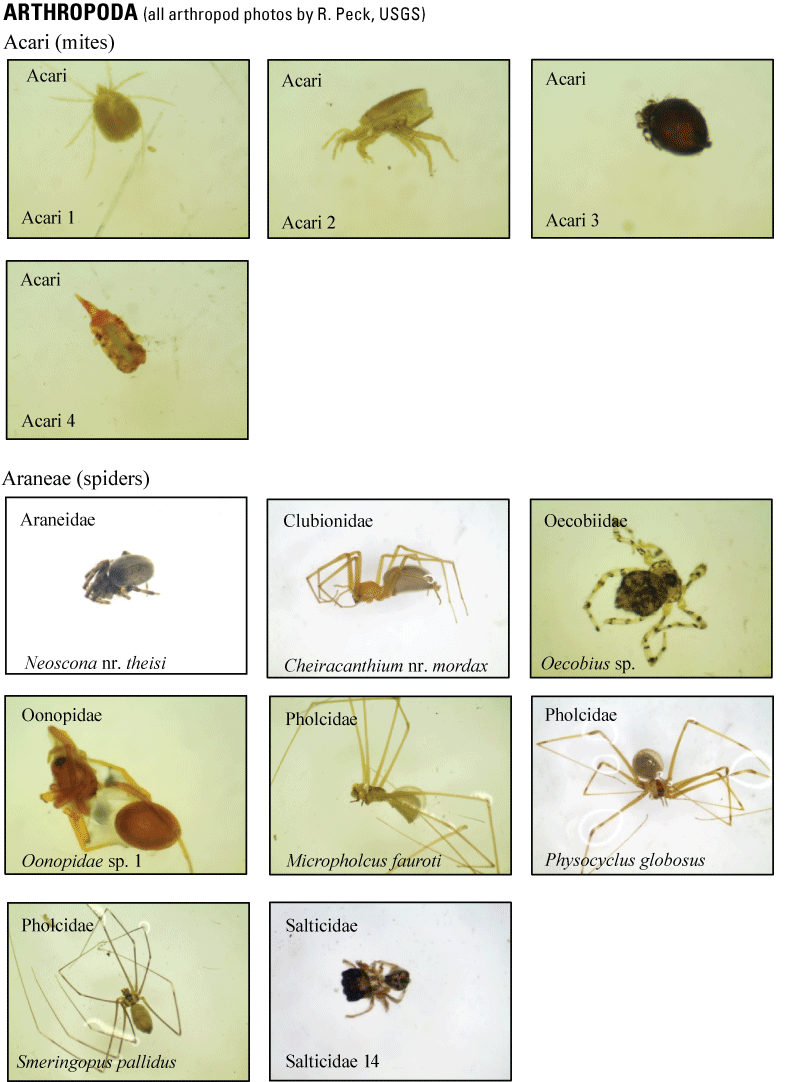
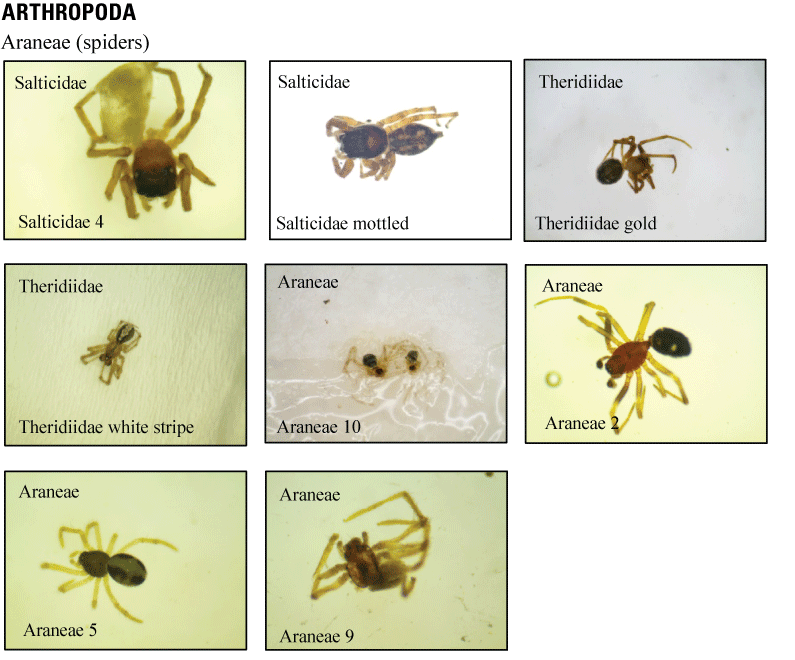
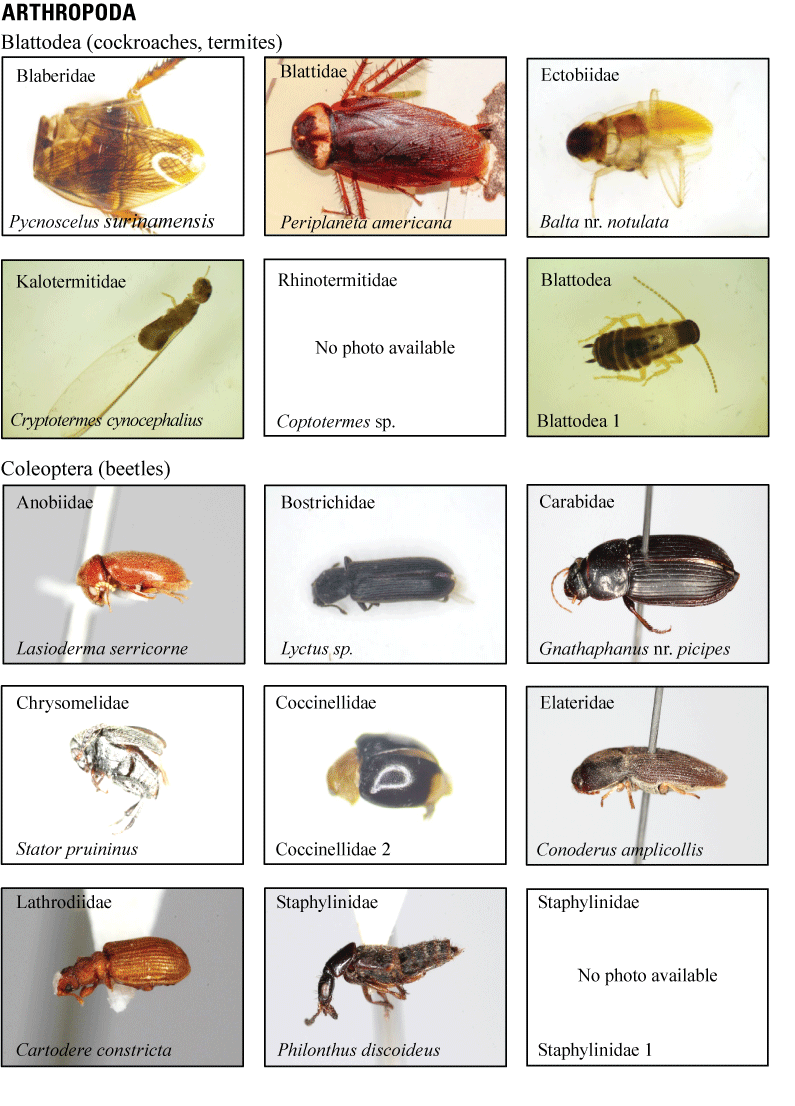
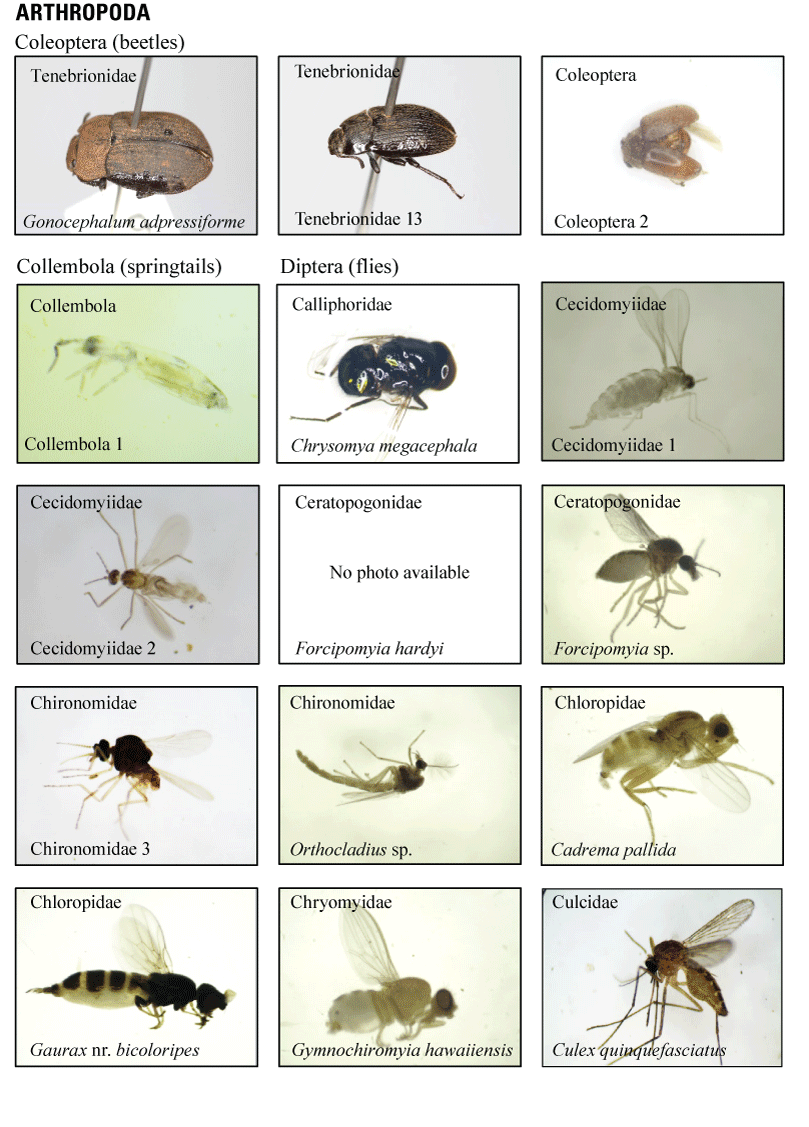
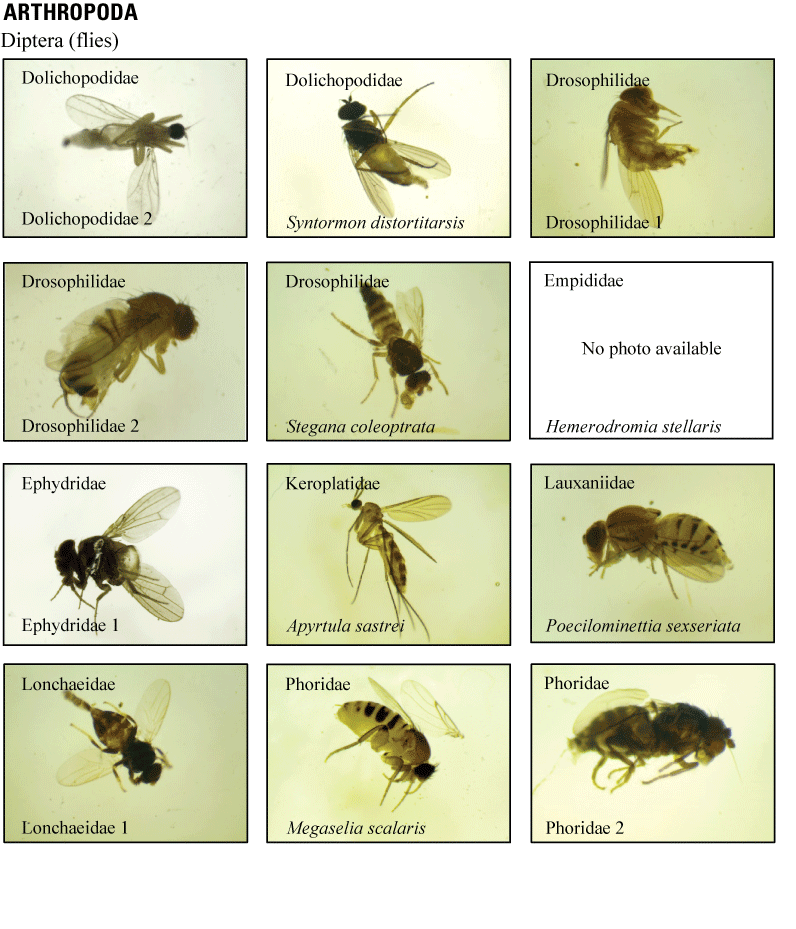
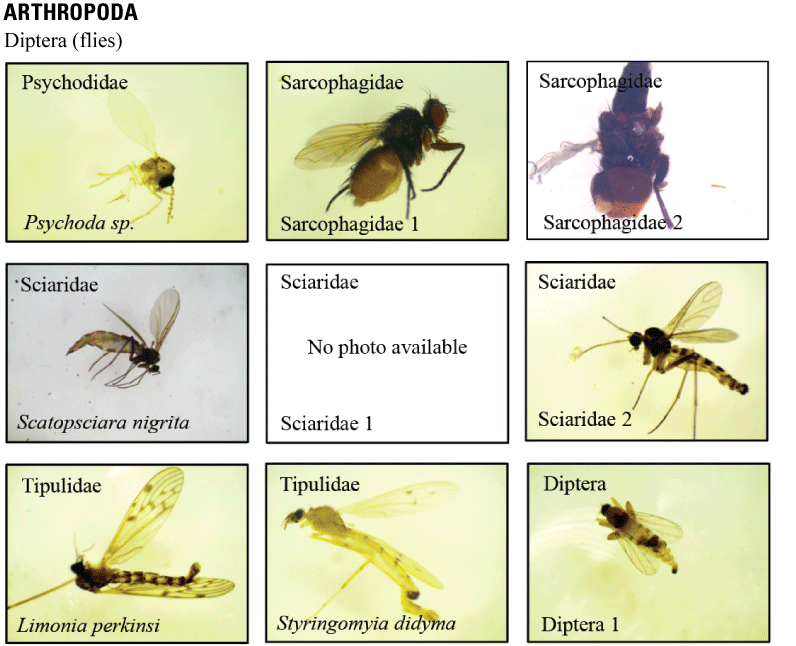
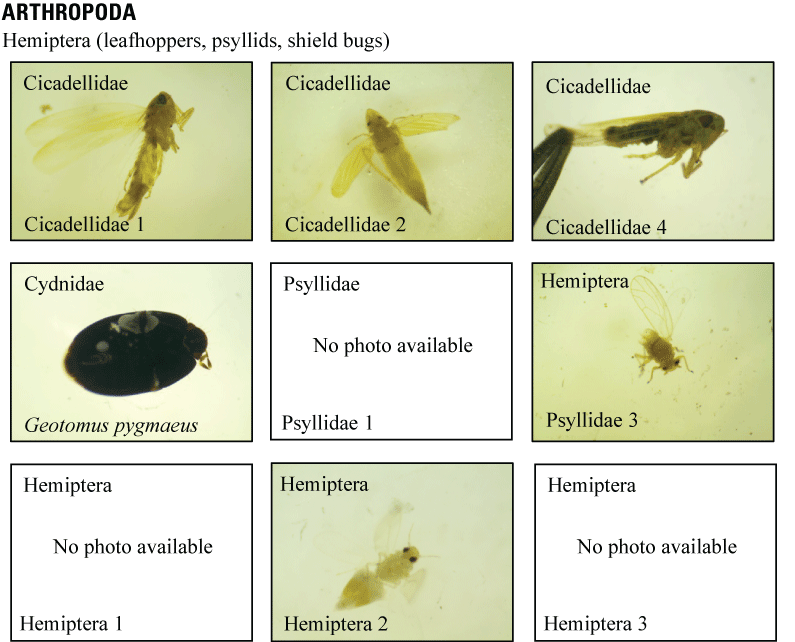
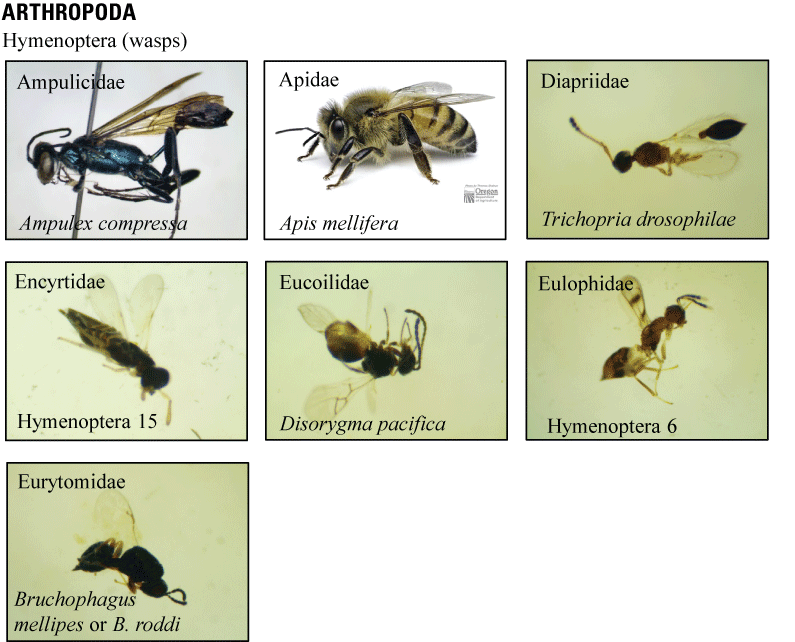
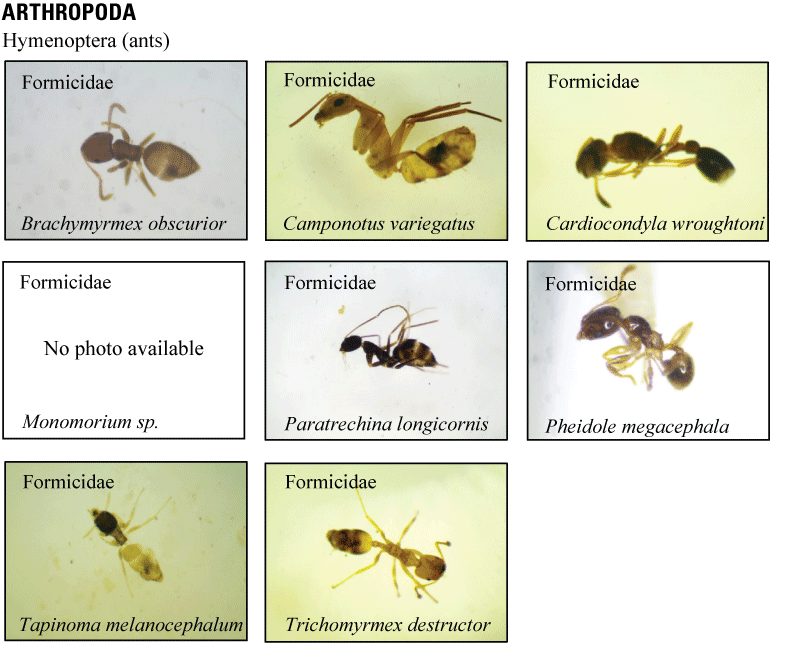
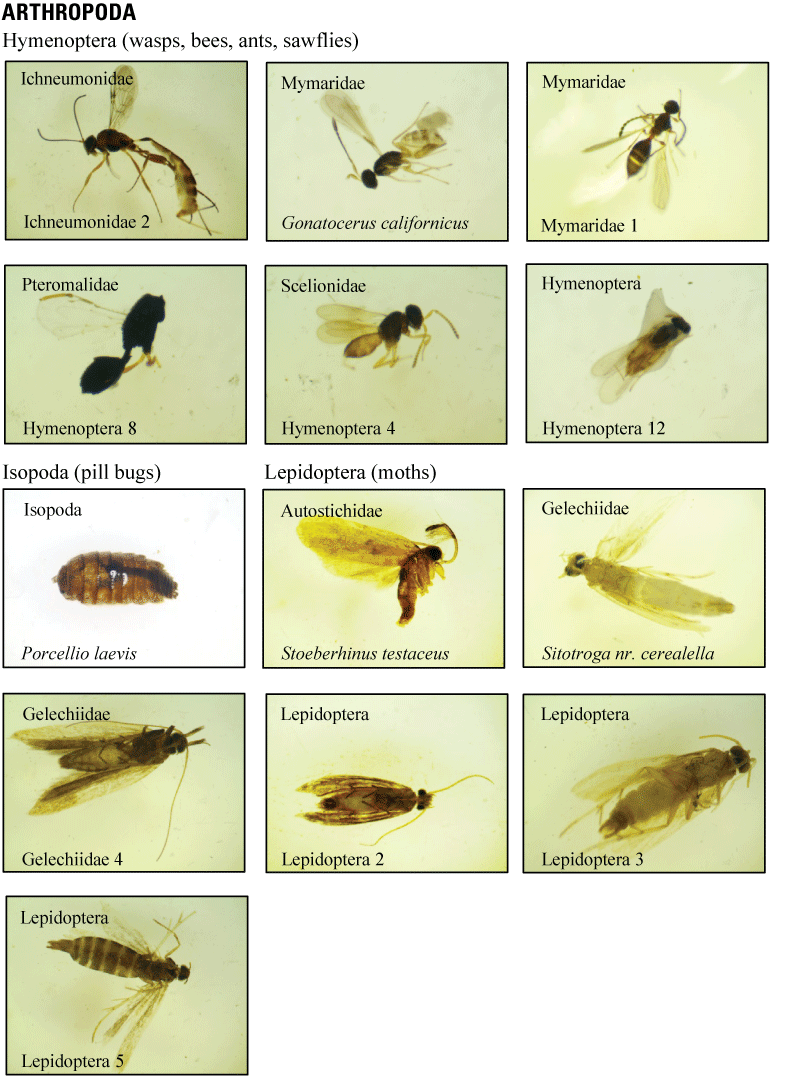
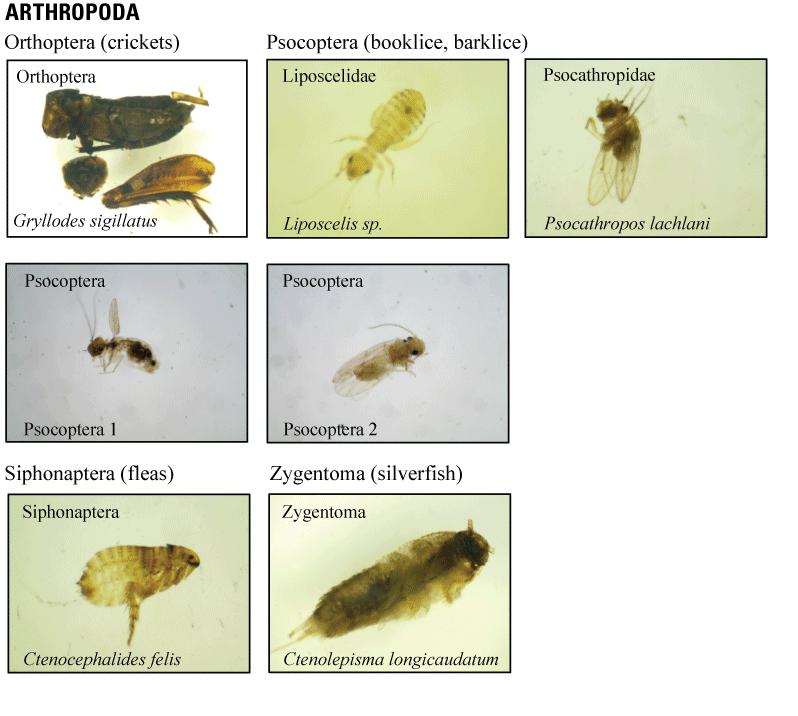
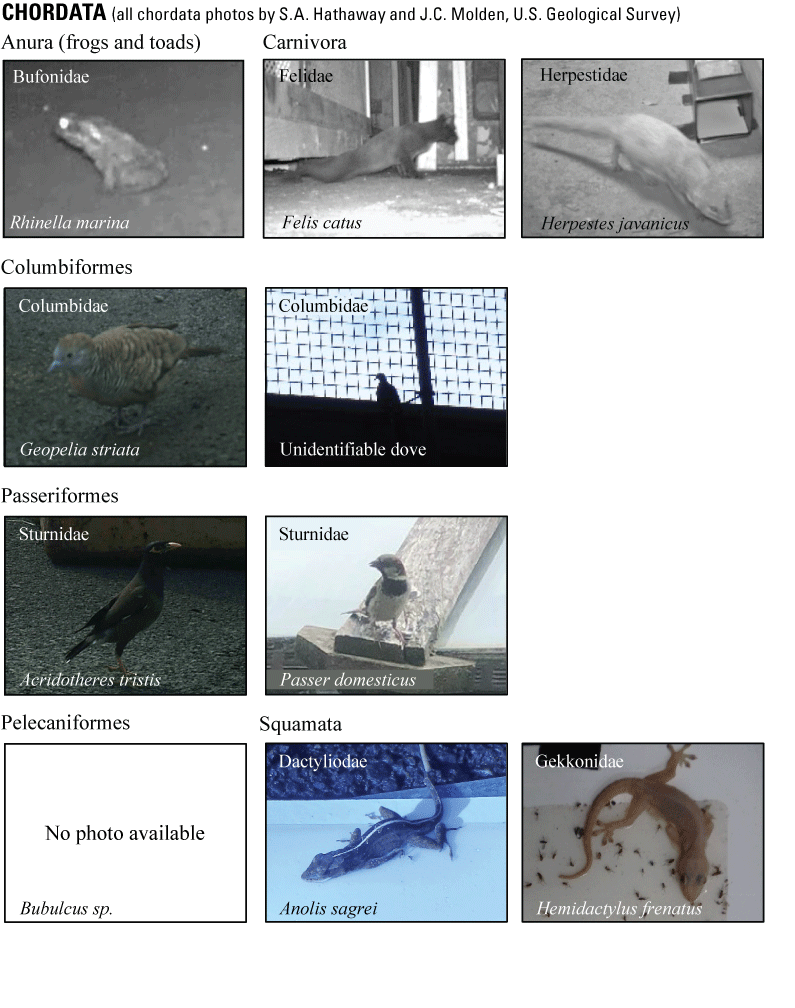
Representative photographs of each species detected during the 2018 Wake Atoll Vessel Movement Biosecurity Program Efficacy Evaluation.
Appendix 3. Representative Photographs of Shipping Container Integrity Issues Detected During 2018 Wake Atoll Vessel Movement Biosecurity Program Efficacy Evaluation
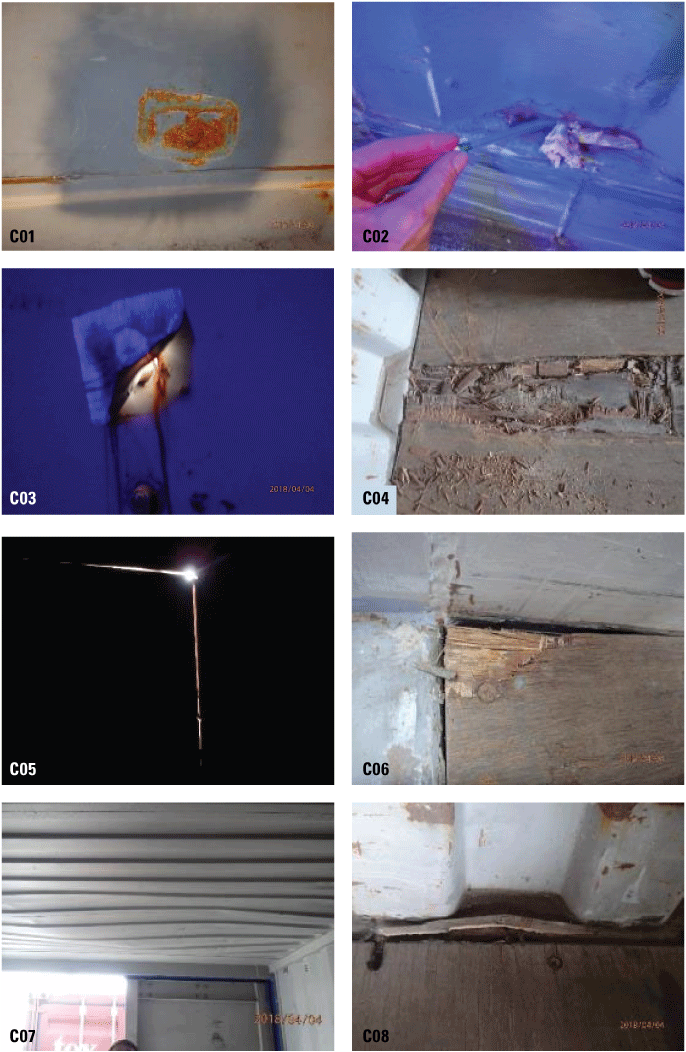
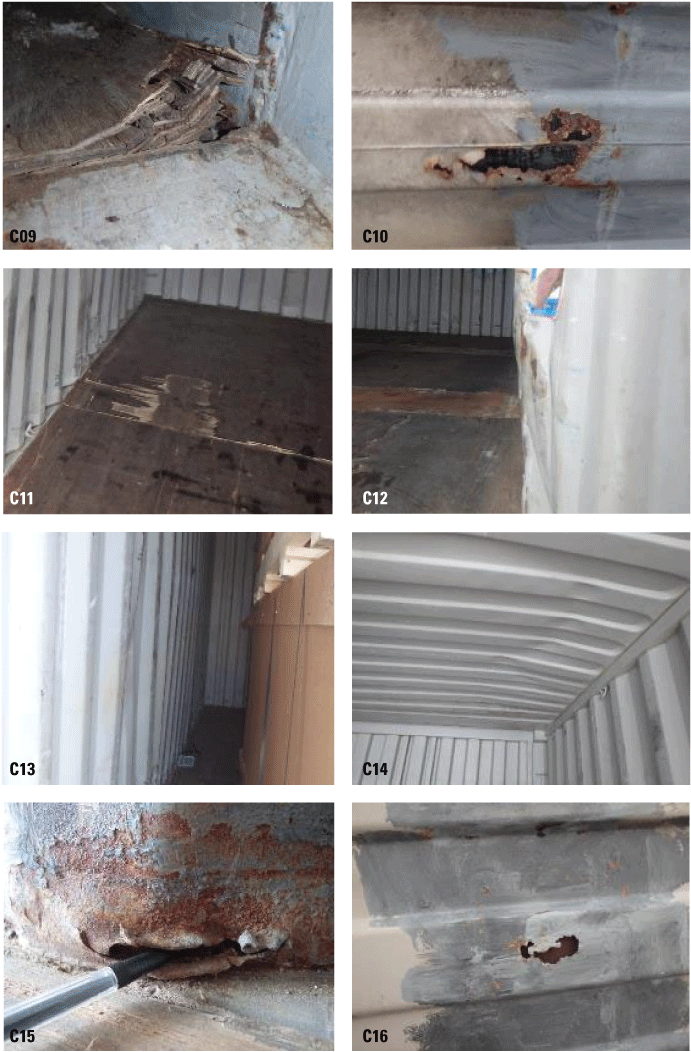
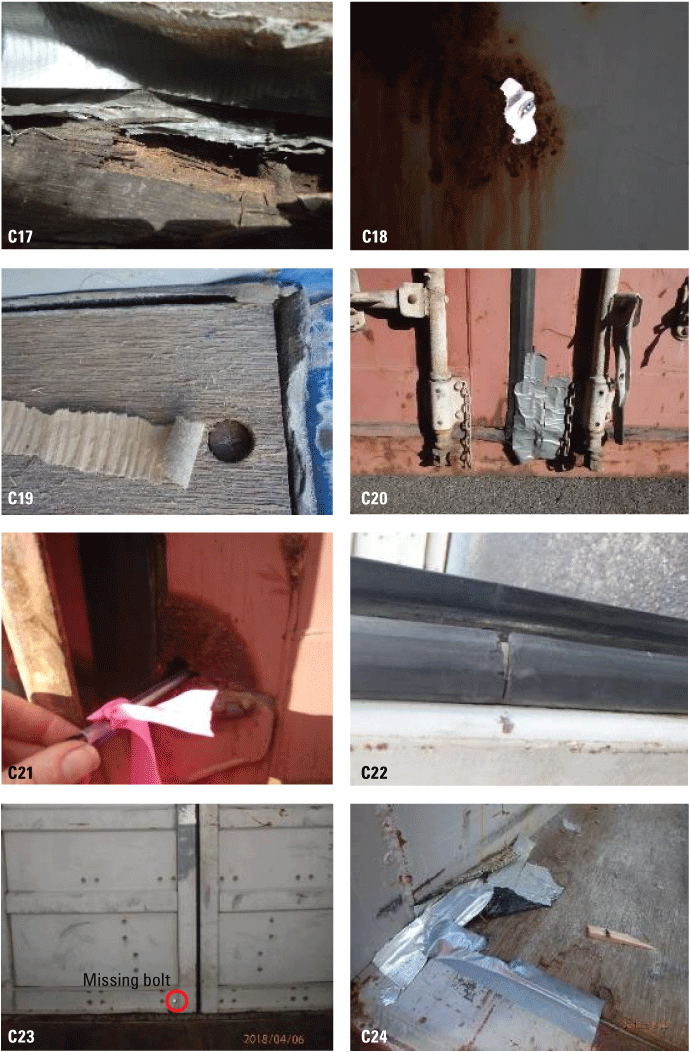
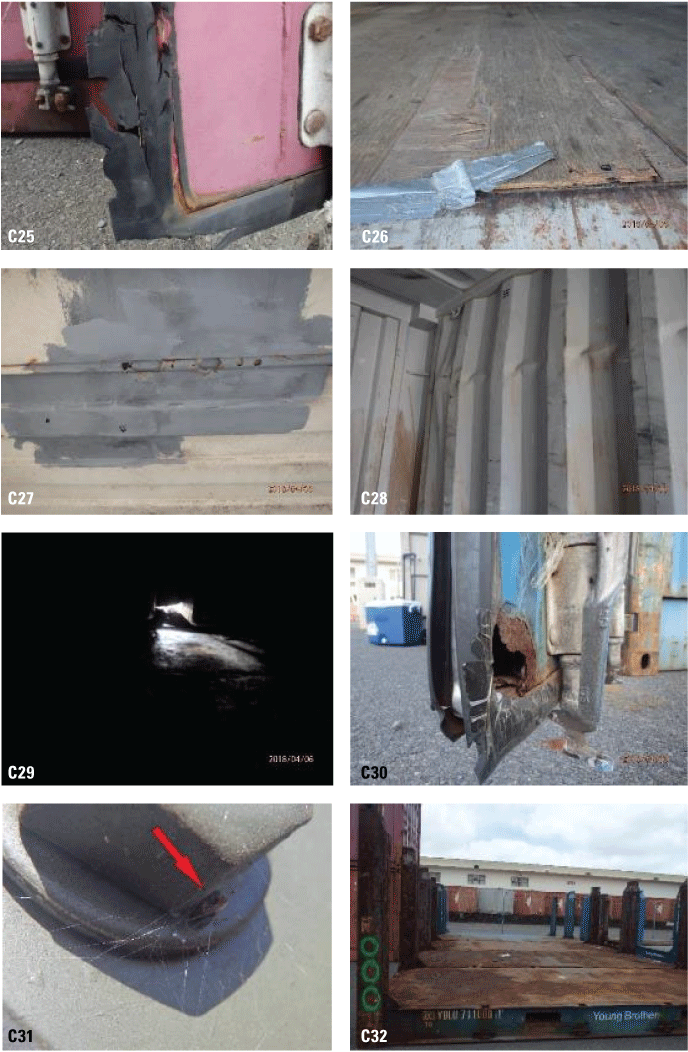
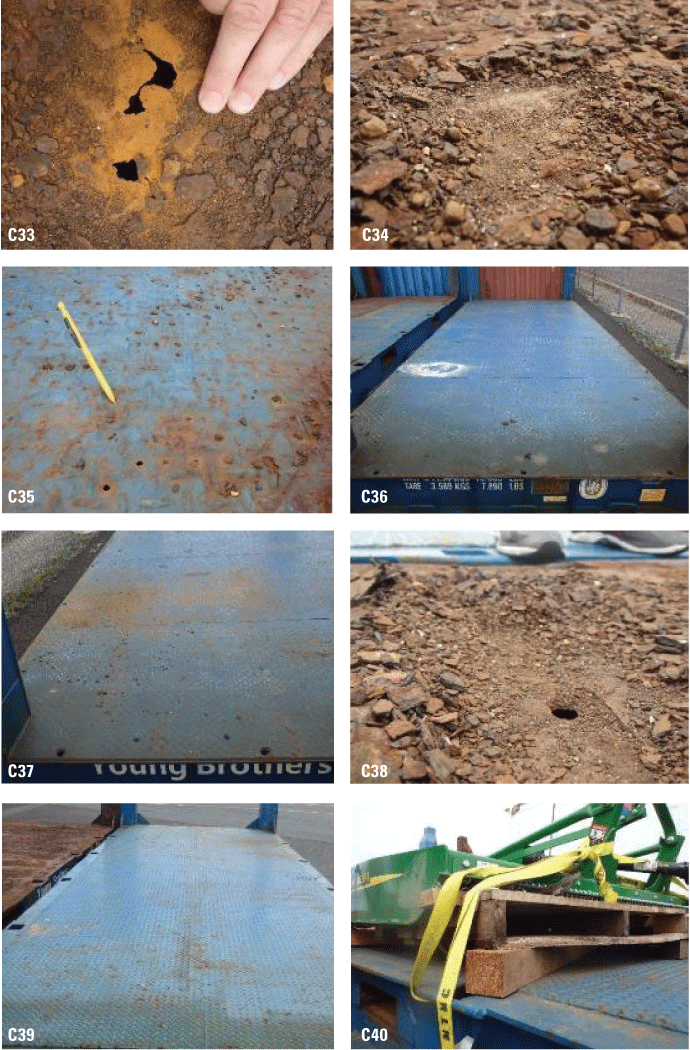
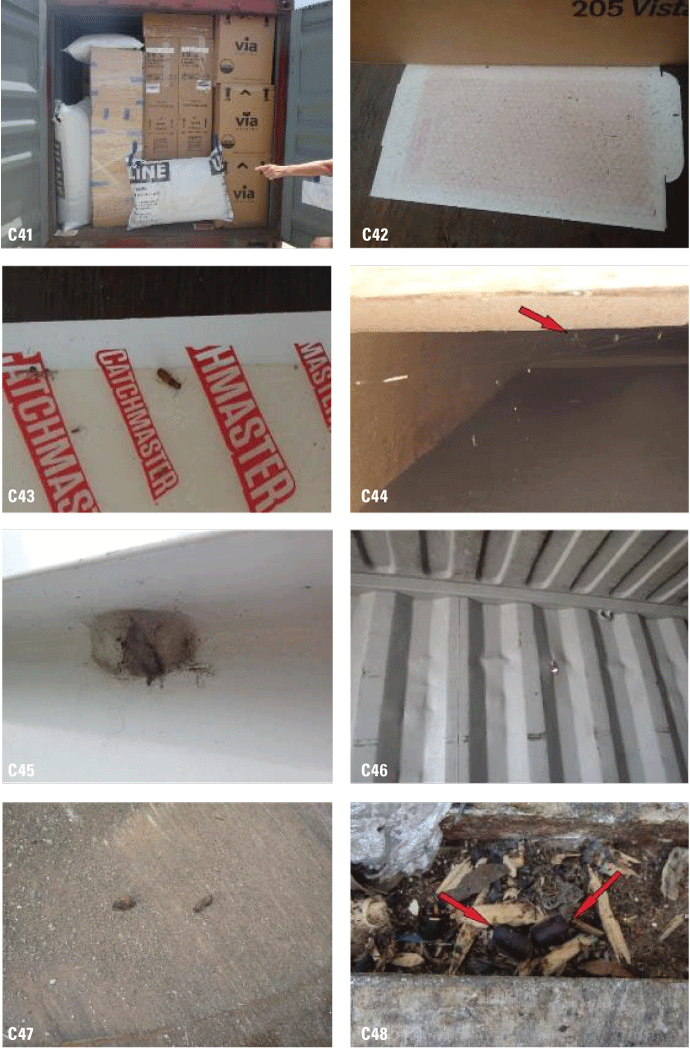
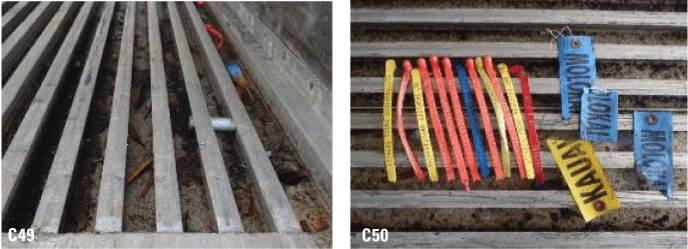
A photograph representing each container inspected (C01–C50) is included: (C01) A failing patch on container ceiling. (C02) Hole in container side stuffed with a wet shipping invoice. (C03) Holes rusted through container door. (C04) Wood damage on container floor. (C05) Gap in container door seal. (C06) Gap in container floor. (C07) Buckled container ceiling. (C08) Gap in container floor with peeling caulk and missing floor bolt. (C09) Warping of container floor and missing floor bolt. (C10) Holes rusted through container ceiling. (C11) Damage to container floor and buckled container wall. (C12) Buckled container wall. (C13) Buckled container wall. (C14) Buckled container ceiling. (C15) Hole in container wall. (C16) Hole rusted through container ceiling. (C17) Hole between damaged container floor and container wall patched with duct tape. (C18) Hole through container door. (C19) Gap in container floor. (C20) Damaged container door seal patched with duct tape. (C21) Hole in container door. (C22) Crack in container door seal. (C23) Container door missing bolt. (C24) Gap in container floor with peeling duct tape. (C25) Damaged container door seal. (C26) Gap in container floor. (C27) Holes in container ceiling. (C28) Buckled container wall. (C29) Gap in container door. (C30) Hole rusted through container door. (C31) Fuel truck chassis with spider in web. (C32) Flat racks with loose rust and debris on deck. (C33) Holes rusted through flat rack deck. (C34) Layer of dirt (or soil) and debris on flat rack deck. (C35) Holes rusted through flat rack deck. (C36) Flat rack deck which harbored seeds and cobwebs. (C37) Debris on flat rack deck. (C38) Hole rusted through flat rack deck under approximately 2.5 centimeters loose rust and debris. (C39) A flat rack in relatively good condition. (C40) Mower deck secured with old lumber on flat rack. (C41) A Missile Defense Agency (MDA) container on Wake with two glue boards and a desiccant packet but no rodent bait station or pest strip visible. (C42) An MDA container on Wake with the glue board not set (protective film still attached). (C43) Insects captured on an MDA container glue board. (C44) A spider living within an MDA container pallet. (C45) A jumping spider (Salticidae family) within silk shelter on the hazardous materials container. (C46) Hole and buckling in container wall. (C47) Animal droppings in a Chugach container on Wake designated to go back to Hawai`i. (C48) Dirt (or soil) and debris build up on reefer floor, including Periplaneta sp. (cockroach) oothecae (egg masses within a protective covering). (C49) Dirt (or soil) and debris build up on reefer floor. (C50) Shipment seals and tags observed within reefer indicated at least 12 movements to 3 or more islands (Kaua`i, Molokai, and O`ahu) without being cleaned before it was sent to Wake Atoll. All photographs by Stacie A. Hathaway, U.S. Geological Survey.
Appendix 4. Rodent Inspection Certification for Wake Island Air Field Resupply Barge Spring 2018
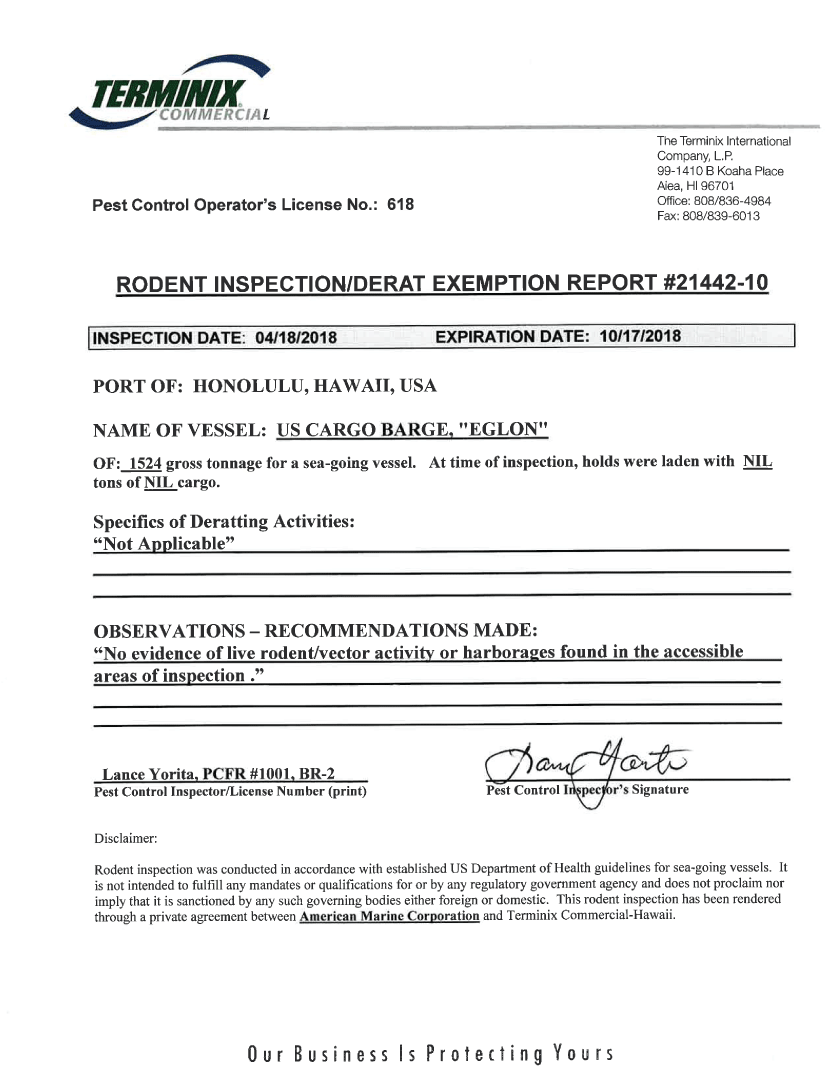
Rodent inspection/derat exemption report #21442-10.
Appendix 5. Rodent Inspection Certification for Wake Island Air Field Resupply Tug Spring 2018
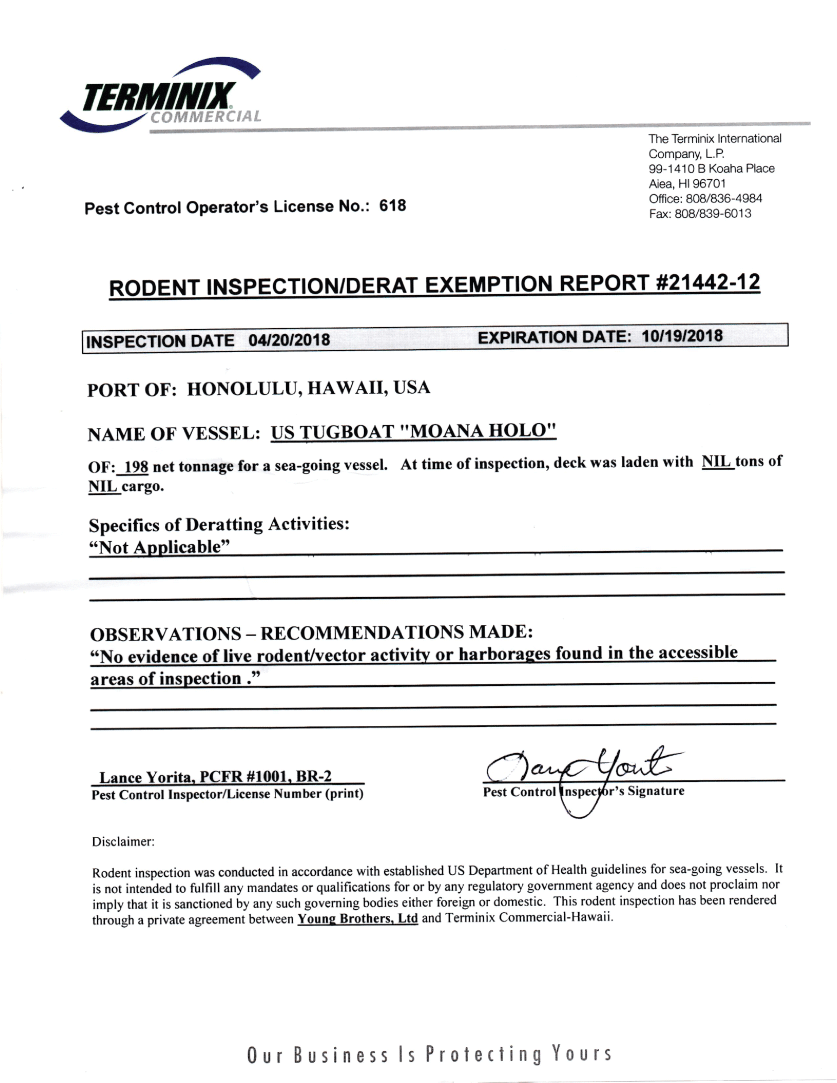
Rodent inspection/derat exemption report #21442-12.
Appendix 6. Example Empty Container Inspection Datasheet
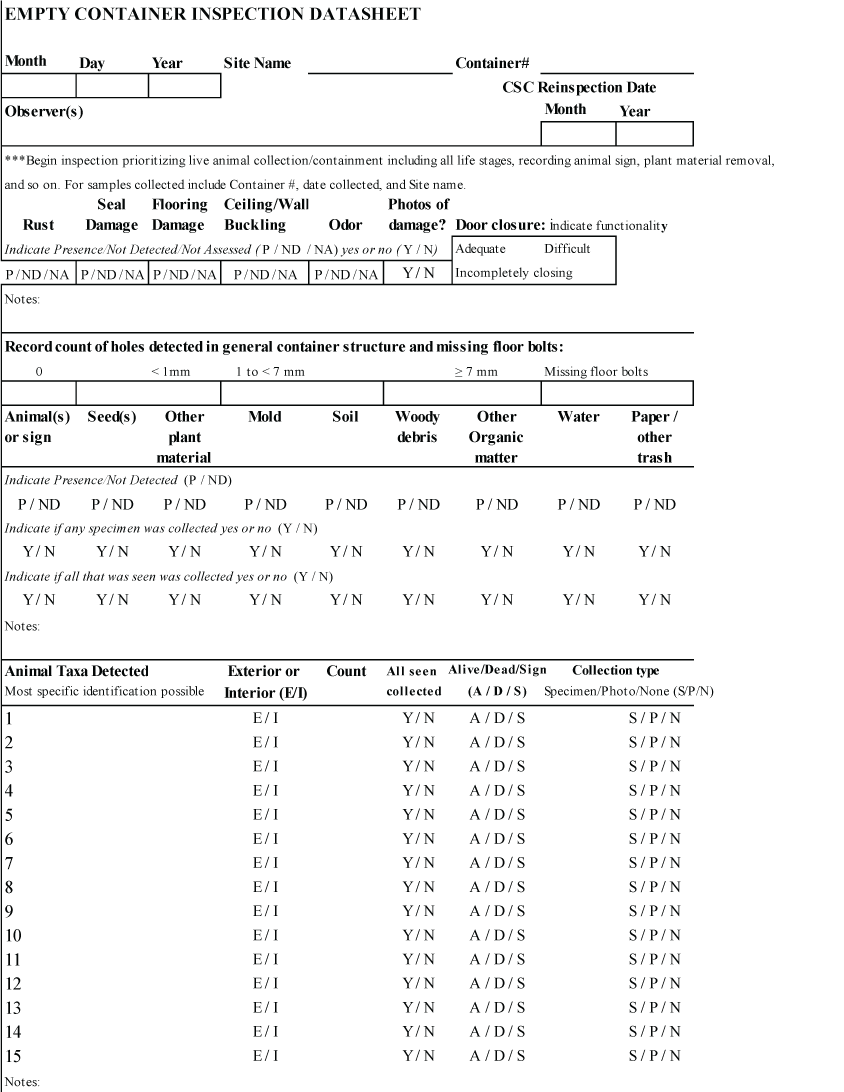
Empty container inspection datasheet.
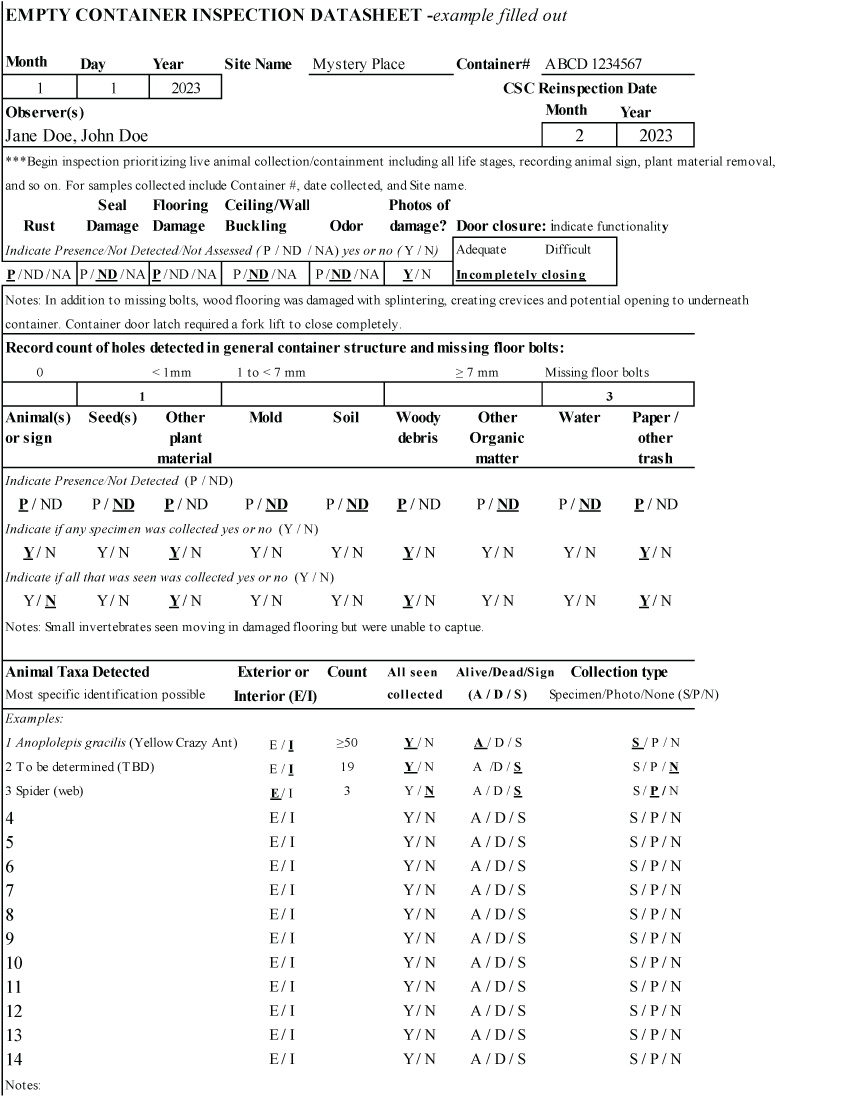
Empty container inspection datasheet, example filled out.
Conversion Factors
International System of Units to U.S. customary
Temperature in degrees Celsius (°C) may be converted to degrees Fahrenheit (°F) as follows:
°F = (1.8 × °C) + 32.
Abbreviations
BOS
base operating support
CSC
Convention for Safe Containers
cTmax
critical thermal maximum
IMO
International Maritime Organization
INRMP
Integrated Natural Resources Management Plan
IPM
Integrated Pest Management
JBPHH
Joint Base Pearl Harbor–Hickam
MDA
Missile Defense Agency
NAVSUP
Naval Supply Systems Command
USAF
United States Air Force
USGS
United States Geological Survey
UTC
Universal Time Coordinated
VES
visual encounter survey
W1
Warehouse 1
W2
Warehouse 2
For more information concerning the research in this report, contact the
Director, Western Ecological Research Center
U.S. Geological Survey
3020 State University Drive East
Sacramento, California 95819
https://www.usgs.gov/centers/werc
Publishing support provided by the U.S. Geological Survey
Science Publishing Network, Sacramento Publishing Service Center
Disclaimers
Any use of trade, firm, or product names is for descriptive purposes only and does not imply endorsement by the U.S. Government.
Although this information product, for the most part, is in the public domain, it also may contain copyrighted materials as noted in the text. Permission to reproduce copyrighted items must be secured from the copyright owner.
Suggested Citation
Hathaway, S.A., Molden, J.C., Peck, R., Rex, K.R., Brehme, C.S., Black, T., and Fisher, R.N., 2025, Wake Atoll vessel movement biosecurity program efficacy: U.S. Geological Survey Open-File Report 2025–1026, 130 p., https://doi.org/10.3133/ofr20251026
ISSN: 2331-1258 (online)
Study Area
| Publication type | Report |
|---|---|
| Publication Subtype | USGS Numbered Series |
| Title | Wake Atoll vessel movement biosecurity program efficacy |
| Series title | Open-File Report |
| Series number | 2025-1026 |
| DOI | 10.3133/ofr20251026 |
| Publication Date | July 08, 2025 |
| Year Published | 2025 |
| Language | English |
| Publisher | U.S. Geological Survey |
| Publisher location | Reston, VA |
| Contributing office(s) | Western Ecological Research Center |
| Description | x, 130 p. |
| Other Geospatial | Wake Atoll |
| Online Only (Y/N) | Y |