Shallow Geologic Framework of the Mississippi Sound and the Potential for Sediment Resources

Scientific Investigations Report 2025-5100
Prepared in cooperation with the U.S. Army Corps of Engineers, Mobile District
By:  and 

Links

  • Document: Report (12.9 MB pdf) , HTML , XML
  • Related Works:
    • USGS Data Series 1047 - Digitized analog boomer seismic-reflection data collected during U.S. Geological Survey cruises Erda 90-1_HC, Erda 90-1_PBP, and Erda 91-3 in Mississippi Sound, June 1990 and September 1991
    • USGS Data Series 724 - Archive of Digital Chirp Subbottom Profile Data Collected During USGS Cruise 10BIM04 Offshore Cat Island, Mississippi, September 2010
    • USGS Data Series 611 - Archive of Digital Chirp Subbottom Profile Data Collected During USGS Cruises 10CCT01, 10CCT02, and 10CCT03, Mississippi and Alabama Gulf Islands, March and April 2010
    • USGS Data Series 620 - Archive of Digital Chirp Subbottom Profile Data Collected During USGS Cruise 08CCT01, Mississippi Gulf Islands, July 2008
    • USGS Open-File Report 2014-1070 - The shallow stratigraphy and sand resources offshore from Cat Island, Mississippi
    • USGS Data Series 429 - Archive of digitized analog boomer seismic reflection data collected from the Mississippi-Alabama-Florida Shelf During cruises onboard the R/V Kit Jones, June 1990 and July 1991
    • USGS Open-File Report 2011-1173 - The Shallow Stratigraphy and Sand Resources Offshore of the Mississippi Barrier Islands
  • Data Release: USGS Data Release - Archive of Digitized Analog Boomer Seismic Reflection Data Collected during USGS Cruise USFHC in Mississippi Sound and Bay St. Louis, September 1989
  • NGMDB Index Page: National Geologic Map Database Index Page
  • Download citation as: RIS | Dublin Core

Acknowledgments

This study is part of the U.S. Army Corps of Engineers, Mobile District (USACE-Mobile) intra-agency agreement 19MNGJFA00928 “Literature and Data Review, Synthesis, and Resource Assessment, Mississippi Sound.” The intent of the study is to provide information about sediment resources within the Mississippi Sound that could be utilized for coastwide beach and dune projects. The authors would like to thank project collaborators Julie McGuire (USACE-Mobile) and Valerie Morrow (USACE-Mobile) for their assistance, and peer reviewers Nicholas Ferina (Bureau of Ocean Energy Management) and Walter Barnhardt (formerly U.S. Geological Survey [USGS]) for their valuable scientific/editorial reviews, Betsy Boynton (formerly USGS) for her figure conformance and visual identity review, and Michael Deacon and Kimberly Borgnine for their editing review.

Abstract

The Mississippi Sound, an estuarine environment located between the mainland and barrier islands bordering the northern Gulf of America (formerly the Gulf of Mexico), serves as a vital ecosystem for the States of Mississippi and Alabama. Spanning approximately 100 kilometers from east to west and covering 1,400 square kilometers, the sound is home to marine industry and ports, and its shallow and brackish waters sustain a diverse array of marine life. Barrier islands along the southern edge of the sound separate the microtidal estuary from the Gulf of America. This protection from gulf wave action mediates current flow within the sound, resulting in predominantly fine-grained sediment deposition along the seafloor. This study, conducted by the U.S. Geological Survey in cooperation with the U.S. Army Corps of Engineers, provides insight on fluvial and tidal processes spanning the past 5,000 years. The report synthesizes existing research to provide a comprehensive overview of the sound geology, from Pleistocene origins to present-day morphology, and utilizes high-resolution single channel seismic profiles and sediment data to identify and map sedimentary deposits and morphologic features at and below the seafloor. Despite its ecological significance, the Mississippi Sound faces environmental challenges, including water-quality issues, habitat degradation, storm-induced erosion, and the ongoing threats of sea-level rise and environmental changes. This study uses the present-day understanding of the sound's geology to inform coastal management decisions, hazard assessment, and potential mineral resources.

Introduction

The Mississippi Sound is an estuarine environment separated from the northern Gulf of America (formerly the Gulf of Mexico) by a chain of barrier islands. The waterbody is bordered to the north by the States of Mississippi and Alabama, and merges to the east and west with Mobile Bay and Lake Borgne, respectively (fig. 1). The sound spans approximately 100 kilometers (km) from east to west and encompasses an area of approximately 1,400 square kilometers. The five barrier islands that enclose the Mississippi Sound on the seaward side are Dauphin, Petit Bois, Horn, Ship, and Cat Islands. Except for Dauphin Island, the barrier islands are part of the Gulf Islands National Seashore. Large inlets between the islands provide connectivity between the gulf and sound.
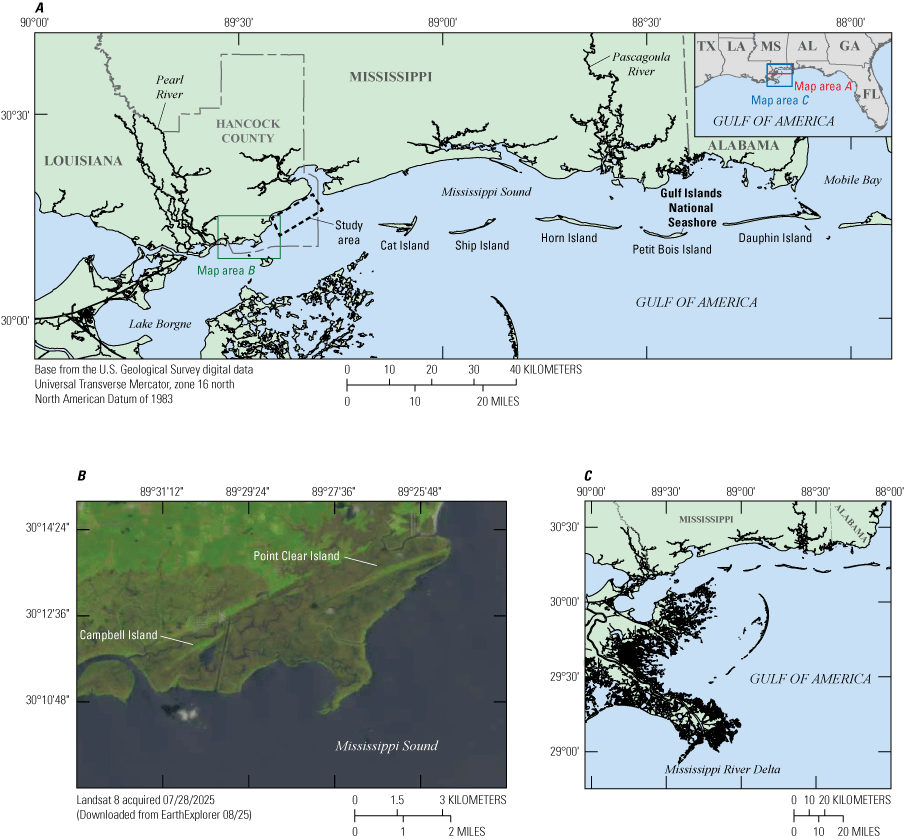
Northern Gulf of America coast from Louisiana to Alabama just north of a west-to-east
                     chain of barrier islands.
Figure 1.

A. Map showing the Mississippi Sound and surrounding features discussed in this study. The study area where sediment deposits are identified and evaluated is shown just offshore of Hancock County, Mississippi. B. Inset map showing an enlarged view of antecedent barrier island systems preserved on Point Clear Island and Campbell Island. C. Inset map showing the Mississippi River Delta located south of the study area.

Other than tidal and shipping channels, the bathymetry within the Mississippi Sound is shallow, with water depths typically less than 5 meters (m) (fig. 2). The water is generally brackish (Priddy and others, 1955), with freshwater supplied to the sound from major waterways such as the Pascagoula and Pearl Rivers (fig. 1). The critical blend of freshwater and saltwater within the sound creates a diverse and ecologically rich environment that supports a wide variety of marine life. Important aquaculture operations include shrimp and oyster harvesting, and the sound supports marine industries such as commercial/recreational fishing and maritime shipping.
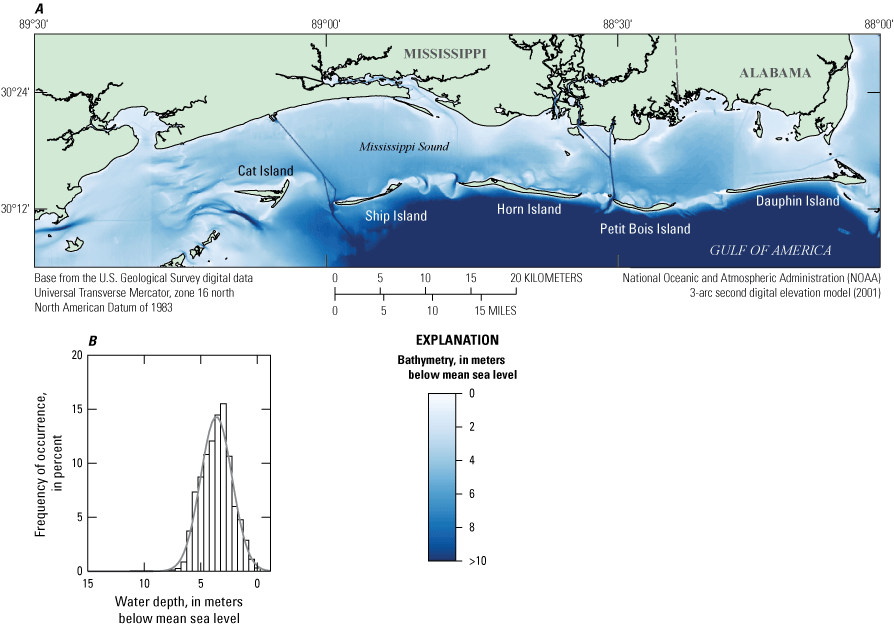
Water depth is mostly less than 5 meters within the Mississippi Sound and deeper south
                     of the barrier islands.
Figure 2.

A. Map showing a digital elevation model of the Mississippi Sound and surrounding area, with water depths and land elevations provided. B. Inset graph showing the frequency of occurrence by depth of 5-meter cells within the sound, indicating that 80 percent of the sound is less than 5 meters deep.

The geology of the Mississippi Sound region is influenced by a complex interplay of sea-level fluctuations, fluvial and deltaic processes, and barrier island evolution. The present-day morphology of the sound reflects a geologic history that extends back to the Pleistocene, when sea-level fluctuations drove fluvial processes that both eroded and deposited sediments across the region. The modern barrier islands (fig. 1) developed toward the end of the last sea-level transgression (Otvos, 2001). These islands provide critical habitat for the diverse flora and fauna of the area.

The stratigraphy offshore of Hancock County, Mississippi (fig. 1), reflects the dynamic evolution of the sound and barrier island systems. Using high-resolution single channel seismic profiles (HRSPs) and sediment vibracore data, the U.S. Geological Survey (USGS) in cooperation with the U.S. Army Corps of Engineers (USACE), identified numerous features below the modern seafloor that are related to fluvial and tidal processes occurring during the last 5,000 years. For this study, seismic descriptions and core interpretations were analyzed for these features, where available. Deposits that provide the potential for sediment resources (for example, sand for coastal nourishment) were mapped for spatial extent and volume. Lastly, a coring strategy is provided to further investigate these features to determine their sedimentary characteristics.

The Mississippi Sound faces environmental challenges such as water-quality issues, habitat degradation, erosion, and the impact of sea-level rise and climate change (La Peyre and others, 2014; Morgan and Rakocinski, 2022). Efforts to protect and restore the sound's ecosystem are crucial to preserving its ecological and economic value for the region. Understanding the geology is crucial for informing coastal management decisions, hazard assessment and mitigation, and identifying potential mineral resources. The literature review completed for this study aims to provide a comprehensive overview of the geology of the Mississippi Sound by synthesizing existing research and data to identify morphologic features and processes.

Purpose and Scope

This report documents the shallow geologic framework of the Mississippi Sound and the potential for sediment resources. The literature review herein provides an outline of the Pleistocene and Holocene geology, the evolution of the Mississippi barrier islands, and the marine habitats and morphologic features within the sound. Existing reports and scientific journal articles pertaining to the geology, morphology, geography, physical processes (sediment transport, hydrology, oceanography), management, physical assessment (sediment type, biology), and habitat associated with the Mississippi Sound are provided in appendix 1. Geologic data, such as seismic data, sediment cores, and structure and elevation maps, are also identified and synthesized.

Methodology

To compile existing literature specific to the study area, search resources from the USGS library catalog were used, and more than 80 articles were identified. For each article, a list of keywords that summarize content was created and is provided in text format in appendix 1.

All HRSP data holdings acquired within the Mississippi Sound and archived by the USGS in St. Petersburg, Florida, are shown in figure 3. This dataset contains seismic data collected from 1980 to 2010 in various analog (paper prints) and digital (image) formats. The analog HRSP, formerly “boomer” data archived as paper rolls and fan-folds, has been converted to digital format, and both the former analog and existing digital data have been published in USGS series publications and data releases (Sanford and others, 2009; Forde and others, 2011a, b, 2012; Bosse and others, 2017).
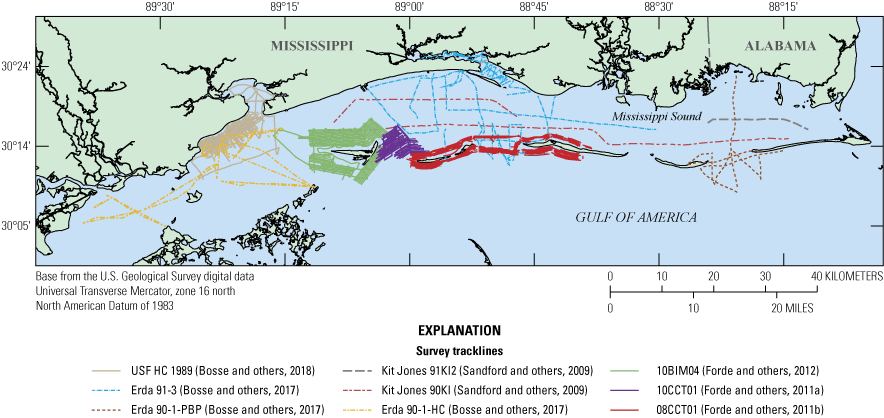
Tracklines of nine different surveys cover the Mississippi Sound south of Mississippi
                     and Alabama.
Figure 3.

Map showing location of high-resolution single channel seismic profile data collected in the Mississippi Sound between 1980 and 2010 and archived by the U.S. Geological Survey at St. Petersburg, Florida. Data from Sanford and others (2009), Forde and others (2011a, b, 2012), Bosse and others (2017, 2018).

A key geologic horizon within the sound, the Pleistocene-Holocene surface is relevant to regional morphologic evolution and sediment resource assessment. This unconformable surface is traceable continuously in subbottom profiles across the region and represents the last sea-level lowstand. It has been identified and mapped in four previous studies (Hollis, 2018; Adcock, 2019; Gal and others, 2021; Peoples, 2022). For this study, a regional Pleistocene surface was integrated from these efforts and is discussed in the following section.

Offshore of Hancock County in the northwestern area of the Mississippi Sound (fig. 4), HRSP data were used to identify the acoustic stratigraphy. Approximately 225-line km of HRSP data were scanned from paper copies archived at the USGS in St. Petersburg, Fla., converted to industry standard Society of Exploration Geophysicists Y Format (SEG-Y) (Barry and others, 1975), and published as a USGS data release (Bosse and others, 2018). For this study, the data were entered into seismic-data interpretation software (OpendTect version 7.0, https://dgbes.com), along with the National Oceanic and Atmospheric Administration’s National Geophysical Data Center (NGDC) bathymetric digital elevation model (NGDC, 2010), to develop a three-dimensional visualization cube (fig. 5). The HRSP lines were resampled to the bathymetric grid to align the lines to a common vertical datum, specifically the North American Vertical Datum of 1988 (NAVD 88). To ground truth the geophysical data, 81 sediment vibracore and 12 penetrometer logs from within the survey area were recovered from USACE archives and analyzed for use in this study. These logs contain descriptions of stratigraphic units within the upper 9 m of sediment (fig. 6). The depths to the tops of these units were digitized and entered into the visualization cube using the spatial information included in the logs. This process allows for direct correlation of acoustic horizons captured in the seismic data to stratigraphic information derived from the vibracore data.
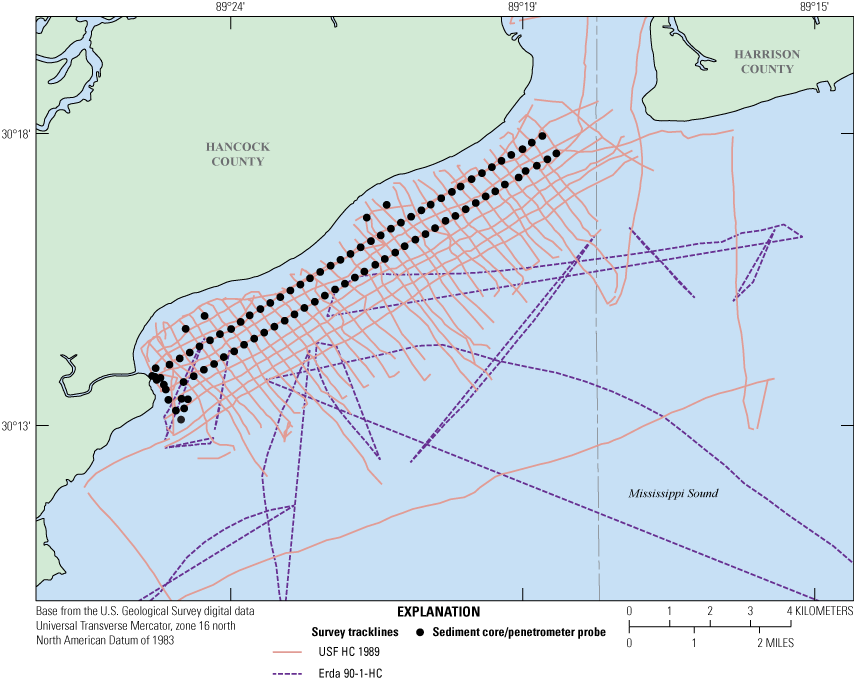
Study area covered by tracklines from two surveys and sediment core sample locations.
Figure 4.

Map showing high-resolution single channel seismic profile tracklines acquired in the Mississippi Sound, offshore of Hancock County, Mississippi, during the USF HC 1989 (Bosse and others, 2018) and Erda 90-1-HC (Bosse and others, 2017) cruises. Sediment vibracores and penetrometer probes collected within the study area were acquired from U.S. Army Corps of Engineers archives (Schmid, 2001). See figure 3 for regional trackline location.
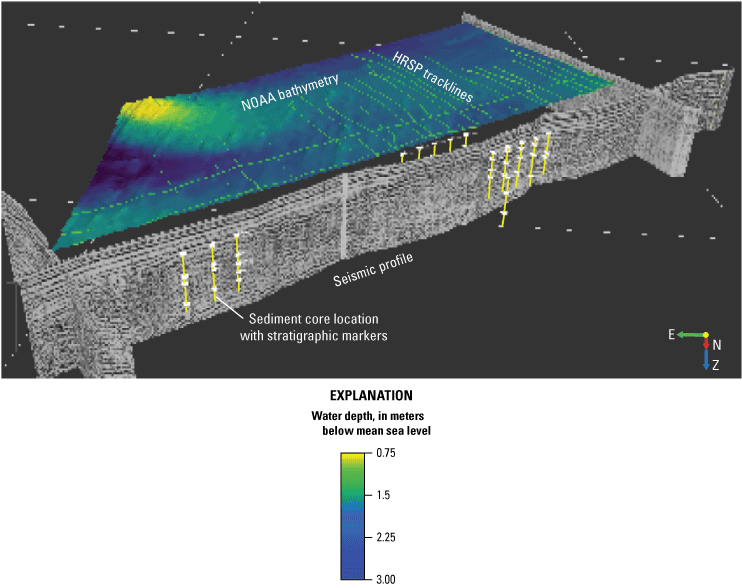
3D cube representing part of study area combines digital seismic profiles and bathymetric
                     Digital Elevation Model.
Figure 5.

Schematic diagram showing the data cube within the OpendTect software visualization environment. The high-resolution single channel seismic profiles (HRSPs) (Bosse and others, 2018) are integrated in three-dimensional space with a National Oceanic and Atmospheric Administration (NOAA) National Geophysical Data Center (NGDC) digital elevation model (NGDC [2010], shown as a spectral overlay) and the stratigraphic marker depths (white discs) from the sediment vibracore logs.
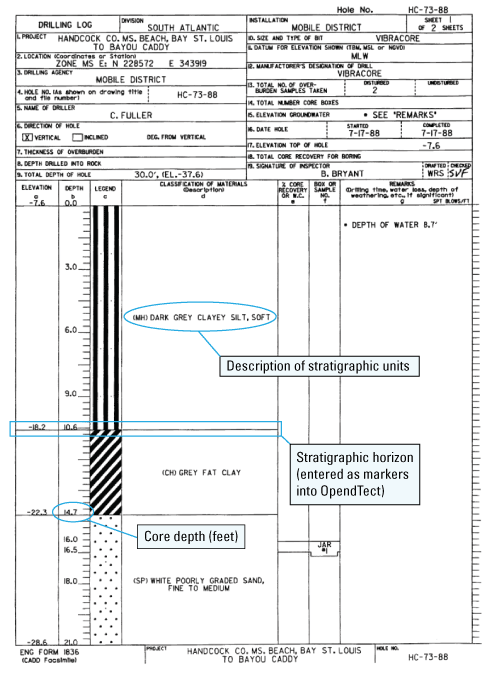
Vibracore survey engineering log containing spatial data, labeled with data types
                     entered in seismic interpretation software.
Figure 6.

Digitized page of engineering log from the vibracore dataset used in this study (Schmid, 2001). The logs contain descriptive information about the core (for example, location and elevation), and describe stratigraphic units by texture (for example, dark grey clayey silt) relative to depth below the seafloor. Spatial data are included in the logs; the spatial data and depth to stratigraphic horizons were digitized and entered into the OpendTect seismic interpretation software.

To properly correlate stratigraphic depths from the core logs to the two-way travel time (TWTT) of acoustic horizons in the HRSP, a velocity analysis was performed on the data where the HRSP overlapped with the core data. It was assumed that a contrast in lithology produces a sharp reflector (significant impedance in the acoustic data displays as an amplitude peak) across the density gradient, in this case the transition from clay to sand, and that the corresponding depth in TWTT and depth to the stratigraphic horizon, in meters, can be used to calculate the sound velocity of the acoustic signal within the sediments. This velocity was used to correlate the HRSPs to the sediment cores. A strong acoustic horizon in the HRSP was identified that correlated to a specific stratigraphic horizon in the core logs (in this case, the transition from a clay unit to a sand unit occurring 3–6 m below the seafloor [mbsf]). The comparison of depth to the acoustic reflector and depth to the stratigraphic horizon between the HRSP and sediment cores is shown in table 1.

Table 1.    

Comparison between depth to a well-defined acoustic horizon in high-resolution single channel seismic profiles (HRSPs) (Bosse and others, 2018) and stratigraphic horizons in sediment cores (Schmid, 2001).

[It is assumed that a contrast in lithology produces a sharp reflector across the density gradient, in this case the transition from clay to sand, and that the corresponding depth in two-way travel time (TWTT) and depth to the stratigraphic horizon, in meters, can be used to calculate the sound velocity of the acoustic signal within the sediments. This velocity is used to correlate the HRSP to the sediment cores. ID, identification; no., number; ms, millisecond; and mbsl, meters below sea level]

HRSP ID line no. Depth to reflector TWTT (ms) Core ID number Stratigraphic transition above/below Depth to horizon (mbsl)
32 6.5 70 Clay-silt/sand 8.1
32 5.3 69 Clay/sandy-clay 6.9
31 6.7 68 Clay/sandy-clay 8.5
31 5.3 67 Clay-silt/sand 5.9
29 7.2 64 Clay/sand 7.7
29 4.6 63 Silty-sand/sand 5.5
28 7.0 62 Clay/sand 8.2
28 4.2 61 Clay/sand 5.5
40 4.9 54 Clay/sand 6.8
38 5.2 53 Clay/sand 6.6
40 7.2 59 Silty-sand/sand 8.4
38 5.1 51 Clay/sand 7.0
38 5.5 49 Clay/sand 6.4
20 4.8 46 Clay/sand 6.7
20 5.2 45 Clay/sand 5.9
38 5.8 43 Clay/sand 6.3
19 4.5 44 Silty-sand/sand 6.6
8 6.2 19 Clay/sand 7.9
36 5.0 77 Clay/sand 6.7
34 5.9 74 Clay-sand/sand 7.4
Table 1.    Comparison between depth to a well-defined acoustic horizon in high-resolution single channel seismic profiles (HRSPs) (Bosse and others, 2018) and stratigraphic horizons in sediment cores (Schmid, 2001).

The TWTT to the reflector for 20 instances was graphed versus the depth of the stratigraphic horizon relative to sound source, which is positioned at the water surface. The cross-plot (fig. 7) produces a best-fit second-order polynomial curve that was used to calculate depth in TWTT, in milliseconds, for depth intervals in 1-m increments over the range of target depths (3–6 mbsf). Using the curve fit to the data rather than direct comparisons reduces water-column sound velocity artifacts and temporal level variations from the downcore depth correlation. The resulting velocities for each depth interval range from 1,161 to 2,471 meters per second (m/s), which are comparable to the expected range (1,491–1,836 m/s) for marine sediments (Hamilton, 1971). The average value of the range (1,878 m/s) was assumed to be the best-fit sound velocity for the sediment column. This velocity was then applied to the stratigraphic depth of the markers that have been entered into the visualization software for correlation with the HRSP.
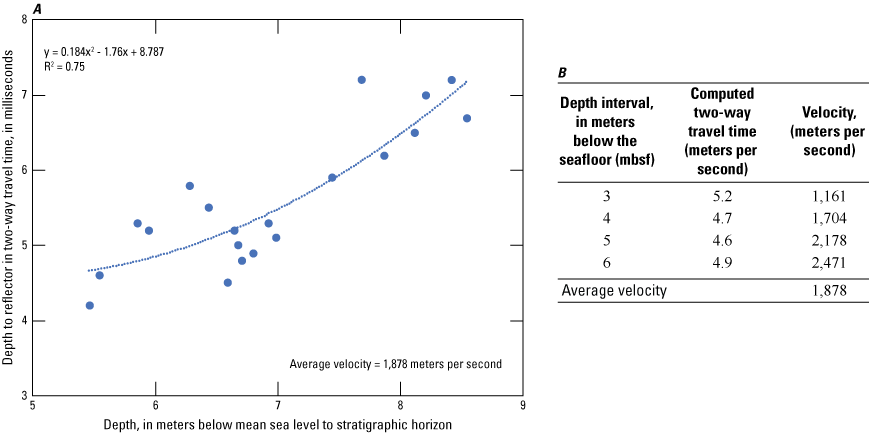
Graph of curve rises from left to right showing that as the water depth increases,
                     the two-way travel time of signal increases.
Figure 7.

Graph showing velocity analysis used to correlate marker depth from the core logs (Schmid, 2001) to two-way travel time (TWTT) in the high-resolution single channel seismic profile (Bosse and others, 2018). A second-order polynomial fit was applied to, A, a cross-plot of acoustic versus stratigraphic horizons. The resulting curve solution was used in, B, the associated table to convert depth, in meters below the seafloor (mbsf), within the correlation range (3–6 meters) to sound velocity in 1-meter increments. The average from the velocity model (1,878 meters per second) was then used in the visualization software to adjust core depth stratigraphic markers provided in mbsf to TWTT.

Once the HRSP and core data were properly aligned in the visualization software, the data were interpreted to characterize the geologic framework within the study area. Where the sediment core data overlapped the HRSP, sedimentary texture was inferred to continue along the profile to the extent of the acoustic horizon. As subsurface sediment deposits were identified, their spatial distribution was mapped and extracted for volumetric analysis. These features are discussed in the analysis section of this study.

Geology of the Mississippi Sound

Pleistocene Deposits

The oldest shallow (< 50 m) stratigraphy in the Mississippi Sound is a series of transgressive and regressive sequences associated with Pleistocene sea-level fluctuations in response to glacial cycles (Anderson and others, 2016; Peoples, 2022). During interglacial periods, when sea level was near its present position, sediments associated with estuarine, deltaic, and shallow marine environments formed the coastal terraces throughout the region (Heinrich, 2006), and deltaic deposits from ancestral rivers infilled areas of the present-day sound. As sea level dropped during glacial periods, these deposits were incised by fluvial systems that meandered across exposed areas of the inner shelf, forming river valleys (Kindinger and others, 1994). As subsequent sea-level rise flooded the region, these deposits were eroded and reworked into expansive sand sheets. The river embayments filled with sediment as bayhead deltas retreated upstream (Bart and Anderson, 2004). When these interglacial and glacial-period deposits are viewed in a seismic profile, the incised valleys form distinct features that are characterized as dipping or chaotic reflectors within a sequence boundary reflector that represents the previous regressive surface (Flocks and others, 2015). The infill deposits are a combination of fluvial channel sands or muds associated with estuarine deposits (Hollis, 2018).

The stratigraphic surface representing the last sea-level lowstand is described in sediment cores as a stiff, oxidized medium gray to orange clay. The oxidized nature is indicative of subaerial exposure during lowstand conditions (Greene and others, 2007). This surface marks the transition from the Pleistocene to Holocene and is readily mapped in seismic profiles (fig. 8). Four studies have mapped the upper surface of the Pleistocene within the sound (Hollis, 2018; Adcock, 2019; Gal and others, 2021; Peoples, 2022). A compilation of the Pleistocene surface mapped in these studies is shown in figure 9. The surface deepens from east to west and seaward and it exhibits a dendritic appearance typical of fluvial systems. Sediments above this horizon represent marine-transgressive and backstepping fluvial depositional processes that occurred during the Holocene.
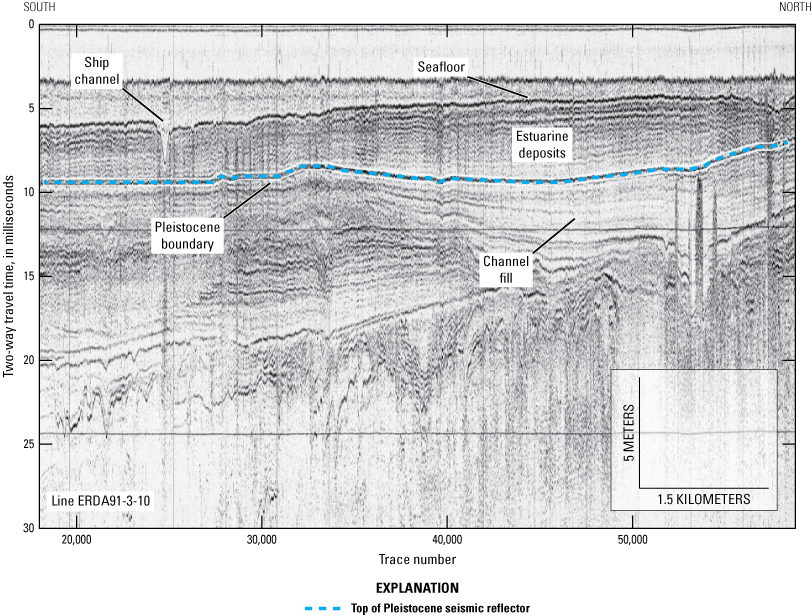
Marine subsurface consists of layered sediments, primarily horizontal shifting layers.
Figure 8.

High-resolution single channel seismic profile (ERDA91-3-10) from the Mississippi Sound. The vertical axis represents profile depth below sea level in terms of time, and the horizontal axis is distance represented by consecutive traces. The profile shows the reflector representing the Pleistocene boundary. Deposits below this horizon include fluvial valley fill, and those above it are composed of Holocene fluvial and estuarine sediments. Location of profile is shown in figure 9.
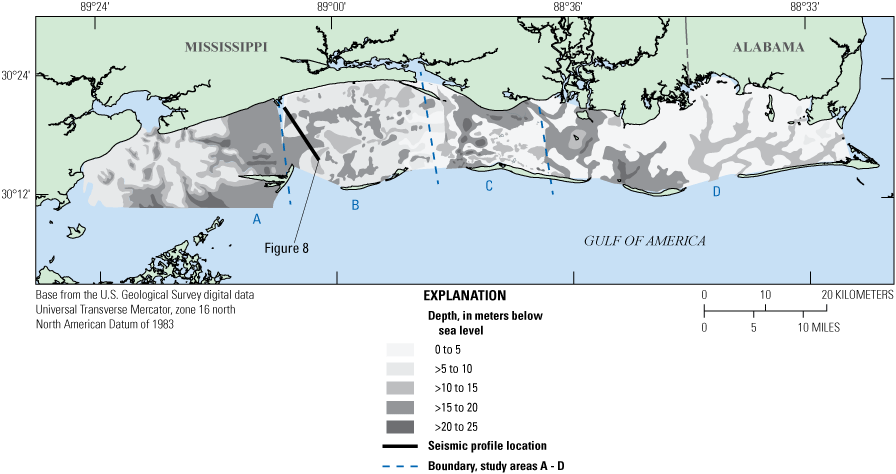
Depth to the Pleistocene level increases westward and seawater.
Figure 9.

Map showing depth to the Pleistocene surface reconstructed from four studies of the Quaternary stratigraphy in the Mississippi Sound, with individual study areas separated by dashed lines. The surface is identified as the (A) Pleistocene-Holocene unconformity in Adcock (2019), (B) paleochannel depth in Peoples (2022), (C) MIS 2 sequence boundary in Gal and others (2021), and (D) MIS 2 lowstand sequence boundary in Hollis (2018).

Holocene Deposits

Sea-level rise during the Holocene eroded the Pleistocene interfluve areas, creating a disconformity between the Pleistocene sequence boundary and subsequent marine deposits. As the Mississippi Sound embayment was initiated, transgressive deposits infilled the Pleistocene paleovalleys. When sea level neared the present position, 4–6 m of marine sands and muds (estuarine deposits in fig. 8) had been deposited within the area of the present-day sound (Twichell and others, 2013). The reworking of these marine deposits formed the first of the Mississippi Barrier Islands around 5,500 years ago (Otvos and Giardino, 2004). To the east, sediment transport from Dauphin Island and a feature known locally as the “Mobile Pass ebb-tide delta” provided sandy sediments for the evolving barrier island system. Recent studies indicate that the barrier islands formed along a change in gradient in a former Pleistocene lowstand sequence boundary (Hollis, 2018) and that recurring tidal inlets between the islands correlate with the positions of former Pleistocene fluvial valleys (Flocks and others, 2015; Gal and others, 2021). Although the current barrier island configuration is relatively young, remnants of earlier barrier island systems, such as Point Clear Island and Campbell Island, remain stranded within mainland estuaries along the Mississippi coast (Otvos, 2001).

To the west, progradation of the Mississippi River Delta influenced sediment transport across the sound. Delta lobes from the St. Bernard delta complex of the Mississippi River transgressed into the western sound and Lake Borgne areas between 4 and 2 kilo-annum (ka) (Frazier, 1967; Otvos and Giardino, 2004). These lobes introduced fine-grained sediments (for example, clays) into the system, which had formerly been dominated by active barrier island development (for example, sands). The change from an open embayment to delta marsh environment reduced wave energy and promoted marsh expansion around the barrier islands that had been developing along the mainland shoreline. Mainland adjacent islands, such as Point Clear Island, were stranded within the newly formed estuarine environment. Offshore, the T-shape of Cat Island (fig. 1) reflects this diversion in wave energy and reduced sediment supply that restructured sediment transport directions at the island (Otvos and Giardino, 2004).

The present-day Mississippi Sound is defined by the barrier island system that flanks the seaward side. The barrier islands range in length from approximately 2 to 20 km and are less than 2 km wide (fig. 2). The islands are highly dynamic; storm-induced breaching and island reconfiguration are commonly observed (Morton, 2008). Some of the breaches have evolved into tidal inlets, and tidal flow through the inlets has developed expansive flood-tidal deltas that introduce sandy sediments to the otherwise muddy estuarine deposits of the sound. An analysis of surface sediments (Upshaw and others, 1966) shows sandier sediments distributed along the barrier islands, whereas the majority of sediments within the sound are composed of silts and clays (fig. 10). The morphology of the northern (mainland) shoreline is composed of a mixture of microtidal estuaries, tidal marsh, and pocket bays (Greene and others, 2007), with remnant barrier islands immediately offshore or drowned within the marsh environment (Otvos and Giardino, 2004).
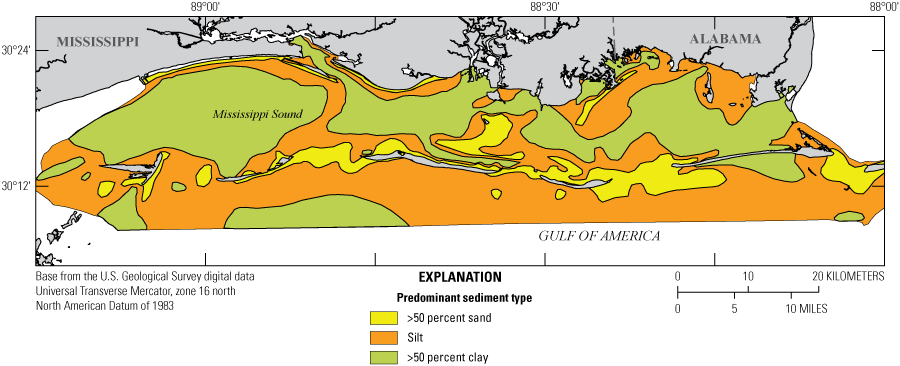
Three primary sediment types are present across the study area: mostly sand, silt,
                        and mostly clay.
Figure 10.

Sediment distribution map showing overall texture of surface sediments, reconstructed from entropy-ratio data in Upshaw and others (1966). Grain size was determined using mechanical sieving of grab samples collected across the Mississippi Sound and offshore.

Shallow-water seagrass beds are present on the sound side of the barrier islands and along the mainland shoreline. Areas along the northern shore with harder substrates provide attachment for oyster reefs, and freshwater flow from rivers is an important contributor to reef development. The main rivers entering the sound, the Pascagoula River to the east and Pearl River to the west (fig. 1), introduce freshwater and provide nutrients for oyster development. Along with the seagrass beds and oyster reefs, sandy shorelines, such as Hancock County beach in Mississippi, provide mainland protection from storms and sea-level rise. This shoreline is experiencing erosion at a rate of about 7,600 cubic meters (m3) per year and requires regular renourishments of sand from borrow pits immediately offshore (Schmid, 2002). Sand is a finite resource, and identifying areas of potential sandy deposits for future coastal restoration is a continuing challenge. The following section of this report characterizes geologic features offshore of Hancock County in the context of potential sand-rich sediment resources.

Potential Sediment Resources of Hancock County, Mississippi

Analysis

Offshore of Hancock County, the acoustic stratigraphy was interpreted from approximately 125-line km of HRSP (fig. 4) to identify sediment deposits. The HRSP within the study area represents the top 100 m of stratigraphy, and distinct sedimentologic features are interpreted and mapped by following the subsurface horizons that persist throughout the seismic profiles. Within the Mississippi Sound region, these features are associated with buried fluvial channels, marine-transgressive deposits, and tidal deposits (Twichell and others, 2011; Miselis and others, 2014; Flocks and others, 2015). To ground truth the sedimentologic composition represented by the reflectors, direct sampling of the stratigraphy using borings and sediment cores is necessary. Within the study area, 93 vibracores and penetrometer logs were identified from the digital archives of the USACE (fig. 4). The cores were collected adjacent to the shoreline, and their distribution does not extend offshore where the majority of the HSRPs were collected. Where core data interpretations are correlated with the acoustic horizons in seismic profiles, the stratigraphic horizon can be spatially expanded using the latter. However, where acoustic facies did not have stratigraphic correlation, only assumptions about the nature of the stratigraphy could be made. In this study, four distinct sedimentologic deposits and one horizon (fig. 11) were mapped and are discussed in the following section.
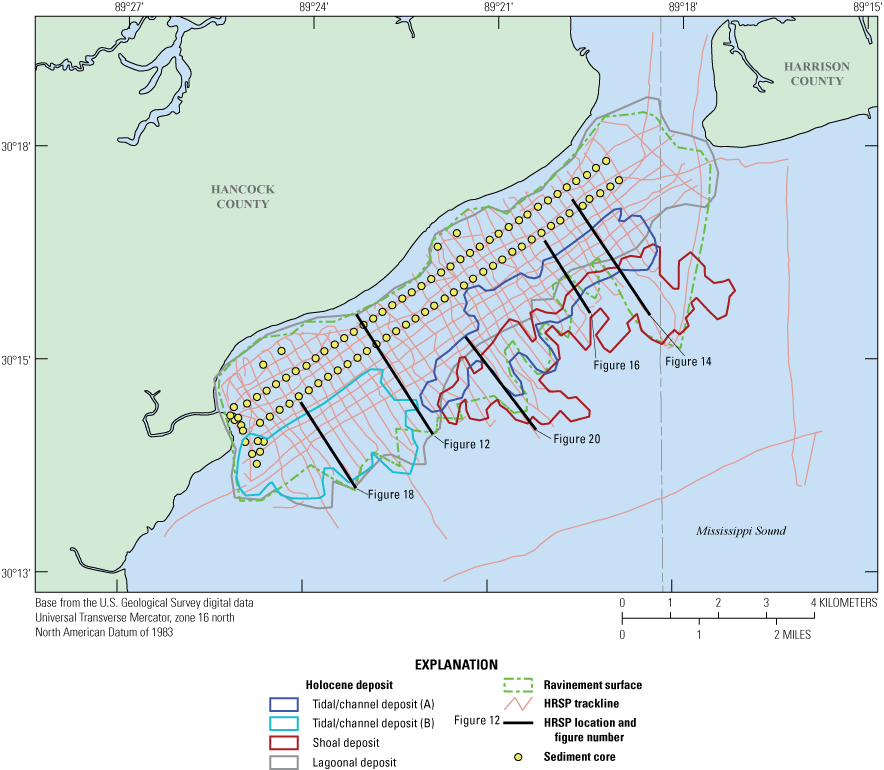
Four Holocene sediment deposits above Pleistocene boundary overlap with HRSP survey
                        tracklines and sediment core locations.
Figure 11.

Map of the Mississippi Sound adjacent to Hancock County displaying high-resolution single channel seismic profile (HRSP) coverage and four specific Holocene deposits identified above the Pleistocene boundary (ravinement surface). Location of seismic profiles shown in other figures indicated on map.

Pleistocene Seismic Horizon

Throughout the study area, an acoustic reflector that shallows landward (south to north, fig. 12) is identified and mapped in all of the HRSPs. Depths to this flooding surface (ravinement), in meters below the sound-source which resides at sea level, range from 2.25 m nearshore to over 7 m offshore (fig. 13). No cores penetrate this horizon, but the depth of the reflector correlates with the Pleistocene stratigraphy observed throughout the Mississippi Sound (figs. 89). The strength and persistence of the return signal suggests the horizon represents a ravinement surface within the Pleistocene, possibly the top of the Prairie Formation (Otvos, 2001; Heinrich, 2006). The stratigraphy above this horizon would correspond to sediments deposited at the end of the Pleistocene and throughout the Holocene.
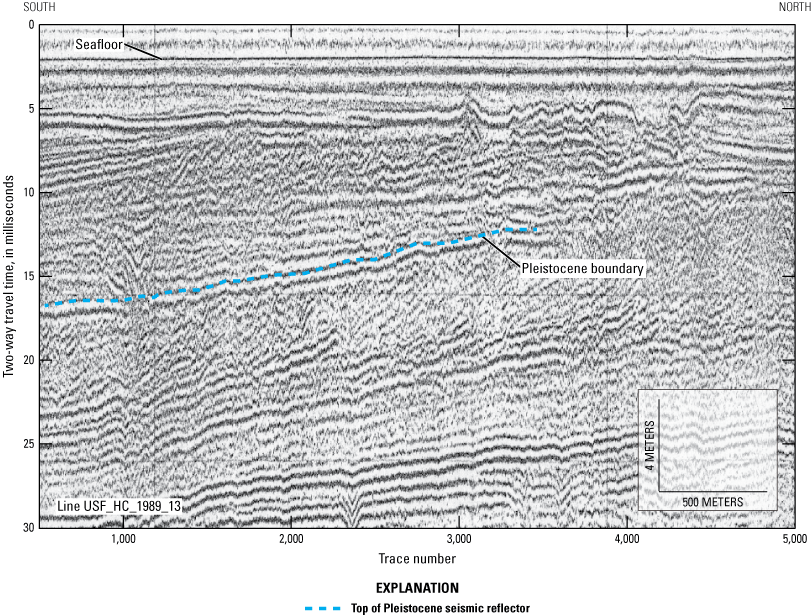
The sediment boundary between the Holocene and Pleistocene slopes up toward the north.
Figure 12.

High-resolution single channel seismic profile (USF_HC_1989_13) showing the location of the acoustic reflector that represents the Pleistocene ravinement surface. Location of profile is shown in figure 11.
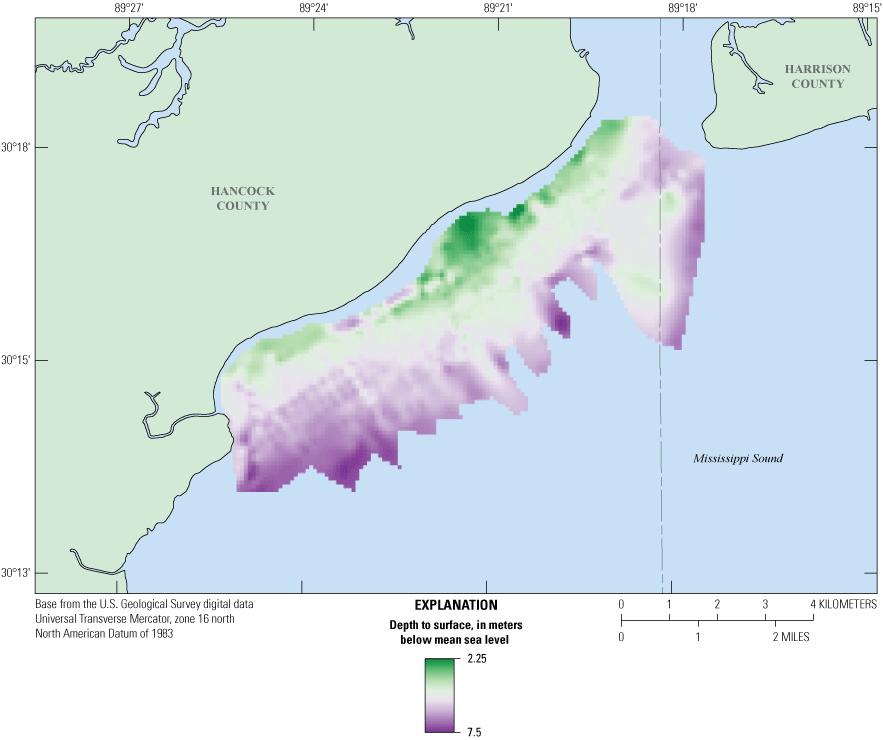
A gradient over the study are shows depth from the Pleistocene surface layer to the
                        sea surface in meters.
Figure 13.

Map showing depth to the acoustic reflector that represents the Pleistocene ravinement surface.

Holocene Lagoon Deposits

The predominant deposits within the study area are estuarine muds that accumulated within the Mississippi Sound throughout the Holocene. As the Mississippi River prograded into the area from the west to form the St. Bernard delta complex, it not only deposited thick sequences of prodelta muds (Twichell and others, 2011) but also formed a morphological transition from an open embayment to lagoonal environment. The decrease in current energy was coupled with a decrease in sand supply from the barrier island chain to the east (Otvos, 2001). Silts and clays from the fluvial systems to the north and marine muds transported by tidal currents from the Gulf of America became the dominant deposits within the sound. Sediments collected from this environment are described in the USACE vibracore logs as dark gray silty clay (fig. 6). In the seismic profiles, the lagoonal deposit is generally characterized by weak horizontal reflectors infilling a strong basal reflector (fig. 14). Depth to this basal horizon is variable but generally deepens seaward and to the southwest (fig. 15).
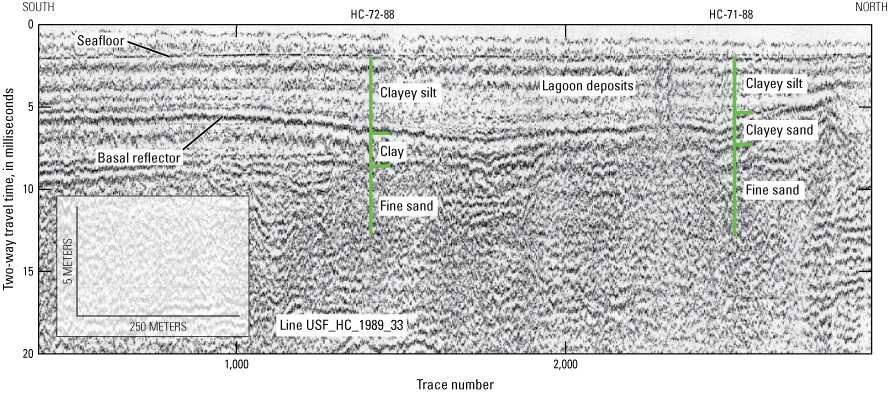
Clayey-silt lagoonal deposits overlie clay and clayey-sand deposits, which both overlie
                        fine-sand deposits.
Figure 14.

High-resolution single channel seismic profile (USF_HC_1989_33) showing the horizontal acoustic reflectors that represent lagoonal deposits. Two sediment cores (HC-72-88 and HC-71-88) acquired along the profile contain clays and silts and rest on top of fine sand. The depth to the base of the deposits (base reflector) is shown in figure 15. Location of profile is shown in figure 11.
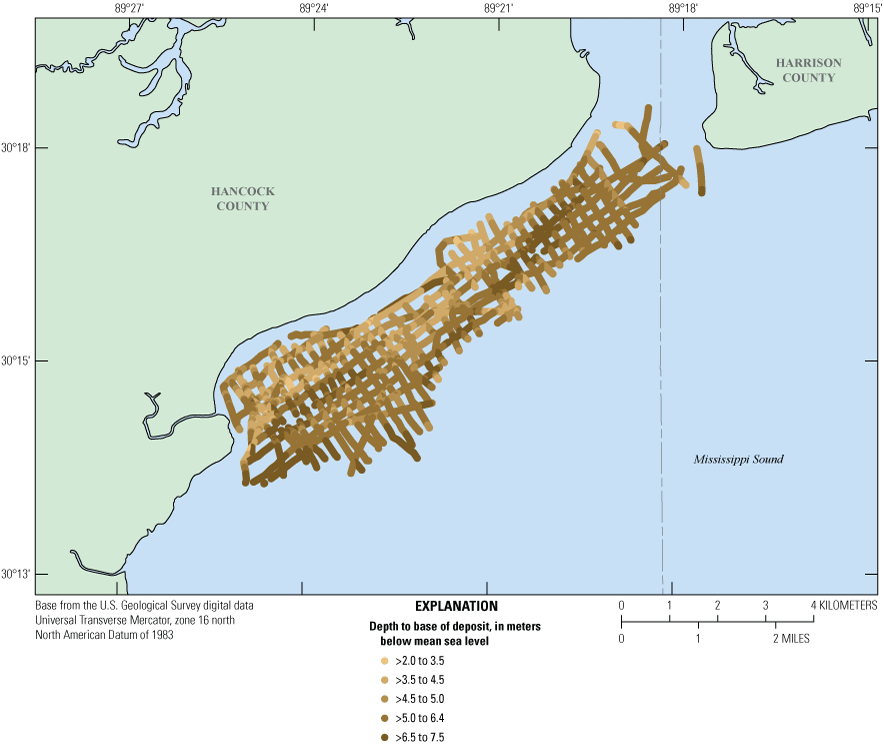
Depth to the base of the lagoonal deposits southeast of the coast increases seaward
                        and toward the southwest.
Figure 15.

Map showing the depth to the base of the lagoonal deposits (basal reflector in fig. 14).

Fluvial Channel and Tidal Deposits (A and B)

Two features in the offshore portion of the study area (deposits A and B in fig. 11) have acoustic reflectors that resemble deposits found throughout the northern Gulf of America and were formed through fluvial or tidal processes. Parallel acoustic reflectors that are either horizontal or dipping represent fluvial valley fill, tidal deltas, or tidal inlet fill (Twichell and others, 2011; Miselis and others, 2014; Flocks and others, 2015). Without direct sampling through sediment cores, it is often not possible to determine the exact provenance of these features, but all are formed through current activity, either tidal or fluvial driven. These high-energy current processes typically move and deposit sand, although fluvial channel fill can commonly contain muds as well.

The first feature (deposit A in fig. 11) has the acoustic characteristics of a buried fluvial channel, with down-dipping reflectors forming a channel base, overlain by “infilling” horizontal reflectors (fig. 16). The chaotic pattern at the thalweg of the channel represents biogenic gas accumulation, which attenuates the acoustic return and obscures any underlying stratigraphy, a common occurrence in buried fluvial channels. During the last sea-level lowstand, fluvial channels entrenched the inner shelf (Kindinger and others, 1994; Hollis, 2018; Gal and others, 2021). As sea level rose, the channels were infilled with bayhead delta and marine deposits. No sediment cores penetrate this deposit, and direct sampling is necessary to determine the texture of the infill. The feature generally trends northeast-southwest across the study area and is mapped across consecutive HRSP lines. An isopach map of the deposit (fig. 17) shows the concave nature, with up to 9 m of channel fill within the center and thinning toward the flanks.
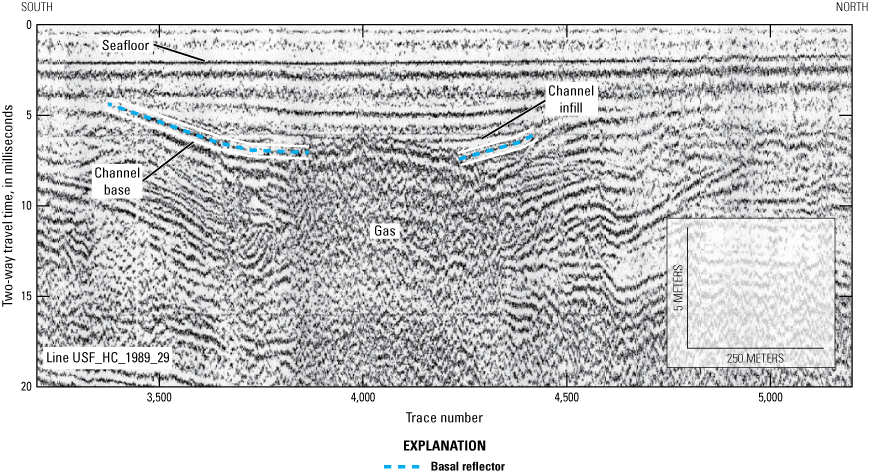
Fluvial channel infill consists mostly of horizontal layers above basal reflector
                        boundary lies between Holocene and Pleistocene deposits.
Figure 16.

High-resolution single channel seismic profile (USF_HC_1989_29) showing the cross-section of the possible fluvial channel feature within the study area. The basal reflector along the flanks of the feature dips down toward the center, which has an accumulation of gas at the thalweg. Profile and deposit A location shown in figure 11.
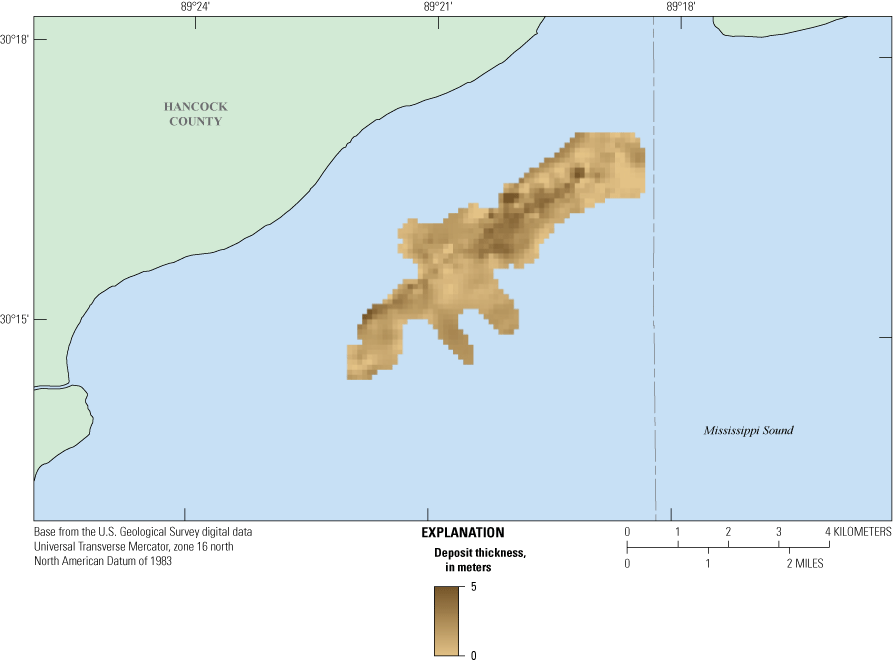
Thickness of deposit A’s basal surface, southeast of the coast, is greatest along
                        the center of the deposit.
Figure 17.

Map showing Isopach derived from interpretation and gridding of deposit A (channel fill) basal surface (shown in fig. 16). The thickness and spatial extent show the linear and concave channel-like nature of the feature.

The second feature (deposit B in fig. 11) is characterized by acoustic reflectors down-lapping in an offshore, southerly direction (fig. 18). The deposit extends beyond the HRSP coverage; consequently, the total spatial extent of this unit is unknown. The acoustic pattern of this feature is consistent with tidal deposits seen elsewhere across the Gulf of America shelf (Twichell and others, 2011). Although no vibracores were collected within this deposit, four penetrometer logs were acquired along the western edge (fig. 11). The penetrometer probe met refusal at 4 mbsf, where it encountered a fine white sand; this depth below the seafloor likely corresponds to the top of the tidal deposit. An isopach map of deposit B (fig. 19) indicates that, within the study area, the deposit thickens up to 5 m offshore with a volume of 8.5×10⁶ m3.
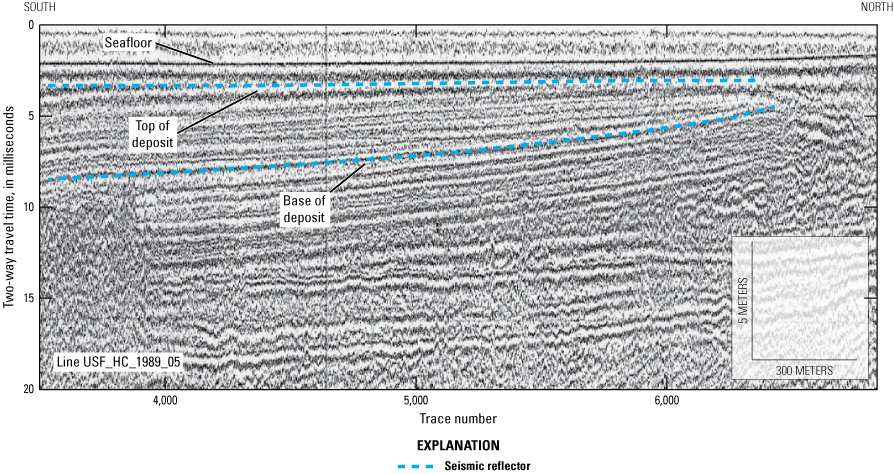
Downlapping deposit consists mostly of parallel sediment layers.
Figure 18.

High-resolution single channel seismic profile (USF_HC_1989_05) showing thinly laminated, parallel reflectors dipping downward offshore (toward the south). Penetrometer probes met refusal at the top of this deposit and samples acquired consisted of fine sand. Location of profile is shown in figure 11.
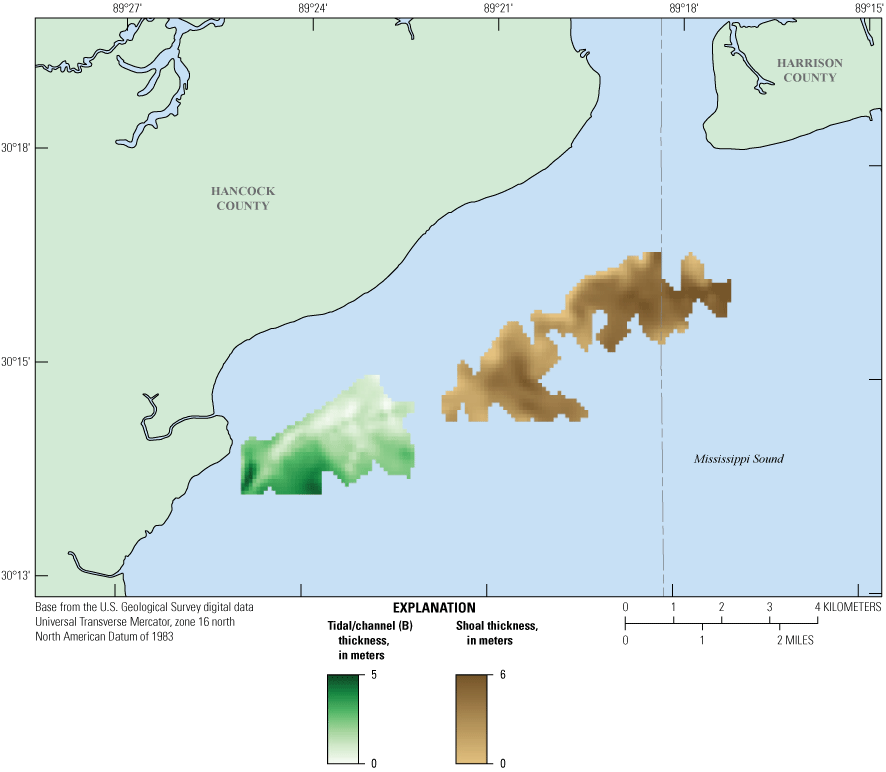
Irregularly shaped gradients for two study areas southeast of the coast.
Figure 19.

Isopachs of the possible tidal deposit B and the shoal deposit (locations shown in fig. 11). Deposit B thickens seaward, and the shoal deposit thickens toward the center of the feature.

Shoal Deposit

At the seaward edge of the study area, there is a deposit that resembles, in shape, a remnant barrier or shoal system (fig. 11). The acoustic signature is consistent with shoal deposits identified in the northern Gulf of America (Twichell and others, 2011; Kindinger and others, 2014), with distinct bottom and top reflectors, and chaotic or massive interior reflectors (fig. 20). No sediment cores were acquired from the deposit, so the stratigraphy can only be assumed from the chaotic nature of the seismic signal observed within the HRSP. A similar deposit was identified between the study area and Cat Island to the southeast. The deposit, described as light olive-brown sand with shell fragments (North Upper Sand deposit in Kindinger and others, 2014), contains over 92 percent fine- to medium-grained sand. Both features align with the strandplain ridges along the Hancock County shoreline and Cat Island offshore; the alignment suggests they could be submerged island remnants postulated in Otvos and Giardino (2004). The thickness of the deposit exceeds 5 m at the crest (fig. 19), with a study-area volume of 12.3×10⁶ m3.
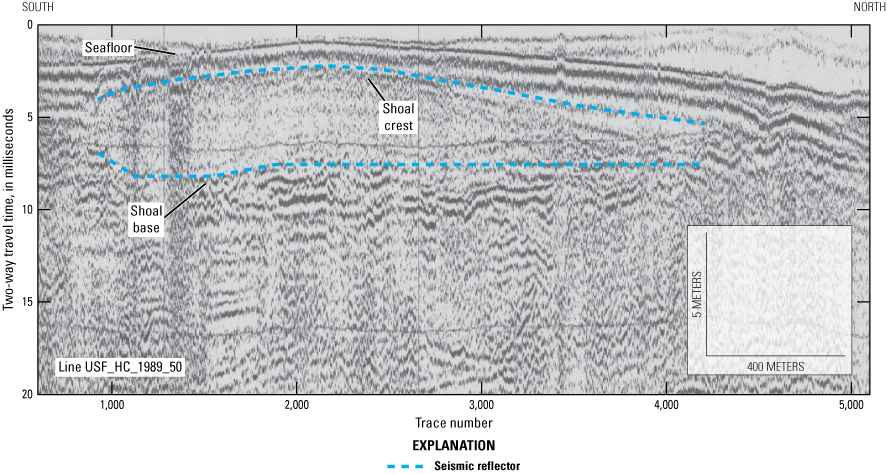
Sediment boundaries outline the crest and base of a possible shoal or island.
Figure 20.

High-resolution single channel seismic profile (USF_HC_1989_50) showing possible island remnant or shoal feature within the study area. The deposit is crest-shaped and contains chaotic acoustic reflectors indicative of massive sand deposits up to 5 meters thick (see fig. 19 for isopach map). Location of profile is shown in figure 11.

Proposed Reconnaissance Coring Strategy to Ground Truth the HRSP

The three deposits identified in this study that have potential as sediment resources for shoreline restoration include the possible fluvial channel (figs. 1617), tidal (figs. 1819), and shoal deposits (figs. 1920). The spatial and volumetric extents of these features determined in this study are shown in table 2. To ground truth the seismic reflection interpretations and assign sediment types to the seismic stratigraphy, direct sampling of the sediments is necessary. To identify shallow geologic and seafloor morphologic features in marine environments, 9-m-long sediment cores are commonly collected using a vibratory system (vibracore). Analysis of vibracores can include visual interpretation, sediment grain size measurements, and other analytic procedures that provide data and insight into the sedimentology of the samples collected and the stratigraphy. Seismic reflectors represent changes in density between lithologic units (for example, a transition from sand to silt) and are correlated with stratigraphic horizons. Once the seismic reflectors have been correlated to the sedimentology and stratigraphy in a vibracore or vibracores, the stratigraphic units can then be extrapolated across the study area using the HRSP.

Table 2.    

Spatial and volumetric extents of potential sand-resource deposits identified in this study.

[ID, identification; m2, square meter; m, meter; m3, cubic meter]

Deposit ID Area (106 m2) Thickness range (m) Volume (106 m3) Overburden1 (m)
Fluvial deposit (A) 16.4 2–7 10.2 2–3
Tidal deposit (B) 13.2 1–3.5 8.5 1
Shoal 31.4 1–5 12.3 1
Table 2.    Spatial and volumetric extents of potential sand-resource deposits identified in this study.
1

Refers to the thickness of sediment that overlies the deposit but is not part of the deposit.

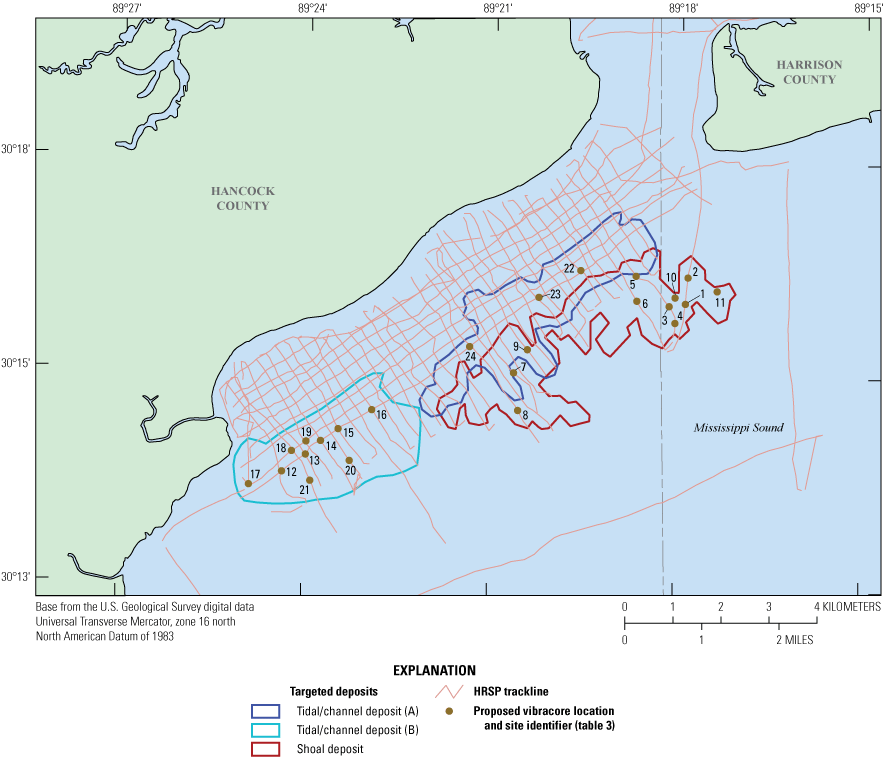
For features within the study area to be considered a viable sediment resource, the deposit must be at or near the seafloor. For this study, a minimal overburden (less than 3 m) of nonsuitable sediments (for example, silts and clays) was used to optimize sediment recovery. In the Mississippi Sound, the overburden is considered to be lagoonal or estuarine muds. The deposits that best fit these criteria are the tidal deposit (B) and the shoal deposit (fig. 11). The possible fluvial deposit (A) may contain suitable sand; however, it may have significant overburden, making it a less viable source (table 2). The proposed coring strategy is broad and at a reconnaissance level, with cores centered on the HRSP to provide ground truthing for the seismic reflectors. The intent of the exploratory coring is not to provide the high-resolution stratigraphic characterization necessary for engineering and designing borrow sites, but rather to investigate large-scale features that can be delineated using HRSPs. Table 3 lists the proposed core sites with relevant information about each site, the target deposit, and the HRSP used to select the location. Thickness values for the sediment deposit were extracted from the isopach maps (figs. 17 and 19) at each potential vibracore site. Figure 21 shows the potential core site selections in map view based on the resource criteria, as discussed, targeting the fluvial/tidal features (A and B), and the shoal deposit.

Table 3.    

Proposed core sites to provide textural information of the targeted deposits along the high-resolution single channel seismic profile (HRSP).

[The relevant information includes site coordinates, water depth (meters) at the core site extracted from the National Oceanic and Atmospheric Administration Digital Elevation Model (fig. 2), the target deposit and thickness at the core site, and the closest HRSP to the site (Bosse and others, 2018). ID, identification; UTM, Universal Transverse Mercator; m, meter; NAD 83, North American Datum of 1983]
Core site ID UTM X/UTM Y
(m NAD 83 UTM 16 north)
Water depth (m) Feature ID Feature thickness (m) Nearest HRSP (USF_HC_1989_#)
1 278931/3350603 1.0 Shoal 5.0 50
2 279000/3351287 2.5 Shoal 3.5 50
3 278510/3350542 1.1 Shoal 4.9 34
4 278660/3350108 2.4 Shoal 4.0 34
5 277653/3351332 2.1 Shoal 3.9 34
6 277671/3350685 2.1 Shoal 5.6 33
7 274473/3348826 2.6 Shoal 4.6 21B
8 274578/3347851 2.7 Shoal 3.8 19
9 274832/3349427 2.7 Shoal 1.9 23
10 278662/3350766 1.0 Shoal 6.3 ERDA_90-1_14
11 279756/3350928 1.6 Shoal 6.6 ERDA_90-1_14
12 268455/3346288 3.0 Tidal/channel (B) 2.2 44, 1
13 269071/3346724 2.8 Tidal/channel (B) 2.1 44, 3
14 269465/3347076 2.7 Tidal/channel (B) 1.3 44, 5
15 269921/3347382 2.7 Tidal/channel (B) 0.9 44, 7
16 270794/3347874 2.6 Tidal/channel (B) 0.9 44, 10
17 267596/3345955 2.8 Tidal/channel (B) 3.5 49, 43
18 268712/3346815 2.6 Tidal/channel (B) 1.4 43, 2
19 269088/3347062 2.6 Tidal/channel (B) 1.5 43, 4
20 270211/3346556 2.9 Tidal/channel (B) 1.2 6
21 269187/3346043 2.8 Tidal/channel (B) 3.1 2
22 276218/3351482 2.9 Tidal/channel (A) 3.1 44, 30
23 275133/3350786 2.7 Tidal/channel (A) 3.3 44, 26
24 273335/3349510 2.6 Tidal/channel (A) 2.4 44, 19
Table 3.    Proposed core sites to provide textural information of the targeted deposits along the high-resolution single channel seismic profile (HRSP).
Three Holocene-era sediment deposits collocated with HRSP survey tracklines and proposed
                     locations for new vibracores.
Figure 21.

Map showing proposed core site locations to provide textural information of the targeted deposits along the high-resolution single channel seismic profiles (HRSPs). Core site numbers correspond to the statistics shown in table 3.

Conclusion

The Mississippi Sound is a microtidal estuary located between the central gulf coast mainland and the Gulf of America. The sound is separated from the open ocean by a barrier island system with large inlets that allow tidal flow and sediment exchange between the gulf and sound. Rivers such as the Pearl and Pascagoula provide freshwater from the mainland to maintain a brackish water environment in the sound.

The physical environment of the Mississippi Sound has been shaped by fluvial and marine-transgressive processes that have occurred across the northern gulf since the Pleistocene. Former fluvial channels infilled with sediment during the last sea-level rise, while interfluve areas were eroded and incised by rivers. Dynamic sediment transport processes formed the present barrier island system, while delta lobe progradation from the Mississippi River Delta to the west restricted island development and enhanced marsh and estuarine evolution.

The sediments dispersed across the seafloor of the Mississippi Sound reflect the Holocene history, with muds accumulating across most of the sound and sandy deposits accumulating along the barrier island platform and tidal deltas. Barrier island systems and shoals that developed early in the Holocene are buried within the sound, and sand associated with the dynamic sediment processes indicative of their evolution (for example, fluvial and tidal flow) are retained in the shallow stratigraphy below the seafloor. Data from geophysical surveys and sediment cores were used to identify three deposits and evaluate their spatial extent, volume, and depth below seafloor. Lastly, the study outlined a sediment-coring strategy to further define these features.

References Cited

Adcock, D., 2019, Stratigraphic characterization of the Pleistocene paleodrainage network in the western Mississippi Sound: Starkville, Mississippi, Mississippi State University, Department of Geosciences, Theses and Dissertations 4073, 96 p., accessed February 21, 2024, at https://scholarsjunction.msstate.edu/td/4073.

Anderson, J., Wallace, D., Simms, A., Rodriguez, A., Weight, R., and Taha, Z., 2016, Recycling sediments between source and sink during a eustatic cycle—Case study of late Quaternary northwestern Gulf of Mexico Basin: Earth-Science Reviews, v. 153, p. 111–138, accessed March 6, 2024, at https://doi.org/10.1016/j.earscirev.2015.10.014.

Barry, R.M., Cavers, D.A., and Kneale, C.W., 1975, Recommended standards for digital tape formats: Geophysics, v. 40, no. 2, p. 344–352. [Also available at https://www.seg.org/publications/tech-stand.]

Bart, P., and Anderson, J., 2004, Late Quaternary stratigraphic evolution of the Alabama and west Florida outer continental shelf: Society for Sedimentary Geology Special Publication no. 79, p. 43–53, accessed February 14, 2024, at http://www.geol.lsu.edu/bart/bart/Bio_files/Bart%20and%20Anderson%202004.pdf.

Bosse, S., Flocks, J., and Forde, A., 2017, Digitized analog boomer seismic-reflection data collected during U.S. Geological Survey cruises Erda 90-1_HC, Erda 90-1_PBP, and Erda 91-3 in Mississippi Sound, June 1990 and September 1991: U.S. Geological Survey Data Series 1047, accessed February 14, 2024, at https://doi.org/10.3133/ds1047.

Bosse, S., Flocks, J., and Forde, A., 2018, Archive of digitized analog boomer seismic reflection data collected during USGS cruise USFHC in Mississippi Sound and Bay St. Louis, September 1989: U.S. Geological Survey data release, accessed February 14, 2024, at https://doi.org/10.5066/F7J67G5B.

Flocks, J., Kindinger, J., and Kelso, K., 2015, Geologic control on the evolution of the inner shelf morphology offshore of the Mississippi barrier islands, northern Gulf of Mexico, USA: Continental Shelf Research, v. 101, p. 59–70, accessed March 6, 2024, at https://doi.org/10.1016/j.csr.2015.04.008.

Forde, A., Dadisman, S., Flocks, J., Wiese, D., DeWitt, N., Pfeiffer, W., Kelso, K., and Thompson, P., 2011a, Archive of digital chirp subbottom profile data collected during USGS cruises 10CCT01, 10CCT02, and 10CCT03, Mississippi and Alabama Gulf islands, March and April 2010: U.S. Geological Survey Data Series 611, 11 DVDs, accessed February 14, 2024, at https://pubs.usgs.gov/ds/611/.

Forde, A., Dadisman, S., Flocks, J., and Worley, C., 2011b, Archive of digital chirp subbottom profile data collected during USGS cruise 08CCT01, Mississippi Gulf islands, July 2008: U.S. Geological Survey Data Series 620, 5 DVDs, accessed February 14, 2024, at https://pubs.usgs.gov/ds/620/.

Forde, A., Dadisman, S., Kindinger, J., Miselis, J., Wiese, D., and Buster, N., 2012, Archive of digital chirp subbottom profile data collected during USGS cruise 10BIM04 offshore Cat Island, Mississippi, September 2010: U.S. Geological Survey Data Series 724, 2 DVDs, accessed February 14, 2024, at https://pubs.usgs.gov/ds/724/.

Frazier, D., 1967, Recent deltaic deposits of the Mississippi River—Their development and chronology: Gulf Coast Association of Geological Societies Transactions, v. 17, p. 287–315, accessed February 14, 2024, at https://archives.datapages.com/data/gcags/data/017/017001/0287.htm.

Gal, N., Wallace, D., Miner, M., Hollis, R., Dike, C., and Flocks, J., 2021, Influence of antecedent geology on the Holocene formation and evolution of Horn Island, Mississippi, USA: Marine Geology, v. 431, article 106375, accessed February 14, 2024, at https://doi.org/10.1016/j.margeo.2020.106375.

Greene, D., Rodriguez, A., and Anderson, J., 2007, Seaward-branching coastal-plain and piedmont incised-valley systems through multiple sea-level cycles—Late Quaternary examples from Mobile Bay and Mississippi Sound, U.S.A: Journal of Sedimentary Research, v. 77, no. 2, p. 139–158, accessed March 6, 2024, at https://doi.org/10.2110/jsr.2007.016.

Hamilton, E., 1971, Elastic properties of marine sediments: Journal of Geophysical Research, v. 76, no. 2, p. 579–604, accessed February 16, 2024, at https://doi.org/10.1029/JB076i002p00579.

Heinrich, P., 2006, Pleistocene and Holocene fluvial systems of the lower Pearl River, Mississippi and Louisiana, USA: Gulf Coast Association of Geological Societies Transactions, v. 56, p. 267–278.

Hollis, R., 2018, Late Quaternary evolution and stratigraphic framework influence on coastal systems along the north-central Gulf of Mexico, USA: Ocean Springs, Mississippi, University of Southern Mississippi, no. 598, master's thesis, 84 p., accessed February 29, 2024, at https://aquila.usm.edu/masters_theses/598.

Kindinger, J., Balson, P., and Flocks, J., 1994, Stratigraphy of the Mississippi-Alabama shelf and the Mobile River incised valley system, in Dalrymple, R., Boyd, R., and Zaitlin, B., eds., Incised-valley systems—Origin and sedimentary sequences: Tulsa, Oklahoma, Society for Sedimentary Geology, special publication no. 51, p. 83–95, accessed March 6, 2024, at https://doi.org/10.2110/pec.94.12.0083.

Kindinger, J., Miselis, J., and Buster, N., 2014, The shallow stratigraphy and sand resources offshore from Cat Island, Mississippi: U.S. Geological Survey Open-File Report 2014–1070, 74 p., accessed February 29, 2024, at https://doi.org/10.3133/ofr20141070.

La Peyre, M., Furlong, J., Brown, L., Piazza, B., and Brown, K., 2014, Oyster reef restoration in the northern Gulf of Mexico—Extent, methods and outcomes: Ocean and Coastal Management, v. 89, p. 20–28, accessed March 1, 2024, at https://doi.org/10.1016/j.ocecoaman.2013.12.002.

Miselis, J., Buster, N., and Kindinger, J., 2014, Refining the link between the Holocene development of the Mississippi River Delta and the geologic evolution of Cat Island, MS—Implications for delta-associated barrier islands: Marine Geology, v. 355, p. 274–290, accessed March 1, 2024, at https://doi.org/10.1016/j.margeo.2014.05.021.

Morgan, L., and Rakocinski, C., 2022, Predominant factors limiting the recovery of the eastern oyster (Crassostrea virginica) in western Mississippi Sound, USA: Estuarine, Coastal and Shelf Science, v. 264, article 107652, accessed March 1, 2024, at https://doi.org/10.1016/j.ecss.2021.107652.

Morton, R., 2008, Historical changes in the Mississippi-Alabama barrier-island chain and the roles of extreme storms, sea level, and human activities: Journal of Coastal Research, v. 24, no. 6, p. 1587–1600, accessed February 29, 2024, at https://doi.org/10.2112/07-0953.1.

National Geophysical Data Center [NGDC], 2010, Northern Gulf 1 arc-second NAVD 88 Coastal Digital Elevation Model: National Oceanic and Atmospheric Administration National Centers for Environmental Information web page, accessed April 3, 2024, at https://www.ncei.noaa.gov/metadata/geoportal/rest/metadata/item/gov.noaa.ngdc.mgg.dem:720/html.

Otvos, E., 2001, Mississippi coast—Stratigraphy and Quaternary evolution in the northern Gulf Coastal Plain framework, chap. H in Stratigraphic and Paleontologic studies of the Neogene and Quaternary sediments in southern Jackson County, Mississippi: U.S. Geological Survey Open-File Report 01–415–H, 59 p., accessed March 6, 2024, at https://pubs.usgs.gov/of/2001/of01-415/chap8txt.pdf.

Otvos, E., and Giardino, M., 2004, Interlinked barrier chain and delta lobe development, northern Gulf of Mexico: Sedimentary Geology, v. 169, nos. 1–2, p. 47–73, accessed March 6, 2024, at https://doi.org/10.1016/j.sedgeo.2004.04.008.

Peoples, Z., 2022, Characterization of Quaternary stratigraphy in the Mississippi Sound to evaluate the influence of geologic heterogeneity on submarine groundwater transport and discharge: Starkville, Mississippi, Mississippi State University, master’s thesis, 91 p.

Priddy, R., Crisler, R., Jr., Sebren, C., Powell, J., and Burford, H., 1955, Sediments of Mississippi Sound and inshore waters: University of Mississippi, Mississippi State Geological Survey Bulletin no. 82, 64 p.

Sanford, J., Harrison, A., Wiese, D., and Flocks, J., 2009, Archive of digitized analog boomer seismic reflection data collected from the Mississippi-Alabama-Florida shelf during cruises onboard the R/V Kit Jones, June 1990 and July 1991: U.S. Geological Survey Data Series 429, accessed February 2, 2024, at https://doi.org/10.3133/ds429.

Schmid, K., 2001, Using vibracore and profile data to quantify volumes of renourished sediments, Holocene thickness, and sedimentation patterns—Hancock County, Mississippi: Mississippi Department of Environmental Quality, Office of Geology, Open-File Report 131, 33 p.

Schmid, K., 2002, Biennial report of sand beaches; Hancock County, 2001: Mississippi Department of Environmental Quality, Office of Geology, Open-File Report 110B, 59 p.

Twichell, D., Flocks, J., Pendleton, E., and Baldwin, W., 2013, Geologic controls on regional and local erosion rates of three northern Gulf of Mexico barrier-island systems: Journal of Coastal Research, v. 63, p. 32–45, accessed March 6, 2024, at https://doi.org/10.2112/SI63-004.1.

Twichell, D., Pendleton, E., Baldwin, W., Foster, D., Flocks, J., Kelso, K., DeWitt, N., Pfeiffer, W., Forde, A., Krick, J., and Baehr, J., 2011, The shallow stratigraphy and sand resources offshore of the Mississippi barrier islands: U.S. Geological Survey Open-File Report 2011–1173, 63 p., accessed February 2, 2024, at https://pubs.usgs.gov/of/2011/1173/.

Upshaw, C., Creath, W., and Brooks, F., 1966, Sediments and microfauna off the coasts of Mississippi and adjacent States: Mississippi Geological, Economic and Topographical Survey Bulletin 106, 138 p.

Appendix 1. Literature Associated With the Geology of Mississippi Sound, With Title, Citation, and Keyword Summary

The following is the reference listing with article title (Title), formal citation (Citation), and keywords from the article (Keywords).
Title.—Stratigraphic characterization of the Pleistocene paleodrainage network in the western Mississippi Sound
Citation.—Adcock, D., 2019, Stratigraphic characterization of the Pleistocene paleodrainage network in the western Mississippi Sound: Starkville, Mississippi, Mississippi State University, Department of Geosciences, master’s thesis, 96 p.
Keywords.—coastal plain, conceptual models, core samples, database, erosional unconformity, fluvial channels, Holocene sediments, incised paleofluvial channels, infilling, last glacial maximum, late Pleistocene sediments, Mississippi Sound, modern analogue depositional environments, paleo-channel incision, paleofluvial drainage network, paleotopography, Pleistocene-Holocene unconformity, rivers and streams, sea-level low-stand, subbottom profile data, transgression, unconformity dip, western Mississippi Sound
Title.—Hydrodynamic modeling of the western Mississippi Sound using a linked model system
Citation.—Armandei, M., Linhoss, A., and Camacho, R., 2021, Hydrodynamic modeling of the western Mississippi Sound using a linked model system: Regional Studies in Marine Science, v. 44, p. 1–13, https://doi.org/10.1016/j.rsma.2021.101685.
Keywords.—driving mechanisms, ecological impacts, estuarine circulation, flood control, flooding, flow boundary conditions, flow simulation, graphical analysis, graphical measures, Gulf of America, Gulf of Mexico, habitat suitability models, hydrodynamic model, hydrologic variability, linked hydrodynamic models, lower Pearl River basin, meteorological conditions, pressure boundary conditions, riverine flow, salinity, statistical analysis, statistical measures, temperature, two hydrodynamic models, Visual Environmental Fluid Dynamic Code, water diversions, water quality models, water surface elevation, western Mississippi Sound
Title.—High resolution sea-level history for the Gulf of Mexico since the last glacial maximum
Citation.—Balsillie, J., and Donoghue, J., 2004, High resolution sea-level history for the Gulf of Mexico since the last glacial maximum: Florida Geological Survey, Report of Investigations, no. 103, 78 p.
Keywords.—archaeological, calibrated absolute age-data, geological sea-level indicators, high-resolution, last glacial maximum, published sea-level histories, radiocarbon (14C age dating methodology), sea-level curves, Gulf of Mexico
Title.—Mineralogic study of sediments from nearshore Cat Island, Mississippi
Citation.—Barnhart, L., 2003, Mineralogic study of sediments from nearshore Cat Island, Mississippi: Starkville, Mississippi, Mississippi State University, master’s thesis, 75 p.
Keywords.—Cat Island, Mississippi, clay mineralogy, longshore sediment transport, sediment analysis, sediment lithology, sediment reworking, St. Bernard delta complex, vibracore sediment sampling, x-ray diffraction analysis
Title.—Historical bathymetry and bathymetric change in the Mississippi-Alabama coastal region, 1847–2009
Citation.—Buster, N.A., and Morton, R.A., 2011, Historical bathymetry and bathymetric change in the Mississippi-Alabama coastal region, 1847–2009: U.S. Geological Survey Scientific Investigations Map 3154, 13-p. pamphlet.
Keywords.—160-year evaluation, alongshore currents, barrier islands, bathymetric change, bathymetry, coastal environment, coastal system alteration, dredging, first line of defense, Gulf Islands National Seashore (GUIS), human activities, island migration, land loss, littoral system, Mississippi and Alabama barrier islands, natural and anthropogenic influences, nearshore environments, profile of the seafloor, recreational land, sea-level rise, seafloor change, seafloor evolution, sediment starved, sediment supply, sediment transport, storms, wave and current activity, wildlife protected areas
Title.—Littoral sediment budget for the Mississippi Sound barrier islands
Citation.—Byrnes, M., Griffee, S., and Berlinghoff, J., 2012, Littoral sediment budget for the Mississippi Sound barrier islands: U.S. Army Corps of Engineers, Engineer Research and Development Center report ERDC/CHL TR–12–9, 184 p.
Keywords.—barrier islands, bathymetric change, bathymetric survey data, beach erosion, beach evolution, downdrift, east Ship Island, historical shoreline, Horn Island, island restoration project, littoral sand transport, longevity of littoral sand transport, longshore currents, longshore transport processes, magnitude of net sand transport, Mississippi Sound, navigation channel dredging, net littoral sediment transport pathways, operational sediment budget, Petit Bois Island, restoration plan, sand flux, sand redistribution, sand sink, sand transport rates, shoreline, storm and normal wave and current conditions, washover deposition, wave approach
Title.—Historical sediment transport pathways and quantities for determining an operational sediment budget—Mississippi Sound barrier islands
Citation.—Byrnes, M.R., Rosati, J.D., Griffee, S.F., and Berlinghoff, J.L., 2013, Historical sediment transport pathways and quantities for determining an operational sediment budget—Mississippi Sound barrier islands, in Brock, J.C., Barras, J.A., and Williams, S.J., eds., Understanding and predicting change in the coastal ecosystems of the northern Gulf of Mexico: Coconut Creek, Florida, Journal of Coastal Research, Special Issue No. 63, p. 166–183.
Keywords.—active channels, barrier island system, barrier islands, bathymetric change, bathymetric survey data, channel dredging, Dog Keys Pass, east Ship Island, historical shoreline, Horn Island, island restoration project, magnitude of net sand transport, Mississippi, Mississippi Sound, net littoral sand transport pathways, net sediment sink, operational sediment budget, Petit Bois Island, sand exchange, ship island, shoreline change
Title.—Landscape management and native plantings to preserve the beach between Biloxi and Pass Christian, Mississippi
Citation.—Cathcart, T., and Melby, P., 2009, Landscape management and native plantings to preserve the beach between Biloxi and Pass Christian, Mississippi: Mississippi State University, Office of Agricultural Communications, Bulletin 1183, 26 p., https://www.mafes.msstate.edu/publications/bulletins/b1183.pdf.
Keywords.—beach environment, beach management practices, beach-water interface, Biloxi, compaction, current management practices, currents, erosion processes, fluffed sand, grooming, high-energy events, highway, infiltration, man-made beach, Mississippi Sound, native plant species, Pass Christian, rainwater, raking, renourishment projects, sand, seawall, southerly winds, stormwater, stormwater runoff, sub-sand, vulnerability, water transport, wave action, wind
Title.—Use of structured decision-making to explicitly incorporate environmental process understanding in management of coastal restoration projects—Case study on barrier islands of the northern Gulf of Mexico
Citation.—Dalyander, P.S., Meyers, M., Mattson, B., Steyer, G., Godsey, E., McDonald, J., Byrnes, M., and Ford, M., 2016, Use of structured decision-making to explicitly incorporate environmental process understanding in management of coastal restoration projects—Case study on barrier islands of the northern Gulf of Mexico: Journal of Environmental Management, v. 183, p. 497–509.
Keywords.—adaptive management decision framework, adverse impacts, barrier islands, barrier island restoration, berm, breach, breach formation, coastal ecosystem management, collaborative structured decision-making (SDM), cost effectiveness, dynamic environments, ecosystem restoration, engineering projects, Gulf of America, Gulf of Mexico, island width, longshore extent, minor breaches, priority gaps in knowledge, process knowledge, process-based models, process-understanding, repair decisions, resiliency, sand availability, sand loss, scientific understanding, self-healing, Ship Island, Mississippi, stakeholder objectives, structured decision-making, storms, subjective interpretation, uncertainty, upstream nourishment
Title.—Lithofacies evolution from transgressive to highstand systems tracts, Holocene of the Alabama coastal zone
Citation.—Davies, D., and Hummell, R., 1994, Lithofacies evolution from transgressive to highstand systems tracts, Holocene of the Alabama coastal zone: Transactions of the Gulf Coast Association of Geological Societies, v. 44, p. 145–153.
Keywords.—aggrading bay/lagoonal muds, Alabama State waters, barrier complexes, bayhead delta, bays, carbon-14 dates, circulation, climatic-induced transgression, coastal Escatawpa River, downbay migration, facies, hardbottoms, Holocene, inner shelf, lagoon areas, marginal marine lithofacies, marsh deposits, Mississippi Sound, Mobile Bay, Mobile River system, muddy channel fills, muddy sands, orthoquartzitic sand, oxidized paleosols, oyster reefs, paleochannels, pre-Holocene, quartz sand ridges, salinity, sea-level rise, sediments, sequence evolution, shallow seismic surveys, shallow shelf deposits, shell gravel, shelly transgressive lags, shore-parallel lows, silty clay, sinks, stiff clay, surface sediment samples, transgressive systems tract, Type 1 sequence boundary, vibracores, water energy, wetlands, Wisconsinan paleotopography
Title.—A high-resolution coupled riverine flow, tide, wind, wind wave, and storm surge model for southern Louisiana and Mississippi. Part II—Synoptic description and analysis of Hurricanes Katrina and Rita
Citation.—Dietrich, J., Bunya, S., Westerink, J., Ebersole, B., Smith, J., Atkinson, J., Jensen, R., Resio, D., Luettich, R., Dawson, C., Cardone, V., Cox, A., Powell, M., Westerink, H., and Roberts, H., 2009, A high-resolution coupled riverine flow, tide, wind, wind wave, and storm surge model for southern Louisiana and Mississippi. Part II—Synoptic description and analysis of Hurricanes Katrina and Rita: Monthly Weather Review, v. 138, p. 378–404, https://doi.org/10.1175/2009MWR2907.1.
Keywords.—2005 hurricane season, develop and propagate storm surge, evolution of hurricanes, high-resolution coupled riverine flow, Hurricane Katrina and Hurricane Rita, Mississippi River Delta, southern Louisiana and Mississippi, storm surge model, storm tracks, synoptic histories, tide, topography, wave, wave radiation stress-gradient-induced setup, wind
Title.—Sediment spatial patterns in a Hurricane Katrina overwash fan on Dauphin Island, Alabama, U.S.A.
Citation.—Feagin, R.A., and Williams, A.M., 2008, Sediment spatial patterns in a Hurricane Katrina overwash fan on Dauphin Island, Alabama, U.S.A.: Journal of Coastal Research, v. 24, no. 4, p. 1063–1070.
Keywords.—arc-shaped overwash fans, barrier islands, Dauphin Island, Alabama, directional processes, horizontal spatial pattern formation, Hurricane Katrina, kriging, mantel tests, mean grain size, mineral composition, sediment, sediment patterning, sediment sorting, sediment transport, skewness, spatial distribution, spatially sorted sands, topography, topography correlation, variograms
Title.—Geologic control on the evolution of the inner shelf morphology offshore of the Mississippi barrier islands, northern Gulf of Mexico, USA
Citation.—Flocks, J., Kindinger, J., and Kelso, K., 2015, Geologic control on the evolution of the inner shelf morphology offshore of the Mississippi barrier islands, northern Gulf of Mexico, USA: Continental Shelf Research, v. 101, p. 59–70, https://doi.org/10.1016/j.csr.2015.04.008.
Keywords.—barrier island platform, buried Pleistocene fluvial deposits, chirp subbottom data, coastal processes, coastal zone, evolutionary conceptual model, geology, ground truthed, high-resolution geophysical surveys, Holocene, hydrodynamic processes, inner shelf, late Holocene shore-oblique sand ridges, long-term response, Mississippi barrier islands, morphology, near surface geologic framework, nearshore dynamic, nearshore framework, Petit Bois Island, Petit Bois Pass, physical characteristics, sand-ridge evolution, sea-level rise, shelf geology, shoal origin, shore-oblique sand ridges, sidescan, single-beam bathymetry, stratigraphy, swath bathymetry, vibracore sediment collection
Title.—Near-surface stratigraphy and morphology, Mississippi inner shelf, northern Gulf of Mexico
Citation.—Flocks, J., Kindinger, J., Kelso, K., Bernier, J., DeWitt, N., and FitzHarris, M., 2014, Near-surface stratigraphy and morphology, Mississippi inner shelf, northern Gulf of Mexico: U.S. Geological Survey Open-File Report 2015–1014, 19 p., https://doi.org/10.3133/ofr20151014.
Keywords.—breaches, chirp subbottom profiling, evolution, fluvial distributary systems, geologic framework, geophysical survey, Gulf Islands National Seashore (GUIS), Holocene- and Pleistocene-age features, interferometric swath bathymetry, land-area loss, marine transgressive deposits, Mississippi barrier islands, Mississippi Coastal Improvement Project (MsCIP), morphology, nearshore stratigraphy, sediment cores, sediment sampling strategy, shoreface erosion, sidescan sonar, textural information, volumetric information
Title.—Recent geologic framework and geomorphology of the Mississippi-Alabama shelf, northern Gulf of Mexico
Citation.—Flocks, J.G., Ferina, N.F., and Kindinger, J.L., 2011b, Recent geologic framework and geomorphology of the Mississippi-Alabama shelf, northern Gulf of Mexico, in Buster, N.A., and Holmes, C.W., eds., Gulf of Mexico, origins, waters and biota, volume 3—Geology: College Station, Texas, Texas A&M University Press, p. 157–174.
Keywords.—archived data, bathymetric data, comprehensive overview, delta cycles, delta sequences, deposition, erosion, Florida carbonate platform, future needs, geology, geomorphology, geophysical data, integration of past studies, last ice age, Mississippi River Delta, Mississippi-Alabama shelf, oscillations in sea level, prevailing winds, river valleys, sea-level rise
Title.—Hurricane Katrina storm surge distribution and field observations on the Mississippi barrier islands
Citation.—Fritz, H., Blount, C., Sokoloski, R., Singleton, J., Fuggle, A., McAdoo, B., Moore, A., Grass, C., and Tate, B., 2007, Hurricane Katrina storm surge distribution and field observations on the Mississippi barrier islands: Estuarine Coastal and Shelf Science, v. 74, p. 12–20, https://doi.org/10.1016/j.ecss.2007.03.015.
Keywords.—barrier islands, damage, future hurricane storm surges, gulf coast, Hurricane Katrina, increased vulnerability, inundation distances, maximum storm surges, Mississippi barrier islands, Mississippi coastline, overland flow depths, overtopping, storm surge flooding, storm surge peaks, Gulf of America, Gulf of Mexico, vehicle-based survey, wave action, wind damage
Title.—Seaward-branching coastal-plain and piedmont incised-valley systems through multiple sea-level cycles—Late Quaternary examples from Mobile Bay and Mississippi Sound, U.S.A.
Citation.—Greene, D., Rodriguez, A., and Anderson, J., 2007, Seaward-branching coastal-plain and piedmont incised-valley systems through multiple sea-level cycles—Late Quaternary examples from Mobile Bay and Mississippi Sound, U.S.A.: Journal of Sedimentary Research, v. 77, p. 139–158, https://doi.org/10.2110/jsr.2007.016.
Keywords.—alluvial sediments, backstepping, bay-head delta deposits, channel branching, compound fill, cores, depositional environment, estuaries, fluvial gradients, fluvial systems, Fowl and La Batre fluvial systems, high-resolution seismic data, incised valleys, inner continental shelf, lowstand systems tract, mapped incised valleys, Mississippi Sound, Mobile Bay, Mobile bay-head delta, oxygen isotope stage 2 sea-level lowstand, Piedmont Mobile fluvial system, seaward-branching valleys, Sequence Boundary A, Sequence Boundary B, shelf break, shelf-edge deltas, stage 6 valleys, terraces, transgression, tributaries, unconformity-bounded stacked units, valley-fill architecture
Title.—Pleistocene and Holocene fluvial systems of the lower Pearl River, Mississippi and Louisiana, USA
Citation.—Heinrich, P.V., 2006, Pleistocene and Holocene fluvial systems of the lower Pearl River, Mississippi and Louisiana, USA: Gulf Coast Association of Geological Societies Transactions, v. 56, p. 267–278.
Keywords.—anastomosing channel system, channel widths, crevasse splay complex, deeply-incised relict channel course, Deweyville allochthonous group, Hammond allochthonous formation, lower Pearl River valley, meander belts, Mississippi Sound, paleochannels, Pearl River, Pleistocene fluvial systems, poorly preserved fluvial ridges, Prairie allochthonous group, Saint Tammany Parish, terrace surfaces, terraces
Title.—Late Quaternary evolution and stratigraphic framework influence on coastal systems along the north-central Gulf of Mexico, USA
Citation.—Hollis, R., 2018, Late Quaternary evolution and stratigraphic framework influence on coastal systems along the north-central Gulf of Mexico, USA: Ocean Springs, Mississippi, University of Southern Mississippi, no. 598, master's thesis, 84 p., https://aquila.usm.edu/masters_theses/598.
Keywords.—alongshore and inner shelf sources, antecedent topography, barrier degradation, barrier evolution, climate change, coastal systems, depositional facies, estuaries, geologic record, geomorphic threshold crossings, geophysical data, Gulf of America, Gulf of Mexico, Holocene geomorphic evolutionary model, islands formation and progradation, marine isotope stage (MIS), marine shoals, paleo-valley fill, radiocarbon dates, ravinement surfaces, relative sea-level rise (RSLR), sediment cores, sediment supply, sequence boundaries, storm impacts, stratigraphic framework
Title.—Holocene geologic history of coastal Alabama
Citation.—Hummell, R., 1996, Holocene geologic history of coastal Alabama, in Hummel R.L., and Haywick, D., eds., Coastal deposition and ecosystems of Alabama: Alabama Geological Society Field Guide, p. 1–104 p.
Keywords.—borings, coastal Alabama, conceptual model, cross sections, depositional environments, drill holes, erosion, estuarine deposits, fluvial-deltaic deposits, geologic factors, granulometric analysis, Holocene development, inundation history, isopach maps, late Pleistocene-early Holocene unconformity, lithofacies, Mississippi Sound, Mobile Bay, radiocarbon dates, radiometric dates, seismic records, stratigraphic correlation, structure contour, subsurface facies geometry, transgressive estuary fill sequence, transgressive marine fill sequence, vibracores, west Alabama inner continental shelf
Title.—Guide to the marine resources of Mississippi
Citation.—Irby, B.N., and McCaughan, D., 1975, Guide to the marine resources of Mississippi: NOAA Office of Sea Grant publication MASGP–75–015, 351 p.
Keywords.—agencies, coastal Mississippians, community planning, cultural, economy, education, educational needs, estuarine areas, fishing rights, guide, industries, man's uses of the sea, management, marine environment, marine resources, marine-related enterprises, mineral resources, Mississippi, precious metals, productive uses, research laboratories, scientific, seafood industry, seafood production, south Mississippi, technical knowledge, types of marine resources
Title.—Final Environmental Impact Statement (FEIS) for the Bayou Casotte Harbor Channel Improvement Project
Citation.—Jacobson, J., 2019, Final Environmental Impact Statement (FEIS) for the Bayou Casotte Harbor Channel Improvement Project: U.S. Army Corps of Engineers, 263 p.
Keywords.—18 alternatives, bend easing, benthic dwelling organisms, deep-draft Pascagoula Harbor navigation channel, disposal operations, dredged material, Endangered Species Act (ESA) Section 7 consultation, FEIS (Final Environmental Impact Statement), hopper dredge, Horn Island Pass, increased depth, littoral zone placement area (LZPA), lower Pascagoula and Bayou Casotte channels, maximize net benefits, Mississippi Department of Environmental Quality (MDEQ), motile benthic and pelagic fauna, National Environmental Policy Act (NEPA), no action alternative, ocean dredged material disposal site (ODMDS), operations and maintenance (o&m), Port of Pascagoula, Section 204 report, State of Mississippi, water-quality degradation, widening
Title.—Barrier island erosion during a winter cold front in Mississippi Sound
Citation.—Keen, T., Stone, G., Kaihatu, J., and Hsu, Y.L., 2003, Barrier island erosion during a winter cold front in Mississippi Sound, in Coastal Sediments ‘03 Conference, Clearwater Beach, Florida, May 18–23, 2003, [Proceedings]: World Scientific Publishing, 13 p.
Keywords.—beach erosion, beach replenishment, bed load, bed roughness, changes in coastline, cold fronts, cold front winds, erosion, Grant and Madsen bottom boundary layer model, high-resolution models, hydrodynamic, littoral sedimentation and optics model (LSOM), longshore currents, mean currents, Mississippi Sound, numerical models, Princeton ocean model (POM), sedimentation models, sedimentation patterns, Shorecirc hydrodynamic model, surf zone waves, suspended sediment concentrations, simulating waves nearshore model (SWAN), three-dimensional sedimentation model, tidal conditions, tidal stage, water levels, wave and current interaction, waves, west Ship Island
Title.—Seismic stratigraphy of the Mississippi-Alabama shelf and upper continental slope
Citation.—Kindinger, J., 1988, Seismic stratigraphy of the Mississippi-Alabama shelf and upper continental slope: Marine Geology, v. 83, p. 79–84.
Keywords.—buried stream entrenchments, cyclic sedimentation, depositional and erosional episodes, depositional hiatus, early Wisconsinan lowstand, erosional unconformities, fluvial channel systems, geomorphic pattern, glacioeustatic, high-angle clinoform progradational deposits, Holocene, late Wisconsinan sea retreat, Mississippi-Alabama shelf, prograding shelf and slope sequences, rapid Holocene sea-level rise, relative sea-level changes, sedimentary deposits, seismic profiles, shelf evolution, shelf-margin delta, short-term sandy depositional episodes, St. Bernard delta, stratigraphic position, transgressive deposits, transgressive facies, upper Pleistocene, upper Quaternary shelf and slope deposits, upper slope
Title.—Stratigraphy of the Mississippi-Alabama shelf and the Mobile River incised-valley system
Citation.—Kindinger, J.L., Balson, P.S., and Flocks, J.G., 1994, Stratigraphy of the Mississippi-Alabama shelf and the Mobile River incised-valley system, in Dalrymple, R.W., Boyd, R., and Zaitlin, B.A., eds., Incised-valley systems—Origin and sedimentary sequences: Tulsa, Oklahoma, Society for Sedimentary Geology, special publication no. 51, p. 83–95, https://doi.org/10.2110/pec.94.12.0083.
Keywords.—alluvial valley, barrier islands, bayhead delta, coastal-plain shorelines, conceptual facies model, estuarine depocenter, estuarine deposits, estuary-mouth-bar deposits, fluvial fill, fluvially eroded, glacial maximum, Holocene sea-level rise, incised-valley system, lagoonal sediments, late Quaternary history, longshore sediment transport, marine shoals, microtidal estuary, Mississippi-Alabama continental shelf, Mobile Bay, Mobile River, northern Gulf of America, northern Gulf of Mexico, postglacial transgression, relative sea level, restricted estuary, sea-level high-stand, sediment transport, seismic profiles, shelf-margin delta complex, shoals, southern Alabama, thin estuarine facies, wave-dominated, Wisconsinan regression
Title.—Stratigraphy and Holocene evolution of Mobile Bay in southwestern Alabama
Citation.—Mars, J., Shultz, A., and Schroeder, W., 1992, Stratigraphy and Holocene evolution of Mobile Bay in southwestern Alabama: Gulf Coast Association of Geological Societies, v. 42, p. 529–542.
Keywords.—bay inundation, bay-head delta, bay-head delta progradation, beach, borings, coarsening-upward sequence, Dauphin Island-Morgan Peninsula barrier complex, disconformable contact, entrenched river valley, erosional truncation, estuarine system, fining-upward sequence, Gulf of America, Gulf of Mexico waters, high resolution seismic lines, high salinity, Holocene facies, Holocene inundation, inundated bay margins, late Pleistocene exposure surface, low energy, marsh, Mobile Bay, near-shore and beach deposits, near-shore sediments, open-bay muds, paleotopographic map, Pleistocene lowstand, postglacial sea-level rise, pre-Holocene sediments, progradation, radiocarbon ages, radiocarbon dating, rapid relative sea-level rise, riverine dominance, root mottling, sediment accumulation, sediments reworking, seismic lines, slow relative sea-level rise, southwestern Alabama, thick layer of open-bay mud, vertical stacking, vibracores
Title.—Geomorphic history, geologic framework, and hard mineral resources of the Petit Bois Pass area, Mississippi-Alabama
Citation.—McBride, R., Byrnes, M., Penland, S., Pope, D., and Kindinger, J., 1991, Geomorphic history, geologic framework, and hard mineral resources of the Petit Bois Pass area, Mississippi-Alabama, in Gulf Coast Section of the Society for Sedimentary Geology (GCSSEPM) 12th Annual Research Conference, Houston, Texas, December 8–11, 1991, Program and abstracts: SEPM Society for Sedimentary Geology, v. 12, p. 116–127.
Keywords.—abandoned pre-Holocene fluvial channels, aerial photography, Alabama, antecedent topographic depression, Dauphin Island, ebb-tidal deltas, Escatawpa River, Fowl River, geologic framework, geomorphic history, hard mineral resources, high-resolution seismic reflection data, historical maps, Holocene sediment, Holocene spit, Holocene tidal inlet channels, main inlet channel, mean low water (MLW), Mississippi, natural tidal inlet system, Pascagoula River, Petit Bois Island, Petit Bois Pass, pre-Holocene deposits, primary hard mineral resource targets, sea level, shoreface, shoreface sand ridges, subaerially exposed, tidal channels, vibracores
Title.—A new composite Holocene sea-level curve for the northern Gulf of Mexico
Citation.—Milliken, K.T., Anderson, J.B., and Rodriguez, A.B., 2008, A new composite Holocene sea-level curve for the northern Gulf of Mexico, in Anderson, J.B., and Rodriguez, A.B., eds., Response of upper Gulf Coast estuaries to Holocene climate change and sea-level rise: Geological Society of America Special Paper 443, p. 1–11, https://doi.org/10.1130/2008.2443(01).
Keywords.—Alabama, basal peat, bayline deposits, bays, Caribbean sea-level curves, central Texas, coastal plain, coastal subsidence, composite Holocene sea-level curve, early Holocene, episodic sea-level rise, eustacy, geologic evolution, facies analysis, incised valley, sea-level highstand, late Holocene, middle Holocene, northern Gulf of America, northern Gulf of Mexico coastal region, peat, published sea-level datums, radiocarbon reservoir, regional sea-level curve, relative sea-level rise, subsidence, carbon sample ages, Quaternary, tide-gauge records
Title.—Mississippi coastal geology and regional marine study 1990–1994. Volume 1—Mississippi shoreline geomorphology
Citation.—Mississippi Department of Environmental Quality, Office of Geology, 1994, Mississippi coastal geology and regional marine study 1990–1994. Volume 1—Mississippi shoreline geomorphology: Jackson, Mississippi, Mississippi Department of Environmental Quality, Office of Geology, 99 p.
Keywords.—artificial beach, barrier islands, bathymetric surveying, bathymetry, coastal erosion, coastal processes, erosion control efforts, geologic framework, geomorphic characteristics, geomorphic evolution, geomorphic types, Gulf Islands National Seashore, Holocene, hurricane impact, industrialized ports, mainland coast, man-made influence, marsh shorelines, Mississippi coastal geology and regional marine study, Mississippi Office of Geology, Mississippi Sound, natural beach, natural resources, seawall, shoreline, shoreline evolution, shoreline geomorphology, storm effects, storm event monitoring, Volume One (Mississippi Shoreline Geomorphology)
Title.—Mississippi coastal geology and regional marine study 1990–1994. Volume 2—Geologic framework of coastal Harrison County/Mississippi Sound
Citation.—Mississippi Department of Environmental Quality, Office of Geology, 1994, Mississippi coastal geology and regional marine study 1990–1994. Volume 2—Geologic framework of coastal Harrison County/Mississippi Sound: Jackson, Mississippi, Mississippi Department of Environmental Quality, Office of Geology, 201 p.
Keywords.—barrier islands, bays, bibliography, coastal area, core and drillhole information, core descriptions, digital coastal core geological database, disarray, foraminifera identifications, geologic framework, geologic investigations, grainsizes, Harrison County, Holocene, Jackson and Hancock Counties, Mississippi gulf coast, Mississippi Sound, Pleistocene, seismic grid, seismic lines, seismic sections, strata, volume two (geologic framework of coastal Harrison County/Mississippi Sound)
Title.—Preliminary report on the nature of Holocene sediments offshore of central Belle Fontaine, Mississippi
Citation.—Mississippi Department of Environmental Quality, Office of Geology, 1999, Preliminary report on the nature of Holocene sediments offshore of central Belle Fontaine, Mississippi: Department of Environmental Quality, Mississippi Office of Geology, 5 p.
Keywords.—beach renourishment, Belle Fontaine beach, Belle Fontaine headland, field descriptions, future sand resource studies, Mississippi Department of Environmental Quality, Mississippi Sound, preliminary site investigation, probing methods, sand depths, sand resources, sand samples, sediment depths, shoreline protection schemes, unconsolidated Holocene sediments
Title.—Examples of the Tuckean Swamp (Australia) and the Mississippi Sound (USA)
Citation.—Moody, A., 2022, Examples of the Tuckean Swamp (Australia) and the Mississippi Sound (USA): Hattiesburg, Mississippi, University of Southern Mississippi, Ph.D. dissertation, 224 p.
Keywords.—advective flow, ammonium, aquifer sediments, Australia, Ba (barium), Bonnet Carré Spillway, coastal acid sulfate soils, coastal systems, coastline, dissolved nutrients, drier months, estuary, flood season, groundwater, hypoxia, methane, Mississippi Sound, northern Gulf of America, northern Gulf of Mexico, nutrient fluxes, nutrients, oxygen demand, proxies, radium, radon, recirculating seawater, river influences, sea surface temperature, submarine groundwater discharge (SGD), surface-water flux, trace element inputs, trace metals, Tuckean Swamp (Australia), U (uranium), upwelling, water quality, water table elevation, western Mississippi Sound
Title.—Predominant factors limiting the recovery of the eastern oyster (Crassostrea virginica) in western Mississippi Sound, USA
Citation.—Morgan, L., and Rakocinski, C., 2022, Predominant factors limiting the recovery of the eastern oyster (Crassostrea virginica) in western Mississippi Sound, USA: Estuarine, Coastal and Shelf Science, v. 264, article 107652, https://doi.org/10.1016/j.ecss.2021.107652.
Keywords.—Bonnet Carré Spillway, Crassostrea virginica, early recruitment, eastern oyster, freshwater discharge, larvae supply, microhabitat scale, Mississippi Sound, mortality, mortality event, oyster growth, oyster metapopulation, oyster recruitment, oyster reefs, oyster restoration, oyster size, planktonic larvae, post-settlement limitation, post-settlement stages, recruitment limitation, recruitment period, reference sites, restored sites, settlement samples, spat, spat density, spawning stock biomass, substrate limitation, survival
Title.—Historical changes in the Mississippi-Alabama barrier-island chain and the roles of extreme storms, sea level, and human activities
Citation.—Morton, R.A., 2008, Historical changes in the Mississippi–Alabama barrier-island chain and the roles of extreme storms, sea level, and human activities: West Palm Beach, Florida, Journal of Coastal Research, v. 24, no. 6, p. 1587–1600, https://doi.org/10.2112/07-0953.1.
Keywords.—barrier narrowing, barrier segmentation, barrier-island chains, causal factors, causes of land loss, correlation, Dauphin Island, Alabama, deep-draft shipping, deepening of channels, direct management, downdrift deposition, dredged sediment, elevation changes, engineering records, global warming, Gulf of America, Gulf of Mexico, historical analysis, historical trends, intense storms, island nourishment, land-loss rate, landward migration, lateral transfer of sand, Mississippi barriers, Mississippi Sound, north-central Gulf of Mexico, outer bars, predicted trends, rapid systematic land loss, rebuilding, relative rise in sea level, sand supply, sediment transport system, sediment-budget deficit, storm breaching, tidal inlets, translocation, updrift erosion
Title.—First-order controls of extreme-storm impacts on the Mississippi–Alabama barrier-island chain
Citation.—Morton, R.A., 2010, First-order controls of extreme-storm impacts on the Mississippi-Alabama barrier-island chain: West Palm Beach, Florida, Journal of Coastal Research, v. 26, no. 4, p. 635–648, https://doi.org/10.2112/08-1152.1.
Keywords.—alongshore sediment patterns, antecedent topography, barrier islands, category 3 hurricanes, coastal hazards, cross-shore patterns, current velocities, deposition, erosion, extreme storms, geomorphic conditions, historical poststorm images, hurricane, storm intensity, island breaching, island segments, island width, land elevations, local geomorphic conditions, Mississippi-Alabama barrier-island chain, morphological impacts, nearshore bathymetry, overwash-flow depths, storm path, sediment transport, storm characteristics, storm overwash, storm parameters, subaqueous-boundary conditions, washover features, water levels, wave heights, wind speeds
Title.—Bibliography of Mississippi Gulf Coast geology and related topics
Citation.—Oivanki, S., Bograd, M., and Otvos, E., 1993, Bibliography of Mississippi Gulf Coast geology and related topics: Jackson, Mississippi, Mississippi Department of Environmental Quality Circular no. 5, 33 p.
Keywords.—abstracts, author index, bibliography, culture and human influence, dredging, erosion control, fauna and flora, geological processes, geology, geomorphology, hurricanes, Mississippi gulf coast, oceanography, present geology, previous investigators, subject index, water resources, younger geologic history
Title.—Mississippi coast—Stratigraphy and Quaternary evolution in the northern Gulf Coastal Plain framework
Citation.—Otvos, E., 2001, Mississippi coast—Stratigraphy and Quaternary evolution in the northern Gulf Coastal Plain framework, chap. H in Stratigraphic and paleontologic studies of the Neogene and Quaternary sediments in southern Jackson County, Mississippi: U.S. Geological Survey Open File Report 01–415–H, 59 p.
Keywords.—amino acid d/l ratios, barrier growth, barrier morphology, Belle Fontaine spit complex, Big Ridge fault-line scarp, Biloxi Formation, Citronelle Formation, citronelle upland surface, Escatawpa River delta, eustatic sea-level rise, fossil content, Gulf of America, Gulf of Mexico, Gulfport Formation, Gulfport mainland barrier sectors, Hancock County marshland, late Holocene shoreline, luminescence dates, Magnolia Ridge, Mississippi mainland coast, marine terraces, Miocene age, Mississippi-Alabama border, Mississippi barrier island chain, Mississippi River Delta subsidence, Mississippi River's St. Bernard subdelta, Mississippi Sound, Neogene, northeastern Gulf of Mexico coastal plain, organic-rich pond sediments, oxygen isotope stage (OIS) 7, paralic-alluvial interval, Pleistocene interval, Pliocene sequence, pollen spectra, Prairie Formation, Prairie surface, Quaternary coastal plain, Sangamonian age, Sangamonian interglacial age, sea level, shore erosion, shoreline retreat
Title.—Regressive and transgressive barrier islands on the north-central Gulf Coast—Contrasts in evolution, sediment delivery, and island vulnerability
Citation.—Otvos, E., and Carter, G., 2013, Regressive and transgressive barrier islands on the north-central Gulf Coast—Contrasts in evolution, sediment delivery, and island vulnerability: Geomorphology, v. 198, p. 1–19, https://doi.org/10.1016/j.geomorph.2013.05.015.
Keywords.—anthropogenic impact, area reduction, barrier evolution model, barrier islands, Chandeleur Islands, compactional subsidence, cross-shore transport, delta attrition, deltaic transgressive, devastating cyclones, development history, fine-grained sand, geological settings, Hurricane Katrina, intertidal berm-basins, island erodibility, island morphology, late Holocene, littoral drift volumes, longshore transport, medium sand, Mississippi-Alabama barrier islands, Mississippi sub-deltas, Mississippi-St. Bernard delta lobes, northern Gulf of America, northern Gulf of Mexico, non-deltaic regressive, nourishment, onshore sand flux, ravinement, reworked delta deposits, sand reserves, sandy shoal platforms, sediment budget, sediment sources, shoal belt, storm events, storm impact, transgressive deltaic barrier, unconsolidated muds, wave erosion
Title.—Interlinked barrier chain and delta lobe development, northern Gulf of Mexico
Citation.—Otvos, E., and Giardino, M., 2004, Interlinked barrier chain and delta lobe development, northern Gulf of Mexico: Sedimentary Geology, v. 169, p. 47–73, https://doi.org/10.1016/j.sedgeo.2004.04.008.
Keywords.—absolute chronology, Alabama-Louisiana barrier chain and deltas, archaeology, avulsion, barrier islands, barrier sand, Cat Island, coastal development, delta lobes, deltaic mud sequences, environmental changes, estuary, eustatic transgression, groundwater, gulf coast, Gulf of America, Gulf of Mexico, Holocene sea-level rise, Indian sites, island aggradation and progradation, lagoonal-inshore sediment interval, Lake Borgne embayment, littoral drift, locally variable subsidence rates, Louisiana-Mississippi borderland, microfossil fauna-based depositional facies, mid- to late Holocene, Mississippi barrier islands, Mississippi delta growth, Mississippi River, Mississippi Sound, Mississippi-St. Bernard delta lobes, nearshore marine muddy-sandy unit, Pearl River delta-mainland shore, progradational barrier and deltaic regression, prograding barrier island chain, salinities, sedimentation model, shoaling, subsidence, transgressive history, well-constrained chronology
Title.—Barrier island formation through nearshore aggradation—Stratigraphic and field evidence
Citation.—Otvos, E.G., 1981, Barrier island formation through nearshore aggradation—Stratigraphic and field evidence: Marine Geology, v. 43, p. 195–243.
Keywords.—Apalachicola Bay, barrier islands, breaker zone, constructive deep-water waves, core drilling, downdrift, emergence, emergence process, emerging bars, evolution, fair-weather periods, highest tide levels, intertidal bars, islets, late Holocene times, low intertidal, Mississippi barrier island chain, Mississippi Sound, northeast Gulf of America, northeast Gulf of Mexico, overwash, present-day island chains, primary barrier islands, sand transport, seaward widening of berms, shallow platform areas, shoreline accretion, spit growth, stratigraphic information, subsurface data, subtidal shoals, vertical aggradation, wave bore-currents
Title.—Barrier platforms—Northern Gulf of Mexico
Citation.—Otvos, E.G., 1985, Barrier platforms—Northern Gulf of Mexico, in Oertel, G.F., and Leatherman, S.P., eds., Barrier islands: Marine Geology, v. 63, p. 285–305.
Keywords.—aggradational-progradation platforms, barrier island complexes, barrier platforms, Chandeleur and Isle Dernieres, composite platforms, core samples, Dauphin and Santa Rosa Islands, depositional facies, development stages, foraminiferal biotopes, Holocene island--lagoon complexes, intertidal, lagoonal, marsh, Mississippi and Apalachicola island chains, northern Gulf of America, northern Gulf of Mexico coast, open marine, platform and island evolution, platform surfaces, reconstruction, rotary drillholes, salinity gradients, sediment parameters, shoreface, supratidal, transgressive platforms, underlying shoreface-shoal sediment sequences, vertically and horizontally inter-related, vibracore drillholes
Title.—Hurricane degradation—Barrier development cycles, northeastern Gulf of Mexico—Landform evolution and island chain history
Citation.—Otvos, E.G., and Carter, G.A., 2008, Hurricane degradation—Barrier development cycles, northeastern Gulf of Mexico—Landform evolution and island chain history: Journal of Coastal Research, v. 24, no. 2, p. 463–478, https://doi.org/10.2112/06-0820.1.
Keywords.—aerial photos, aggradational barrier genesis, area loss, attrition episodes, breaches, cyclones, downdrift progradation, drift supply, dynamic changes, ebb-deltas, elongated islands, extinction, foreshore berm ridges, Gulf of Mexico, Holocene barrier evolution, hurricanes, island areas, island genesis, island geomorphology, island reduction, littoral drift, microtidal inlet bypassing, Mississippi-Alabama chain, Mississippi Sound, offshore seafloor areas, overwash, Petit Bois Pass, post-hurricane recovery, regressive barrier islands, relict beach ridges, sandy barrier platform sectors, satellite images, secondary dunes, ship channels, shore retreat, southeastern Louisiana, storm-mobilized sand, storm erosion, strandplain topography, subtidal barrier platform intervals, subtidal-intertidal berm basins, swash, vegetation, widening, wind
Title.—Characterization of Quaternary stratigraphy in the Mississippi Sound to evaluate the influence of geologic heterogeneity on submarine groundwater transport and discharge
Citation.—Peoples, Z., 2022, Characterization of Quaternary stratigraphy in the Mississippi Sound to evaluate the influence of geologic heterogeneity on submarine groundwater transport and discharge: Starkville, Mississippi, Mississippi State University, master’s thesis, 91 p.
Keywords.—burial by transgressive Holocene sediments, central Mississippi Sound, chirp seismic data, coastal ocean, coastal water quality, contaminant loading, fluvial sediments, geologic heterogeneity, Holocene-Pleistocene contact, incised paleochannels, last glacial maximum, Pleistocene paleochannels, Pleistocene sediments, preferential pathways, seafloor sediments, sediment core data, submarine groundwater discharge (SGD), submarine groundwater discharge pathways, shallow subsurface stratigraphy, stratigraphic features, transgressive Holocene deposits
Title.—Sediments of Mississippi Sound and inshore waters
Citation.—Priddy, R., Crisler, R., Jr., Sebren, C., Powell, J., and Burford, H., 1955, Sediments of Mississippi Sound and inshore waters: University of Mississippi, Mississippi State Geological Survey Bulletin no. 82, 64 p.
Keywords.—barrier islands, beach sands, bottom samples, bottom types, brackish water, chemical standpoint, geological standpoint, Gulf Coast, Gulf Coast Research Laboratory, inshore bottoms, land-derived sediments, landlocked, Mississippi River Delta, Mississippi Sound, Mobile Bay, mortality, oysters, physical and chemical nature, Rivers (Pearl, Pascagoula, Alabama), sea-derived sediments, study of bottom material, study of soil, uppermost sediments
Title.—Regional stratigraphy of the Midway and Wilcox in Mississippi
Citation.—Rainwater, E., 1964, Regional stratigraphy of the Midway and Wilcox in Mississippi: Jackson, Mississippi, Mississippi Geological, Economic and Topographical Survey Bulletin no. 102, Mississippi Geologic Research Papers–1963, 102 p.
Keywords.—alluvial and transitional environments, borings, coastal Louisiana, dark-gray clay, deltaic deposits, deltaic environments, early Eocene, glauconitic marl, gulf coast, gulf coastal plain, Kemper County, late Paleocene, lignite beds, Matthews Landing Marl, midway strata, Mississippi embayment, Nanafalia transgression, northeastern Mississippi, oil and gas accumulations, open-sea section, outcrop, Porters Creek, rapid sedimentation, regression, regressive period, sand, silt, and clay, sediment transport, sediments, shale, silt, southwestern Mississippi, subsurface, tertiary, thickness, Tippah County, transgressions of the sea, upper Cretaceous, wells, Wilcox strata
Title.—Response of Mobile Bay and eastern Mississippi Sound, Alabama, to changes in sediment accommodation and accumulation
Citation.—Rodriguez, A.B., Green, D.L., Jr., Anderson, J.B., and Simms, A.R., 2008, Response of Mobile Bay and eastern Mississippi Sound, Alabama, to changes in sediment accommodation and accumulation, in Anderson, J.B., and Rodriguez, A.B., eds., Response of upper Gulf Coast estuaries to Holocene climate change and sea-level rise: Geological Society of America Special Paper 443, p. 13–29, https://doi.org/10.1130/2008.2443(02).
Keywords.—aggraded, Alabama, antecedent topography, bayhead delta, bay shoreline, central-basin depositional environment, delta plain, delta-plain environment, depositional environments, early Holocene, eroded, estuary, Holocene, Holocene rise in sea level, intertidal, island transgression, Mobile Bay, modeled sedimentation rates, peat, sea-level curve, sediment accommodation, sediment accumulation, sediment volume changes, supratidal marsh
Title.—Geomorphologic evolution of barrier islands along the northern U.S. Gulf of Mexico and implications for engineering design in barrier restoration
Citation.—Rosati, J.D., and Stone, G.W., 2009, Geomorphologic evolution of barrier islands along the northern U.S. Gulf of Mexico and implications for engineering design in barrier restoration: Journal of Coastal Research, v. 25, no. 1, p. 8–22, https://doi.org/10.2112/07-0934.1.
Keywords.—barrier islands, bayshore erosion, conceptual model, consolidation, design, eolian transport, future migration, geomorphologic response, gulf and bayshore erosion, Gulf of America, hurricanes, island elevation, large-scale beach restoration projects, loading of underlying substrate, long-term response, Louisiana, Mississippi, Alabama, Florida panhandle, migration, morphologic change, north winds, northern Gulf of Mexico, overwash, poststorm recovery, relative sea-level rise, storm (surge plus setup) elevation, storm duration, storm paths, storm-induced erosion, time-dependent consolidation, underlying sediment, wind speed
Title.—Relict progradational beach ridge complex on Cat Island in Mississippi Sound
Citation.—Rucker, J., and Snowden, O., 1989, Relict progradational beach ridge complex on Cat Island in Mississippi Sound: Gulf Coast Association of Geologic Societies Proceedings, v. 39, p. 531–539.
Keywords.—3,000 years before present, abandonment, aerial photographic studies, barrier island system, Cat Island, Chandeleur Islands, east-west trending ridges, eastward progradation, energy-reduced environment, erosional effects, forested beach ridges, Gulf of America, Gulf of Mexico, inlet migration, island migration, large northeast-southwest trending spit, littoral currents, littoral sediment transport, Middle Spit, Mississippi-Alabama Gulf Coast barrier islands, Mississippi River Delta complex, poorly developed ridges, pre-St. Bernard delta period, progradational ridge complex, reworked, reworked distributary sands, ridge complex, sediment supply, storm wave washover swell, Ship Island, St. Bernard delta, St. Bernard lobe, wave approach, waves
Title.—Biennial report of sand beaches; Hancock County, 1999
Citation.—Schmid, K., 2000, Biennial report of sand beaches; Hancock County, 1999: Mississippi Department of Environmental Quality, Office of Geology, Open-File Report 110, 21 p.
Keywords.—Bay Saint Louis, City of Bay Saint Louis beach, beach profiles, coastal counties, coastal geology perspective, Global Positioning System (GPS), Hurricane Georges, increase in development, infrastructure damage, local communities, Mississippi gulf coast, Mississippi Office of Geology, natural beaches, renourished beach, resource allocation, sand beaches, shoreline surveys, waveland, years (1994-1999), years (1996-1999)
Title.—Biennial report of sand beaches; Harrison County, 1999
Citation.—Schmid, K., 2000, Biennial report of sand beaches; Harrison County, 1999 Mississippi Department of Environmental Quality, Office of Geology, Open-File Report 111, 18 p.
Keywords.—beach, beach profiles, coastal geology perspective, coastal waters, diverse cultural opportunities, economic resources, environmental, GPS shoreline surveys, Harrison County, increase in development, infrastructure damage, Mississippi gulf coast, Mississippi Office of Geology, recreational activities, resource allocation, shoreline, subsurface geology, total-sand-volume calculations, valuable asset, valuable resource
Title.—Using vibracore and profile data to quantify volumes of renourished sediments, Holocene thickness, and sedimentation patterns—Hancock County, Mississippi
Citation.—Schmid, K., 2001, Using vibracore and profile data to quantify volumes of renourished sediments, Holocene thickness, and sedimentation patterns—Hancock County, Mississippi: Mississippi Department of Environmental Quality, Office of Geology, Open-File Report 131, 37 p.
Keywords.—bathymetry, borrow pit, buffer, cost benefits, deposition, elevation of fill/Holocene contacts, erosion, fill or natural sedimentation, Hancock County, high-erosion shoreline areas, lithology, long-term sediment transport, long-term volumetric and spatial results, Mississippi Sound, morphology, nearshore platform, nearshore sediment volumes, origins of sediment, Pleistocene units, profile and sediment data, projected beach life spans, quantifying volumetric change, recreational, renourished sediment, renourishment, sand beaches, sediment composition, sediment source, sedimentary structures, shoreline retreat values, short-term depositional patterns, stabilization, subaerial beach, vertical aggradation, width of nearshore platform
Title.—West Ship Island evolution, morphology, and hurricane response—1995 to 2000
Citation.—Schmid, K., 2001, West Ship Island evolution, morphology, and hurricane response—1995 to 2000: Mississippi Department of Environmental Quality, Office of Geology, Open-File Report 133, 41 p.
Keywords.—acres lost, aerial photography, bathymetry, cross-shore profiles, cross-shore transport, Fort Massachusetts, Global Positioning System (GPS) surveys, Gulf Islands National Seashore, Gulf of America, Gulf of Mexico, hummocky dunes, Hurricane Georges, hurricane retreat, island change, island evolution, lidar, loggerhead shoal, longshore transport, low elevations, Mississippi, Pleistocene topography, recovery, rotational, sediment cores, southward movement, tourist destination, transgressive behavior, west Ship Island
Title.—Biennial report of sand beaches; Hancock County, 2001
Citation.—Schmid, K., 2002, Biennial report of sand beaches; Hancock County, 2001: Mississippi Department of Environmental Quality, Office of Geology, Open-File Report 110B, 59 p.
Keywords.—1994 to 2001, Beach Blvd, beach modifications, beach width, change rate, construction, downtown Bay Saint Louis beach, future renourishment, Hancock County beach, long-term analysis, maintenance, Mississippi Department of Environmental Quality, moderate to high loss of sediment, near-term shoreline change, near-term trends, Office of Geology, physical properties, quantify areas of shoreline change, rapid retreat, renourished areas, renourishment, renourishment profile adjustment, sediment movement, shoreline change, shoreline erosion, shoreline retreat, total sediment loss, volume changes
Title.—Nearshore bar morphology with relationship to shoreline change on a renourished beach—Harrison County, Mississippi
Citation.—Schmid, K., 2003, Nearshore bar morphology with relationship to shoreline change on a renourished beach—Harrison County, Mississippi, in Coastal Sediments ‘03 Conference, Clearwater Beach, Florida, May 18–23, 2003, [Proceedings]: World Scientific Publishing, 12 p.
Keywords.—accretion, aerial photographs, bar morphologies, bar types, bimodal longshore sediment transport regime, change through time, dominant physical conditions, erosion, Harrison County, Mississippi, highly eroding areas, hot spots, little shoreline change, long-term pattern, mainland beaches, Mississippi Sound, multiple bar interfaces, nearshore bar morphology, overall bar morphology patterns, periodically renourish, renourishment, sediment transport regime, shore-parallel bars, shoreline change patterns, transverse bars, wholly renourished beach
Title.—Gulf Islands National Seashore—Geologic resources inventory report
Citation.—Schupp, C.A., 2019, Gulf Islands National Seashore—Geologic resources inventory report: Fort Collins, Colorado, National Park Service, Natural Resource Report NPS/NRSS/GRD/NRR–2019/1986, 124 p.
Keywords.—coastal habitat, Florida barrier islands, geologic features, geologic history, geologic map, Gulf Islands National Seashore, gulf resources inventory (GRI), Mississippi barrier islands, National Park Service, park resources
Title.—Tides of Mississippi Sound and the adjacent continental shelf
Citation.—Seim, H., Kjerfve, B., and Sneed, J., 1987, Tides of Mississippi Sound and the adjacent continental shelf: Estuarine, Coastal and Shelf Science, v. 25, p. 143–156.
Keywords.—April 1980 to October 1981, bottom friction, continuity constraints, cotidal charts, current data, diurnal partial tides, diurnal shelf currents, Gulf of America, Gulf of Mexico, hourly water level, inertial period, Mississippi Sound, period of the K tide, predominant diurnal tide, principal tidal constituents, progressive waves, rectilinear shallow water wave, reflection of first-class waves, semi-diurnal currents, shoaling, sverdrup waves, tidal inlets, tidal wave, waves propagating normal to the coast
Title.—Rapid and widespread response of the lower Mississippi River to eustatic forcing during the last glacial-interglacial cycle
Citation.—Shen, Z., Törnqvist, T., Autin, W., Mateo, Z., Straub, K., and Mauz, B., 2012, Rapid and widespread response of the lower Mississippi River to eustatic forcing during the last glacial-interglacial cycle: Geological Society of America Bulletin, v. 124, nos. 5–6, p. 690–704, https://doi.org/10.1130/B30449.1.
Keywords.—aggradation, allogenic forcing, allostratigraphic units, continental-scale alluvial system, dominant downstream control, fluvial incision, fluvial stratigraphic architecture, fluvial systems, glacial-interglacial cycles, Holocene floodplain, late Quaternary, lower Mississippi River, lower Mississippi Valley, marine isotope stages, MIS 5a-MIS 4 transition, optically stimulated luminescence (OSL) dating, Prairie complex, sea-level fall, sea-level highstands, shoreline, silt-sized quartz, upstream and downstream forcing, widespread Pleistocene strata
Title.—The shallow stratigraphy and sand resources offshore of the Mississippi barrier islands
Citation.—Twichell, D., Pendleton, E., Baldwin, W., Foster, D., Flocks, J., Kelso, K., DeWitt, N., Pfeiffer, W., Forde, A., Krick, J., and Baehr, J., 2011, The shallow stratigraphy and sand resources offshore of the Mississippi barrier islands: U.S. Geological Survey Open-File Report 2011–1173, 63 p., https://pubs.usgs.gov/of/2011/1173/.
Keywords.—abandoned barrier deposits, barrier islands, chirp sub-bottom profiling, coastal Mississippi, dredge spoil, ebb-tide deltas, ecologically diverse shoreline, geophysical and sediment sample information, Gulf Islands National Seashore (GUIS), human alteration, Hurricane Katrina, interferometric swath bathymetry, island decline, island evolution, land areas, littoral zone, lowstand valley fill, March 2010 mapping, Mississippi Coastal Improvement Project (MsCIP), National Park Service, near-surface stratigraphy, offshore sand or sediment deposits, potential sediment resources, relict tidal delta, sand placement, sea-level rise, seafloor elevations, seafloor mapping, seagrass beds, shoals, shoreline erosion, sidescan sonar, storms, structural, nonstructural, and environmental project elements, submerged areas, submerged shoals, substrate, texture, tidal delta deposits, tidal inlets
Title.—Sediments and microfauna off the coasts of Mississippi and adjacent States
Citation.—Upshaw, C., Creath, W., and Brooks, F., 1966, Sediments and microfauna off the coasts of Mississippi and adjacent States: Mississippi Geological, Economic and Topographical Survey Bulletin 106, 138 p.
Keywords.—acid soluble percentage, bays, beaches, bottom samples, carbon isotope ratios, clay analyses, continental shelf, core and grab samples, counts of groups of foraminifera and ostracodes, distribution of foraminifera and Ostracoda, environmental characteristics, Florida, grain size distribution, Gulf of America, Gulf of Mexico, lagoons, lithologic, Louisiana, marshes, microfaunal, Mississippi, Mississippi River Delta, modern depositional province, modern sediments, northern Gulf of Mexico, open marine environments, Pensacola Bay, size and composition of sediments, water depths
Title.—Detailed geochronology of the Mississippi Sound during the late Holocene
Citation.—Velardo, B., 2005, Detailed geochronology of the Mississippi Sound during the late Holocene: Baton Rouge, Louisiana, Louisiana State University, Department of Oceanography and Coastal Sciences, master’s thesis, 95 p.
Keywords.—bar-built estuary, biological processes, core data, deep-water waves, deposition, depositional system, exposure to the open Gulf of Mexico, geochronology data, gulf coast barrier islands, Gulf of America, higher-energy sandy facies, hydrodynamics, late Holocene history, low-energy muddy facies, Mississippi coast, Mississippi River Delta, Mississippi Sound, Mobile Bay, muddy matrix, physical processes, sandy event beds, sea level, sea-bed, sediment column, sediment reworking, sedimentary fabric, sedimentary facies, shear velocity, St. Bernard lobe, storm events, tropical cyclones, water depth, wave dynamics
Title.—Mississippi offshore sediment resources inventory—Late Quaternary stratigraphic evolution of the Mississippi-Alabama shelf
Citation.—Wallace, D.J., 2023, Mississippi offshore sediment resources inventory—Late Quaternary stratigraphic evolution of the Mississippi-Alabama shelf: New Orleans, Louisiana, U.S. Department of the Interior, Bureau of Ocean Energy Management, BOEM 2023–017, prepared by University of Southern Mississippi, Stennis Space Center, Mississippi, under contract no. M16AC00012, 75 p.
Keywords.—backbarrier-sedimentation dynamics, barrier islands, barrier stability, bay environments, coastal hazards, coastal resilience, coastal restoration projects, coastline, critical infrastructure, data gaps, fluvial deltaic geomorphology, geologic evolution, hurricane impacts, late Quaternary deposits, late Quaternary stratigraphic evolution, marshes, northern Gulf of America, northern Gulf of Mexico, nourishment projects, offshore Mississippi, oil spills, outer continental shelf (OCS), relative sea-level (RSL) rise, restoration quality sediment resources, sea-level rise, sediment resources, sediment supply, shoreline response, subsidence, sustainability, tourism destinations, volumetric reserve estimates
Title.—A comprehensive sediment budget for the Mississippi barrier islands
Citation.—Walstra, D., de Vroeg, J., van Thiel de Vries, J., Swinkels, C., Luijendijk, A., de Boer, W., Hoekstra, R., Hoonhout, B., Henrotte, J., Smolders, T., Dekker, F., and Godsey, E., 2012, A comprehensive sediment budget for the Mississippi barrier islands: Coastal Engineering Proceedings, v. 1, no. 33, p. 1–15, https://doi.org/10.9753/icce.v33.sediment.81.
Keywords.—coast of Mississippi, cold fronts, Delft3D, ebb flows, Gulf of America, Gulf of Mexico, historic hurricanes, hurricanes, island restoration, littoral drift zone, long term average, Mississippi barrier islands, Mississippi Sound, net longshore transport, post-Katrina, regional sediment transport, sand, sediment budget, sediment transport model, Ship Island, transport modeling, year-averaged conditions
Title.—Mississippi Coastal Improvements Program; Evaluation of barrier island restoration efforts
Citation.—Wamsley, T., Godsey, E., Bunch, B., Chapman, R., Gravens, M., Grzegorzewski, A., Johnson, B., King, D., Permenter, R., Tillman, D., and Tubman, M., 2013, Mississippi Coastal Improvements Program; Evaluation of barrier island restoration efforts: U.S. Army Corps of Engineers, Engineer Research and Development Center Report ERDC TR–13–12, 517 p.
Keywords.—barrier island restoration plan, borrow areas offshore, C2SHORE model, Camille cut closure, CE-QUAL-ICM, circulation, curvilinear hydrodynamic 3D model (CH3D), eroding shoreline, hydrodynamic modeling, Integrated coastal storm modeling system (CSTORM-MS), Katrina cut closure, mainland Mississippi coast, Mississippi Coastal Improvements Program, Mississippi Sound, morphological response, nearshore borrow areas, nearshore placement of sand, numerical modeling study, model optimization, prograding shoreline, reduction of storm wave energy, sand fate, sediment transport modeling, Ship Island area, shoreline change model (GENESIS), site-specific impacts, spectral nearshore wave transformation model (STWAVE), water-quality modeling, wave modeling
Title.—Responses of benthic macroinvertebrates to thin-layer disposal of dredged material in Mississippi Sound, USA
Citation.—Wilber, D., Clarke, D., and Rees, S., 2007, Responses of benthic macroinvertebrates to thin-layer disposal of dredged material in Mississippi Sound, USA: Marine Pollution Bulletin, v. 54, p. 42–52.
Keywords.—amphinomid fire worms, bathymetries, benthic community responses, brittle stars (Ophiuriodea), community composition, disposal sites, distinctions in community composition, dredged material, gastropod, hemichordate, hydrodynamic regimes, infaunal abundance, lateral immigration, Mississippi Sound, USA, nMDS, open-water disposal practices, oweniid sand worms, pre-disposal conditions, recolonization, reference sites, sediment, sediment composition, sediments, size distributions, study period, taxa, thin-layer disposal, total infaunal abundance, vertical migration

Conversion Factors

International System of Units to U.S. customary units

Multiply By To obtain
centimeter (cm) 0.3937 inch (in.)
meter (m) 3.281 foot (ft)
meter (m) 1.094 yard (yd)
millimeter (mm) 0.03937 inch (in.)
kilometer (km) 0.6214 mile (mi)
kilometer (km) 0.5400 mile, nautical (nmi)
square meter (m2) 0.0002471 acre
square kilometer (km2) 0.3861 square mile (mi2)
cubic meter (m3) 264.2 gallon (gal)
meter per second (m/s) 3.281 foot per second (ft/s)

Datum

Vertical coordinate information is referenced to the North American Vertical Datum of 1988 (NAVD 88).

Horizontal coordinate information is referenced to the North American Datum of 1983 (NAD 83).

Abbreviations

HRSP

high-resolution single channel seismic profile

mbsf

meters below the seafloor

ka

kilo-annum

NAVD 88

North American Vertical Datum of 1988

NGDC

National Geophysical Data Center

SEG-Y

Society of Exploration Geophysicists Y Format

TWTT

two-way travel time

USACE

U.S. Army Corps of Engineers

USGS

U.S. Geological Survey

For more information about this publication, contact 

Director, St. Petersburg Coastal and Marine Science Center

U.S. Geological Survey

600 4th Street South

St. Petersburg, FL 33701

For additional information, visit 

https://www.usgs.gov/centers/spcmsc

Publishing support provided by

U.S. Geological Survey Science Publishing Network,

Lafayette Publishing Service Center

Disclaimers

Any use of trade, firm, or product names is for descriptive purposes only and does not imply endorsement by the U.S. Government.

Although this information product, for the most part, is in the public domain, it also may contain copyrighted materials as noted in the text. Permission to reproduce copyrighted items must be secured from the copyright owner.

Suggested Citation

Flocks, J., and Forde, A., 2025, Shallow geologic framework of the Mississippi Sound and the potential for sediment resources: U.S. Geological Survey Scientific Investigations Report 2025–5100, 37 p., https://doi.org/10.3133/sir20255100.

ISSN: 2328-0328 (online)

Study Area

Publication type Report
Publication Subtype USGS Numbered Series
Title Shallow geologic framework of the Mississippi Sound and the potential for sediment resources
Series title Scientific Investigations Report
Series number 2025-5100
DOI 10.3133/sir20255100
Publication Date December 18, 2025
Year Published 2025
Language English
Publisher U.S. Geological Survey
Publisher location Reston, VA
Contributing office(s) St. Petersburg Coastal and Marine Science Center
Description Report: viii, 37 p.; Data Release
Country United States
State Louisiana, Mississippi
Other Geospatial Mississippi Sound
Online Only (Y/N) Y
Additional publication details