|
Sidescan-Sonar Imagery of the Shoreface and Inner Continental Shelf, Wrightsville Beach, North Carolina
|
 |
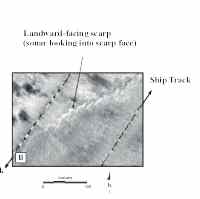 |
Figure 10. Click on figures for larger images with captions. |
| Submarine Hardbottoms:
Two limestone outcrops (Figure 4), form extensive submarine hardbottoms in the study area. The numerous lithologies that comprise the limestone exhibit several different morphologic expressions on the sea floor. These include curvilinear scarps with up to a meter of relief (Figure 10A), and areas characterized by meter-scale karst topography that probably formed during episodes of subaerial weathering. Similar hardbottom morphologies characterize much of the Onslow Bay shelf (Riggs and others 1996). Diver observations indicate they are also productive habitats (Figure 10B; Thieler and others 1995). Physical- and bio-erosion of the hardbottoms produce a residual mix of sediment ranging from gravels to lime mud. These residual sediments are mixed with hardbottom-associated, relatively fresh invertebrate fragments, including small corals and shell material, and form a thin, discontinuous blanket over the rocky substrate.
 |
Based on E. Robert Thieler, William C. Schwab, Mead A.
Allison, Jane F. Denny, and William W. Danforth, Sidescan-Sonar Imagery of the
Shoreface and Inner Continental Shelf, Wrightsville Beach, North Carolina: U.S. Geological Survey Open-file Report OF 98-616.
|
Web page: Donna
Newman
[an error occurred while processing this directive]
|
|


