Sidescan-Sonar Imagery of the Shoreface and Inner Continental Shelf, Wrightsville Beach, North Carolina


Results and Interpretations

  • Rippled Scour Depressions
  • Submarine Hardbottoms
  • Inner Shelf Dunes
  • Exposed Quaternary Channel Fill
  • Bathymetry


  • Rippled Scour Depressions: The surficial morphology of the Wrightsville Beach shoreface is dominated by shore-normal to shore-oblique rippled scour depressions (sea-floor depressions floored with rippled, coarse shell hash and gravel [RSDs], a genetic term used by Cacchione and others [1984] to describe similar features in other shelf environments). On the sidescan-sonar mosaic (see Figures 1 and Figure 4), the rippled scour depressions are defined by shore-oblique areas of high acoustic reflectivity. Most of the depressions develop just outside the fair-weather surf zone at 3-4 meters (m) water depth (just seaward of the longshore bar), and extend onto he inner shelf to depths of about 15 m. Several RSDs also appear to originate on the mid-to lower shoreface. The depressions are floored with very coarse shell hash and quartz gravel. Long, straight-crested, symmetric megaripples (wavelength= 0.7-1.2 m, height=0.1-0.25 m) are present within the depressions (Figure 6); ripple crests are oriented roughly parallel to the shoreline.

    Individual RSDs are approximately 40-100 m wide. They are up to 1 m deep on the upper shoreface, but have a much more subdued (~50 centimeters [cm]) bathymetric expression farther offshore. Figure 7 shows a shore-parallel profile across an RSD on the mid-shoreface. The RSD has approximately 1 m of relief, and is asymmetric with the steeper side to the northeast. The downcore stratigraphy(Figure 8) indicates the center of this RSD is dominated by coarse sediment, with interfingering coarse and fine sediment layers towards the edges. This suggests that this RSD may have existed in the same location for an extended period. In addition, this feature may have formed initially in a pre-existing topographic depression, as evidenced by a thin tidal-inlet sequence overlying an early Holocene backbarrier mud at the base of the RSD sequence.


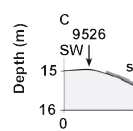
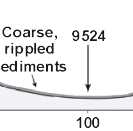
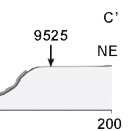
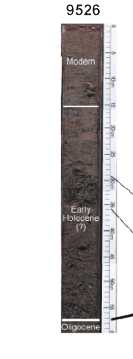
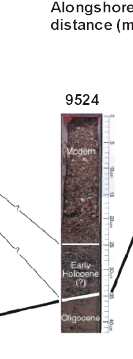
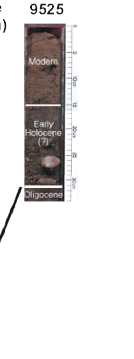
    Figure 9. Cross-section and cores taken across the seaward end of the large rippled scour depression shown in Figure 7A (C-C'). Figure 9. Cross-section and cores taken across the seaward end of the large rippled scour depression shown in Figure 7A (C-C'). Figure 9. Cross-section and cores taken across the seaward end of the large rippled scour depression shown in Figure 7A (C-C').
    Figure 9. Cross-section and cores taken across the seaward end of the large rippled scour depression shown in Figure 7A (C-C'). Figure 9. Cross-section and cores taken across the seaward end of the large rippled scour depression shown in Figure 7A (C-C'). Figure 9. Cross-section and cores taken across the seaward end of the large rippled scour depression shown in Figure 7A (C-C').


    Figure 9. Cross-section and cores taken across the seaward end of the large rippled scour depression shown in Figure 7A (C-C'). Similar to the cores at the inshore end of this rippled scour depression, the center of the feature here is floored by a pre-existing coarse substrate. In this case, the underlying sediment is coarse shell hash and quartz sand, part of an early Holocene (?) estuarine lithosome.


    Click on figure to zoom in.
    This RSD also appears to have experienced fluctuations in width as fine material periodically infilled from both the northern and southern edges. The vertical distribution of coarse and fine material also suggests that the northern boundary is more stable than the southern, and that the RSD is presently narrower than it has been in the past (Figure 7B). The near-surface sediment also contains evidence that fine material periodically infills the edges of the RSD. Specifically, diver observations indicate that ripple crests of the coarse material can be traced laterally for up to several meters under the overlying fine material.

    Farther offshore on the inner shelf, this RSD exhibits a more subdued relief (Figure 9) of only 50-75 cm. Diver-based mapping, however, indicates a similar northeast-southwest asymmetry to that observed on the mid-shoreface. Vibracores show that the center of the RSD at this location is coarse from the seafloor down to the contact between actively reworked, winnowed modern sediment and non-reworked, relict (Holocene?) estuarine material. The relict sequences to either side of the RSD have an underlying substrate of fine sand, which overlies a coarser unit that forms a (basal Holocene?) transgressive lag on top of the Oligocene section. This stratigraphic relationship suggests that either erosion by scour within the RSD removed previously overlying fine material, or that the RSD formed on the initially coarse underlying substrate.
    Back to Top
    Previous Page Next Page
    bar.gif (3055 bytes)
    Based on E. Robert Thieler, William C. Schwab, Mead A. Allison, Jane F. Denny, and William W. Danforth, Sidescan-Sonar Imagery of the Shoreface and Inner Continental Shelf, Wrightsville Beach, North Carolina: U.S. Geological Survey Open-file Report OF 98-616.
    bar.gif (3055 bytes)
    Web page: Donna Newman
    [an error occurred while processing this directive]