|
Sidescan-Sonar Imagery of the Shoreface and Inner Continental Shelf, Wrightsville Beach, North Carolina
|
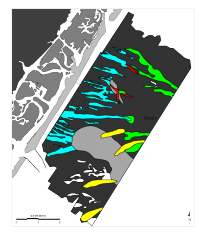
Exposed Quaternary Channel Fill: Several of the Quaternary paleo-fluvial channel-fill (QPFCF) lithosomes (see Figure 2) outcrop on the inner shelf and are present in the sidescan-sonar imagery as readily definable bands of either high- or low-backscatter (see Figure 4 below). The high-backscatter QPFCF outcrops shown on Figure 4 correspond to in-place lags of intensely reworked, predominantly estuarine fauna (e.g , Mercenaria sp.), with occasional limestone cobbles. Whole-valve mercenaria specimens from these locations analyzed by the amino-acid racemization technique yield A/I ratios representing at least three Quaternary amino zones (Wehmiller and Thieler, unpublished data; Wehmiller and others 1995). These data support the interpretation made from the seismic data that the channels have been repeatedly occupied during the Quaternary.
Almost all of the exposed coarse material in this bottom type is heavily bored and encrusted by marine organisms. The surficial lag deposits are underlain by a bio- and lithoclast-rich sandy mud, in which there is a high abundance of Diopatra sp. (4-6 individuals per 100 cm2 of sea floor), an infaunal worm that constructs a shelter by agglutinating shell and rock fragments onto a fibrous organic tube that protrudes several centimeters above the sea floor. The worm tubes and the surrounding gravel- to cobble-sized sediments effectively armor the sea floor, and also contribute to the high acoustic backscatter of this surficial feature.
Mud-filled channels are also exposed on the sea floor. On the sidescan-sonar image, they can be traced for several hundred meters across the inner shelf as bands of low acoustic backscatter (Figure 12). Vibracores penetrating the channels typically contain clean, gray to black muds with occasional thin lenses of fine sand, along with 10-30 centimeters thick shell-rich horizons composed predominantly of in-place oysters (Crassostreavirginica). Radiometric dates on shells from the channels yield exclusively Holocene ages clustered around 9 ky.
|